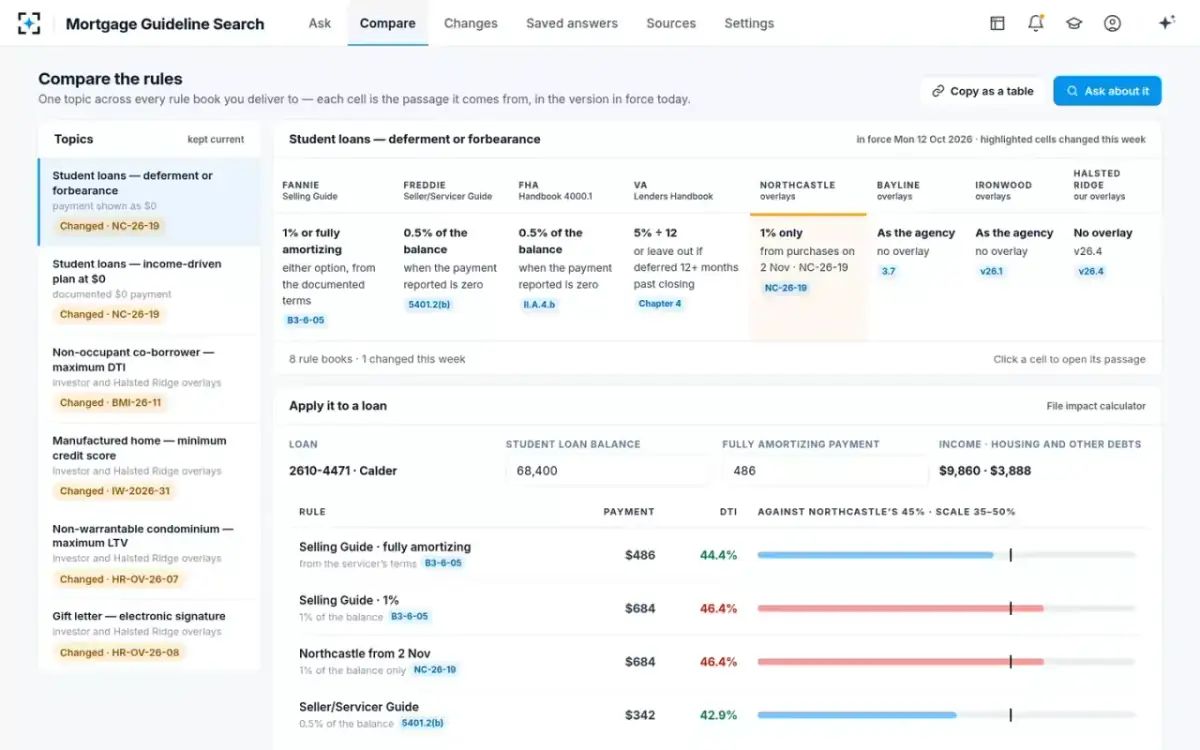
The student loan payment calculation for a conventional mortgage depends on whose rules the loan will be sold under. If the credit report shows a monthly payment above zero, both Fannie Mae and Freddie Mac let the lender use it. If it shows $0, Fannie Mae allows a documented $0 payment for a borrower on an income-driven plan, and for a loan that is deferred or in forbearance either 1% of the balance or a fully amortizing payment from the documented terms; Freddie Mac never lets the payment be zero and uses 0.5% of the balance. FHA also uses 0.5%, and VA 5% of the balance divided by 12. Then the investor buying the loan may add an overlay. Botminds' Mortgage Guideline Search exists for exactly this kind of question: it reads all of those rule books, cites the passage each number comes from, and works each rule through to the loan's debt-to-income ratio.
The difference is not small. On a $68,400 balance the qualifying payment can be $0, $285, $342, $486 or $684 depending on the program and the paperwork, and on a $9,860 monthly income that is a spread of almost seven points of DTI. The examples below use a fictional sample file from the solution, the Calder loan.
Which payment do you count? The question each rule book asks
No, it shows $0 or nothing. Then each book answers differently:
Income-driven plan: a documented $0 may be used.
Deferred or forbearance: 1% of the balance, or a fully amortizing payment from the documented terms.
Never zero. 0.5% of the balance on the credit report, unless the file documents a different payment above zero.
Any status: 0.5% of the outstanding balance.
Deferred 12+ months past closing: leave it out, with written evidence.
Otherwise: 5% of the balance ÷ 12.
How are student loans calculated for a mortgage?
Every student loan counts as a monthly obligation in the DTI ratio unless a specific rule lets the lender leave it out; the only question is which monthly figure to use. Federal law sets the frame. A lender making a residential mortgage must consider "the consumer's current debt obligations" and "monthly debt-to-income ratio or residual income" in deciding whether the borrower can repay (12 CFR 1026.43(c)(2)). The agencies then say how to put a number on each debt.
Student loans are hard because the credit report often does not hold a usable number. A loan in deferment or forbearance reports $0 even though payments will resume. A loan on an income-driven repayment plan may genuinely cost the borrower $0 this year and something else after the next income recertification. Every agency had to decide whether to believe the $0, invent a proxy payment, or ask for the servicer's terms, and they decided differently.
Fannie Mae's student loan 1 percent rule, and when $0 is allowed
Fannie Mae's rule sits in Selling Guide B3-6-05, Monthly Debt Obligations. If the credit report shows a monthly payment, the lender may use it; if the report is wrong, the lender may use the payment on the most recent student loan statement. If the report shows no payment or $0, the lender "must determine the qualifying monthly payment using one of the options below" (B3-6-05, 08/05/2026):
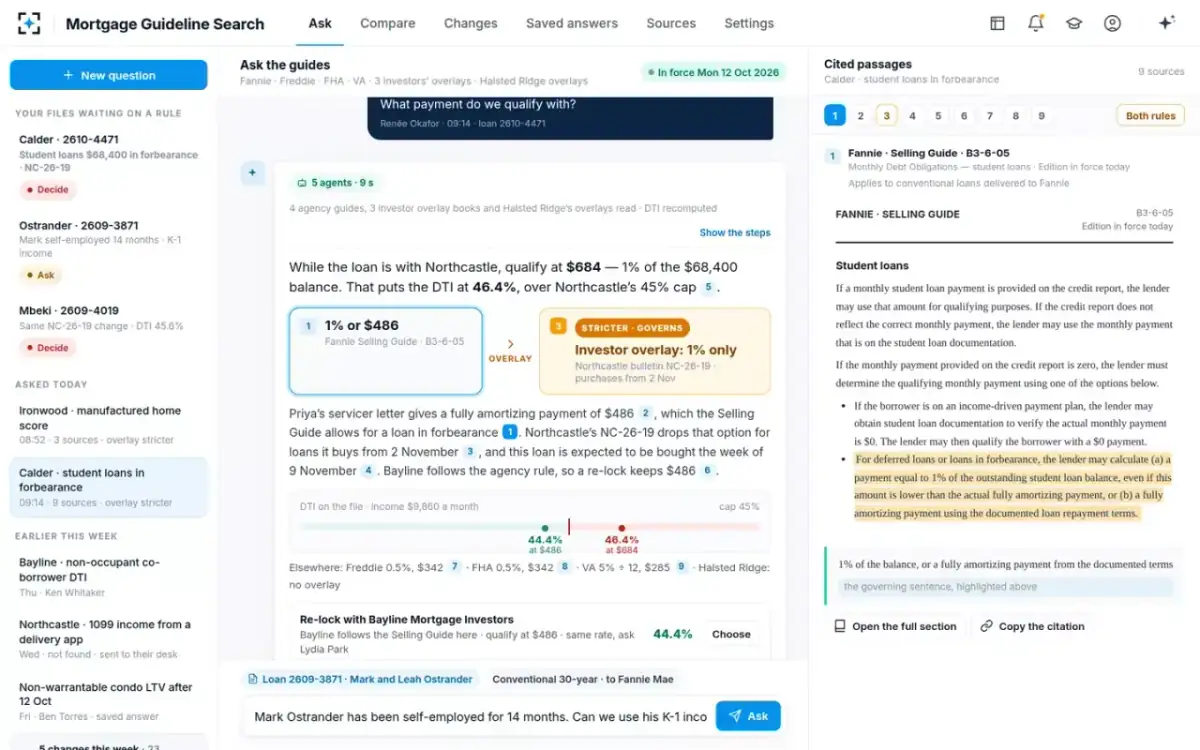
For a borrower on an income-driven payment plan, the lender "may obtain student loan documentation to verify the actual monthly payment is $0. The lender may then qualify the borrower with a $0 payment." Fordeferred loans or loans in forbearance, the lender "may calculate a payment equal to 1% of the outstanding student loan balance (even if this amount is lower than the actual fully amortizing payment), or a fully amortizing payment using the documented loan repayment terms."
Two details trip people up. First, the 1% is an option, not a floor: a lender holding the servicer's repayment terms may use the amortizing payment even when it is lower than 1%, as it is for the Calder file. Second, the documented $0 applies to income-driven plans, not to deferment: a borrower in forbearance cannot qualify at $0 under the Selling Guide, however long the forbearance has to run. This topic has also moved often: the Selling Guide lists four announcements touching B3-6-05 in 2026 alone, so a note written last year may describe an older text.
Freddie Mac student loan payment calculation: never zero
Freddie Mac starts from the opposite principle. Its Seller/Servicer Guide says that "in all cases, an amount greater than zero must be included in the monthly DTI ratio for all student loans" (Freddie Mac Guide 5401.2, effective 08/05/2026). If the credit report shows a payment above zero, the seller uses it unless other documentation supports a different payment above zero. If the report shows zero, the seller "must use 0.5% of the outstanding loan balance, as reported on the credit report", again unless documentation supports a different payment above zero.
Freddie Mac adds a rule for income-driven plans that Fannie Mae's text does not: when the file shows the borrower must recertify income, or the payment will rise, on or before the first mortgage payment date, the seller must use the greater of the current payment or 0.5% of the balance, or the documented future payment if higher, unless the recertification is already done and approved. And Freddie Mac allows a student loan to be left out entirely only when it will be forgiven, cancelled or discharged within ten payments or at the end of a deferment or forbearance, with evidence from the program or the employer.
So the same conventional loan can carry two different student loan payments depending on which enterprise buys it. That is the practical meaning of "conventional": the loan has to meet the rule book of whoever will end up owning it.
Student loan payment calculation, rule book by rule book
| Rule book | Payment above $0 on the credit report | Payment shown as $0 | Can it be left out? |
|---|---|---|---|
| Fannie Mae, B3-6-05 | Use it, or the payment on the latest student loan statement | Income-driven plan: documented $0. Deferred or forbearance: 1% of the balance or a fully amortizing payment from the documented terms | Only if paid by others under the Selling Guide’s debts-paid-by-others rules |
| Freddie Mac, 5401.2 | Use it, unless documentation supports a different amount above zero | 0.5% of the balance on the credit report, unless documentation supports an amount above zero | Only for forgiveness, cancellation or discharge within 10 payments, or at the end of deferment |
| FHA, Handbook 4000.1 | The reported or actual documented payment | 0.5% of the outstanding balance, whatever the payment status | Only if the balance is forgiven, cancelled, discharged or paid in full |
| VA, Lenders Handbook ch. 4 | The reported payment if it is above 5% of the balance ÷ 12; if lower, a servicer statement showing the actual terms | 5% of the balance ÷ 12 | If deferred at least 12 months beyond closing, with written evidence |
FHA and VA student loan payment calculation, for comparison
FHA is the simplest. For outstanding student loans, "regardless of the payment status", the lender uses the payment on the credit report or the actual documented payment when it is above zero, or "0.5 percent of the outstanding loan balance, when the monthly payment reported on the Borrower's credit report is zero" (HUD Handbook 4000.1, Update 18, II.A.4.b.iv(H)). Deferment does not take an FHA student loan out of the ratio, and neither does an income-driven $0.
VA is the only agency that lets a deferred student loan drop out. VA's rule, set out in Circular 26-17-02 and placed in chapter 4 of the Lenders Handbook, says that if the borrower "provides written evidence that the student loan debt will be deferred at least 12 months beyond the date of closing, a monthly payment does not need to be considered." Otherwise the lender calculates "5 percent of the outstanding balance divided by 12 months", uses the reported payment if it is higher, and needs a servicer statement dated within 60 days of closing if the reported payment is lower (VA Circular 26-17-02).
One $68,400 student loan balance, six qualifying payments
A worked example: the Calder file under each rule
Take a sample file as it runs through Mortgage Guideline Search. Jordan and Priya Calder are buying with a conventional 30-year loan, locked with an investor called Northcastle Capital. Priya's $68,400 of student loans are in forbearance and show $0 on the credit report. Their income is $9,860 a month; the new housing payment and their other debts come to $3,888. The servicer has written to confirm a fully amortizing payment of $486.
Under the Selling Guide the underwriter may count $486, which gives a DTI of 44.4%, or $684 at 1%, which gives 46.4%. Fannie Mae's ceiling for a loan underwritten in Desktop Underwriter is 50% (B3-6-02), so both pass Fannie Mae. But Northcastle published a bulletin on 7 October, NC-26-19, accepting only the 1% figure for loans it buys from 2 November, with a 45% cap. This loan will be bought the week of 9 November, so it falls under the bulletin: $684 and 46.4%, over the cap.
The same student loan question, every rule book side by side
The underwriter now has three honest options, each with its own rule book. Re-lock with an investor that follows the Selling Guide on this point and keep $486 and 44.4%. Stay with Northcastle and pay off a $14,900 car loan at closing, which brings the DTI to 41.6% at $684. Or move the loan to FHA, where 0.5% gives $342 and 42.9%, with FHA's own disclosures and mortgage insurance. In the sample, the underwriter chooses the re-lock and the solution drafts a cited note for the file; it never changes the loan, the lock or the Desktop Underwriter submission itself.
What one rule choice does to the Calder DTI
44.4%
Selling Guide, documented amortizing payment of $486
46.4%
Investor overlay, 1% only: $684, over the 45% cap
2.0points
of DTI decided by which investor buys the loan, not by the borrower
How do deferred student loans affect DTI?
A deferred loan affects DTI under every conventional and FHA rule, because none of them treats deferment as a reason to leave the payment out; only VA does, and only with written evidence that the deferment runs at least 12 months past closing. Under Fannie Mae the deferred loan costs 1% of the balance or the documented amortizing payment; under Freddie Mac and FHA, 0.5% of the balance. On a large balance that is a real number: $50,000 deferred adds $500 a month at 1% and $250 at 0.5%.
Which is why the amortizing option matters for Fannie Mae loans. The Selling Guide's words "even if this amount is lower than the actual fully amortizing payment" protect the 1% option when 1% is the smaller figure; they do not make 1% compulsory when the documented amortizing payment is smaller still, as it is on the Calder file. Asking the servicer for the repayment terms before settling for 1% can be worth two points of DTI.
Can an investor overlay change the student loan payment?
Yes, and student loans are one of the places overlays most often appear, because the agency rules leave choices an investor may want to remove. A correspondent investor can accept only one of Fannie Mae's two deferment options, as the sample investor does; require the 0.5% calculation even when an income-driven $0 is documented; or put an age limit on the servicer's documentation. The sample bulletin does the last of these too, accepting an income-driven $0 only with documentation dated within 30 days of the note.
Each such change comes with its own date basis, here loans purchased from a date, so the same overlay reaches some locked loans and not others. The guide to lender overlays explains how the three layers of rules stack and why the stricter one governs. When the sample bulletin arrived, it touched 14 files in the pipeline and put three over the cap; the guide to Selling Guide updates shows how a change is matched to the files it reaches.
The governing sentence, open beside the answer
What the file should show for a student loan payment
Whichever rule is used, the file should let a reviewer rebuild the number. Quality control and an investor's post-purchase review read the file as it was underwritten, against the rule in force for that loan, and a payment that cannot be traced to a rule and a document is a finding waiting to happen.
Student loan payment: what to keep in the file
- The status of each loan
In repayment, income-driven, deferred or in forbearance, from the credit report or the servicer.
- The document behind any payment other than the reported one
A student loan statement, a servicer letter with repayment terms, or income-driven plan documentation; VA asks for a statement dated within 60 days of closing.
- The rule used, with its section and edition
For example Selling Guide B3-6-05 in the 08/05/2026 edition, or Freddie Mac 5401.2 effective 08/05/2026.
- The investor overlay checked
The investor’s current matrix or bulletin, and the date basis that does or does not put the loan under it.
- The arithmetic
Balance × percentage, or the documented payment, and the DTI it produces against the cap that applies.
Questions people ask
Does Fannie Mae use 1% or 0.5% for student loans?
Fannie Mae uses 1% of the outstanding balance, as one of two options for loans in deferment or forbearance; the other is a fully amortizing payment from the documented terms. The 0.5% figure belongs to Freddie Mac and FHA, which use it when the credit report shows a $0 payment.
Can a $0 income-driven payment be used on a conventional loan?
For a loan sold to Fannie Mae, yes: B3-6-05 lets the lender qualify the borrower at $0 once student loan documentation verifies the income-driven payment is $0. For a loan sold to Freddie Mac, no: its Guide requires an amount greater than zero for every student loan, 0.5% of the balance unless documentation supports another positive amount.
How are student loans calculated for an FHA loan?
HUD Handbook 4000.1 uses the reported or documented payment when it is above zero, and 0.5% of the outstanding balance when the credit report shows zero, whatever the payment status. Deferment and forbearance do not remove an FHA student loan from the ratio.
Can deferred student loans be excluded from DTI?
Only for VA loans, and only with written evidence that the deferment lasts at least 12 months beyond closing. Fannie Mae, Freddie Mac and FHA all count deferred loans, at 1% or the amortizing payment for Fannie Mae and 0.5% for Freddie Mac and FHA.
Is 1% of the balance always the safe choice for Fannie Mae?
It is the simpler choice, not always the right one: the Selling Guide lets the lender use a documented fully amortizing payment instead, which is often lower. In the sample Calder file the amortizing payment is $486 against $684 at 1%, a two-point difference in DTI, unless an investor overlay removes the option.