This mortgage guidelines cheat sheet gives the 2026 agency rules underwriters, processors and loan officers look up most: minimum credit scores, maximum debt-to-income ratios, how student loans are counted, how old documents can be, how long a borrower must be self-employed, and the loan limits, for Fannie Mae, Freddie Mac, FHA and VA, each with the section it comes from. It also comes with a warning, because every cheat sheet has a shelf life: Fannie Mae amended 91 of its 410 Selling Guide topics in 2026 alone, and none of these rows shows an investor's overlay. Botminds' Mortgage Guideline Search exists for the moment a sheet like this goes stale: it answers the same questions from the rule books in the version in force, shows the stricter overlay beside the agency rule, and flags every saved answer whose cited passage has changed.
Mortgage guidelines cheat sheet, October 2026
| Rule | Fannie Mae | Freddie Mac | FHA | VA |
|---|---|---|---|---|
| Minimum credit score | None for DU; manual 620 fixed, 640 ARM | LPA assesses credit; manual: any required minimum Indicator Score | 580 for maximum financing; 500–579 at 90% LTV | No minimum in VA’s underwriting regulation |
| Maximum DTI | Manual 36%, up to 45% with Matrix score and reserves; DU 50% | Manual 45% (36% guideline); LPA assesses | Manual 31/43, up to 40/50 with two compensating factors | 41% guideline, with residual income |
| Student loan at $0 | IDR: documented $0. Deferred or forbearance: 1% or amortizing payment | 0.5% of the balance; never zero | 0.5% of the balance | 5% of balance ÷ 12; none if deferred 12+ months past closing |
| Document age | Credit documents ≤ 4 months on the note date | Verifications ≤ 120 days before the note date | Documents ≤ 120 days at disbursement | See the VA Lenders Handbook |
| Self-employed under 2 years | 12 months on the latest returns plus prior history in the field | Combined two years with prior similar work, plus a written analysis | 1–2 years only with 2 years before in the same or related line | See the VA Lenders Handbook |
| 2026 loan limit, one unit | $832,750 in most areas; up to $1,249,125 in high-cost areas | Same conforming limits | $541,287 to $1,249,125 by area | No limit with full entitlement |
Mortgage guidelines debt to income ratio, program by program
The maximum DTI depends on the program and on whether the loan is underwritten by the agency's automated system or by hand. Fannie Mae: 36% manual, up to 45% "if the borrower meets the credit score and reserve requirements reflected in the Eligibility Matrix", and 50% for loans underwritten through Desktop Underwriter (B3-6-02). Freddie Mac: a manual loan above 45% "is ineligible for sale", with 36% as a guideline and a documented justification above it; Loan Product Advisor assesses the ratios on automated loans (5401.2).
FHA's manual ratios come in pairs, housing payment and total debt: 31/43 with no compensating factors, 37/47 with one, 40/40 with no discretionary debt, and 40/50 with two; borrowers below 580 or without a score may not exceed 31/43 (Handbook 4000.1, II.A.5, Approvable Ratio Requirements). VA treats 41% as a guideline: above it a loan may be approved with a supervisor's justification, or without one if residual income beats the standard by at least 20% (38 CFR 36.4340(c)).
The highest total DTI each rule book's text allows
VA residual income: the row most cheat sheets leave out
A VA loan is qualified on two tests, and the second has no counterpart in the conventional or FHA rows. Residual income is what is left each month "to meet living expenses after estimated monthly shelter expenses have been paid and other monthly obligations have been met", and VA's regulation sets the minimum by loan size, family size and region. Every member of the household counts, "even if the veteran's spouse is not joining in title or on the note" (38 CFR 36.4340(e)).
The two tests trade off. Ordinarily the veteran must meet both, but "failure to meet one standard, however, will not automatically disqualify a veteran"; above 41% DTI, residual income that exceeds the guideline by at least 20% removes the need for a supervisor's written justification. And meeting both "does not mean that the loan is automatically approved": the veteran must still be a satisfactory credit risk.
VA minimum residual income, family of four, loans of $80,000 and above
What is the minimum credit score for Fannie Mae, FHA and VA?
In 2026 the honest answer for Fannie Mae is "it depends how the loan is underwritten". The Selling Guide says "a minimum credit score is not required for DU loan casefiles"; manually underwritten loans need 620 for fixed-rate and 640 for ARMs, and government loans delivered to Fannie Mae need 620 (B3-5.1-01, 04/22/2026). FHA ties financing to the Minimum Decision Credit Score: 580 or above for maximum financing, 500 to 579 for up to 90% LTV (Handbook 4000.1, II.A.2). VA's underwriting regulation sets standards for the debt-to-income ratio and residual income and names no minimum score (38 CFR 36.4340).
Those are agency floors. The score a borrower is quoted can be the lender's or its investor's overlay instead, which is why a cheat sheet row on credit scores may answer a different question from the one a loan officer is asked. The guide to lender overlays explains the layers.
How are student loans counted in DTI?
By the payment on the credit report when it is above zero, and by each rule book's own formula when it is not. Fannie Mae allows a documented $0 for an income-driven plan and, for deferred loans or loans in forbearance, 1% of the balance or the documented amortizing payment (B3-6-05). Freddie Mac never counts zero and uses 0.5% (5401.2). FHA uses 0.5% whatever the payment status (II.A.4.b.iv(H)). VA uses 5% of the balance divided by 12, and leaves the loan out only with written evidence that deferment runs at least 12 months beyond closing (VA Circular 26-17-02).
On a $68,400 balance that is anything from $0 to $684 a month. The student loan payment calculation guide works one sample file through every rule.
How old can credit documents be for a mortgage?
About four months, measured three different ways. Fannie Mae: "credit documents must be no more than four months old on the note date" (B1-1-03). Freddie Mac: verifications "must be dated no more than 120 calendar days before the Note Date", plus a 10-day pre-closing verification of employment (5102.4). FHA: documents "may not be more than 120 Days old at the Disbursement Date", with separate rules for appraisals (Handbook 4000.1, II.A.1). The reference points differ, note date against disbursement date, and four calendar months is not always 120 days, so a document can be in date for one program and stale for another on the same closing day.
How long must a borrower be self-employed for a mortgage?
Two years is the norm everywhere, and each program has its own way to accept less. Fannie Mae accepts less than two years when the most recent signed personal and business tax returns "reflect a full year (12 months) of self-employment income from the current business", with prior income in the same field (B3-3.5-01). Freddie Mac wants "a combined two-year history" of the current self-employment and prior similar work, a written analysis of stability, and at least 12 months of self-employed income on the returns (5304.1). FHA allows one to two years only if the borrower was previously employed "in the same line of work in which the Borrower is self-employed or in a related occupation for at least two years" (Handbook 4000.1, II.A.4.c.x).
The trap in all three is the tax return: twelve months in business is not twelve months on a filed return. FHA adds another: business income that has fallen by more than 20% over the analysis period requires a downgrade to manual underwriting.
Loan limits for 2026
For loans Fannie Mae and Freddie Mac acquire in 2026, the one-unit conforming limit is $832,750 in most of the country (FHFA, November 2025), and $1,249,125 is the one-unit high-cost ceiling. FHA's one-unit limits run from $541,287 to $1,249,125, 65% and 150% of the conforming limit, for case numbers assigned from 1 January 2026 (ML 2025-23). VA: a borrower with full entitlement has no loan limit, "as long as you can afford the loan amount and the property appraisal supports the purchase price" (VA); with partial entitlement, the county limit matters.
Why do mortgage cheat sheets go out of date?
Because the rules under each row change on their own schedules, and a sheet records none of the dates. Fannie Mae issued nine Selling Guide announcements in 2026 by October, and four of them touched the one topic behind the student loan row (B3-6-05). Freddie Mac's DTI section already has a future version due in February 2027. FHA's August 2026 Handbook update had to be applied by 10 November, and 39 of its sections now carry that date. A cheat sheet printed in July is wrong in places by November, and nothing on it says where.
How fast the rules under a cheat sheet move
91
of 410 Fannie Mae Selling Guide topics amended in 2026
25
Freddie Mac bulletins in 2026 by 14 October
39
FHA Handbook sections dated 11/10/2026, Update 18’s deadline
The second reason is overlays. No row on an agency cheat sheet can show an investor's matrix or a lender's credit policy, and those are what decide many files. The third is that a sheet travels: training notes and desk copies keep circulating long after the rule behind them has changed, and no one can recall them all.
A cheat sheet that updates itself, and where it stops
Mortgage Guideline Search turns the rows of a sheet like this into saved answers, each citing its passages, approved by the policy and training lead and re-checked the moment a passage it cites changes. In the sample library, 186 saved answers are kept for training and QC and were used 1,284 times in a month; in one week four were marked out of date because an investor bulletin or overlay had changed the text behind them, and their edits were drafted for approval. The compare screen does what the table above does, for any topic, across every rule book the lender delivers to, including the overlays.
One topic across every rule book, each cell cited
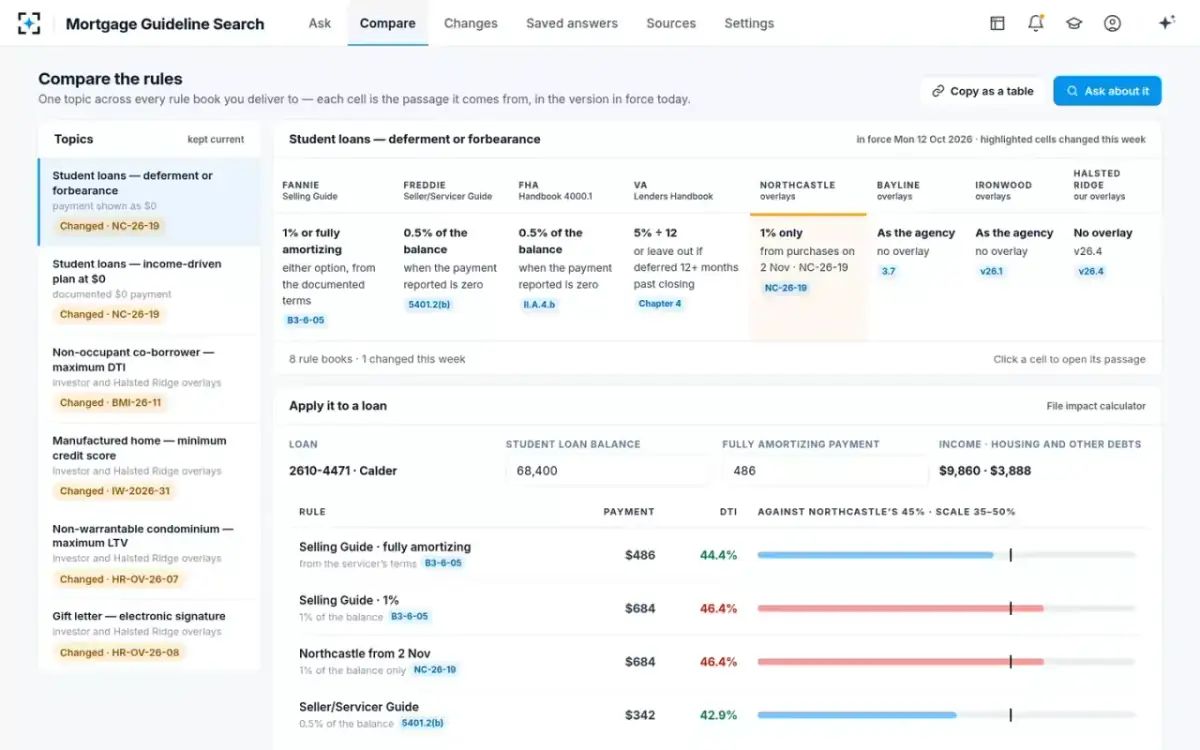
It stops at the decision. The solution answers and compares; the underwriter decides, signs the note, and sends exceptions to the credit committee, and the agents never change a loan file, a lock or an AUS submission. For a loan officer who wants a printed sheet anyway, the Fannie Mae and Freddie Mac comparison goes deeper on the two conventional columns.
If you keep a printed cheat sheet, make it safe
- Put the section and its date in every cell
B3-6-05 (08/05/2026), not “Fannie Mae”. A reader can then check whether it has changed.
- Date the sheet and give it an owner
One person re-checks it after each announcement, bulletin, mortgagee letter and circular.
- Add an overlay column
Your own policy and your main investors’ matrices, or a line saying none are shown.
- Mark the rows that depend on the AUS
DU and LPA findings can override a manual-underwriting number.
- Recall old copies
Retire superseded versions from shared drives and training packs when the sheet changes.
Questions people ask
What is the maximum DTI for Fannie Mae and Freddie Mac?
For manual underwriting, 45% at both, with 36% as the starting point. Fannie Mae allows 50% for loans underwritten through Desktop Underwriter; Freddie Mac relies on Loan Product Advisor's assessment of the ratios for automated loans.
What is the FHA debt-to-income limit in 2026?
For manually underwritten FHA loans, 31% housing and 43% total with no compensating factors, rising to 37/47 with one compensating factor and 40/50 with two. Loans scored through TOTAL are assessed by the scorecard, and borrowers below 580 or without a score are held to 31/43.
Does VA have a minimum credit score?
VA's underwriting regulation, 38 CFR 36.4340, sets debt-to-income and residual income standards and names no minimum credit score. Where a VA borrower is held to a score floor, it comes from the lender's or the investor's credit policy, not from the regulation.
Is a mortgage cheat sheet safe to use for underwriting?
As a reminder, yes; as the basis for a decision, only if it shows each rule's section and date and is checked after every update. Underwriting decisions should cite the passage in force for the loan, and any investor overlay that applies.
Where do I find the current agency guides?
Fannie Mae's Selling Guide is published online at selling-guide.fanniemae.com, Freddie Mac's Seller/Servicer Guide at guide.freddiemac.com, HUD Handbook 4000.1 as a PDF on hud.gov, and VA's circulars on its Home Loans pages.