An FHA indemnification agreement is a lender's written promise to HUD that it will not file an insurance claim on a particular FHA loan, or will reimburse FHA for any loss on claims it pays, because the loan was found not to meet FHA's requirements. FHA asks for one when a review finds an unacceptable defect that the lender cannot cure with documents or put right with money: under HUD Handbook 4000.1 the term is five years from endorsement or the life of the loan, depending on the defect. Most defects that lead there begin as a guideline read wrongly or a rule applied from the wrong version, by someone who certified the loan in good faith. Botminds' Mortgage Guideline Search is built for the start of that chain: every underwriting answer cites the passage it stands on, in the version in force, and the underwriter decides on the file and signs the note.
This guide follows the chain of people who answer for an FHA loan, from the Direct Endorsement underwriter to the lender's quality control and FHA's own reviewers, and shows where an indemnification agreement sits in it.
Who answers for an FHA loan, from certification to claim
Today
Decides the loan on FHA’s behalf; FHA does not review it before insuring it.
With agents
Is “ultimately responsible” for the decision and must use the care of a lender relying on the property alone.
Still theirs: The file, the worksheets and the reasoning behind each judgement
Today
Reviews closed loans and decides which findings are material.
With agents
Must report fraud to FHA immediately and other unmitigated material findings within 90 days.
Still theirs: Findings, mitigation and the decision whether to self-report
Today
Is named by the lender in FHA’s Loan Review System to sign indemnification agreements.
With agents
Commits the lender to forgo a claim, or repay FHA’s loss, for the agreed term.
Still theirs: The lender’s exposure: claims it has agreed not to file
Today
Selects loans for review: early defaults, random samples, risk scores, self-reports.
With agents
Grades each finding by the Defect Taxonomy and asks for mitigation, remediation or indemnification.
Still theirs: Tier and remedy for every finding
Today
HUD-OIG receives every FHA finding of fraud or material misrepresentation, whatever its tier.
With agents
The Justice Department pursues lenders that knowingly certify ineligible loans, under the False Claims Act.
Still theirs: What the lender’s own QC knew, and when
What is an FHA indemnification agreement?
It is one of three remedies FHA uses to resolve an unacceptable finding on a loan it has insured, and the one that leaves the lender holding the risk. The FHA Defect Taxonomy, Appendix 8.0 of the Handbook, lists the remedies in order. A finding can be mitigated, with documents that were not in the file FHA reviewed or with evidence of corrective action. Some findings can be financially remediated: a refund of an unallowable fee, a principal reduction, an escrow adjustment. "When other remedies are not applicable, or when alternatives have been exhausted, Mortgagees may resolve loan-level Findings in LRS by indemnifying HUD against the risk of financial losses" (HUD Handbook 4000.1, Appendix 8.0).
The agreement itself is short in effect: "the Mortgagee agrees to abstain from submitting an insurance claim to FHA in connection with the loan, or to reimburse FHA for any loss due to claims paid by FHA." For a loan that performs, the cost may never arrive. For a loan that defaults, the lender has turned an insured loan into an uninsured one, at the moment the insurance was needed.
How long does FHA indemnification last?
For underwriting findings, either five years from the endorsement date or the life of the loan. The Handbook ties the term to what went wrong. Violations about the borrower's credit or income that affect "creditworthiness or capacity to repay", or about verifying funds to close and assets used to qualify, generally earn a five-year term. Fraud the lender knew or should have known about, property eligibility or valuation violations, and certain basic borrower-eligibility failures generally earn life-of-loan.
FHA indemnification terms and what generally leads to each
| Term | Underwriting findings | Servicing findings |
|---|---|---|
| 1 year | — | Loan current at review; the servicer tried in good faith to mitigate but could not, for reasons beyond its control |
| 5 years | Borrower credit or income violations that affect capacity to repay; funds to close or qualifying assets not verified and documented to FHA’s requirements | Loan not current; good-faith mitigation failed; or an assumption completed for a borrower who was not credit-qualified |
| Life of loan | All Tier 1 fraud or material misrepresentation; property eligibility or valuation violations; certain basic borrower-eligibility violations; HECM policy violations | Loan in conveyance or claim when foreclosure should not have happened; certain eligibility violations whatever the loan’s status |
The pattern matters for anyone answering guideline questions. Income and credit errors, the everyday material of "what's the guideline?", sit in the five-year row. A misread income rule that pushes a TOTAL Scorecard loan into a "Refer" it cannot survive on manual underwriting is a Tier 2 unacceptable finding with a five-year indemnification remedy for forward mortgages, under the Borrower Income defect area of the Taxonomy.
Who is liable for FHA underwriting errors?
The lender is, and within the lender the Direct Endorsement underwriter carries the decision. Under the Direct Endorsement program FHA lets approved lenders underwrite and certify loans for insurance themselves. The Justice Department put the consequence plainly: "Under the DEL program, the FHA does not review a loan for compliance with FHA requirements before it is endorsed for FHA insurance", so lenders must underwrite properly, "maintain a quality control program that can prevent and correct deficiencies" and "self-report any deficient loans identified by their quality control program" (U.S. Department of Justice, M&T Bank settlement, May 2016).
The Handbook names the person. "The Direct Endorsement (DE) underwriter is ultimately responsible for making an underwriting decision on behalf of their Direct Endorsement Mortgagee in compliance with HUD requirements" (Handbook 4000.1, II.A.5.d). That responsibility does not move to whoever prepared the documents: the underwriter must review appraisals, inspections and credit analyses "to ensure reasonable conclusions, sound reports, and compliance with HUD requirements regardless of who prepared the documentation."
What does a DE underwriter certify?
That the loan meets FHA's requirements, to a standard of care the Handbook defines. The underwriter "must exercise the same level of care that would be used in underwriting a Mortgage entirely dependent on the Property as security. Compliance with FHA requirements is deemed to be the minimum standard of due diligence required in originating and underwriting an FHA-insured Mortgage" (Handbook 4000.1, Duty of Care/Due Diligence). The underwriter must also review each loan as a separate transaction and weigh the "totality of the Borrower's circumstances and the impact of layering risks".
"Compliance with FHA requirements" is a moving target. The Handbook is 1,872 pages in its August 2026 edition, and its sections carry their own effective dates; the guide to FHA guidelines in 2026 shows how many changed this year. An underwriter certifies against the rule in force for that loan, which is why the passage relied on, and its version, belongs in the file with the decision.
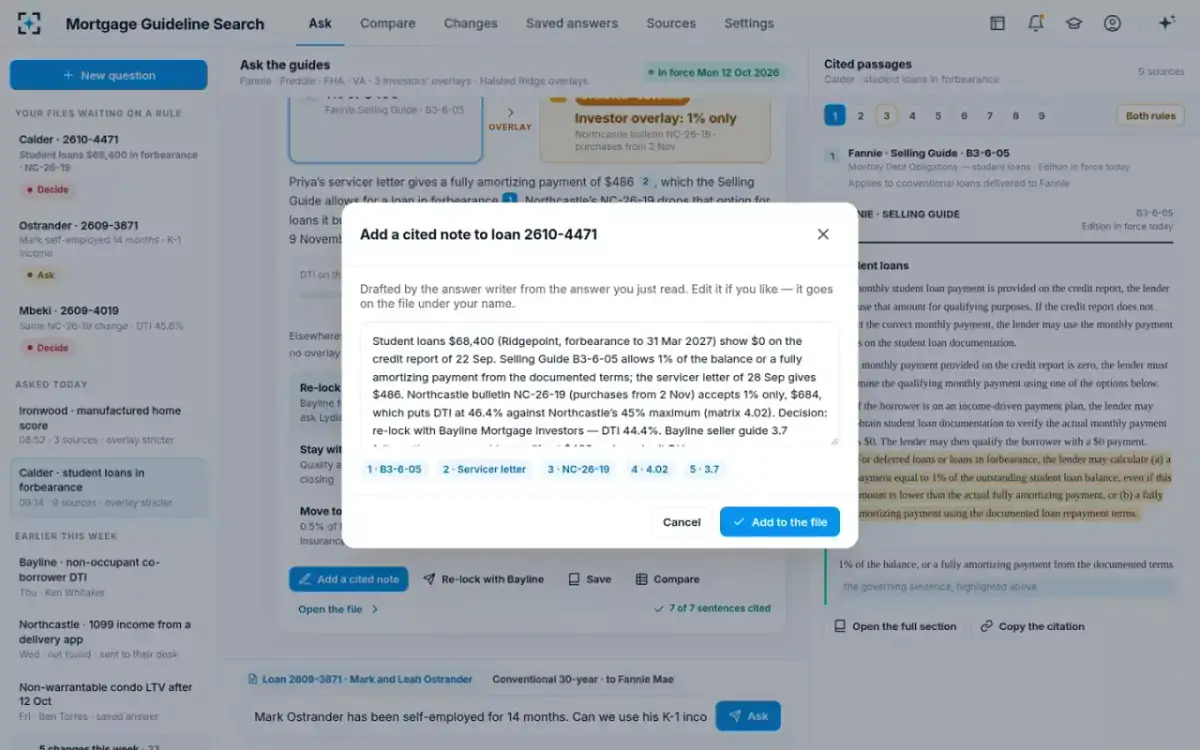
The underwriter's note, with the passages it relied on
What happens when FHA finds a defect?
FHA reviews insured loans in its Loan Review System and grades each finding by the Defect Taxonomy, which HUD announced in 2015 to replace "99 different codes" with "nine distinct defects", each assigned "to one of four tiers indicating the severity of the defect" (HUD press release 15-078, June 2015). Tier 1 and 2 findings are unacceptable and require a lender response; Tier 3 and 4 are deficient and "do not impact a loan's eligibility for FHA insurance" (FHA Loan Review System Basics, 2023). For an unacceptable finding the lender can rebut, mitigate, remediate or indemnify.
HUD's own figures show how often reviews end in a material finding, and where. In the year to 30 September 2022 FHA completed 27,405 underwriting reviews and found net material defects in 3,085 of them, 11.26%. Loans selected after an early payment default came out at 9.12%, random selections at 3.40%, and loans the lenders had self-reported at 41.27% (HUD, FHA Quality Assurance Update, January 2023).
FHA loan reviews, fiscal year 2022: how often a review finds a material defect
11.26%
of 27,405 underwriting reviews ended with a net material finding
9.12%
of loans reviewed after an early payment default
3.40%
of randomly selected loans
Where FHA's material underwriting findings came from, by defect area
What is self-reporting to HUD?
Self-reporting is the lender's duty to tell FHA about defects its own quality control finds, and it is where most of the legal exposure lies. The Handbook requires the lender to report "all Findings of fraud or material misrepresentation to FHA immediately" and "all other Material Findings that the Mortgagee is unable to mitigate to FHA no later than 90 Days after the completion of the initial Findings report", through the Self-Report feature in the Loan Review System, with a corrective action plan (Handbook 4000.1, V.A.2). Findings already mitigated, and not involving fraud, need not be reported.
FHA's training material puts the decision as three questions: is it fraud, is it material, was it mitigated in time? "Document your decisions", and "when reporting, be prepared for indemnification or other remedy" (FHA Loan Review System Basics). A self-reported loan is very likely to need a remedy, which is why the 41% material rate on self-reports is not a sign of bad lending; it is the system working.
When a guideline mistake becomes a False Claims Act case
The large FHA settlements were not about a single misread rule. They were about lenders whose own quality control found defects and did not report them. Wells Fargo agreed in 2016 to pay $1.2 billion, which HUD's Secretary called "the largest recovery for loan origination violations in FHA's history". Between 2002 and October 2005 the bank "made only one self-report to HUD", while its internal reviews identified "approximately 3,000 FHA loans with material findings" (U.S. Department of Justice, April 2016).
M&T Bank paid $64 million: it identified numerous loans with "major errors" between 2006 and 2011 but "did not report a single loan to HUD until 2008, and thereafter self-reported only seven loans" (Justice Department, 2016). Academy Mortgage paid $38.5 million in 2022 to settle a case brought by one of its own underwriters, who alleged a process that "led employees to disregard FHA rules and falsely certify compliance with underwriting requirements"; the claims were allegations only, with no determination of liability (Justice Department, December 2022).
An indemnification agreement settles one loan. What turns a run of defects into a case is the gap between what the lender's own reviews knew and what it reported.
Where the guideline answer enters the chain
Every link in the chain eventually asks the same question: which rule did the underwriter apply, in which version, and was it the right one for this loan? The DE underwriter needs the answer before certifying. QC needs to read it as it stood on the day, not as the rule reads now. FHA's reviewer will judge the loan against the Handbook in force for it. A desk that answers from memory, or from a checklist written before the last Handbook update, cannot show any of that.
That is the job Mortgage Guideline Search does for the people in the chain, not instead of them. It searches HUD Handbook 4000.1 with the mortgagee letters, the VA Lenders Handbook, the agency guides and the lender's own overlays in the version in force on the date that decides the loan; it cites every sentence or says "not found"; and it never changes a loan file, a lock or an AUS submission. The underwriter decides on the file and signs the note. QC reads each saved answer as it read on the day the file was underwritten. The guide to the Fannie Mae repurchase process traces the equivalent chain for conventional loans.
What an FHA file should hold to answer a later finding
- The rule relied on, with its Handbook section and effective date
For example II.A.4.b.iv(H) Student Loans, in the Update 18 text, with the date that put the loan under it.
- The documents behind each judgement
Servicer statements, income worksheets, verifications, each in date.
- The underwriter’s reasoning, in her own note
Why the rule applies, what it produced, and any compensating factors relied on.
- QC’s finding and its decision
Mitigated, reported or not material, and why: FHA’s own training says to document the decision.
- Corrective action
For findings that must be reported, what has been done and what is pending.
Questions people ask
Does an FHA indemnification agreement mean the loan loses its insurance?
Not formally: the loan stays endorsed, but the lender agrees not to file a claim on it, or to reimburse FHA for any claim paid, for the agreed term. In practice the insurance protects FHA's fund rather than the lender for as long as the agreement runs.
Can a lender rebut an FHA finding instead of indemnifying?
Yes. FHA's Loan Review System lets the lender rebut any unacceptable Tier 1 or 2 finding, or mitigate it with documentation that was not in the reviewed file. Indemnification is the remedy the Handbook describes for when other remedies are not applicable or have been exhausted.
Which FHA findings lead to life-of-loan indemnification?
Under Appendix 8.0 of Handbook 4000.1, life-of-loan generally follows Tier 1 findings of fraud or material misrepresentation the lender knew or should have known about, violations of property eligibility or valuation, certain basic borrower-eligibility violations and HECM policy violations.
How quickly must a lender self-report a defect to FHA?
Findings of fraud or material misrepresentation must be reported immediately. Other material findings the lender cannot mitigate must be reported no later than 90 days after the initial findings report, through the Self-Report feature of the Loan Review System.
Who signs an FHA indemnification agreement?
The lender does, through people it authorises in the Loan Review System. The Handbook requires a Title II lender to grant the LRS indemnification authorisation to the individuals it has authorised to sign indemnification agreements, which keeps the decision with named people rather than the underwriting desk.