Fannie Mae and Freddie Mac underwriting guidelines are close cousins, not twins. Both buy conforming loans up to the same 2026 limit of $832,750 for a one-unit home in most of the country (FHFA), both cap manually underwritten loans at 45% DTI, both want two years of self-employment as the norm, and both publish their changes on the same Wednesdays. The differences are in the details a borderline loan turns on: Fannie Mae will count a documented $0 income-driven student loan payment and Freddie Mac never counts zero; Fannie Mae allows 50% DTI through Desktop Underwriter while Freddie Mac leaves ratios to Loan Product Advisor's assessment; their document-age rules differ by a few days. Botminds' Mortgage Guideline Search reads both guides in the version in force for the loan, compares any topic across them with each cell cited, and works each rule through to the file's numbers, so the question "which enterprise does this loan fit?" has an answer with sources.
Fannie Mae vs Freddie Mac underwriting guidelines at a glance, October 2026
| Rule | Fannie Mae Selling Guide | Freddie Mac Seller/Servicer Guide |
|---|---|---|
| Maximum DTI, manual underwriting | 36%; up to 45% with the credit score and reserves in the Eligibility Matrix (B3-6-02) | Ineligible above 45%; 36% as a guideline, with documented justification above it (5401.2(d)) |
| Maximum DTI, automated | 50% for loans underwritten in DU (B3-6-02) | Loan Product Advisor calculates and assesses the ratios; an Accept means they are acceptable (5401.2(d)) |
| Student loan shown as $0 | Documented income-driven $0 allowed; deferred or forbearance: 1% of balance or documented amortizing payment (B3-6-05) | Never zero: 0.5% of the balance unless documentation supports another payment above zero (5401.2) |
| Self-employed under two years | Most recent personal and business returns show a full 12 months, plus prior history in the same field (B3-3.5-01) | Combined two-year history of current self-employment and prior same or similar work, with a written analysis (5304.1) |
| Age of documents | Credit documents no more than four months old on the note date (B1-1-03) | Verifications dated no more than 120 calendar days before the note date (5102.4) |
| Minimum credit score | None for DU loan casefiles; 620 fixed, 640 ARM for manual (B3-5.1-01) | Loan Product Advisor assesses credit; manual loans must meet any minimum Indicator Score required (5202.1) |
What is the difference between Fannie Mae and Freddie Mac underwriting guidelines?
Mostly detail, occasionally substance. Both enterprises buy loans under representations and warranties that the loan "complies with the standards outlined in the Enterprise's selling and servicing guides", under a repurchase framework FHFA built with both of them (FHFA), so their guides answer the same questions in the same order: who is eligible, how income is counted, which debts count, how much can be borrowed. Where they part is in how cautious each is about a particular number, and that is where a loan sits on one side of a limit at one enterprise and the other side at the other.
They also run on different automated systems, Desktop Underwriter for Fannie Mae and Loan Product Advisor for Freddie Mac, and each guide defers to its own system on judgements it leaves to the model. That is why the "automated" rows in the table above are not like for like: Fannie Mae writes a 50% ceiling for DU into its Guide, while Freddie Mac writes that an LPA Accept means the ratios are acceptable.
Are Fannie Mae and Freddie Mac guidelines the same on DTI?
On manual underwriting, nearly. Fannie Mae's maximum total DTI for a manually underwritten loan "is 36% of the borrower's stable monthly income", which "can be exceeded up to 45% if the borrower meets the credit score and reserve requirements reflected in the Eligibility Matrix" (B3-6-02). Freddie Mac says that above 45% "the Mortgage is ineligible for sale to Freddie Mac", that "as a guideline, the monthly DTI ratio should not be greater than 36%", and that above 36% "the Seller must document in the Mortgage file justification for the higher qualifying ratio" (5401.2(d)).
The difference is in what earns the room between 36% and 45%. Fannie Mae points to the Eligibility Matrix's score and reserve requirements. Freddie Mac lists justifying factors in its own text, among them an energy-efficient property, a borrower's "probability for increased earnings", rent paid by related persons living in the property, and a 12-month record of carrying higher expenses, and asks that cash-out refinances and 2- to 4-unit loans stay at 36% "except in rare circumstances". A manually underwritten loan at 42% may qualify for one on its reserves and for the other on its compensating factors, and the file has to show whichever applies.
Freddie Mac guidelines on student loan payments, against Fannie Mae's
This is where the two guides differ most, and it moves real loans. Fannie Mae lets a lender qualify a borrower on an income-driven plan "with a $0 payment" once documentation verifies it, and, for deferred loans or loans in forbearance, choose between 1% of the balance and "a fully amortizing payment using the documented loan repayment terms" (B3-6-05). Freddie Mac starts from "in all cases, an amount greater than zero must be included in the monthly DTI ratio for all student loans", using 0.5% of the balance when the credit report shows zero, and adds rules for income-driven plans that must be recertified before the first payment date (5401.2).
The Calder student loans, $68,400 in forbearance: the payment each guide counts
Neither rule is generally the more generous one. For a borrower in forbearance with no documented amortizing payment, Freddie Mac's 0.5% is half Fannie Mae's 1%. For a borrower on an income-driven plan genuinely paying $0, Fannie Mae's documented $0 beats Freddie Mac's 0.5%. The student loan payment guide adds FHA and VA and the investor overlays that sometimes remove the choice.
Fannie Mae vs Freddie Mac credit score requirements in 2026
Both enterprises are moving to new credit score models, and both now let their automated systems decide most credit questions. Fannie Mae's Guide says "a minimum credit score is not required for DU loan casefiles", while manually underwritten loans need 620 for fixed-rate and 640 for ARMs; it names the FHFA-approved models as "classic FICO, VantageScore 4.0, and FICO 10T", with VantageScore 4.0 available to approved lenders and FICO 10T to follow (B3-5.1-01, 04/22/2026). Freddie Mac announced the same two models as approved in Bulletin 2026-D on 22 April 2026, and broad seller availability of VantageScore 4.0 in Bulletin 2026-H on 9 September (Freddie Mac bulletins).
For manual underwriting Freddie Mac's credit chapter is built around the credit reputation: payment references, the Underwriting Score chosen from the bureaus' scores, and "when a minimum Indicator Score is required, it must be met or exceeded for the Mortgage to be eligible" (5202.1). A desk that keeps a single "conventional minimum score" in its head is now out of date for both.
Fannie Mae vs Freddie Mac self-employed income
Both want two years and both accept less, worded differently. Fannie Mae will consider income from less than two years of self-employment "as long as the borrower's most recent signed personal and business federal income tax returns reflect a full year (12 months) of self-employment income from the current business", with documented prior income at the same or greater level in the same field (B3-3.5-01). Freddie Mac asks the seller to "document that the Borrower has a combined two-year history of receipt of income from the current self-employment and the prior job in the same or similar occupation or industry", include "a written analysis justifying the determination of stability", and see at least 12 months of self-employed income on the tax returns (5304.1).
The practical trap is the same at both: twelve months on the calendar is not twelve months on a filed return. A borrower who started a business in August has not yet filed a return showing a full year of it, whatever the business's age on the day of application.
How old can documents be for Fannie Mae and Freddie Mac?
Four months against 120 days, which is not quite the same thing. Fannie Mae: "credit documents must be no more than four months old on the note date" (B1-1-03). Freddie Mac: verifications of employment, business existence, income, source of funds and payment history "must be dated no more than 120 calendar days before the Note Date", plus a 10-day pre-closing verification of employment for employed borrowers (5102.4).
One verification dated 1 June 2026, two expiry dates
Fannie Mae: four months on the note date: 1 October 2026, when it becomes four months old
Freddie Mac: 120 calendar days before the note date: 29 September 2026, day 120
Fannie Mae: four months on the note date: In date
Freddie Mac: 120 calendar days before the note date: Stale by one day: re-verify
Fannie Mae: four months on the note date: Separate rules for tax returns and verbal VOE timing
Freddie Mac: 120 calendar days before the note date: A 10-day pre-closing verification for employed borrowers
How each guide tells you what changed, and when
The two enterprises date their rules differently, and a team reading both has to know each method. Fannie Mae shows a date beside each topic, the date of the last announcement that amended it, and tells lenders to read the announcement "to determine the policy effective date" (Selling Guide preface). Freddie Mac shows the effective date of each section and a version selector: its age-of-documentation section 5102.4 is effective 4 February 2026 with a future version dated 9 November 2026, and its DTI section 5401.2 has a future version mandatory on 3 February 2027.
Freddie Mac has also written AI governance into its Guide. Section 1302.8, effective 3 March 2026, conditions any use of AI or machine learning in originating loans sold to Freddie Mac on policies approved by senior management, disclosure on request, audits and monitoring, and an indemnity for losses arising from that use (1302.8). The guide to mortgage guidelines AI maps those duties to what a guideline tool must provide.
Which guidelines apply to my loan, Fannie Mae's or Freddie Mac's?
The guide of the enterprise the loan will be delivered to, plus any overlay of the investor delivering it. A lender selling directly knows which enterprise it is underwriting for; a correspondent lender often does not decide, because the investor buying the loan chooses where to deliver it and publishes its own seller guide and matrix. That is why the overlay layer belongs in any comparison.
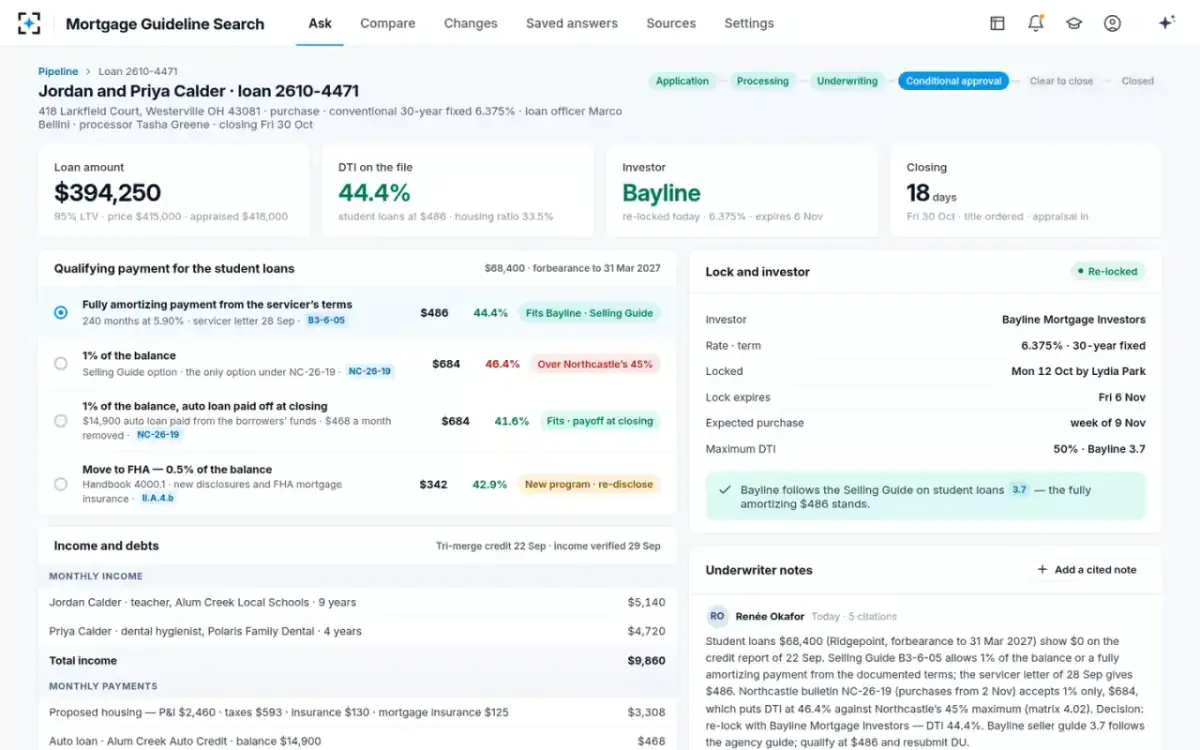
Mortgage Guideline Search answers that comparison on one screen. For a topic, it shows the Selling Guide, the Seller/Servicer Guide, HUD Handbook 4000.1, the VA Lenders Handbook and each investor's and the lender's overlay in columns, each cell the passage it comes from in the version in force that day, and a calculator under the grid applies each rule to the loan. In the sample, the Calder file fits Fannie Mae's rule at $486 and 44.4% and Freddie Mac's at $342 and 42.9%, but not its locked investor's at $684 and 46.4%; the underwriter re-locks with an investor that follows the Selling Guide.
The loan file, after the rule was chosen
Before choosing an enterprise for a borderline conventional loan
- Run the deciding rule both ways
Student loans, DTI room above 36%, self-employment history, document dates: the topics where the guides part.
- Read each in the version in force
Fannie Mae: the announcement’s effective date. Freddie Mac: the section version for the loan’s dates.
- Add the investor’s overlay
A correspondent investor’s matrix can remove the option that made the loan fit.
- Check the automated finding
DU or LPA must still accept the loan as submitted under the rule chosen.
- Write it down
The enterprise, the sections, the arithmetic and the reason, in the underwriter’s note.
Questions people ask
Are Fannie Mae and Freddie Mac loans both conventional loans?
Yes. "Conventional" means not insured or guaranteed by a government agency such as FHA, VA or USDA. Both enterprises buy conventional conforming loans up to the same 2026 limit, $832,750 for one unit in most areas, but each under its own guide.
Does Freddie Mac allow a $0 student loan payment?
No. Freddie Mac's Guide says an amount greater than zero must be included for every student loan, 0.5% of the balance when the credit report shows zero, unless documentation supports a different payment above zero. Fannie Mae allows a documented $0 for income-driven plans.
Is the maximum DTI the same for Fannie Mae and Freddie Mac?
For manual underwriting both stop at 45%, with 36% as the starting point. For automated underwriting Fannie Mae writes a 50% maximum for DU loan casefiles into its Guide, while Freddie Mac relies on Loan Product Advisor's assessment of the ratios.
Do Fannie Mae and Freddie Mac publish changes on the same day?
Usually. In 2026 Freddie Mac's selling bulletins came out on the same first-of-the-month Wednesdays as Fannie Mae's Selling Guide announcements, and both changed their credit score rules on 22 April. The details and effective dates still differ, so each must be read on its own.
Can a loan fit Freddie Mac and not Fannie Mae?
Yes, at the margins. In the sample Calder file, student loans in forbearance count at $342 under Freddie Mac against $486 or $684 under Fannie Mae; for a borrower near a DTI limit that difference alone can decide which enterprise the loan fits.