A medical insight is relevant information a medical affairs professional collects — in a scientific exchange, in a medical information inquiry, or from data about the disease community — which, after analysis and validation, can drive planning, actions or decisions. The three conditions are the whole definition: where it came from, what was done to it, and what it could change. A note that fails any of them is an observation. The reason this matters in practice is volume: a mid-sized therapy area collects thousands of notes a quarter across five systems that do not talk to each other, so the lead reads and codes them by hand and the meaning arrives weeks after the quarter closed. Botminds' Medical Insights Management is the agentic solution for that gap: six agents bring the five channels into one de-identified insight record, code and cluster them into themes whose every sentence cites the notes behind it, and hand each theme to the insights lead to decide.
The screens and worked numbers on this page come from the solution's sample data: Northwind Bio, a fictional company, running medical affairs for a fictional immunology product called Veltrimab. The research figures come from peer-reviewed surveys of the profession, linked where they appear.
How organisations measure insight work today
92%
count clinician engagements as a field medical performance measure
53%
count the number of actionable insights submitted
40%
use the quality of the actionable insights gathered
What is a medical insight?
A working answer has three parts, and it is most useful read as a test: an insight starts in relevant information a medical affairs professional collected from a real exchange or from data about the disease community; it has been analysed and validated; and it could then drive planning, actions or decisions.
Where it came from. An insight begins in a real exchange — a scientific conversation with a physician, a written inquiry that came into medical information, a question at an advisory board — or in data about the disease community, such as a survey of treating clinicians. A statement with no traceable origin is an opinion, and nobody can check it later.
What was done to it. Analysis and validation are the part programmes often skip. Analysis means the note has been read against other notes: is this one physician, or thirty across three countries? Validation means somebody competent has confirmed that the reading holds — that the pattern is not an artefact of who happened to be visited that month.
What it could change. The last clause is the sharpest. If no plan, study, document or conversation would be different whether or not the organisation knew this, it is not an insight. It may be interesting; it is not actionable.
Why a note that confirms what you already believed still counts
Definitions of an insight tend to stress the new: the surprise, the gap, the thing nobody expected. That leaves out half of what a programme needs. An exchange that confirms what the team already believed is still worth recording, because confirmation is evidence too, and a theme that holds steady for four quarters is itself a finding.
So write the definition in two sentences rather than one. The first opens the funnel: new information, understanding or perspectives that may identify a gap, inform strategy or confirm an existing view. The second closes it: only what has been analysed and validated, and could change something, is reported as an insight. The field team needs to hear the first sentence, or they will only send surprises, and a programme that only records surprises cannot tell you that anything has stayed the same.
What is the difference between an insight and an observation?
An observation is what one person heard once. An insight is what the organisation now knows, with its working shown. The difference is not quality of writing; it is whether anything happened between the two. The table below is the test we apply on the sample data, row by row.
The same field note, before and after the work that makes it an insight
Observation: One exchange, as it happened. "A gastroenterologist in Ohio said she holds back from starting the drug in her over-70s."
Insight: A validated statement about a population of clinicians. "Community gastroenterologists in three countries hesitate to start treatment in patients over 65 because published results do not report infection rates for that age group separately."
Observation: Nobody. It stands or falls on one colleague having heard it correctly.
Insight: The insights lead, against the other notes that say the same thing and the ones that do not.
Observation: Itself.
Insight: Numbered citations to each underlying note, each opening the exchange it came from with the passage highlighted.
Observation: No. It describes.
Insight: Yes. It names what would change: in the sample, a pooled safety analysis of the patients aged 65 and over already enrolled.
Observation: A free-text box in the field team's system, coded however that colleague codes.
Insight: One common insight record with the same coding scheme applied to every channel, so it can be counted next to the others.
Observation: It is read, or it is not.
Insight: It joins a theme, the theme gets a decision and an owner, and the owner has a date.
One consequence is worth stating plainly, because it is where many arguments with a brand team start: the raw observation is usually the less useful artefact, not the more useful one. A single vivid quotation is memorable and unrepresentative. The theme is the thing you can act on, and the quotation belongs inside it as evidence. Who may see which of the two is a separate question with a regulatory answer, and it is the subject of what a brand team may and may not see.
The four tests a real insight passes
Before a note is called an insight, four questions have answers. They are short enough to put on a card and strict enough that applying them honestly will cut a quarter's declared count — which is the point.
Four tests, in the order they fail
- Has it been analysed against other notes?
Not "is it interesting" but "how many others say this, across how many colleagues and how many countries". One voice is a lead, not a finding.
- Has somebody validated it?
A named person has confirmed the reading holds — and is willing to be the one who said so. Validation without a name is a rubber stamp.
- Is it relevant to something the team decided to listen for?
Insight collection is not an undirected survey. If it answers none of your listening priorities, record it, but do not report it as a finding this quarter.
- Could it change a decision, and whose?
Name the decision and the role that owns it: an evidence plan, a standard response document, a slide module, a question in the next survey. If no role is named, nothing will happen.
- Can every clause be cited?
Each sentence of the statement should open the exchanges behind it. A sentence that cannot be cited is the author's view, and should be labelled as one.
The fifth line is the one that technology changed. Citing every clause used to be impractical when a lead was collating ninety notes in a spreadsheet; it is now the minimum a reader should accept, because the system that wrote the statement can keep the link to every note it used.
Where insights come from: five channels, not one
Field medical is the channel everyone pictures, and it is the largest, but it is not the only one and it is biased in a specific direction: colleagues visit the clinicians they already know. A working definition includes medical information inquiries and disease community data for exactly that reason: they are heard from clinicians the field team does not already know, and they arrive in systems that rarely talk to the field team's own.
Five channels, one record, and the two steps where a person decides
Agent
Insight intakePulls from the field team's export, the medical information case database, advisory board summaries, congress notes and survey results, and writes one common record per insight with the clinician de-identified to specialty, practice setting and region.
Never: copies a name, a practice name or contact details into the record
Agent
Insight coderApplies the coding scheme — topic, product, sentiment, clinician segment — to every record, whatever channel it arrived through, and flags any question the clinician wants answered in writing.
Never: sends a request to medical information on its own
Agent
Theme clustererGroups coded records into themes by meaning, names each theme in plain words and writes its statement with a citation on every sentence.
Agent
Evidence and plan linkerMatches each theme to the evidence-gap register, the medical plan objectives and the data the company already holds, and proposes actions with an owner and a date.
Never: accepts an action on an owner's behalf
A person decides
Insights leadDecides each theme: promote it to a key insight, keep watching it, merge it with another, or rule that it is not a theme — with a reason.
A person decides
Medical directorSigns the quarterly report, with the meaning of the signature recorded next to it.
The integration point is the one that pays. Once the same coding scheme is applied to a field note and a medical information inquiry, the two can be counted in one denominator — and in the sample data the inquiry channel is what turns a suspicion into a theme, because inquiries about older patients rose from 19 to 52 over the same quarter that the field notes doubled. Designing that scheme so it survives contact with five channels is a job of its own, and what an insight taxonomy has to carry works through it.
Key insight topics and key insight questions: listening on purpose
A key insight topic is a subject the team has decided in advance it needs to understand this year — adoption in older patients, say, or how clinicians sequence therapies after a first failure. A key insight question is the sharper thing underneath it: the specific question whose answer would change a plan. Topics organise the coding scheme; questions organise the quarter.
Writing them down changes what the field hears, for two reasons. The first is attention: a colleague who knows the team is trying to understand sequencing will notice a sequencing remark that would otherwise have passed. The second is the denominator. If you have ten declared questions and a quarter produces nothing on three of them, that silence is itself a finding — either nobody is asking, or nobody is being asked.
The discipline has a failure mode, and it is worth naming: a listening plan that is too tight turns into a questionnaire, and the field stops reporting the thing nobody expected. Keep a channel open for the unprompted observation, and review the topics at least twice a year against what actually arrived.
Why insight programmes drown in volume rather than meaning
The characteristic failure of an insights programme is not too few insights. It is thousands of them, uncoded or coded twelve different ways, in a system whose reports nobody reads. A single data point is just a data point; it becomes part of an insight only when enough others point the same way.
That has an uncomfortable corollary for how programmes are measured. In a global survey of 1,023 medical affairs professionals across 63 countries, the number of actionable insights submitted was already one of the most common measures of field medical performance, used by 53% of organisations — second only to counting engagements, at 92% (Dyer, Hyder and Kraemer, Pharmacy, 2025). Counting submissions rewards the colleague who submits the most notes, which is exactly the behaviour that buries the signal. Which insight measures survive scrutiny is a longer argument; the short version is that a count of inputs is not a measure of understanding.
The second failure is slower and harder to see. When nothing visibly happens to a submitted note, submission stops, and that is a design problem rather than a morale problem: the fix is a feedback loop that lets colleagues see the impact their submitted insights had. The practical form is small: the colleague whose note is cited in a theme statement should be able to see that it was. What happens in the ten minutes after a meeting depends on it entirely.
How a theme turns ninety notes into one sentence somebody can act on
A theme is the unit a leadership team can act on, and it is built, not declared. In the sample data the over-65 theme holds 174 insights from five channels, clustered into four sub-themes, with a statement whose every sentence carries numbered citations into the notes beneath it. The agents took 9.6 seconds; the value is not the speed but that the chain from the sentence back to the exchange stays intact.
One theme, its statement, and the note behind the sentence
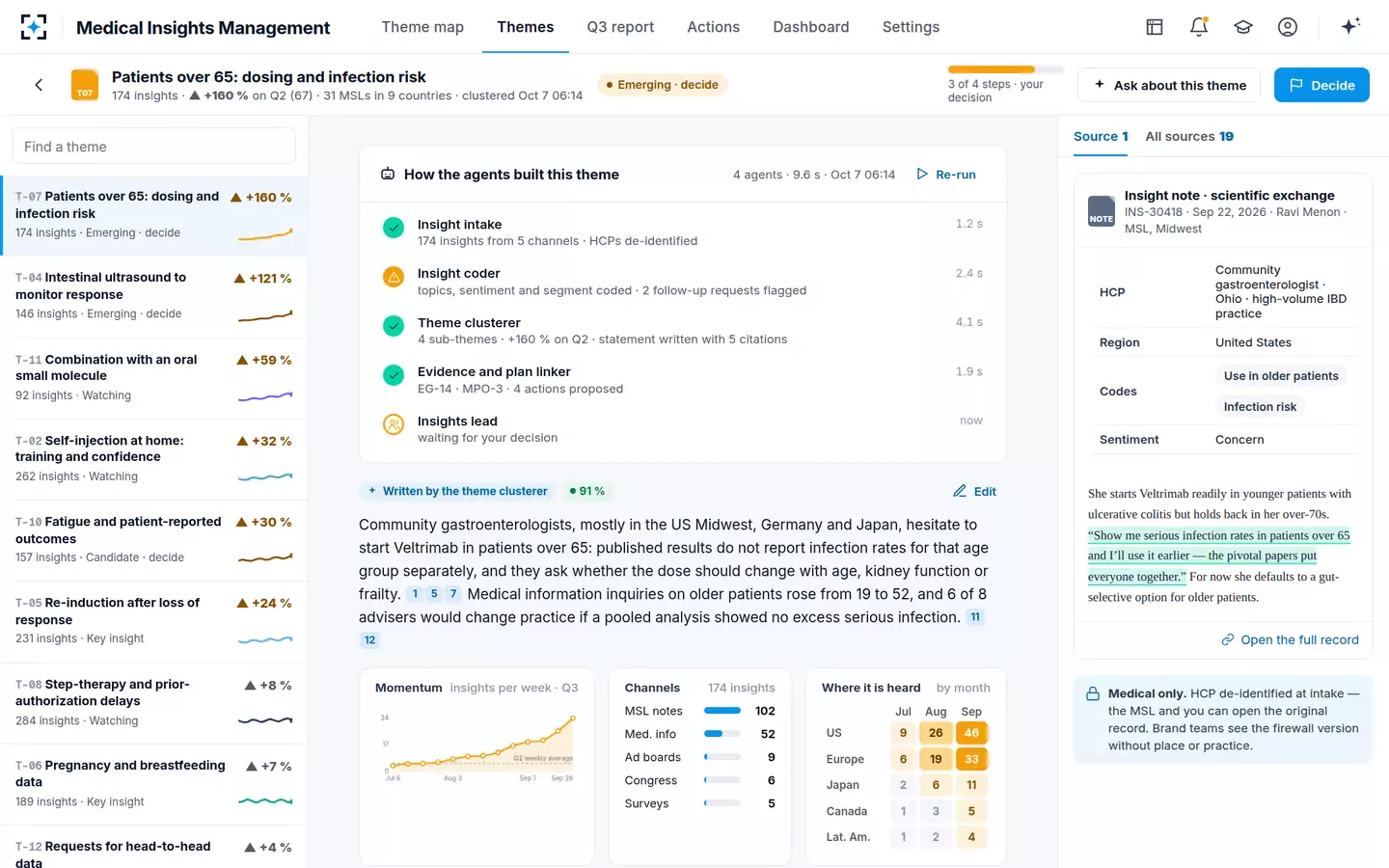
Read the statement and the panel together and the definition becomes concrete. "Community gastroenterologists, mostly in the US Midwest, Germany and Japan, hesitate to start Veltrimab in patients over 65" is the analysed part. The citation chips are the validation trail. "Published results do not report infection rates for that age group separately" is the clause that names what could change — and because the company already holds 212 patients aged 65 and over across three studies, the change is a pooled analysis rather than a new trial.
Note what the theme does to a single dramatic quotation. The remark from Ohio is still there, as one citation among 174, where a reader can weigh it. It is no longer the finding.
What the insight record has to carry for the theme to be citable
Everything above depends on one unglamorous artefact: a record with the same fields whatever channel it came from. Eight fields are enough — the date and channel; the clinician as a segment rather than a person; the region; the topic and sentiment codes with the scheme version that produced them; what was actually said, in the clinician's words; anything the clinician asked for; and the listening priority it answers.
Two of those deserve a line each. The clinician's own words matter because a theme statement is only as good as the passages a reader can check; a note paraphrased into company vocabulary cannot be re-read later for a meaning the first coder missed. And the identity must not travel: in the solution the clinician's name and contact details never leave the source system, and the record carries specialty, practice setting and region instead. That is a design rule, not a setting someone can switch off.
Twelve themes as a map, and the alert that names the notes behind it
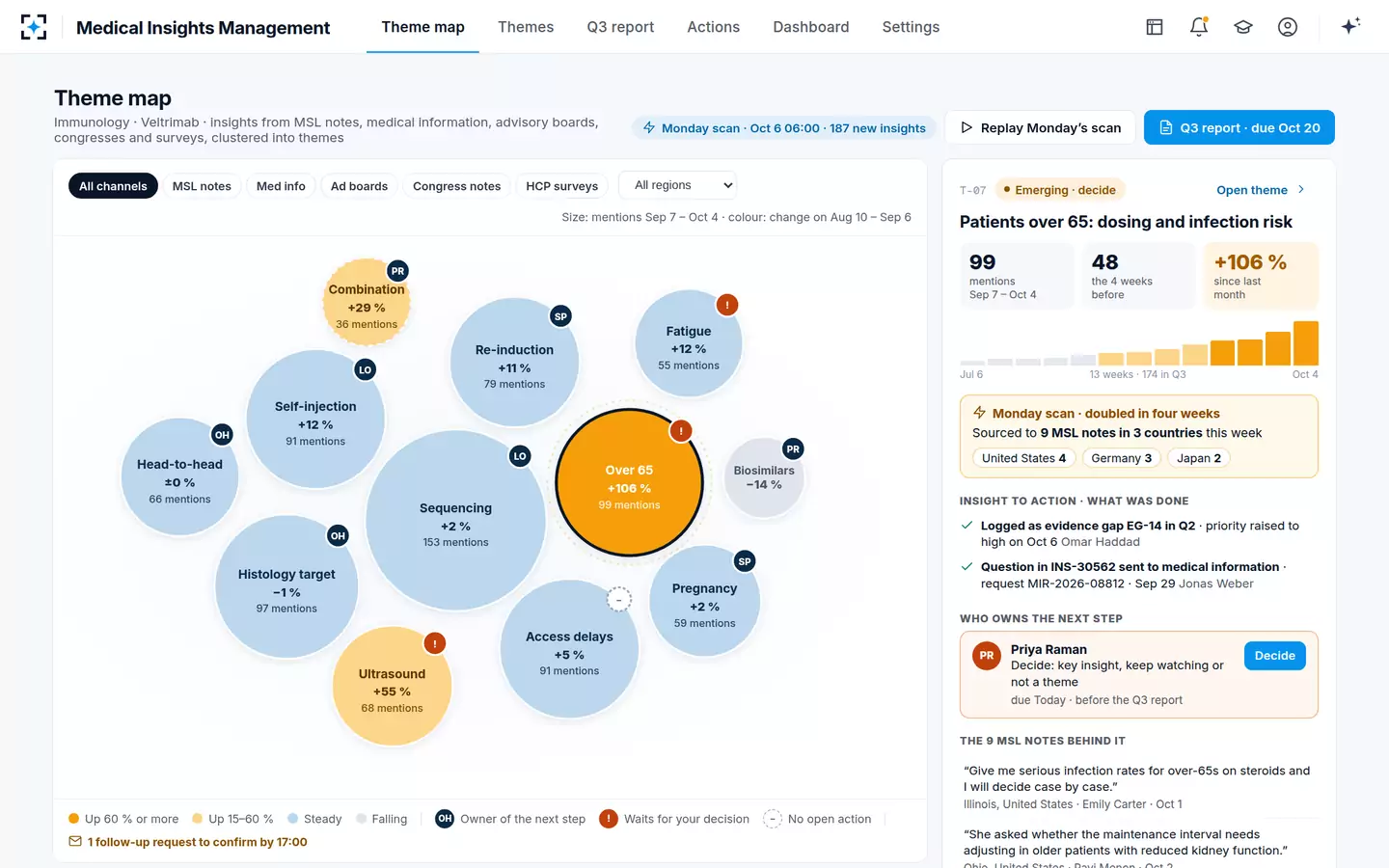
The map is also where the definition stops being theoretical. A bubble that has doubled is not yet an insight; it is a candidate for one, and the badge on it says who has to decide. Telling a real emerging theme from a busy month is the next question this series takes up.
Questions people ask
What makes a good medical insight?
A good insight names a population of clinicians rather than one person, cites the exchanges it rests on, says what would change if it is true, and names the role that owns that change. A useful definition requires analysis and validation before the word is used at all, so a note that has been read by nobody but its author is not yet an insight however well it is written.
Who writes medical insights in a pharmaceutical company?
Field medical colleagues capture most of them, but medical information specialists, advisory board facilitators and congress attendees all contribute, and medical information queries and disease community data belong alongside scientific exchange as sources. The synthesis — turning captured notes into validated themes — usually sits with an insights lead in medical excellence or medical operations rather than with the field.
What should a medical insight contain?
At minimum: the date and channel, the clinician as a segment rather than a name, the region, what was said in the clinician's own words, the codes applied with the version of the scheme that produced them, anything the clinician asked for in writing, and the listening priority it answers. The clinician's identity should stay in the source system; a theme can be built from specialty, setting and region alone.
Are medical insights the same as market research?
No, and the difference is both methodological and regulatory. Market research is commissioned, sampled and run to a protocol; insight collection is a by-product of scientific exchange that medical affairs conducts for its own reasons. The two also sit on different sides of the firewall between medical and commercial, which is why a theme about an unapproved use can be a legitimate medical finding and still never reach a brand team.
How many insights should a field medical team produce?
We know of no published benchmark, and a target number is a bad idea: counting submissions rewards volume, and 53% of organisations in a global survey of 1,023 professionals already use the number of actionable insights submitted as a performance measure. A more useful pair of numbers is how many of your declared listening questions got any coverage this quarter, and how many themes reached a decision with a named owner.
Is a key insight the same thing as an insight?
No. In many programmes, and in this solution, a key insight is a theme that a named person has promoted after reading the evidence — the small set that goes to the leadership team with a recommendation attached. Everything else stays on the map as a theme being watched, which is a status, not a failure.