A medical affairs team structure for field insights has to name an owner for each step an insight takes: the medical science liaison who captures it, the insights function that codes it and groups it into themes, the insights lead who decides whether a theme is a key insight, the functional owners (evidence generation, medical information, field medical) who act on it, medical governance that controls what reaches brand teams, and the therapy-area medical director who signs the quarterly report. Most teams name the first and the last, and the work between them waits on whoever has time. Two adjacent duties sit outside the insights chain and must not be lost inside it: adverse event reports go to pharmacovigilance on a regulatory clock, and themes about unapproved use stay inside medical. Botminds' Medical Insights Management codes the notes, builds cited themes and drafts the report and the brand version; the insights lead, the owners, governance and the medical director decide.
This guide is for heads of medical affairs, medical excellence and operations leads, and therapy-area medical directors. The worked example is a fictional company, Northwind Bio, whose immunology team is the solution's sample data; survey figures come from two peer-reviewed studies of 1,023 medical affairs professionals.
What medical affairs teams say about measuring the field
40%
of respondents said their organisation measures MSL impact at all
92%
of organisations measure MSLs by activity, such as the number of KOL engagements
67%
called measuring MSL performance “difficult” or “very difficult”
How should a medical affairs team be structured around field insights?
Around decisions, not around activities. Each step from a physician's remark to a changed medical plan needs one named owner with the authority to decide that step, and the structure works when nobody has to ask who decides whether a rising theme matters.
Seven steps a field insight takes, and who should own each
| Step | Owner | What the owner decides |
|---|---|---|
| Capture | MSL, medical information, advisory board lead | What is worth writing down from the exchange, in the physician’s words |
| Code and group | Insights function | Which code an insight takes and which theme it joins, under the current coding scheme |
| Decide the theme | Medical insights lead | Promote to key insight, keep watching, merge or dismiss, with a reason |
| Act | Evidence generation, medical information, field medical leads | Whether to accept the action, and how and when it is done |
| Govern sharing | Medical governance | What the brand-team version may contain, and when it is released |
| Sign the report | Therapy-area medical director | That the quarterly report is a fair reading of what the field heard |
| Route safety | Pharmacovigilance | Whether a reported event is an adverse event case, outside the insights chain |
The step most often left unowned is the theme decision. Without it, the quarterly report becomes a list of counts, the same theme returns quarter after quarter, and MSLs learn that what they log is not read. A theme that nobody has decided has no owner for its next action, which is the failure the structure exists to prevent.
Where the insights function sits: central, embedded or a hub
Usually in medical operations or medical excellence, reporting to the head of medical affairs, rather than inside the field team or a single therapy area. The function's job is to decide which themes are real, and that judgement needs to be indifferent to whose territory a note came from and able to see patterns across therapy areas.
Two ways to place the insights function, and what each costs
Embedded in field medical or a therapy area: Close to the exchange; can tell an important remark from a polite one.
Central, in medical operations or excellence: Further away; needs rotation or field time to keep that judgement.
Embedded in field medical or a therapy area: Incentives run toward its own territory and relationships.
Central, in medical operations or excellence: Indifferent to whose notes a theme came from.
Embedded in field medical or a therapy area: Sees one product or area.
Central, in medical operations or excellence: Can see a pattern across four areas that none sees alone.
Embedded in field medical or a therapy area: Each team drifts its own way.
Central, in medical operations or excellence: One scheme, one version, comparable quarter to quarter.
Embedded in field medical or a therapy area: History leaves with the person who read the notes.
Central, in medical operations or excellence: Still at risk unless the system carries each theme’s history.
Scale decides the shape inside the function. One product with modest volume can be covered by a single insights lead; several therapy areas usually need a lead per area with shared coding standards; a large portfolio justifies a hub that owns the coding scheme, the reporting calendar and the tools, with therapy-area leads deciding themes. In each shape the theme decision stays with a named lead, and the coding scheme has one owner and one version. How to build a scheme that still holds next quarter is set out in insight taxonomy.
Who decides a theme, and who signs the report?
The medical insights lead decides each theme; the therapy-area medical director signs the report; medical governance releases anything that leaves medical affairs. Separating the three keeps the person closest to the data from also certifying it, and keeps the release of brand-facing material with a function that answers for compliance.
Take the sample team's Monday. The weekly scan finds that questions about patients over 65, on dosing and infection risk, went from 48 to 99 mentions in four weeks, sourced to nine MSL notes in the United States, Germany and Japan. The agents propose four actions, each with an owner and a due date: a pooled safety analysis of patients 65 and over from two trials and their extension, for the evidence generation lead; an MSL slide module on older adults, for the field medical director; an update to the standard response on use in older patients, for the medical information lead; and two questions in the next physician survey, for the insights lead. They suggest promoting the theme at 91% confidence. The insights lead decides, and records that the 212 patients aged 65 and over already in the trials mean the question can be answered from data on file.
The theme decision: proposed actions with owners, and the lead's choice
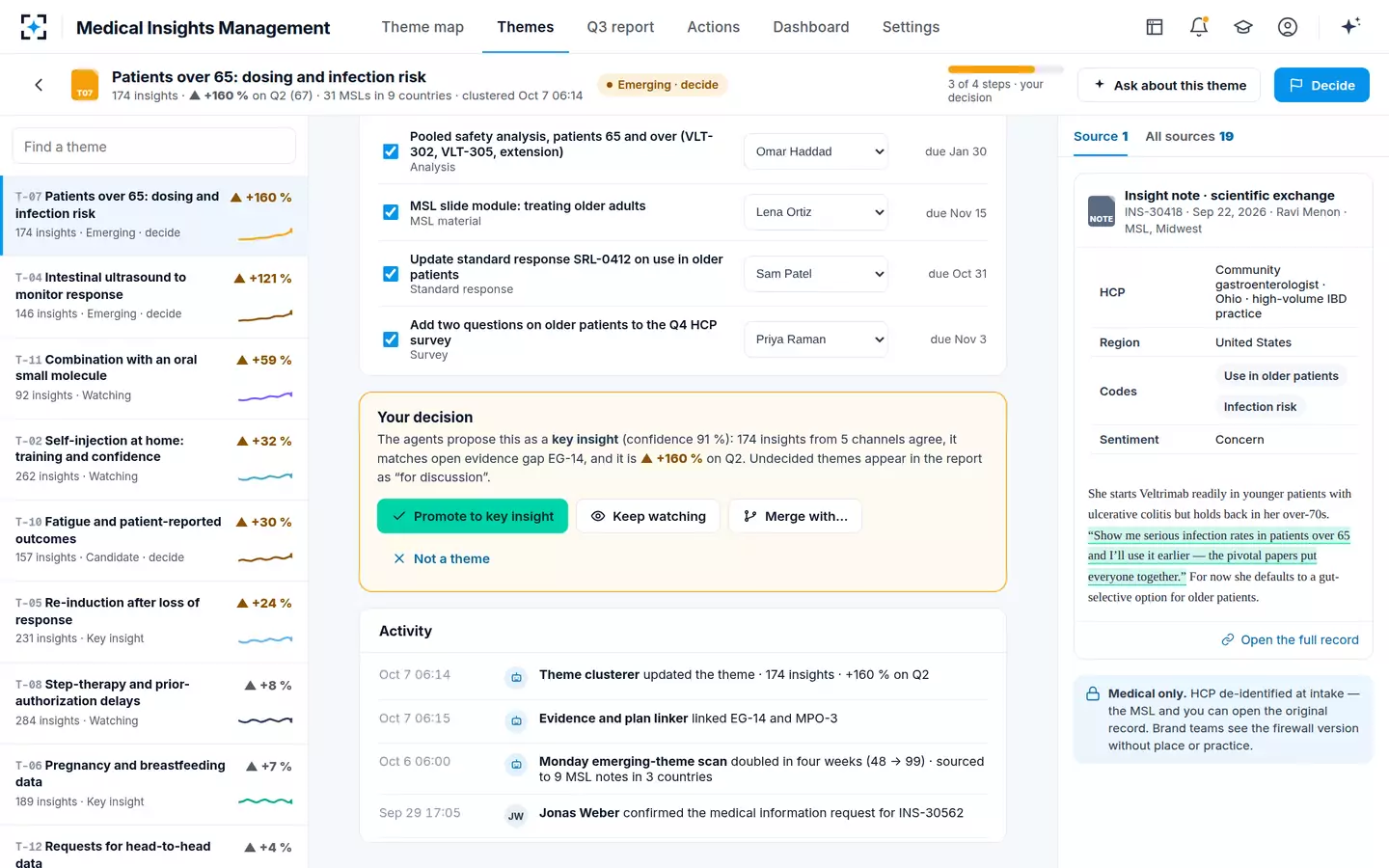
The decision is what turns the theme into work for other people. Once promoted, each action sits with its owner, and the report records it as a key insight with the notes behind each sentence. Linking a theme to an evidence gap and the medical plan is covered in the integrated evidence plan.
Field medical's part: capture, and a reason to keep capturing
MSLs capture most insights, and the structure has to give them a reason to keep doing it well. An MSL who logs the same physician question every week and never learns whether anyone read it stops logging it, and the first theme the company misses is the one nobody wrote down.
Measurement is part of the problem. In the global survey, 92% of organisations measured MSLs by activity such as KOL engagement counts, while respondents preferred qualitative, impact-based measures 52% to 7% (Pharmacy (Basel), 2025). Only 40% said their organisation measured MSL impact at all, and 76% named the difficulty of measuring the quality of MSL activity as a key challenge (Cureus, 2026). A structure that cites MSL notes in theme statements and names the owner of each resulting action gives the field a visible consequence, which an engagement count cannot. What a well-captured insight looks like is the subject of MSL insights generation.
What happens when a field insight is an adverse event?
It leaves the insights chain and goes to pharmacovigilance, on the safety clock, and the structure must make that route automatic. For an approved US product, the holder "must promptly review all adverse drug experience information obtained or otherwise received by the applicant from any source, foreign or domestic", and must report each event that is both serious and unexpected "as soon as possible but no later than 15 calendar days from initial receipt of the information" (21 CFR 314.80).
"From any source" includes an MSL's notes. The clock runs from when the company receives the information, not from when the insights function codes it at quarter end. A structure that relies on the quarterly read-out to surface safety information has already missed the deadline. The usual control is a capture rule (any report of an adverse event goes to pharmacovigilance at the time of capture, under the company's safety procedure), with the insights function trained to recognise and redirect anything that slips through. Coding a note for themes is not a safety assessment, and the two processes should never share an owner.
The medical and commercial boundary: what brand teams may see
Brand teams may see a governed version of the report, never the raw insights. The structure needs one function (medical governance in the sample) that approves what leaves medical affairs, and a rule set that is versioned so that every release can be explained later.
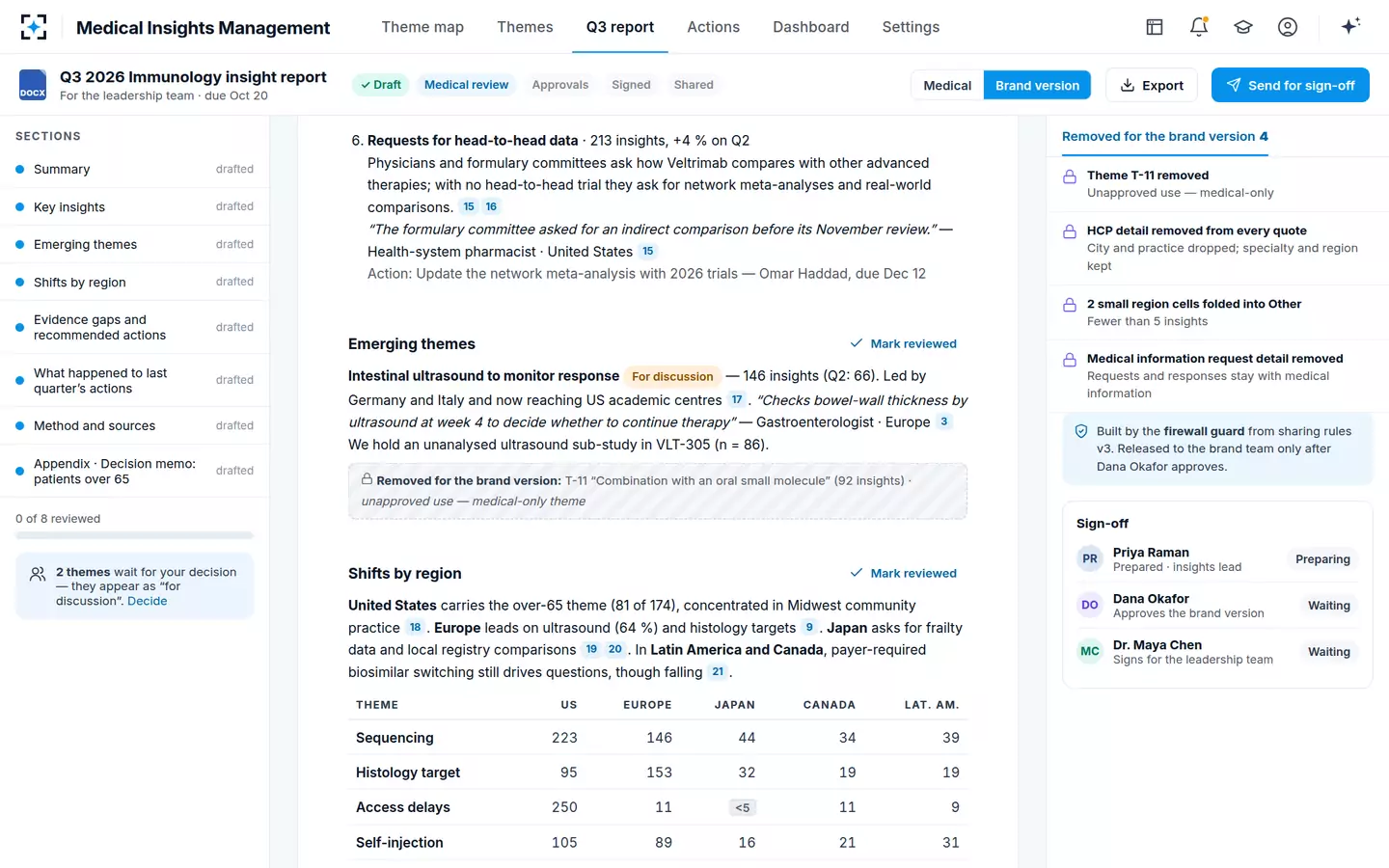
On the sample team the brand version is built from sharing rules version 3, and for the third-quarter report it listed four removals with their reasons: a theme about an unapproved use, which stays medical-only; physician detail, with city and practice dropped; two small region groups folded into "Other"; and medical information request detail. Groups under five insights are hidden, and anything the rules cannot classify is removed rather than released. Medical governance approves the brand version before release. Who may see a field insight, and why, is set out in medical affairs vs commercial.
The brand version, with every removal and its reason
Where the insights lead's quarter goes
Mostly on reading and coding. On the solution's estimate for one product's quarterly cycle, an insights lead spends about 25 working days by hand, of which eight go on reading and coding notes and five each on grouping themes and writing the report. That is most of a quarter for one product, which is why a function covering several products by hand is always behind.
One product's quarterly insight cycle by hand, in working days
The staffing consequence is that the decision steps (the theme decision, the link to the medical plan, the governance check) get the least time, because they come last and the quarter is already over. Moving coding and grouping off the lead's desk does not remove a role; it gives the insights lead the weeks to decide themes while they are still rising rather than reporting them after the fact. How to measure that change is covered in medical affairs analytics.
Six measures a head of medical affairs can hold the insights structure to
- Time from capture to theme.
How long a remark takes to reach a theme the lead can decide.
- Themes decided, not just counted.
Promoted, watched, merged or dismissed, each with a reason.
- Actions with a named owner, and their status.
Proposed, accepted, in progress, done, and whether it changed anything.
- Days from quarter end to a signed report.
The signature is the medical director’s; the date shows whether the report is still useful.
- Brand releases approved by governance, with removals listed.
Every release explainable from the rules in force.
- Safety reports redirected from insight capture.
A non-zero count is a training signal; a zero may be a missed route.
Where Medical Insights Management fits in the team structure
Medical Insights Management takes in insights from MSL notes, medical information inquiries, advisory boards, congress notes and surveys with physicians de-identified, codes them against the current scheme, groups them into themes with a weekly scan for anything rising against its baseline, proposes actions with owners and links to evidence gaps, and drafts the quarterly report with a citation for every sentence. It builds the brand version through versioned sharing rules and lists every removal.
It does not decide or release. The insights lead promotes or dismisses every theme; owners accept their actions; medical governance approves the brand version; the therapy-area medical director signs the report with the meaning of the signature stated. Anything the lead has not decided is marked for discussion, and no sentence appears without a citation. What changes for the structure is that the people in the decision seats spend their time deciding, with the notes behind each theme in front of them.
Questions people ask
What does a medical affairs team structure usually include?
Field medical (MSLs), medical information, medical education, evidence generation and health economics, medical governance or compliance, and medical operations or excellence, under a head of medical affairs, often with therapy-area medical directors. The insights function usually sits in medical operations or excellence so it can work across therapy areas.
Who owns field medical insights in a pharma company?
MSLs own capture, the insights function owns coding and themes, and a named medical insights lead decides which themes become key insights. Functional leads own the resulting actions, medical governance controls what reaches brand teams, and the therapy-area medical director signs the report.
Should the medical insights function report to field medical?
Usually not. A function that decides which themes matter needs to be independent of the territories the notes come from and able to see across therapy areas, so it more often reports into medical operations or excellence. Proximity to the field is kept through rotations or set field time.
Do MSL insights have to be checked for adverse events?
Yes. Under 21 CFR 314.80, an applicant must promptly review adverse drug experience information from any source, and serious, unexpected events must be reported within 15 calendar days of receipt. Safety information in an MSL note should go to pharmacovigilance at capture, not wait for the insights cycle.
Can brand teams see medical insights?
A governed version, approved by medical governance, with unapproved-use themes, physician detail and small groups removed. The raw insights stay inside medical affairs. A versioned rule set lets the company show later why each item was or was not released.
How should MSL insight work be measured?
By what the insights led to as well as how many were logged. In a global survey, 92% of organisations used activity counts such as KOL engagements, while respondents preferred qualitative, impact-based measures. Citing MSL notes in decided themes and tracking the actions that follow gives a measure of consequence.