Teams searching for medical affairs software are usually missing one specific thing, and it is rarely the system they are searching for. The stack is already four layers deep — the CRM that records the interaction, the medical information system that holds the inquiry and its answer, something that turns those into themes and decisions, and whatever draws the charts. The third layer is the one often absent, improvised in spreadsheets, or asked of a CRM that was never designed for it. Botminds' Medical Insights Management is a candidate for that third layer: six agents over five channels, one de-identified record per insight, cited theme statements, a weekly scan, actions with owners, a cited quarterly report and a separate version for brand teams, with every rule a versioned setting.
This page is written to be used against any vendor, including us. The useful parts are the four-layer map, the question list, the two bodies of rules that already constrain the record whatever you buy, and a test — replaying a quarter you have already lived — that is the most honest way to compare candidates. The sample figures come from a fictional company's data inside the solution and are labelled as such.
Three numbers that frame whether you need this layer at all
53%
of organisations count actionable insights submitted as a field medical performance measure — counted, but not necessarily read
40%
say their organisation measures the impact of its field medical team at all
2,946
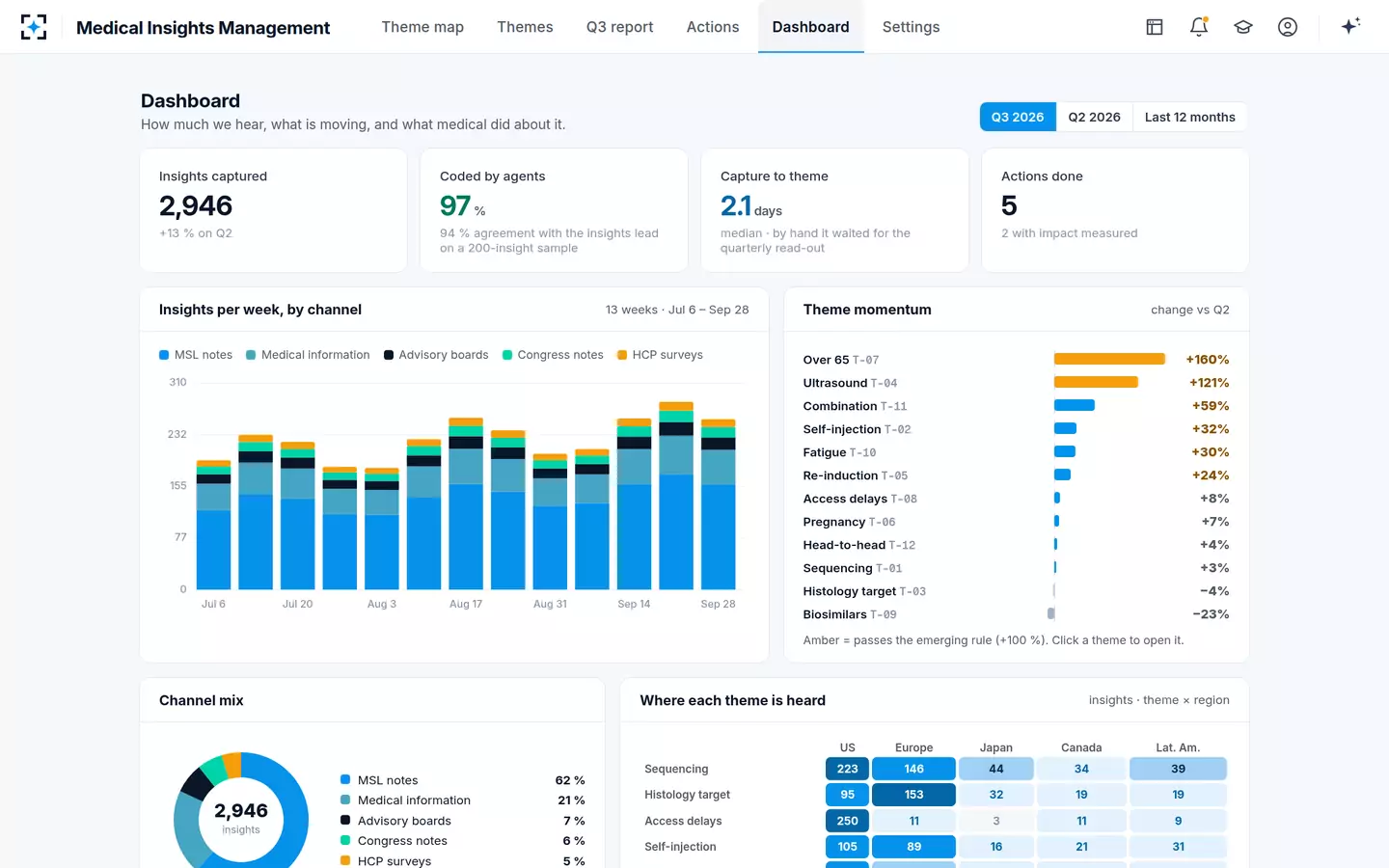
insights in one quarter from five channels, on the solution’s fictional sample data — the volume at which a spreadsheet stops answering “what changed”
What software do medical affairs teams actually run?
Four layers, bought separately and usually in this order. The CRM comes first because the field team needs it from the day it exists. The medical information system comes with the first inbound inquiry that has to be answered in writing within a service standard. The reporting layer arrives when someone senior asks for a dashboard. The insights layer, which is the one that turns the first two into the third, is typically the last to be bought and the first to be improvised.
Four layers of a medical affairs stack, and what each one owns
| Layer | What it owns | What it is bad at | Who complains first when it is missing |
|---|---|---|---|
| The CRM | The interaction: who met whom, when, about what, and the identity of the person met. | Reading across thousands of free-text notes. It is organised around the external stakeholder, not around the subject of the conversation. | Nobody — which is why its gaps go unnoticed for years. |
| The medical information system | The inquiry and its answer: the case, the standard response used, the clock, and the audit trail of the response. | Telling you that inquiries about one topic tripled this quarter, in the same view as the field notes that explain why. | The medical information manager, at the quarterly review. |
| The insights layer | The theme and the decision: one record per insight across every channel, the coding, the trend, the citation trail and the action with an owner. | Being the system of record for an interaction or a case. It should read from those, not replace them. | The medical director, who asks what changed this quarter and gets a count. |
| The reporting layer | The read-out: tiles, trends and the slide a leadership team sees. | Everything upstream of itself. A chart built on inconsistent coding is a confident wrong answer. | The insights lead, who is asked to explain a tile nobody can trace. |
Is the CRM enough for insights?
For capture, yes. For everything after capture, usually not, and the reason is a design mismatch rather than a missing feature. A CRM is organised around the person: this clinician, these interactions, this history. An insight programme is organised around the subject: this question about older patients, raised by eleven people in three countries across two channels, rising. You can store the second in a system built for the first, and teams do; what you cannot do is read it back, because the view that answers "what is this quarter about" does not exist and cannot easily be built.
Keeping insights in the CRM also quietly decides a governance question that should be decided deliberately. A field insight as captured contains the clinician's identity and sometimes a question about an unapproved use; if it lives in a system that commercial roles can read, the default answer to who may see a field insight has been given by a licence configuration rather than by a policy.
The four jobs an insights layer has to do
Four jobs make a usable specification. The first is intake across kinds of source — structured exports from the CRM and the medical information system, and the unstructured material that lives elsewhere. In plain terms: the advisory board summary in a slide deck has to arrive on the same footing as the CRM export.
The second job is coding: applying one scheme consistently across everything that arrives, and surfacing what it could not classify rather than guessing. The third is reporting that feeds the metrics and reporting tools the company already reads, rather than becoming a fifth place to look. The fourth, easy to treat as a nice extra and not optional in practice, is an interface the people submitting insights will actually use.
A fifth job belongs on your list too: the decision. A layer that produces themes and no mechanism for deciding them pushes the work back into email, and the decision is where an insights programme either works or quietly stops.
Extending the CRM against buying a layer that does this job
Build it on the CRM you have: Fast for capture fields; slow for anything that reads across records, because the data model is per stakeholder.
A dedicated insights layer: Slower to procure, faster to a theme, because reading across the corpus is the thing it is for.
Build it on the CRM you have: Medical information cases, advisory boards, congress notes and surveys have to be loaded in, usually by hand or by a bespoke integration per source.
A dedicated insights layer: Intake across channels is the first job; the question is which of your five it already handles.
Build it on the CRM you have: Depends on each contributor applying the scheme the same way. Drifts within two quarters, invisibly.
A dedicated insights layer: One scheme applied the same way every time, with the uncertain ones escalated — if it escalates them.
Build it on the CRM you have: Governed by CRM roles, which were designed for a different question.
A dedicated insights layer: Should be governed by explicit sharing rules, with a separate version for brand teams and a list of removals.
Build it on the CRM you have: At the first quarter where somebody asks what changed and why, and the answer takes three weeks.
A dedicated insights layer: At procurement, and at the moment it is asked to be the system of record for an interaction it should only read.
Build it on the CRM you have: A shared spreadsheet and a monthly meeting, which can be a reasonable answer for a small programme.
A dedicated insights layer: And an unreasonable one at thousands of insights a quarter. Many teams are somewhere in between and should say which end they are nearer.
What to ask a vendor, in the order that matters
Ask for demonstrations, not for capability statements. Every vendor in this category will say yes to every question in the abstract; the differences appear when a specific artefact is on the screen. The order below is deliberate — the first four questions disqualify faster than the last eight.
Twelve questions, each answered by something on a screen
- Show me a theme statement, and open the insight behind one of its sentences.
If a sentence cannot be traced to the notes that produced it, nothing downstream of it can be defended to a medical director.
- Show me an insight the system could not code, and what happened to it.
The handling of uncertainty is a strong signal of whether the coding can be trusted. Silence here means quiet guessing.
- Show me the audit trail of a code that was changed.
Who changed it, when, from what to what, and why. A record that can be edited without a trail is not evidence of anything.
- Show me the version of a report that went to a brand team, and what was removed from it.
Then ask who approved the release, and whether the removal rules are versioned.
- Load one of my advisory board summaries, as a slide deck, and show me the insights from it.
Intake across unstructured sources is where products are often weakest and demonstrations often strongest.
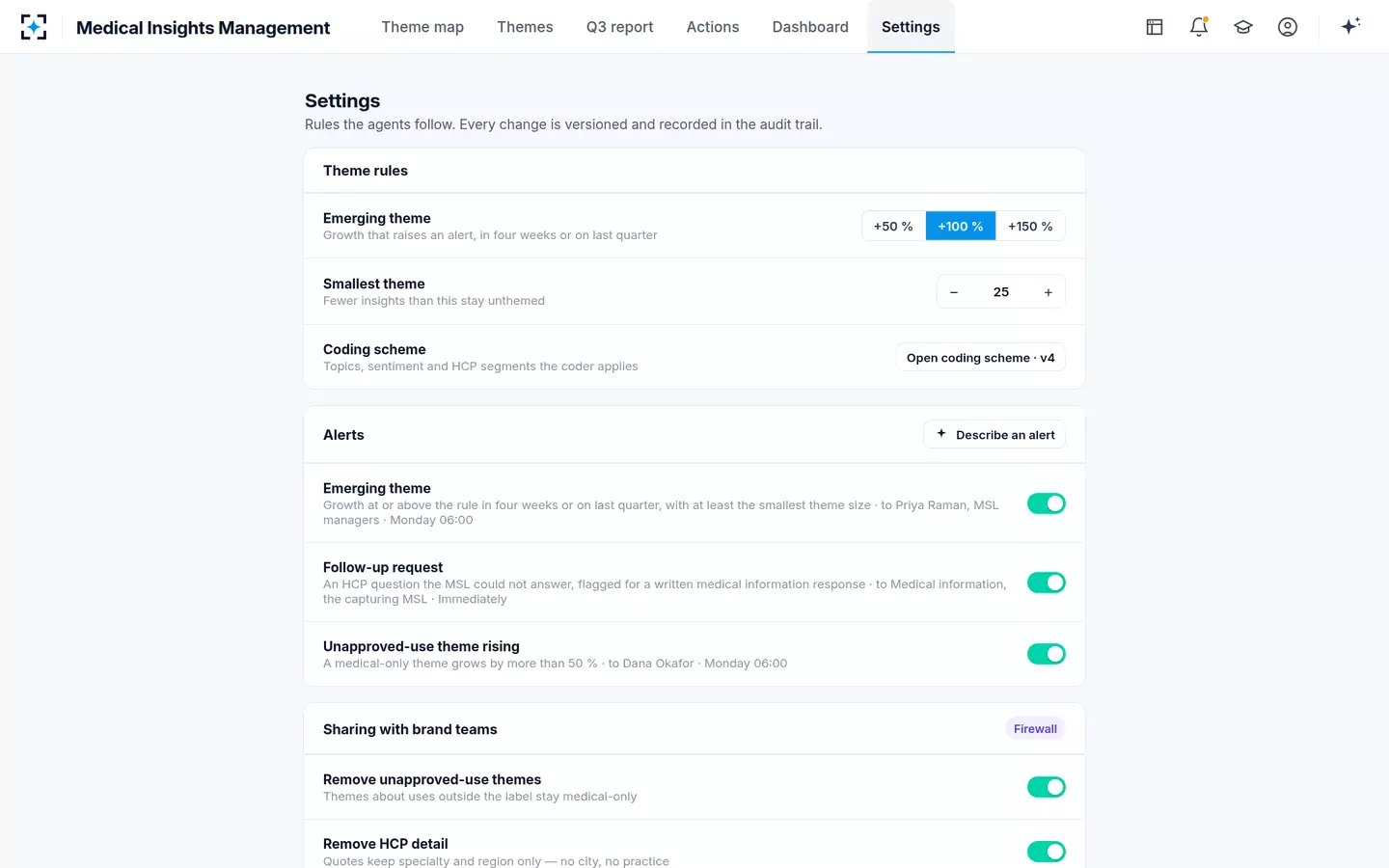
- Change the emerging-theme threshold in front of me.
If a rule change needs a support ticket, every rule in the system is really the vendor’s rule.
- How does the system decide two themes are the same?
And can a person refuse the merge? A merge applied automatically rewrites the quarter’s history.
- What accuracy do you claim, measured how, against whom, on what data?
A number with no test set, no comparator and no methodology is a marketing figure.
- Where does the data sit, and what leaves your environment?
Including what goes to any model provider, what is retained there, and for how long.
- What happens when we leave?
Ask for the export of insights, themes, codes, decisions and the audit trail, in a format you can read without them.
- Who maintains the coding scheme, and what happens when it changes mid-year?
A scheme change breaks comparability with last quarter; the system should make that visible rather than silently re-code history.
- Show me last quarter, from my own data.
The replay test below. Everything above it is a filter; this is the decision.
Signatures and audit trails: what the rules already require of the record
Two requirements apply to the record itself before any procurement question is asked, and both are worth quoting at a vendor. On trails, the electronic-records regulation requires secure audit trails, written by the computer and stamped with the time, that record on their own when someone enters data or creates, changes or deletes a record — and it adds the clause that rules out tidy-up edits: a change must not hide what was recorded before (21 CFR Part 11).
On signatures, the same regulation is specific about what a signed record must show: the signer's printed name, the date and time of signing, and what the signature means — review, approval, responsibility or authorship. The third element is the one easiest to omit and the one that matters most in a review, because approving a redaction and endorsing a conclusion are different acts and a bare signature cannot tell them apart.
Whether these rules are legally binding on your insights system depends on what you use it for, and that is a question for your own quality and compliance colleagues rather than for a vendor. What is not in doubt is that they describe what a defensible record looks like. A system that cannot show who changed a code, or that records a signature without its meaning, is weaker than the standard your organisation already applies elsewhere — and no vendor, this one included, should be taken to have validated anything for your use.
Every rule as a setting, versioned and on the audit trail
Physicians' names are personal data wherever they sit
The clinicians a field team meets are identifiable individuals, and European data protection law applies to the insight record as it applies to the CRM. Two of the regulation's principles translate directly into system settings: personal data must be "collected for specified, explicit and legitimate purposes and not further processed in a manner that is incompatible with those purposes", and "kept in a form which permits identification of data subjects for no longer than is necessary for the purposes for which the personal data are processed" (GDPR, Article 5(1)).
Purpose limitation is the question a buying team usually forgets to ask: insights were collected for medical purposes, so re-using the same corpus for a commercial targeting exercise is a different purpose, whatever the licence allows. Storage limitation is the setting nobody configures: an insight corpus that keeps identification indefinitely because nothing ever deletes is a decision made by inaction. Both are better answered before the implementation than after it, which is why compliance and privacy colleagues belong in the first meeting rather than the last.
The practical design that answers most of this is to keep identity where it already lives. In this solution the insight record carries the clinician as a segment — specialty, practice setting, region — and the name and contact details never leave the source system. That choice makes the small-group threshold matter more rather than less, for the reasons set out in designing a coding scheme that still holds next quarter.
The replay: testing a system on a quarter you already know the answer to
The most useful test is the one where you know the right answer in advance. Take a quarter that has already closed, feed in the insights as they were captured, and compare what the system produces with the decisions you actually took at the time — including the themes you decided were not themes.
The replay test, in five steps
A person decides
Pick a quarter you can still argue aboutRecent enough that the team remembers it, old enough that the consequences are known. Write down, before you start, the themes you promoted and the ones you rejected.
Agent
Load the insights as they were capturedEvery channel, in the form they arrived, including the messy ones. A test on the clean export tests nothing you will experience.
Agent
Let it code and cluster without helpNo tuning on the answers. If a vendor wants to adjust the scheme first, note what they changed — that is part of the result.
A person decides
Score it on four separate thingsDid it find the themes you found? Did it rank them as you would have? Did it invent any? And how much work was the review — which is the number that decides whether you use it in month four.
A person decides
Read the misses, not the matchesThe themes it missed and the ones it imagined tell you more than the agreement figure. A single invented theme that reached a medical director would have cost you more than ten correct ones saved.
Do the measurement properly or not at all. The federal framework for managing risk in these systems makes the point about buying one in particular: risk metrics used by the organisation developing a system "may not align with the risk metrics or methodologies uses by the organization deploying or operating the system", and the developer "may not be transparent about the risk metrics or methodologies it used" (NIST AI RMF 1.0). The vendor's number was measured on the vendor's data for the vendor's purpose. Yours is the only one that decides anything, and what the published agreement figures actually measure is worth reading before you design the scoring.
What it costs to run, beyond the licence
Four costs recur, and only one of them is on the quotation. The first is connecting the channels: each source needs an export, a schedule and someone to notice when it stops. The second is the scheme — writing it, versioning it, and checking each quarter that it has not drifted — which is a few days a quarter of an experienced person, permanently. The third is review: somebody confirms the uncertain codes and the proposed merges, and that work does not disappear, it changes shape. The fourth is the one teams underestimate, which is the decision meeting itself: a system that surfaces twelve themes a quarter creates twelve decisions that did not previously have to be made.
Against that, be sceptical of time-saved arithmetic, including ours. A credible business case for this layer is not a headcount reduction; it is a theme seen in week two rather than week fourteen, and an action with an owner where last year there was a slide. If the only justification you can write is hours saved, the honest conclusion may be that a shared spreadsheet is still the right answer for now.
The read-out a medical director opens, built from the same record as the themes
What this insights layer takes on, and what it leaves alone
It is an insights layer, and it reads from the others. It does not replace the CRM, the medical information case system or the safety system, and it should not be bought as though it might. The field team goes on working in the CRM; medical information cases are answered where they are answered now, under their own service standards; a suspected adverse event follows the pharmacovigilance route it already follows, and is not something an insights system decides about.
What it does take on is the layer between those systems and the decision: intake from the five channels into one de-identified record, coding against your scheme, themes with citations, a weekly scan against a threshold you set, actions with owners, a cited quarterly report, a separate version for brand teams with every removal listed, and the rules as versioned settings. Going live works the same way: the solution is built and deployed from your own documents — your coding scheme, your evidence-gap register, your medical plan and a sample of past insights — and goes live once the quality checks pass. The sensible first step is not a procurement exercise but the replay above, on a quarter you already know the answer to.
Questions people ask
What should a medical insights platform do?
Four jobs: take information in from structured systems such as CRMs and medical information systems and from unstructured sources such as slide decks; code it against dimensions that matter to the organisation; create and deliver reports and metrics that link into the analytics tools the company already uses; and present an interface that the people submitting insights will actually use. A fifth, not optional in practice, is to carry the decision on each theme rather than pushing it back into email.
Does an insights system need Part 11 validation?
That depends on what the records are used for, and it is a question for your own quality and compliance colleagues rather than for a vendor. What the regulation describes is worth insisting on regardless: secure, computer-generated, time-stamped audit trails that record who created, modified or deleted a record, changes that do not obscure what was there before, and signatures that carry the signer's printed name, the date and time, and the meaning of the signature. Treat those as your specification whatever the regulatory answer turns out to be.
How long does a medical insights implementation take?
The honest answer is that the software is rarely the longest part. Connecting five channels, agreeing a coding scheme everyone will use, settling the sharing rules with compliance and privacy, and deciding who may promote a theme are the four items that set the calendar, and three of them are your decisions rather than a vendor's work. Ask any vendor to describe an implementation in terms of those four, and treat a schedule that does not mention them as incomplete.
What data does a medical insights system need on day one?
Four things, and all of them exist already in many teams: your coding scheme or taxonomy as it stands, your evidence-gap register, your medical plan objectives, and a sample of past insights large enough to argue about — a closed quarter is ideal, because it lets you run the replay test. If a vendor does not ask for the last of those, they are proposing to show you their data rather than yours.
Should insights live in the same system as medical information cases?
No, and for a practical reason rather than a regulatory one: a medical information case is a piece of work with a clock, a standard response and a service standard, while an insight is an observation that may never be acted on individually. Forcing both into one queue makes the clock meaningless. What the insights layer does need is a read of the inquiry trend, because a topic rising in inbound questions is a strong signal that a field theme is real.
Can you start with a spreadsheet?
Yes. For a small programme — tens of insights a quarter from one or two channels — a shared spreadsheet and a monthly or quarterly review meeting is a reasonable way to manage them. At thousands a quarter across five channels it plainly is not. The question to ask is not which end you are at but which direction you are moving in, and whether the spreadsheet is still answering "what changed this quarter" within a week of the quarter closing.