Medical affairs and commercial are separated because they answer different questions for different reasons: medical affairs exists to exchange science with the people who treat patients, and commercial exists to promote an approved product within its labelling. The practical difference people search for is not the mission statement but the permission — who may ask a physician a question, who may answer one about an unapproved use, and who may read the insight report afterwards. That last one is hard because a field insight is useful to a brand team and, in parts, must never reach it. Botminds' Medical Insights Management turns MSL notes, medical information inquiries, advisory boards, congress notes and surveys into cited themes with owners, and builds a separate brand version of any report that lists every removal and its reason before medical governance releases it.
What follows is the documented part of the answer. Three published texts — an Office of Inspector General compliance guidance from 2003 and two FDA guidances, from 2011 and 2025 — say what sales and marketing personnel may not do with a scientific question, what scientific material may not be packed alongside, and where research funding may not start. Everything else is a company's own policy. The worked example comes from a fictional sample company, Northwind Bio, and its immunology team; the people, the product and the figures in it are characters and sample data.
Medical affairs against commercial, by permission rather than by job title
Medical affairs: Scientific exchange with clinicians and researchers, and the evidence that answers their questions.
Commercial: Promotion of an approved product, within the uses the labelling supports.
Medical affairs: Investigators, specialists, guideline authors, payers’ clinical staff — including about uses outside the label, when they raise them.
Commercial: Prescribers and purchasers, about approved uses.
Medical affairs: Respond to a question that was not prompted, in scientific terms, with the labelling attached.
Commercial: Nothing. FDA recommends that sales and marketing shape none of the answer.
Medical affairs: The insight as captured: the physician’s words, the segment, the channel and the date.
Commercial: A version with unapproved-use themes, identifying detail and small groups removed.
Medical affairs: Medical governance approves; the therapy-area medical director signs the report.
Commercial: Brand teams receive; they do not decide what is released to them.
Medical affairs: Who captured each insight, who coded it, who promoted the theme and on what reason.
Commercial: Which version was released, when, who approved it, and what was taken out.
What is the difference between medical affairs and commercial?
The difference is what each function is allowed to do with a question it did not ask for. A physician who says, in a scientific meeting, that she will not start a drug in patients over 75 without infection data by age band has raised a question about an unapproved use of an approved product. Medical affairs may answer her, in writing, in scientific terms. Commercial may not, and under FDA's draft guidance on unsolicited requests, may not even help compose the answer: because sales and marketing staff are trained, and practised, in promoting the company's products, the agency recommends that they have no say in what an answer to an unsolicited off-label question contains.
That single sentence does most of the work. It is not a rule about seating plans or reporting lines; it is a rule about a document. It means the drafting of a scientific answer, the choice of which publications to cite and the decision about what the data show have to happen outside the commercial function. The same guidance puts the point as a heading of its own: answers to unsolicited requests should come from medical or scientific staff who are independent of sales and marketing.
Everything else people mean by the separation follows from that and from two related rules — one about mixing scientific material with promotional material, one about where a research contract may originate. None of the three is a rule about insight reports. The insight report is where a company has to decide for itself how far the principle reaches, which is why the answer differs between companies and why it should be written down before a brand team asks.
Why the separation is written down rather than assumed
Treating the separation as a culture rather than a document fails in a predictable way: the first request that does not fit the culture wins, because nobody can point to the sentence that refuses it. The three texts below are the sentences. They are worth reading in the original, because each forbids something narrow and specific, and a policy built on a vague memory of them tends to be both too strict in the places that do not matter and too loose in the one that does.
Three published texts, and what each one actually forbids
| The text | What it says | What it does not say |
|---|---|---|
| OIG Compliance Program Guidance for Pharmaceutical Manufacturers, 68 FR 23731 (5 May 2003) | Research contracts that start in the sales or marketing functions, or are offered to physicians alongside sales contacts, are singled out as particularly suspect, and payment for research should be fair market value for services that are legitimate, reasonable and necessary. | That medical and commercial may not discuss evidence needs. It is about where a research contract starts and what it pays. |
| FDA, Responding to Unsolicited Requests for Off-Label Information (December 2011, draft) | Sales and marketing staff should have no say in the answer to an unsolicited off-label question, and the answer should come from medical or scientific staff who stand apart from sales and marketing. | That a commercial colleague may not know a question was asked. It is about authorship of the answer. |
| FDA, Communications From Firms to Health Care Providers Regarding Scientific Information on Unapproved Uses (January 2025, Revision 2) | "SIUU communications should be separate from promotional communications about approved uses of medical products." | That the two kinds of material may never exist in the same company. It is about keeping them apart in the hands of the reader. |
Read together, the three texts describe a boundary around three artefacts: the answer to an unapproved-use question, the pack a physician is handed, and the research contract. A field insight touches all three. It often contains the question; it is sometimes quoted in material that circulates; and it is frequently the reason a study gets proposed. That is why an insights programme is where the separation gets tested often, and why what counts as an insight at all is worth settling before the sharing rules are written.
Can commercial teams see field medical insights?
Some of them, in a version built for them, after someone with the authority to release it has approved it. Nothing in the published guidance forbids a brand team from learning that community gastroenterologists want infection data by age band. What the guidance does not permit is a brand team receiving, and then using, the part of the same report that discusses a use the labelling does not support — or receiving it in a form that identifies the physicians who said it.
In practice companies land on one of three postures. The first shares nothing, which protects the company and wastes the insight: the field goes on reporting into a system whose output nobody outside medical affairs ever sees, and MSLs notice. The second shares the report as written, which is the posture that produces findings. The third builds a second version, deliberately, and records what it took out — the only one of the three that both uses the insight and can explain itself a year later.
"Nothing unapproved reaches a brand team."
The sample company's medical governance lead, in the solution's own sample data
The third posture has a cost: somebody has to do the removing, every quarter, consistently. Done by hand it is the step that slips when the quarter is late, and the step a reviewer cannot check, because a hand-edited copy does not say what was edited. Doing it from written rules, and printing the list of removals next to the report, is what makes the posture auditable rather than merely well intentioned.
Off-label questions: who answers, and who may not even comment
An unsolicited question about an unapproved use is answered by medical or scientific personnel, independent of sales and marketing, and the commercial function contributes nothing to the content. That is the clearest instruction in any of the three texts, and it has a direct consequence for insight capture: the moment an MSL records a question a physician wants answered in writing, the item has become the start of a medical information response, and its routing has to stay inside medical affairs.
It also has a consequence for the insight report. If the report quotes the question and the answer, the report has become, in part, scientific material about an unapproved use. The 2025 guidance's instruction — that such communications "should be separate from promotional communications about approved uses of medical products" — is then live, and the simplest way to honour it is not to put the unapproved-use theme in the version that circulates with brand material at all.
How the answer itself is written, cleared and sent is a separate discipline with its own rules, and this guide does not cover it. What matters here is narrower and often missed: the question's presence in an insight is enough to change who may handle the insight. In the solution, a question a physician wants answered in writing is flagged where it is captured and drafted as a request to medical information for a person to confirm, which is the subject of capturing what the field actually hears.
Keep the scientific material out of the promotional pack
A less-discussed rule is about packaging. Material sent in response to an unsolicited request should be "scientific in tone and presentation", should "not be promotional in tone or presentation", and — the operative clause — should not travel together with anything promotional (FDA, December 2011).
For an insights team this is a rule about attachments and slide decks. A quarterly insight read-out that travels as one file with the brand plan appended has mixed the two categories, whatever each half says on its own. So has a congress debrief that opens with the promotional headline and closes with the unapproved-use theme. The remedy is dull and effective: the medical version and the brand version are separate documents with separate distribution, and the brand version contains nothing that would need the scientific caveats.
FDA's 2018 guidance on communications consistent with the labelling is the other half of the same thought, and it is worth knowing how strict its test is: the agency weighs a communication against three factors, and a communication that fails any single one of them is not consistent with the labelling (FDA, June 2018). A theme statement written for medical readers is not drafted against those three factors, and should not be pasted into something that is.
Research that starts in marketing is a problem of its own
The reason an insights programme exists is that themes should cause evidence. That is exactly where the 2003 OIG guidance places a warning. Research contracts that start in the sales or marketing functions, or are offered to physicians alongside sales contacts, are singled out as particularly suspect, and payment for research should be fair market value for services that are legitimate, reasonable and necessary (68 FR 23731).
Nothing there prevents a brand team from telling medical affairs that it does not know how a drug performs in older patients. What it prevents is the chain running the other way: the request becoming a study, the study becoming a payment, and the payment landing on a physician a sales colleague has been calling on. The protection is a documented origin. A theme whose written trail starts in nine field notes from three countries, is matched to an existing evidence gap and is funded on a medical recommendation has an origin a reviewer can follow — which is the whole point of handing a theme over as an evidence gap with its citations rather than as a request.
What a brand version removes, and why it lists every removal
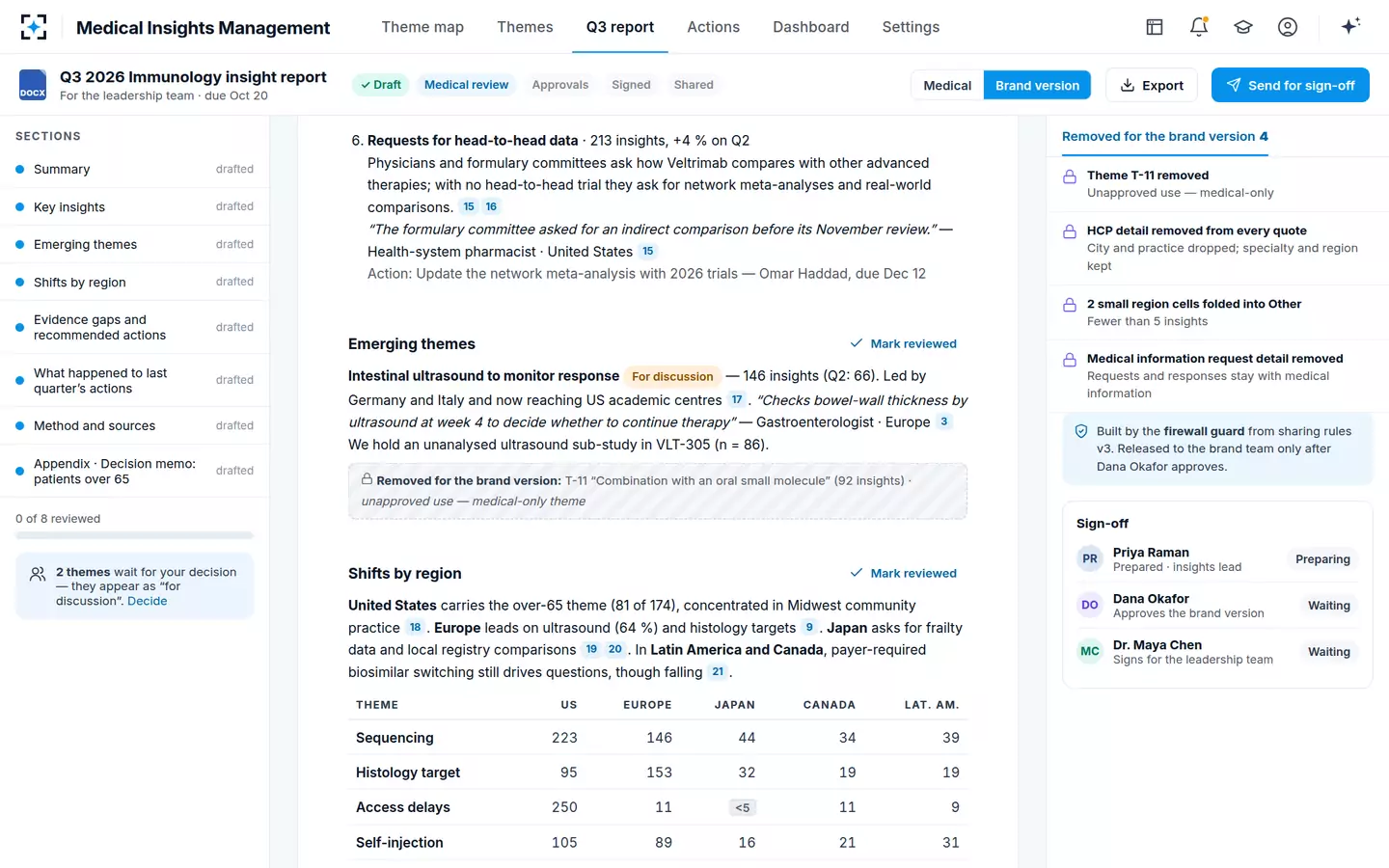
A brand version is the medical report minus four classes of content, and plus one thing: a list of what went. In the sample company's Q3 report the four removals were an unapproved-use theme that stays medical-only, the identifying detail on the physicians quoted, two region cells too small to show, and the detail of medical information requests.
The sample Q3 report: what the brand version keeps, and what it folds away
Themes in the report (12 in the medical version)
- Also in the brand version · 92%
- Unapproved-use theme, medical only · 8%
Region cells in the regional table (18 in the medical version)
- Shown as their own row · 89%
- Folded into "Other": under 5 insights · 11%
Detail held about each physician quoted
- Specialty and region, kept · 33%
- City, practice, contact and name, never leave the source system · 67%
The list of removals is the part people leave out, and it is the part that makes the version defensible. Without it, the brand version is just a shorter report, and nobody downstream can tell a deliberate omission from an oversight. With it, a reader can see that one theme is missing and why, and an auditor can ask whether the reason was right. It also protects the medical team from the follow-up request, because "what was in the version you did not send us" has a written answer.
The six rules a brand version of an insight report should be built from
- Unapproved-use themes stay medical-only
A theme about a use the labelling does not support is not abbreviated for the brand version; it is absent from it.
- Physician detail reduced to specialty and region
Name, city, practice and contact details stay in the source system. A quotation survives; the person attached to it does not.
- Small groups folded into "Other"
A region or segment below a stated threshold is combined, because a cell of two in one country is a name to anyone who works there.
- Medical information request detail left out
The fact that inquiries rose is a theme. The individual request, its wording and its answer belong to the medical information process.
- Every removal listed with its reason
The reader sees that something was taken out, and which rule took it. An unexplained gap is worse than a visible one.
- Nothing released before governance approves
The approver is named in advance and signs the release, so the decision has an owner rather than a sender.
Medical Insights Management builds the brand version and prints what it took out
Small groups and named physicians: the re-identification risk you own
Removing a name is the easy half. The harder half is that a small enough group is a name. A theme attributed to "two transplant nephrologists in Finland" identifies people to anyone who works in that field, and no field in the record has to carry a name for that to happen.
Two bodies of law describe the test, and they describe it in almost the same way. Under the HIPAA privacy rule's expert-determination route, information about patients may be treated as de-identified only where a qualified person "determines that the risk is very small that the information could be used, alone or in combination with other reasonably available information, by an anticipated recipient to identify an individual", and documents the method; under the safe-harbour route the entity must also not have "actual knowledge that the information could be used alone or in combination with other information to identify an individual" (45 CFR 164.514). That rule governs patient information, not the physicians a field team meets — but the standard it sets, risk judged against what a recipient could reasonably combine it with, is the right standard for a report about physicians too.
For the physicians themselves, European data protection law is the one that bites. Personal data means "any information relating to an identified or identifiable natural person", including someone identifiable "indirectly" by reference to "one or more factors specific to the physical, physiological, genetic, mental, economic, cultural or social identity of that natural person" (GDPR, Article 4(1)), and the regulation's own commentary tells you how to judge identifiability: account should be taken "of all objective factors, such as the costs of and the amount of time required for identification, taking into consideration the available technology at the time of the processing" (Recital 26). A specialty, a country and a quarter can satisfy that test on their own in a small therapy area.
So the small-group threshold is not decoration. It is the mechanism by which a report about 2,946 insights stops being a report about identifiable individuals, and the number has to be chosen deliberately: too high and the regional picture disappears, too low and a cell of one reaches a brand team. Setting it is the same decision as the suppression rule in identifying emerging themes, and it should be the same number in both places.
Who signs the release, and what the signature means
A release has to have an owner, and a signature is how the owner is recorded. In the sample company two people sign for different things: medical governance approves the brand version, and the therapy-area medical director signs the report itself with the meaning of her signature stated — "I approve this report for the medical leadership team". The distinction matters in a review, because approving a redaction and endorsing a conclusion are different acts.
A signature with its meaning stated, after the brand version is approved
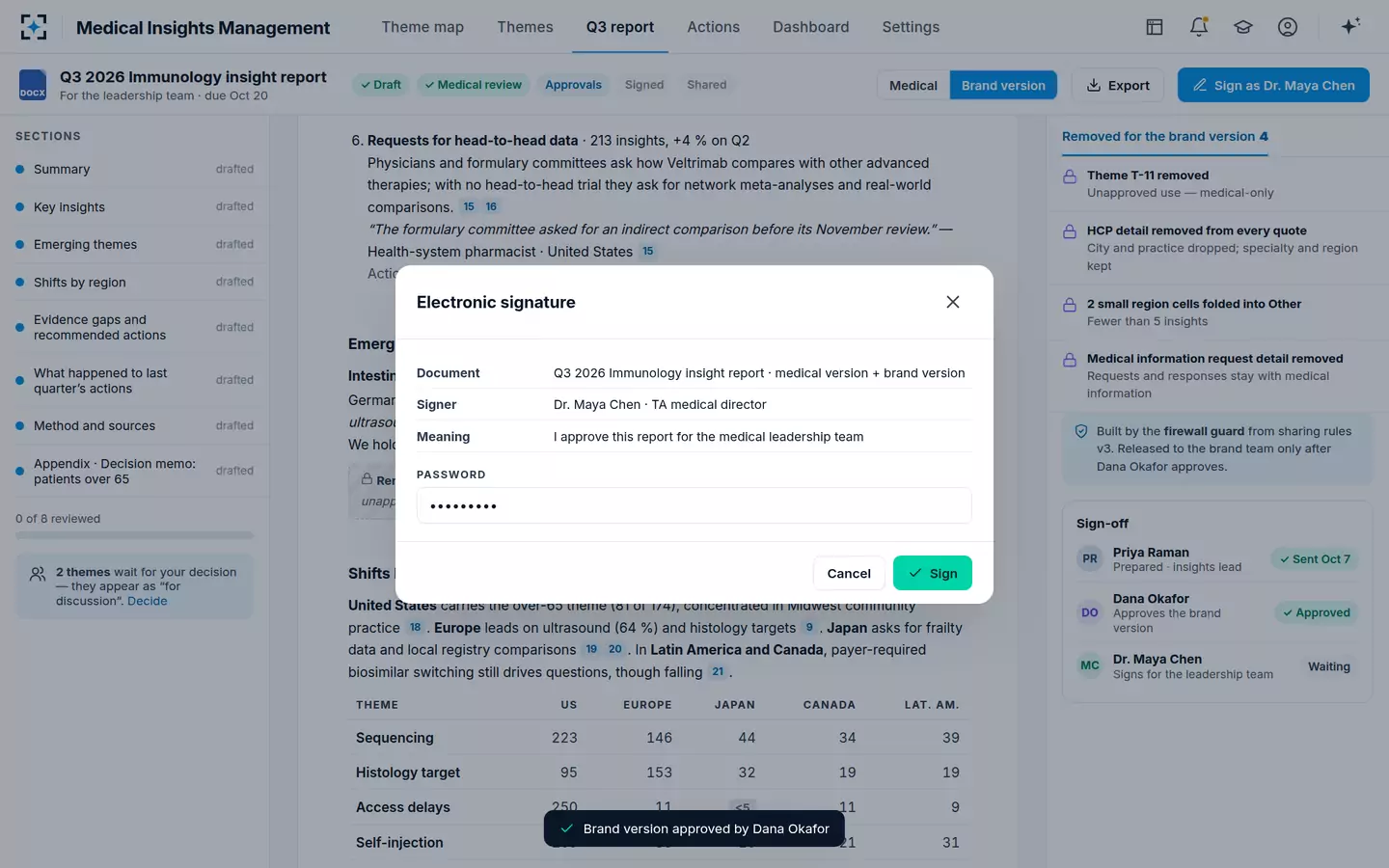
What the signature does not do is make the removals correct. That depends on rules written in advance, applied the same way every quarter, and visible as settings rather than as habits — which is the part of the problem a system can take, and the reason the sharing rules in the solution are versioned and recorded. The governance detail sits alongside the rest of the buying question in where the insights layer belongs in a medical affairs stack.
One thing the report cannot protect: the relationship is already public
18
categories a manufacturer must choose between when it reports the nature of a payment to a physician; "Consulting fee" is the first of them
1category
per payment: where a transfer could fall in more than one, the manufacturer "should select one category that it deems to most accurately describe the nature of the payment"
0
of that disclosure is changed by a brand version. Hiding an adviser’s identity in an insight report does not hide the consulting relationship behind it
This is the honest limit of the whole exercise. A report can stop a brand team learning which named physician raised a concern. It cannot unpublish the fact that the same physician was paid a consulting fee by the company last year, because that disclosure is made under a different rule, by a different part of the company, to a public database. The removals in an insight report are there to prevent the company's own scientific exchange from being read as a commercial asset — not to make an adviser anonymous in the world.
Questions people ask
What is the medical commercial firewall?
It is the industry's shorthand for a set of company rules about who may generate, see and approve scientific material, not a term used in any regulation. The published parts of it are narrow and specific: sales and marketing personnel should have no input on the content of a response to an unsolicited off-label question, scientific material about unapproved uses should be kept separate from promotional material, and research contracts should not originate in the sales or marketing functions. Everything beyond those, including what a brand team sees of an insight report, is policy a company writes for itself.
Can medical and commercial share a CRM?
Many companies do, and no published guidance forbids it; what matters is what each role can read and write, not how many databases exist. The usual arrangement keeps field medical insights visible to medical affairs and hides them from commercial roles, because the insight as captured contains the physician's identity and sometimes an unapproved-use question. A shared system with no role separation is the configuration to avoid, since it releases to a brand team by default everything the brand version would have removed.
What can an MSL tell a brand team?
What an approved version of the report says, in the words the report uses. The safe habit is to route the content rather than summarise it: a theme that has been through the sharing rules and been approved can be discussed, and anything else waits for the next version. The temptation to answer a direct question in a corridor is an easy way for an unapproved-use theme to cross the line, and it leaves no trail at all.
Who approves what a brand team sees?
A named person, decided in advance. In the sample company medical governance approves the brand version and the therapy-area medical director signs the report, with the meaning of the signature recorded; both are settings rather than conventions, so the approver cannot quietly become whoever is available. The approval is of a version built from written rules, which is what makes it an approval rather than a reading.
Are advisory board payments public?
In the United States, payments and transfers of value from applicable manufacturers to covered recipients are reported to the federal government and published. The reporting regulation requires the manufacturer to classify each one under a nature-of-payment category, of which "Consulting fee" is the first of eighteen, and to pick a single category where more than one could apply. So an adviser's paid relationship with a company is already on a public record, whatever an internal insight report does or does not say about who attended a board.
Does the separation mean medical and commercial never meet?
No, and a policy written as though it did tends to be ignored rather than followed. The published rules restrict three things — authorship of off-label answers, the packaging of scientific and promotional material, and the origin of research contracts. They do not prohibit a conversation about what the company does not yet know. The workable arrangement is a documented channel: brand teams receive an approved version and may ask questions through it, and medical affairs decides what evidence is worth generating.