MSL insights generation is the practice of turning what a medical science liaison hears in a scientific exchange into a written record somebody else can analyse: what the clinician said, in their words, with enough structure around it that it can be coded, counted and cited months later. It is harder than it sounds, and not because writing is hard. The note gets written in a car park between two meetings, by a colleague whose working day is mostly external, and three of the things that can be in it — a suspected adverse reaction, a request for information that was not answered in the room, and a clinician's identity — are governed by rules that live outside the insights process entirely. Botminds' Medical Insights Management is built around that: its intake agent writes one de-identified record whatever channel the insight came from, its coder flags the question that needs a written answer and drafts the request for a person to confirm, and the identity stays in the system it came from.
The worked examples below use the solution's sample data — Northwind Bio and its immunology product Veltrimab are fictional, and so are the colleagues and case numbers. The rules quoted are real and current, and are linked where they appear.
The clocks a field note can start
15days
calendar days, in the US, to report a serious and unexpected adverse drug experience — from initial receipt of the information by the applicant
Day 0
in the European guidance: the day the information first reaches any personnel of the marketing authorisation holder, medical representatives and contractors included
1business day
the solution’s design target for a flagged request for information to leave for medical information — a target, not a measurement
How do MSLs capture insights after a scientific exchange?
In many organisations, by typing into the field team's own system, as soon after the meeting as the day allows — and the timing is part of the requirement, not a courtesy. An insight has to be consolidated with others, analysed and acted on, which is three different people's work, and all three fail quietly if the note arrives in week eleven.
What is captured matters more than where. A note that records the colleague's conclusion — "concerns about use in older patients" — cannot be re-read; a note that records what was said can be re-coded next year under a scheme that did not exist yet. The rule of thumb that survives contact with reality is: write the clinician's question or statement close to verbatim, then add the structure around it.
The ten minutes after the meeting decide what the insight is worth
Everything that makes an insight usable is decided before the colleague starts the car. There are five things to do, they take about ten minutes, and two of them start clocks that do not belong to the insights programme.
Five things to do before the next meeting starts
- Write what was said, close to the clinician's words~4 min
- Check for a suspected adverse reaction~2 min
- Check for a request you did not answer~2 min
- Strip the identifiers~1 min
- Code and submit~1 min
The order is deliberate. Safety first, because the European guidance treats the moment the information reaches any company personnel — field representatives included — as day zero of the reporting clock, so a note written on Friday about a Tuesday conversation has already spent three days. The request for information comes second, because the clinician is waiting for it. De-identification comes before coding because once the name is out, every later step is safe by construction.
What belongs in the note, and what belongs in another system entirely
A useful insight record carries eight fields and nothing that belongs to a different process. The eight below are what the analysis downstream actually consumes; anything else is optional and most of it is noise.
Eight fields that make a field note usable a year later
- Date of the exchange, not the date of writing
The gap between the two is itself a measure worth watching, and the safety clock runs from the first.
- Channel
Scientific exchange, advisory board, congress, medical information inquiry or survey. Without it, no denominator makes sense.
- Specialty and practice setting
Community versus academic is a split that often separates two themes that look like one.
- Region
Country at minimum. Regional differences are where strong findings often sit.
- What was said, close to verbatim
The passage a theme statement will cite. Paraphrase into company vocabulary and the note stops being evidence.
- What was asked for, if anything
A request for data, a publication, a standard response document. This field is what turns a note into something a clinician actually receives.
- The codes, with the version of the scheme that produced them
A code without a version cannot be compared across a scheme change.
- The listening priority it answers, or none
"None" is a legitimate and informative answer; it is how you learn your priorities missed something.
Three things do not belong in the note at all: the clinician's name and contact details, a suspected adverse reaction as the only place it is reported, and the colleague's own recommendation presented as the clinician's view. Each has its own home — the field team's own system, the safety database, and a separate comment field respectively. Why the codes need a version number, and how to keep them stable while the scheme evolves, is the subject of the coding scheme that still holds next quarter.
Do MSLs have to report adverse events they hear in the field?
Yes — and the obligation belongs to the company, which means it reaches the colleague the moment they hear it. Under the European pharmacovigilance guidance a spontaneous report is "an unsolicited communication by a healthcare professional, or consumer to a competent authority, marketing authorisation holder or other organisation … that describes one or more suspected adverse reactions in a patient who was given one or more medicinal products", and it "does not derive from a study or any organised data collection systems" (EMA, GVP Module VI Rev 2). A remark made in a scientific conversation is exactly that.
The deadline is short and it is counted from the wrong end, as far as a busy field calendar is concerned. In the United States, the applicant has to report every adverse drug experience that is both serious and unexpected, from anywhere in the world, as soon as possible and within 15 calendar days of first receiving the information (21 CFR 314.80). The European guidance says the same thing about who counts as the company: the clock starts when the information reaches any personnel of the marketing authorisation holder, including medical representatives and contractors.
Two practical consequences follow. The first is that the safety check belongs in the ten minutes, not in the weekly admin block. The second is a boundary this solution respects rather than blurs: an insights system does not discharge a pharmacovigilance obligation. The safety database does that. What the insight record can do is make sure the colleague is prompted at the right moment and that the note carries a flag and a route, so nothing sits unnoticed in a free-text field while the clock runs.
Why a clinician survey changes how the same safety report is classified
The same sentence from the same clinician can be a spontaneous report or a solicited one, and the difference is not what was said but how the company came to hear it. Solicited reports "are those derived from organised data collection systems, which include clinical trials, non-interventional studies, registries, post-approval named patient use programmes, other patient support and disease management programmes, surveys of patients or healthcare professionals, compassionate use or name patient use, or information gathering on efficacy or patient compliance" (EMA, GVP Module VI Rev 2). A survey of clinicians is on that list. A conversation is not.
One remark about a side effect, two classifications
Heard in a scientific exchange: An unsolicited remark during a conversation the colleague arranged for scientific reasons.
Collected in a clinician survey: An answer to a question the company asked, inside a programme designed to collect data.
Heard in a scientific exchange: A spontaneous report — it does not derive from a study or any organised data collection system.
Collected in a clinician survey: A solicited report — it derives from an organised data collection system, and surveys of healthcare professionals are named as one.
Heard in a scientific exchange: The colleague, immediately, through the safety process.
Collected in a clinician survey: The programme owner, through the process written into the programme, with causality assessed as the guidance for solicited reports requires.
Heard in a scientific exchange: Carries a flag and a route, and keeps a link to the exchange.
Collected in a clinician survey: Carries the same flag, plus the programme the response came from, so it is never mistaken for a spontaneous one.
Heard in a scientific exchange: Counts toward the theme, with its channel recorded.
Collected in a clinician survey: Counts toward the theme, but a sudden rise may be the survey, not the world.
There is a trap in the middle of this, and the guidance names it. Asking clinicians questions does not convert their answers into study data; the opposite is closer to true.
stimulated reporting that occurs consequent to a direct healthcare professional communication …, publication in the press, questioning of healthcare professionals by company representatives, communication from patients' organisations to their members, or class action lawsuit
EMA, Guideline on good pharmacovigilance practices, Module VI Rev 2
Those are listed in the guidance as situations that should also be considered spontaneous reports. In other words, a field colleague who asks a clinician how their patients have tolerated a product and hears about a reaction has produced a spontaneous report, not a solicited one, and the short clock applies. The distinction matters for the insights programme for a second reason too: a question asked of a hundred clinicians produces a hundred notes that look like a sudden theme, and a count that does not record its channel cannot tell the difference. That failure, and its cure, run through how to tell a real emerging theme from a busy month.
The off-label question you cannot answer in the room
Sooner or later a clinician asks a question whose honest answer lies outside the approved labelling. The US guidance on unsolicited requests is short on this point: off-label questions should be passed to the company's medical or scientific staff to answer (FDA draft guidance, Responding to Unsolicited Requests for Off-Label Information). For the field colleague, that means the move in the room is to note the question exactly and say it will be answered in writing — not to improvise an answer because the questioner is a specialist and the conversation is scientific.
What happens next is where programmes often leak. The question gets written into the insight note, the note goes into the analysis queue, and the clinician hears nothing. In this solution the question is treated as a separate object from the moment it is captured: the coder flags any request the clinician wants answered in writing and drafts the request to medical information with the source passage attached, and a person confirms it before it is sent.
From an unanswered question to a confirmed request, inside one business day
A person decides
Field colleagueRecords the question close to verbatim in the insight note and tells the clinician it will be answered in writing.
Never: answers an off-label question from memory in the room
Agent
Insight coderFlags the question as a request for a written response and drafts the request to medical information, carrying the source passage and the product, with the clinician's contact details left in the source system.
Never: sends the request itself
A person decides
Insights leadReads the draft against the passage and confirms it, or declines it with a reason.
Agent
Insight coderOn confirmation, hands the request to medical information, which answers it; the request stays linked to the insight it came from.
A drafted request, waiting for a person to confirm it
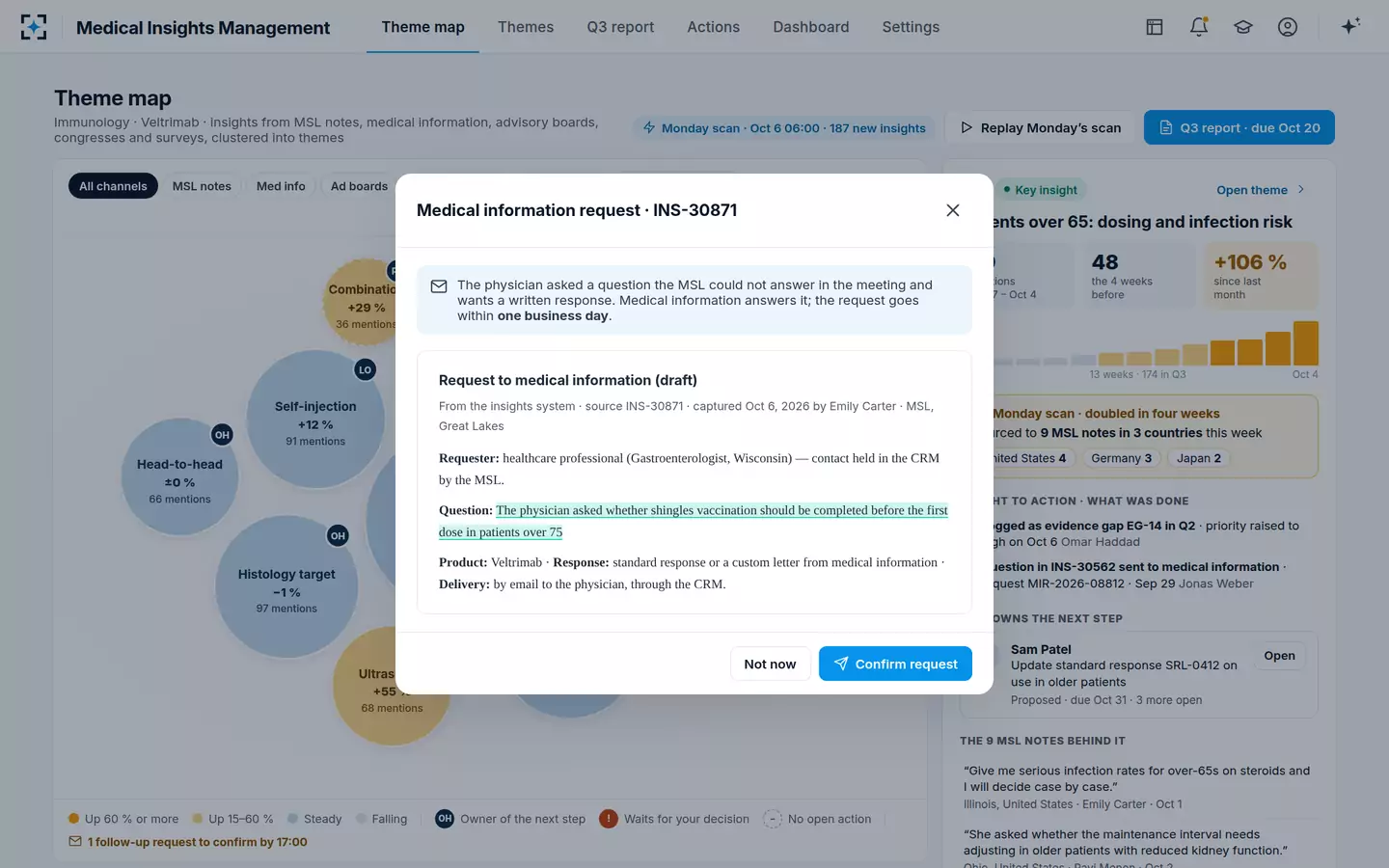
This page stops at the field colleague's end of that chain on purpose. Writing the response itself — what may be said, how the request is documented, and how the answer is kept consistent across hundreds of them — is a different discipline with its own rules, and a different solution.
Should the clinician's name be in the insight record?
No, and the cleanest way to hold that line is to make it structural rather than a matter of care. In Medical Insights Management the intake agent replaces the clinician with a segment — specialty, practice setting, region — and the name, practice name and contact details never leave the system they arrived in. The record links back to its source, so a colleague who needs the identity can reach it through the system that is supposed to hold it, with whatever controls that system applies.
Two reasons, one practical and one not. The practical one is that the identity is of little use downstream: a theme is built from specialty, setting and region, and no analysis in the quarter improves because a name is in the free-text field. The other is that free text is where de-identification often fails — which is why the de-identification guidance for health information makes no distinction between data in structured fields and information entered as free text, and treats an identifier as an identifier wherever in the record it appears. The same principle applies to a note dictated into a text box in a car park.
There is one more identity in the record that is easy to forget: the colleague's own. A note is attributable, and that is deliberate, because validation needs a name. It also means that counting notes per colleague is a measure that will change behaviour — usually for the worse. Which measures survive scrutiny takes that argument apart.
Why MSLs stop logging, and what brings them back
Submission does not fall off because colleagues disagree with the process. It falls off because nothing visibly happens. A note written carefully in a car park, submitted, and never seen again teaches a rational person to write shorter notes next time. The cure has to be part of the design: a loop that lets the colleague see what their note caused.
Three forms of that feedback are worth separating, because the last one is the most direct. A quarterly email saying how many insights the team submitted is a count, and counts are not feedback. A case study at the national meeting is better, and lands once a quarter for one team. The one most likely to change behaviour week to week is the colleague seeing their own note cited, by number, in the statement a leadership team read — and seeing who now owns the next step.
A field colleague's note, cited inside the theme it helped build
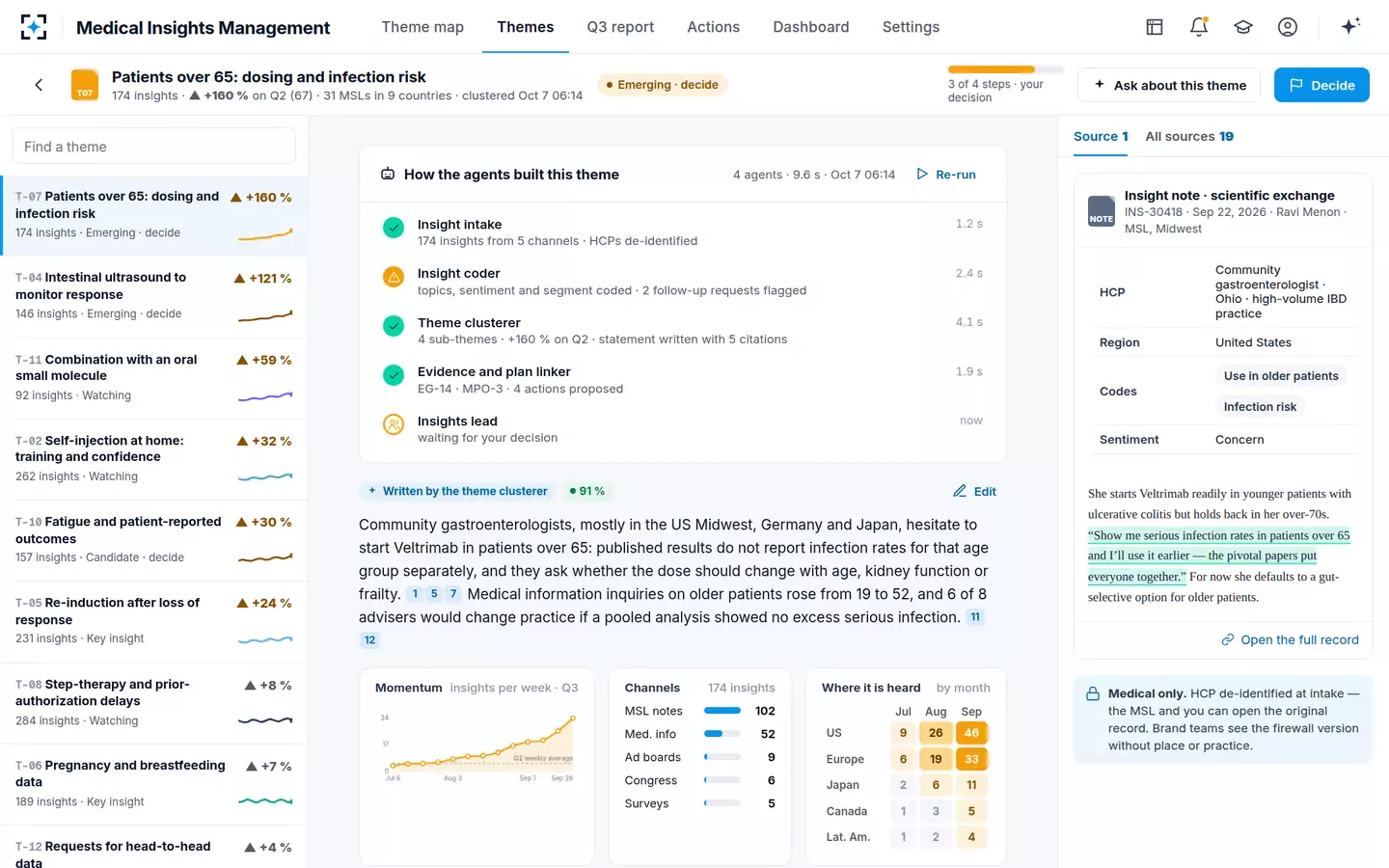
What a field team should get back, and how fast
Three things, on three different clocks. Within a day: confirmation that a flagged request has gone, because the clinician is waiting and the colleague will be asked at the next meeting. Within a week or two: the knowledge that the note joined a theme, which is the difference between filing and contributing. Within the quarter: the decision — this theme is now a key insight, this one is still being watched, this one was merged — and who owns what follows.
The last of those is the one many programmes never deliver, and it is also the cheapest to fix, because the decision has to be made anyway. In the sample quarter the theme a colleague's Ohio note helped build ends with a named owner and a date against each of four actions, and that list is visible from the note. The solution's design target is a median of 2.1 days from a captured insight to its theme; the target that matters more to the field is the second one, and we know of no published benchmark for it — measure your own and tell the team the number.
If you are standing up a programme from scratch, start at the other end of this page rather than this one: decide what you will call an insight, and what you will not. What a medical insight is, and what is only an observation sets out the tests, and the quality of everything the field writes follows from them.
Questions people ask
What should an MSL write in an insight?
What the clinician said, as close to their words as memory allows, plus the date of the exchange, the channel, the specialty and practice setting, the region, anything the clinician asked for, and the listening priority it answers. Leave out the clinician's name and contact details, and keep your own interpretation in a separate field so a later reader can tell the evidence from the reading of it.
How many insights does an MSL log in a quarter?
We know of no published benchmark, and chasing a number is counterproductive: a quota rewards volume and buries the signal in it. A more useful pair of questions is whether each of your declared listening priorities got any coverage, and whether the notes that arrived are specific enough to be cited in a statement a medical director would sign.
What is the difference between a solicited and a spontaneous adverse event report?
A spontaneous report is an unsolicited communication describing a suspected adverse reaction that does not derive from a study or an organised data collection system. A solicited report derives from one — clinical trials, registries, patient support programmes, and surveys of patients or healthcare professionals are all named in the European guidance. The classification follows how the company came to hear it, not how serious it is.
Can an insight be edited after it is submitted?
The passage should not be rewritten, but codes and structure often change: a scheme is revised, a code is corrected, a note is merged into a theme. The workable rule is that the clinician's words are fixed and everything applied to them is versioned, so a trend line can be read across a change rather than silently broken by it.
Does a clinician have to consent to being quoted in an insight?
Consent requirements depend on your jurisdiction and your own privacy process, so take the answer from your privacy colleagues rather than from a guide. What is universally safer is to need less: a de-identified record that carries specialty, setting and region supports every analysis a quarterly programme performs, and leaves the identity in the system that was built to hold it.
Who reads field insights inside the company?
The insights lead and the therapy area medical team first, then evidence generation, medical information and medical governance as a theme touches their work. Brand and commercial colleagues do not read raw notes: they see an approved version of a report with unapproved-use themes, clinician detail and small groups removed, and only after medical governance has released it.