An integrated evidence plan is a cross-functional plan for everything a company will generate to answer the questions its external stakeholders have — regulators, health technology assessment bodies, clinicians, payers and patients — rather than only the evidence a submission requires. The reason it belongs in a guide about field insights is that the published description of the planning process names an insight as one of its starting materials: external stakeholders' practices and assumptions set the evidence needs, the needs are mapped against what the company already has, and what is left over is a gap. Botminds' Medical Insights Management is the part of that chain nobody has time to do by hand — it matches a theme to the evidence-gap register, to the medical plan objectives and to the data the company already holds, and proposes actions with an owner for the insights lead and the evidence generation lead to accept.
The hard part is not the diagram. It is that a field theme arrives as prose, in a quarter's worth of notes from several countries, and an evidence plan runs on a prioritised list of answerable questions. This guide is about the translation between the two: what a gap record has to carry before it can be argued for, which gaps can be closed with data already on file, which need a study, and what happens to the theme's author once the decision is made. The worked example is a fictional sample programme, Northwind Bio's Veltrimab; the study codes, patient counts and owners in it are sample data.
Three dates that shape an evidence plan, and one from the sample programme
Phase 2
the point by which evidence generation planning is usually initiated, in the published account of the process
2007
any applicable clinical trial initiated after 27 September that year must be registered — the regulation offers no discretion
21days
the deadline for submitting registration information after the first participant is enrolled, where that is the later date
212
patients aged 65 and over already enrolled across three studies in the sample programme — the reason its theme needed no new trial
What is an integrated evidence plan, and who owns it?
It is the plan that brings the company's evidence generation into one place and one order of priority. Published descriptions use integrated evidence plan and integrated evidence generation plan interchangeably; the 2026 account in Pharmaceutical Medicine states the objective plainly — to "bring together cross-functional stakeholders and local affiliates to address the evidence needs of external stakeholders efficiently, while also raising awareness of the evidence generation strategy and tactics to ensure alignment across large organisations" (Fujii and colleagues, 2026).
Ownership is contested in many companies and the paper does not pretend otherwise; it names the open question directly — "who is ultimately accountable for delivery of cross-functional priorities?" — while arguing that medical affairs, with its understanding of what clinicians and patients actually need, "is often best placed to lead the process as early as possible in the product life cycle". In practice three functions have a claim: clinical development owns the trials, market access owns the payer evidence, and medical affairs owns the questions that arrive from practice. The plan is where their three lists are reconciled, which is why it is a negotiation rather than a document.
The timing is less contested. Because evidence has to be generated across the whole development timeline, "IEGP development is usually initiated no later than when the treatment is entering Phase 2 clinical trial(s)" — and the paper is candid about the cost of that, since most compounds in phase 1 never reach approval, so early planning is an investment made against a risk.
Where a field insight enters the plan
It enters as a stakeholder evidence need, before any gap analysis has happened. The paper's own framing is that "external stakeholders provide insights that drive the strategic direction of a product", and that "it is important to consider what their current practices and assumptions are to generate evidence that will best inform decision making". That is a precise and useful claim: what a company needs from the field is not a wish list of studies but an account of how clinicians currently decide, and what they are assuming in the absence of data.
A theme that says "physicians want more data" is useless at this stage. A theme that says "community gastroenterologists hesitate to start the drug in patients over 65 because published results pool all ages, and they are managing that uncertainty by case-by-case decisions on steroid-treated patients" is an evidence need, because it names the decision the evidence would change. Getting from the first form to the second is the work described in identifying emerging themes, and it is the reason a theme statement is worth writing in full sentences with citations rather than as a tag.
The cost of getting the hand-over wrong is easy to state. A theme with no route into a plan does not sit patiently waiting for one; it is re-raised the next quarter as a new theme, counted again, and eventually dropped by the field team that keeps raising it.
How do you identify an evidence gap?
By subtraction, not by listing what you would like to know. The published definition is explicit about the method: evidence gaps "are the areas in which additional evidence generation tactics are required to meet the needs of healthcare decision makers, and are identified by mapping complete, ongoing and planned internal and external tactics to evidence needs".
Three things follow from that sentence. First, you cannot identify a gap without an inventory — of your own completed and running studies, of what is planned, and of the external literature. Second, a gap is defined relative to a need, so an unmet need with nobody who would act on the answer is not a gap worth funding. Third, the mapping is the expensive part, and the paper names the cost: "without automation, this part of the IEGP process relies on manual information exchange and communication across functions and geographies, which can be both inefficient and costly". The paper also names the consequence of doing it badly — if gaps are not analysed accurately, there may be "duplication of effort or misplaced urgency".
Four kinds of evidence gap, and the tactic each one actually needs
| What the theme is asking | The kind of gap | The tactic that answers it | What it costs you |
|---|---|---|---|
| "Does it work the same way in this subgroup?" | A subgroup question, where the data exist but have not been analysed that way | A pooled or post-hoc analysis of studies already completed | Statistics time and a publication plan; no new participants |
| "Is it better than what I use now?" | A comparative question with no head-to-head data | A trial, or an indirect comparison if the published evidence supports one | Years, and a budget decision above the medical plan |
| "How does it behave in my clinic, not in a trial?" | A practice question about use outside trial conditions | A study using real-world data, or a registry | Data access, and a design argument about confounding |
| "Nobody told me this was already answered." | Not a gap at all — an awareness problem | Communication: a slide module, a standard response, a congress symposium | Days, not quarters — and often the fastest win of the quarter |
The fourth row deserves more attention than it gets. A good share of what the field reports as an evidence need is an awareness need, and the honest response is a slide module or an updated standard response rather than a study. Classifying the theme correctly before it reaches the prioritisation meeting is what keeps the meeting short, and what protects the credibility of the gaps that genuinely need money.
Data on file first: the analysis you can run this quarter
Before anyone funds a study, the question is whether the company already holds the answer. "Data on file" means exactly what it says — results the company holds and can cite, from completed studies, analyses and registries, that have not necessarily been published. It is often the cheapest tactic in the plan and an easy one to skip, because finding out what is on file requires asking several functions who each keep their own inventory.
In the sample programme the theme was about patients over 65, and the answer to "do we already hold this?" was yes: 212 patients aged 65 and over across two completed studies and a long-term extension. That turned a question that looked like a trial into a pooled safety analysis with a statistics estimate and a January due date. The sample company's proposed action list put the pooled analysis first, with the evidence generation lead as its owner.
A pooled analysis of data you already hold, against a new study
Pooled analysis of data on file: Whether a pattern already present in your own participants holds when you look at them as a group.
A new study: A question your existing participants cannot answer: a comparator you never studied, a population you never enrolled, a practice setting you never ran in.
Pooled analysis of data on file: Create statistical power that the original enrolment did not provide, or remove the selection that trial eligibility already imposed.
A new study: Answer anything this quarter.
Pooled analysis of data on file: Weeks to a few months of statistics and medical writing time.
A new study: Quarters to years, before the first result exists.
Pooled analysis of data on file: The usual publication and disclosure practice for a post-hoc analysis, including that it was post-hoc.
A new study: Registration, where it is an applicable clinical trial, and results reporting afterwards.
Pooled analysis of data on file: Treated as though it were pre-specified. A subgroup finding that was not planned is a hypothesis.
A new study: Funded to answer a theme that the data on file would already have answered.
What counts as real-world evidence, and what does not
For a practice question, the tactic is often real-world evidence, and the definition is narrower than casual use suggests. FDA's framework defines real-world data as "data relating to patient health status and/or the delivery of health care routinely collected from a variety of sources", and real-world evidence as the clinical evidence about usage and potential benefits or risks "derived from analysis of" that data (FDA, December 2018).
The boundary the framework draws is the one worth quoting in a planning meeting: "under FDA's RWE Program, evidence from traditional clinical trials will not be considered RWE. However, various hybrid or pragmatic trial designs and observational studies could generate RWE." So the word is not a synonym for "not a trial", and it is not a cheaper label for an ordinary study. It describes where the data came from — routine care — and that is what makes it both relevant to a practice question and contested on confounding.
For a field theme this matters in a specific way. Many practice questions that arrive from MSLs are about patients who would not have met the trial's eligibility criteria: older, frailer, on more concomitant medication. That is precisely the population routine-care data contains and the trial does not — and also precisely the population in which confounding by indication is hardest to argue away. The theme is a good reason to look; it is not an argument that the answer will be clean.
Prioritising evidence gaps when every function wants its own answered
The paper is blunt that this is where plans fail: "prioritisation of evidence gaps can often be the most challenging step in a cross-functional setting", and it gives the example that lands hardest — a company launching in the United States will want to prioritise evidence for approval and not slow the regulatory submission down with the parts of the plan that mostly support payer decisions elsewhere.
A theme from the field arrives into that argument with a structural disadvantage: it has no deadline attached, while a submission does. The counterweight is not advocacy, it is a record. A gap that arrives with its citations, its question in a formal structure, a statement of what is already held and a named decision it would change can be compared with the other items on the list. One that arrives as "the field keeps asking about this" cannot.
What a gap record should carry before anyone argues about priority
- The theme and its citations
How many insights, over what window, from which channels and countries — and a link from each sentence of the theme statement to the note behind it.
- The question in a formal structure
Population, intervention, comparator, outcome and time. The published planning process uses PICOT for exactly this reason: it forces a question that can be answered or refused.
- What is already held
Completed, ongoing and planned studies that touch the question, inside and outside the company, with the participant counts.
- Who asked, and who would act
The stakeholder whose decision the evidence changes. "Clinicians would find it interesting" is not a decision.
- The objective it serves
The medical plan objective, so a gap that serves nothing in the plan is visible as such rather than quietly funded.
- The tactic proposed, and its owner
Named before the meeting, so the discussion is about priority rather than about who would do it.
A study that answers the theme has to be registered
If the chosen tactic is an applicable clinical trial, registration is not a policy choice. The regulation states the general specification without qualification: "any applicable clinical trial that is initiated after September 27, 2007, must be registered" (42 CFR 11.22), and the companion section sets the deadline — registration information must be submitted no later than 21 calendar days after the first participant is enrolled, where that is the later of the two dates the section names.
Two consequences matter for an insights team. The first is a timing one: the public record of the study will exist before any result does, so the theme that caused it becomes, in effect, visible as a research question long before the company has an answer to give the physicians who raised it. The second is a scope one: a pooled analysis of completed studies is not a new applicable clinical trial, which is one more practical reason the data-on-file route gets a programme moving.
Nothing in an insights system files a registration, and no insights system should claim to. What it can do is make sure the theme, its citations and the decision that created the study are all attached to the same thread, so that a year later anybody can answer the question "why did we run this?".
Keep the funding decision away from the sales and marketing side
The oldest published warning about research in this industry is about where the request came from. The government's compliance guidance treats research contracts that begin in sales or marketing, or that are offered to physicians during sales contacts, as particularly suspect, and expects research to be paid at fair market value for services that are genuinely needed (OIG, 68 FR 23731, 5 May 2003).
This is a practical argument for the insight-to-evidence chain being written down rather than conversational. A theme whose written history begins with nine field notes in three countries, is matched to an existing gap in the register, and is funded on a recommendation that medical affairs signed has an origin anyone can follow. The same study, requested in a meeting and documented afterwards, has the same scientific merit and a much worse story. Which function may be in the room for which part of that conversation is the subject of where the line between medical affairs and commercial sits.
Medical Insights Management proposes the actions; the owners accept them
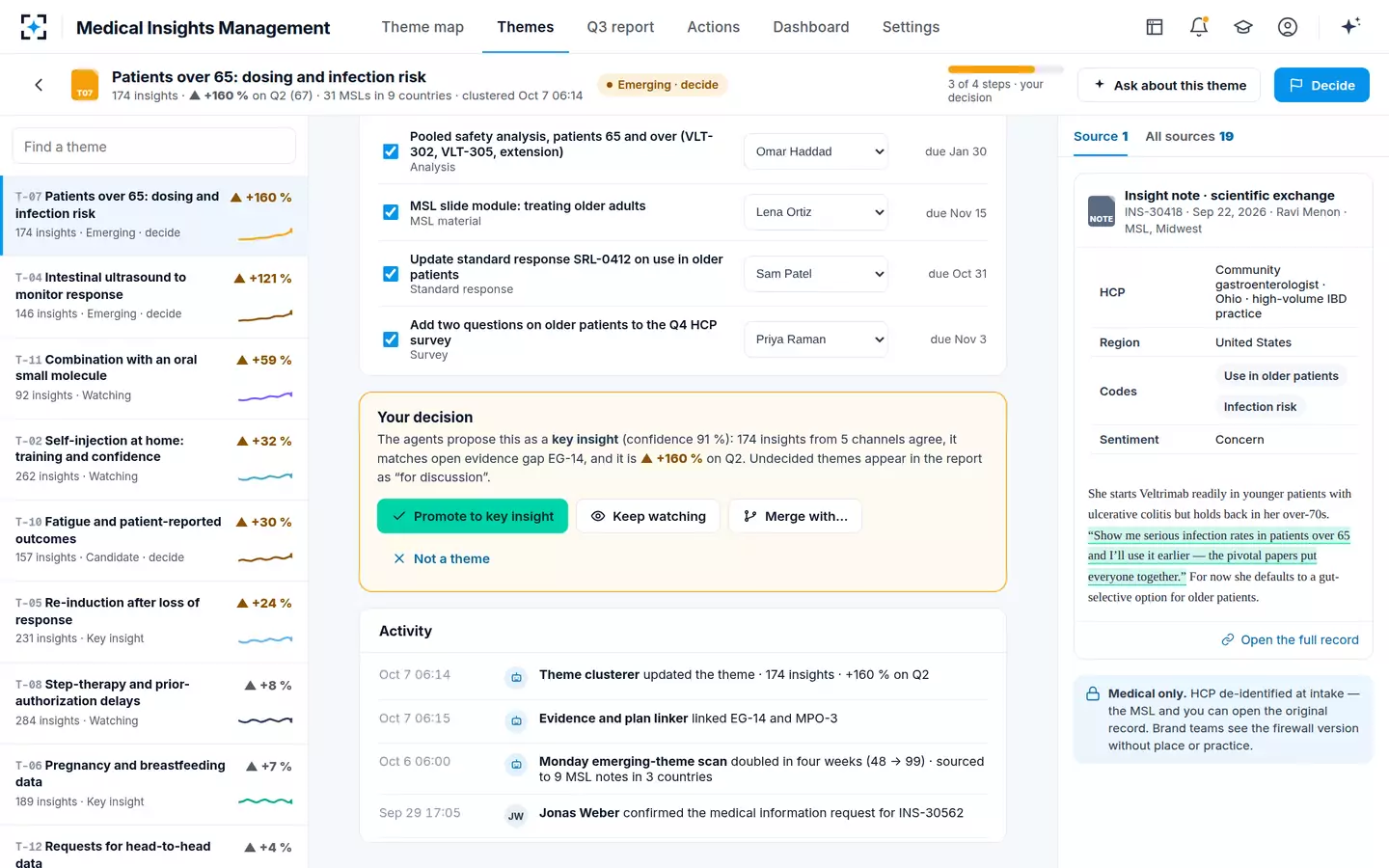
The chain Medical Insights Management runs between a theme and an owned evidence action
Agent
Theme clustererGroups the coded insights into a theme, names it in plain words, and writes the statement with a citation on every sentence.
Never: applies a merge or a split without the insights lead
Agent
Evidence and plan linkerMatches the theme to the evidence-gap register, to the medical plan objectives and to the data already held, and proposes actions with an owner and a date.
Never: promotional wording, and never an action an owner has not accepted
A person decides
The insights lead decides the themePromotes it to a key insight, keeps it on watch, merges it or dismisses it, with a reason that stays on the record.
A person decides
The evidence generation lead accepts the gapTakes the pooled analysis, confirms the question and the statistics estimate, and owns the date it is due.
Agent
Report writerPuts the theme, the decision and the actions into the quarterly report with their citations, and marks anything undecided for discussion.
Never: a sentence without a citation
Closing the loop, so the field sees what its note caused
The last step is the one that decides whether there will be insights next quarter. An MSL who writes a careful note about an older patient's infection risk, and never hears anything again, learns that the field's notes are an administrative obligation. The same MSL, shown that nine notes including hers produced a pooled analysis with a date on it, learns something else.
Every action from a key insight, from proposed to impact measured
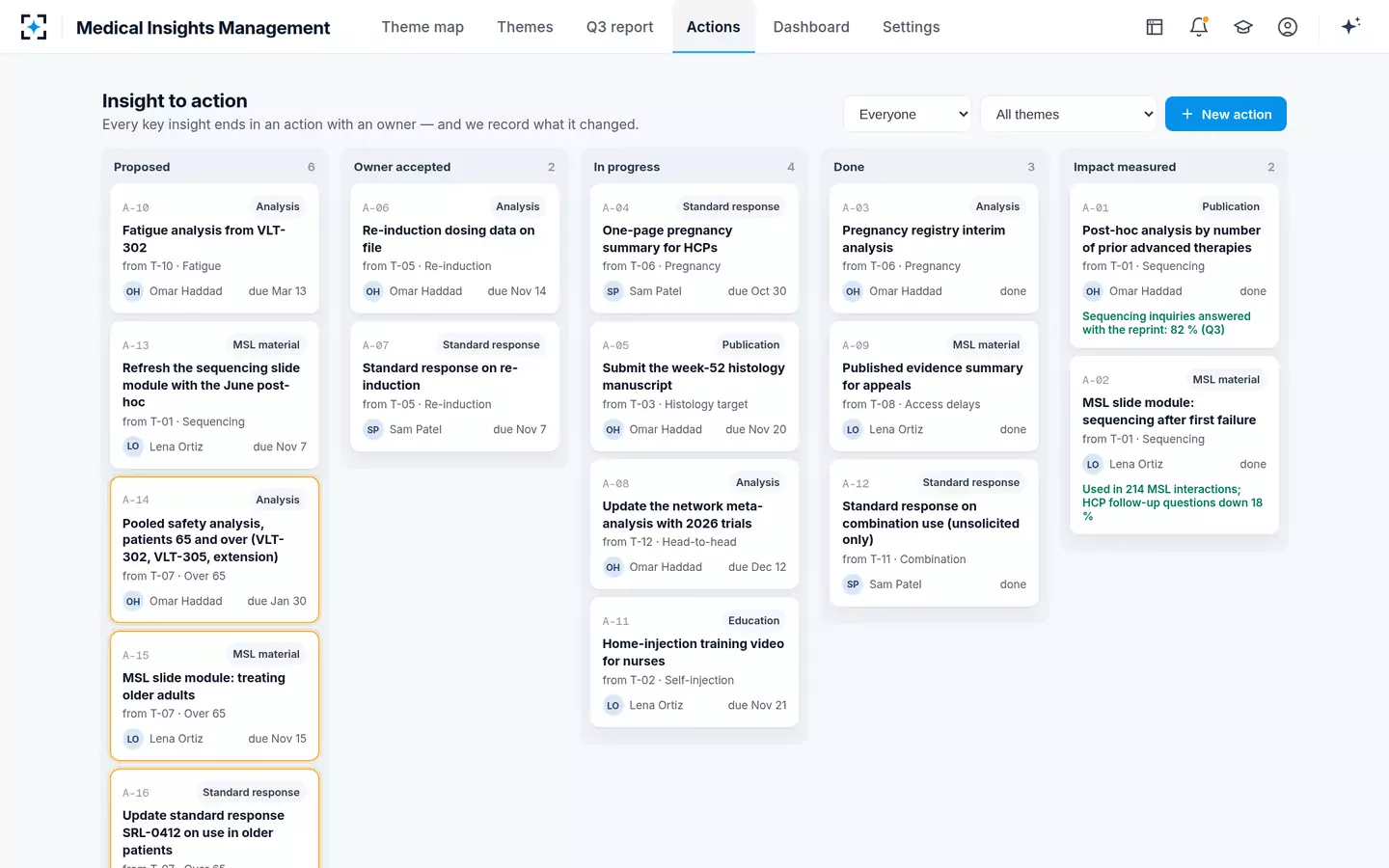
Two mechanics make the loop real. The first is that the action carries the theme with it, so the owner of a slide module can see the nine notes that caused it and quote one. The second is that the board keeps a column after "done" — for what changed — because an action completed is not the same as a question answered. Whether the whole programme is working is a measurement question of its own, taken up in measuring insights without just counting them.
Questions people ask
How do field insights feed evidence generation?
As evidence needs, at the start of the planning process rather than as requests at the end of it. The published description of the process is that external stakeholders' insights drive a product's strategic direction, and that what matters is understanding their current practices and assumptions. The practical route is: the theme states the decision clinicians are making without data, the gap analysis checks it against completed, ongoing and planned work, and what survives that subtraction goes to the prioritisation discussion with its citations attached.
What does "data on file" mean, and what may you do with it?
It means results the company holds and can cite — completed studies, pooled analyses, registries and safety data — whether or not they have been published. It is the first place to look when a theme arrives, because an analysis of participants you already enrolled can often be delivered in a quarter rather than years. The limit is statistical rather than regulatory: an analysis that was not pre-specified produces a hypothesis, and should be described as what it is wherever it is used.
Is an integrated evidence plan the same as an integrated evidence generation plan?
In practice yes; the peer-reviewed literature uses both names for the same artefact, and the abbreviation IEGP appears for either. What varies between companies is scope — whether the plan covers only post-approval evidence or runs from early development — and that is worth settling in a first meeting, because two functions using the same name for different scopes is a common reason a prioritisation discussion goes badly.
Who should be in the room when evidence gaps are prioritised?
The functions that own the tactics and the function that owns the questions: clinical development, market access, medical affairs, and the regions or affiliates whose stakeholders generate the needs. The published account argues that medical affairs is often best placed to lead the process, while naming accountability for cross-functional delivery as an open problem. The practical answer is that whoever leads it, the gap list has to be one list, with one order.
How many evidence gaps should a plan carry?
Few enough that each one has an owner and a date. There is no published number, and a plan with forty gaps and six owners is a list of regrets rather than a plan. A workable discipline is that a gap enters the plan only when a tactic and an owner are named for it; everything else stays in the register as a candidate, visible, dated and available for the next prioritisation round.
What happens to a theme that cannot become evidence?
It should still get a decision and a reason. Some themes are awareness problems and are answered with a slide module or an updated standard response; some are real but not fundable this cycle, and belong in the register with the date of the decision; a few are not themes at all. The failure mode is silence: a theme left undecided is raised again next quarter by the same people, and the organisation learns nothing except that raising it does not work.