The clearest insurance litigation trend in auto injury claims is that more claims become lawsuits while almost none become trials. In the Insurance Research Council's study of 7.4 million auto injury claims closed between mid-2017 and mid-2022, the share of claimants in litigation rose from 10% to 18% and the share represented by an attorney from 40% to nearly 50%; of the federal motor vehicle injury suits that ended in the year to September 2025, 0.7% ended during or after a trial. For a carrier the expensive turn is the first one, claim to suit, because a suit adds defense counsel, discovery and years of elapsed time whether or not it is tried. Botminds' Litigation Propensity Prediction is built for that turn: it reads every open injury file each night and scores the chance of a lawyer or a suit, with the phrase behind every point, so the claims unit can act while a direct resolution is still possible.
This guide is written for claims executives, litigation managers and casualty claim leaders. The research figures come from the federal courts, the Bureau of Justice Statistics, the U.S. Treasury's Federal Insurance Office and the Insurance Research Council, an insurer-supported non-profit; the product examples come from a fictional sample carrier on invented files.
Five years of auto injury claims: more lawyers, more suits, larger payments
10→18%
claimants in litigation, 2017 to 2022, all coverages
40→~50%
claimants represented by an attorney over the same period
7.8%
annualised rise in the average bodily injury payment, about $14,000 to more than $20,000
~440days
median wait to closure for represented bodily injury claimants, more than double the unrepresented
What are the main insurance litigation trends in auto injury claims?
Three trends run together: more representation, more suits, and larger and slower payments. The Council's release puts the litigation figure plainly: "Litigation rates nearly doubled over the same period, from 10% to 18% of claimants." Bodily injury claimants saw the largest gain in representation, up 11 percentage points, and the average bodily injury payment rose 7.8% a year, more than double the rate of medical care inflation.
The study also measures how payments relate to medical bills. Bodily injury claimants received $2.00 in total settlement for every dollar of medical bills paid, a ratio that rose from $1.80 in mid-2017 to more than $2.30 by mid-2022. General damages are therefore amplifying medical cost growth, and every point of litigation rate amplifies it again, through defense spend and time.
The Council is supported by insurers and measures what insurers see, so its figures are best read beside public court data. The two sources do not measure the same thing: the Council counts claimants in litigation, the courts count cases by how they ended. Together they describe a funnel that narrows twice.
The auto injury litigation funnel, stage by stage
Half of auto injury claimants never hire a lawyer, about a third hire one without suing, and about a fifth end up in litigation. Of the suits that reach federal court, about a fifth end with no court action, half end before pretrial, a quarter during or after pretrial, and fewer than one in a hundred at trial.
The auto injury funnel narrows twice: at the suit, and again before trial
Auto injury claimants, 2022 (all coverages)
- No lawyer · 50%
- Lawyer, no lawsuit · 32%
- In litigation · 18%
Federal motor vehicle injury cases ended, year to Sept 2025 (5,333)
- No court action · 20%
- Ended before pretrial · 53%
- During or after pretrial, incl. 37 trials · 27%
The middle band of the top bar is where a claims unit has the most room. A represented claimant who has not sued can still be resolved without defense counsel; what a letter of representation changes, and what it does not, is set out in the guide to letters of representation. Once a summons is served, the unit is managing a case on the court's calendar.
How many litigated auto injury claims reach trial?
Under 1% in federal court, and a few percent in state courts. Of the 5,333 federal diversity motor vehicle injury cases that ended in the year to 30 September 2025, 37 ended during or after a trial, 34 of them before a jury: 0.7%, as the courts' own table prints it (U.S. Courts, Table C-4). Across all 407,379 federal civil cases that ended that year, 0.4% reached trial.
How 5,333 federal motor vehicle injury cases ended, year to 30 September 2025
| Stage at which the case ended | Cases | Share |
|---|---|---|
| No court action | 1,079 | 20.2% |
| Court action, before pretrial | 2,840 | 53.3% |
| During or after pretrial | 1,377 | 25.8% |
| During or after trial (34 jury, 3 non-jury) | 37 | 0.7% |
| All cases | 5,333 | 100% |
State courts handle most injury suits and publish no national table of this kind each year. The last national survey, for 2005, found that "trials collectively accounted for about 3% of all tort, contract, and real property dispositions in general jurisdiction courts," and that motor vehicle accident cases were the most common type of civil case tried, 35% of about 26,950 civil trials (Bureau of Justice Statistics). The data are old; the proportion, trials as a small minority, is consistent with the federal figures.
What a suit costs the insurer before any trial
A suit costs time and defense spend whether or not it is tried. In federal court, the median civil case that ended before pretrial took 18.8 months from filing, and one that ended during trial took 30.7 months (U.S. Courts, Table C-5). Add the time before filing, a median of nearly 440 days to closure for represented bodily injury claimants in the Council's data, and a contested auto injury claim can stay open three or four years.
Median months from filing to disposition in federal court, by when the case ended
The industry's defense bill is measured in premium. The Federal Insurance Office reports that U.S. property and casualty insurers' defense and cost containment expenses incurred ran at about 4.5% of direct premiums earned between 2015 and 2020 and fell to 3.9% in 2023 and 2024 (Federal Insurance Office, 2025 annual report). Behind every one of those points is a file that was sued and defended, most of which, on the courts' figures, never saw a jury. How defense spend adds to a single represented claim is worked through in attorney involvement in auto injury claims.
Why litigation rose: what regulators cite, and what reforms did
The public sources describe the rise more precisely than they explain it. The Federal Insurance Office lists the factors cited: "(1) class action lawsuits, (2) high jury verdicts, (3) litigation funding by outside third parties," "one-way" attorneys' fees laws, assignment-of-benefits laws and "efforts by plaintiff attorneys to undo tort reforms intended to deter personal injury lawsuits" (FIO, 2025). Those are factors cited, not measured causes, and the Office notes they "may have different impacts in different states."
One state shows a measured effect. After Florida's 2022 reforms, which eliminated one-way attorney's fees, restricted assignment of benefits and shortened claim timelines, Florida insurers' defense and cost containment expenses fell from 6.6% of direct premiums earned in 2022 to 5.1% in 2024, and the Office links the national decline to Florida's, particularly in homeowners and private auto. A national litigation trend is, in practice, a set of state trends that move on their own legislative calendars.
Third-party litigation funding: how states regulate it
| State rule | Number of states |
|---|---|
| Have adopted laws or regulations governing third-party litigation funding | At least 21 |
| Cover both consumer and commercial funding contracts | 14 |
| Cover consumer contracts only | 7 |
| Prohibit the contract from giving the funder control over settlement | 16 |
| Require disclosure of the contract’s contents to the opposing parties | 5 |
| Place special restrictions on foreign funders | 8 |
For a claims unit, the practical consequence is that the same file carries different suit risk in different venues, and that the risk shifts when a legislature acts. A litigation model trained on a book before a reform will over- or under-predict after it, which is why the signal weights in any such model need re-testing on recent closed files.
State or federal court: where auto injury suits are filed
Most auto injury suits are filed in state court, because federal court is open to them only in limited cases. A typical crash claim reaches federal court on diversity jurisdiction, which requires that the parties be from different states and that the matter in controversy "exceeds the sum or value of $75,000, exclusive of interest and costs". A local crash between residents of one state, or a smaller claim, stays in state court.
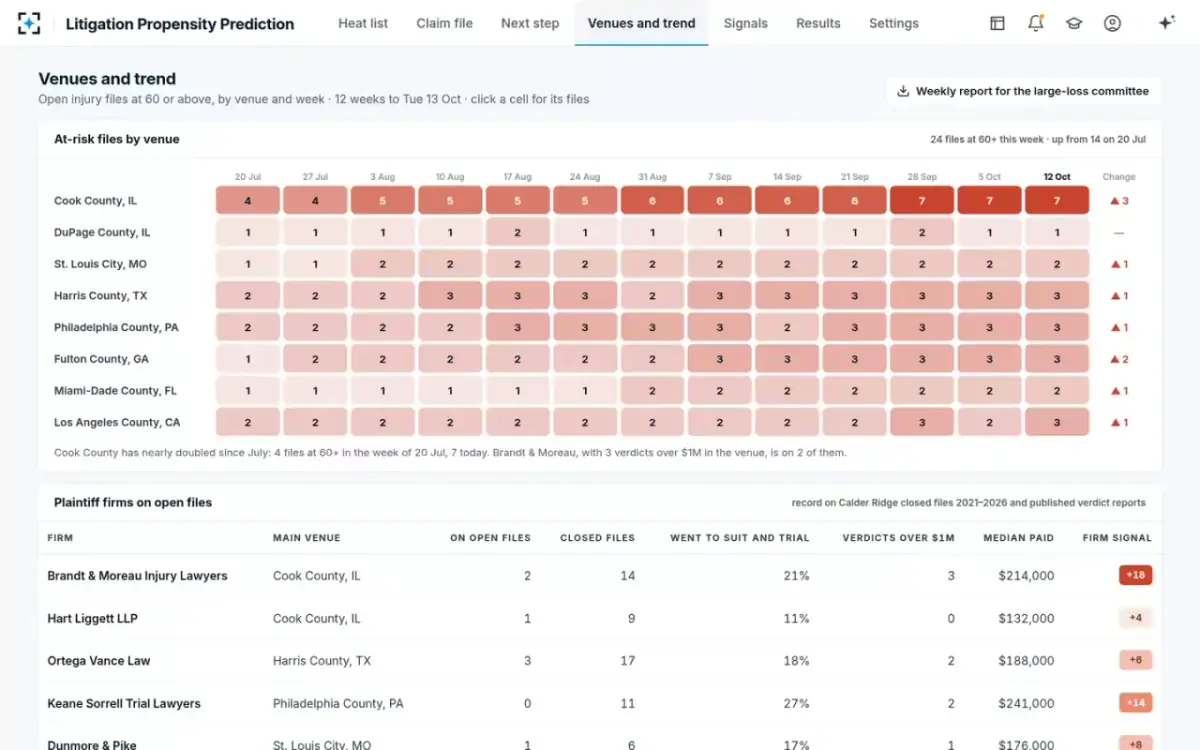
That makes the federal tables a particular slice: larger claims between parties from different states, decided under federal procedure. A litigation manager comparing figures should compare like with like, claims with claims, suits with suits and trials with trials, and should read venue, not just jurisdiction, as the variable that matters. In the fictional sample carrier, at-risk files in Cook County, Illinois, nearly doubled over twelve weeks, from 4 to 7.
Verdicts: why the rare trial still shapes every settlement
Trials are rare, but their outcomes set the range every settlement is negotiated within. The cases that reach a jury are the ones that could not settle, often because liability was disputed or the two sides valued the injury very differently, so published verdicts are a filtered sample of an already rare event.
A suit is common and expensive. A trial is rare and memorable. Planning around the memorable one misprices the common one.
The last national state-court survey shows how ordinary most motor vehicle trials were. In 2005, motor vehicle accident cases accounted for more than 40% of all plaintiff award winners, the median award in those cases was $15,000, and 40% of plaintiff winners in motor vehicle trials were awarded $10,000 or less (Bureau of Justice Statistics). The very large verdicts that drive reserve conversations are the tail of that distribution; how carriers should weigh them is taken up in nuclear verdicts and insurance.
Venue and plaintiff firm are where the trial-level data does belong in a claims decision. A firm that tries cases more often than its peers, in a venue whose juries award more, changes the value of every file it takes, even though most of those files will still settle. That is a profile to read on the file, not a reason to plan every file for trial.
What to measure in your own book: suit rate, warning and outcome
Industry figures show the direction; a carrier's own closed files show how exposed it is. Three measures matter: the share of injury files that were sued, how long before service the signs were in the file, and what happened to files that were acted on early. All three can be computed from closed files before any model is bought.
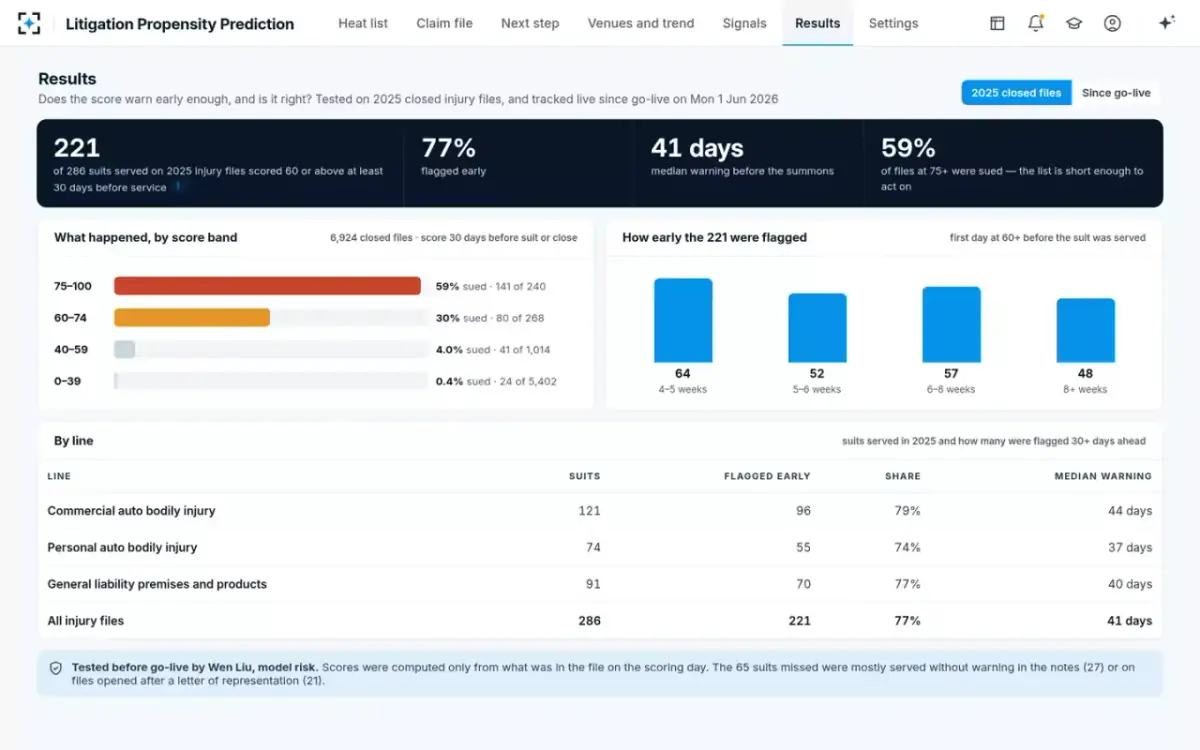
In Litigation Propensity Prediction's test on the fictional sample carrier's 2025 injury book, 286 of 6,924 closed files were sued, 4.1%. Scored as the files stood at the time, 221 of the 286 suits, 77%, had scored 60 or above at least 30 days before service, with a median warning of 41 days, and 59% of files that reached 75 or above were sued.
What happened to closed files by the score they reached
Litigation Propensity Prediction tested on a year of closed files
Where Litigation Propensity Prediction fits against the trend
A litigation trend is acted on one file at a time, and the signs are usually written down before the suit: "my lawyer said" in a call note, an MRI and a surgical consult in the medical updates, a voicemail nobody returned. In a unit with more than a thousand open injury files and supervisors who review diaries by sample, those signs are usually seen when the summons lands. Litigation Propensity Prediction reads every open file each night; in the sample, 1,284 files, 2,318 new notes, letters and medical updates and 212 signals between 02:00 and 02:41.
The score predicts the suit, not the trial, because the suit is the event a claims unit can still change. Each point carries the phrase in the file behind it, any signal can be dismissed with a reason, and the agents never contact a claimant, make an offer or change a reserve: the supervisor decides up to $50,000 and the claims manager above it. Since go-live in the sample, 168 files crossed 75, 97 were taken by a specialist before a lawyer's letter, and 61 resolved without counsel. How a prediction tool differs from court analytics is covered in litigation prediction AI vs litigation analytics, and the whole series starts from Litigation Propensity Prediction.
Where the at-risk files would be filed, and who would bring them
Questions people ask
What percentage of auto injury claims are litigated?
About 18% of auto injury claimants in 2022, up from 10% in 2017, in the Insurance Research Council's data across all coverages. About half of claimants had a lawyer, so most represented claimants were not in litigation.
What percentage of injury lawsuits go to trial?
0.7% of federal motor vehicle injury cases that ended in the year to September 2025 ended during or after a trial, and 0.4% of all federal civil cases. In the last national survey of state courts, for 2005, trials were about 3% of tort, contract and real property dispositions.
Are defense costs rising for insurers?
Not across the industry recently. The Federal Insurance Office reports defense and cost containment expenses at about 4.5% of direct premiums earned from 2015 to 2020, falling to 3.9% in 2023 and 2024, a decline it ties to Florida's 2022 reforms. Per claim, the suit rate is still what drives defense spend.
How many states regulate third-party litigation funding?
At least 21, according to the Federal Insurance Office's 2025 report. Sixteen prohibit the funder from controlling settlement, and only five require the contract's contents to be disclosed to the opposing parties.
How long does a litigated auto injury claim stay open?
Represented bodily injury claimants waited a median of nearly 440 days to closure in the Council's data. Once sued, a federal civil case that ends before pretrial has a median of 18.8 months from filing, and one that ends during trial 30.7 months.
Should a litigation model predict trials or suits?
Suits. Trials are under 1% of federal motor vehicle injury cases, too rare to act on, while a suit adds defense counsel and court deadlines to every file it touches. The useful warning comes while the claimant can still be contacted directly.