Who manages equipment lease end of term is really five separate questions, because no single occupation title covers the work: it spans credit, asset management and customer service, and a lease moving from maturing to resolved passes through all three. Lease End-of-Term Management, Botminds' agentic solution for this work, does the reading, dating, valuing and pricing; the five people below still carry the schedule, and still make every decision that puts money or a notice in front of a customer. The desk below is Harrow Peak Equipment Finance, a fictional sample lessor, and the schedule running through it is Hudson Ledge Aggregates' Schedule 07, nine quarry machines on a New York law lease.
Five people, one schedule, five different weeks
A single maturing lease touches an end-of-term specialist who owns its dates, an asset manager who has to agree to any price below what the lease was booked at, a remarketing manager who decides what happens to equipment that actually comes back, a vice president who watches the whole book's residual position, and a customer service lead who is handed the file the day a customer stops answering. None of the five seats disappears once an agentic review reads the clause, checks usage, values the machines and prices the options; what each person's week is spent on changes, from finding and checking toward deciding.
The same schedule, five different weeks
Today
Tracks every maturing schedule on a spreadsheet, starts the dates and the drafting by hand, and finds out a lease renewed when the customer calls about it.
With agents
Opens a gallery of every schedule maturing in 180 days, each with its dates and its options already priced, and decides what to send.
Still theirs: Approving and sending every reminder and offer — nothing goes out without her.
Today
Prices a buyout from the booked residual curve, because a fresh, sourced value for every machine takes longer than the window allows.
With agents
Sees every machine’s value next to its booked residual, with the comparable sales behind it, before deciding whether a below-book price is right.
Still theirs: Co-approving any price below booked residual — the agents price it, he signs it.
Today
Starts pricing a return only after it physically arrives, with whatever buyers happen to be available that week.
With agents
Gets a plan per returning machine — channel, timing and expected net against book — while the machine is still with the customer.
Still theirs: Approving the channel and the price for every disposal.
Today
Learns how a quarter of maturities actually went only once the numbers are compiled after the fact.
With agents
Watches booked residual against today’s value by equipment category, and how leases are ending, as the quarter runs rather than after it closes.
Still theirs: Approving the largest disposals — more than $250,000 below book comes to her alone.
Today
Learns a customer never saw the renewal notice when that customer calls in, already upset about a bill.
With agents
Is handed the call before it becomes a complaint, with the deadline, the letter sent and the offer already in front of him.
Still theirs: Every live conversation with a customer who has gone quiet.
What the desk is carrying on Monday 12 October
412
schedules maturing in the next 180 days, 3,906 machines, $38.9M of booked residual
9
of the lessor’s own reminders due in 30 days, by New York law or its own policy
61
customer deadlines in the same 30 days, 23 with no reply yet
6
schedules already renewing by clause: $1.38M of rent nobody chose
The end-of-term specialist: who starts every date on the clock
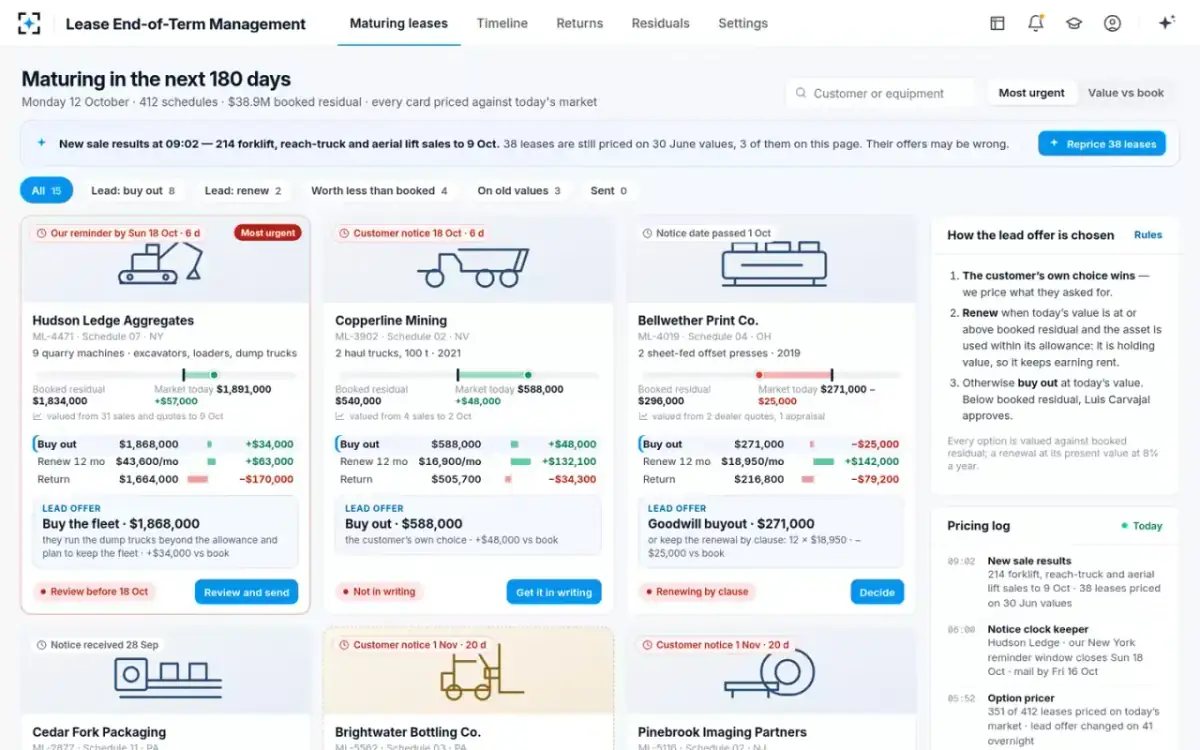
Dana Whitfield owns the dates. On any given morning she is carrying several hundred schedules at different points between maturing and resolved, and her first job every day used to be arithmetic: read each clause, work out the lessee's own notice deadline, work out whether the governing state adds a reminder duty of the lessor's own, and put both on a calendar before either one closes. Across Harrow Peak's book that is 412 schedules maturing within 180 days, representing $38.9 million of booked residual, and Hudson Ledge sits near the top of the list with six days left on its own reminder window.
What changes for Dana is not the decision — she still approves and sends every reminder and offer — it is where her week starts. Instead of opening a spreadsheet and working out which schedules need attention this week, she opens a gallery already sorted by what is closest to a deadline, each one showing the date that matters, the booked residual against today's market, and the buy, renew and return options already priced against it.
Every maturing schedule as a line, with the date that matters first
The asset manager: who has to say yes to a price below book
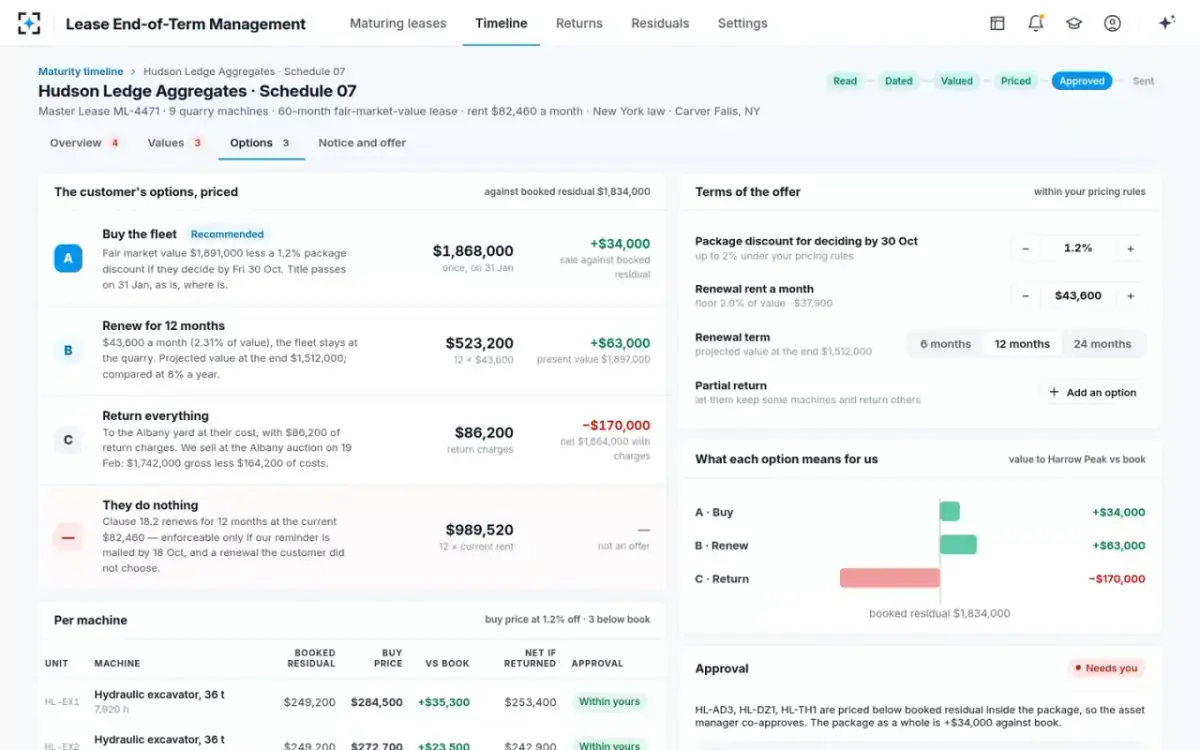
Luis Carvajal's seat exists because a booked residual is a number set years earlier, and the market a machine actually sells into on the day its lease ends can be well above or well below that number. His job is to decide what to do about the below-book cases specifically: three of Hudson Ledge's nine machines, including a high-hour dump truck, price under what the fleet was booked at, and nobody below Luis can approve offering one at that price without his signature.
That co-approval step is not new; what is new is what Luis is approving against. Before, a below-book price was a judgment call made from a residual curve and whatever recent sales the desk happened to know about. Now each value arrives with the comparable sales it rests on, adjusted for hours and region, and never older than 90 days — so Luis is agreeing to a number he can trace to specific sales, not to an estimate. The decision is still his; the evidence behind it is what changed.
The remarketing manager: who decides where a returned machine goes
Priya Natarajan's week starts when a customer is likely to return equipment rather than buy or renew it, and the old version of her job started only once the machine was physically back in a yard, costing money every day it sat there while she worked out where it should go. The new version starts earlier: a remarketing plan — dealer, auction or re-lease, with transport, reconditioning and selling costs and the expected net against book — is ready for her to approve while the machine is still with the customer, because the agents can read the usage and condition data and price a disposal before the equipment moves at all.
A plan per returning machine, ready before the equipment moves
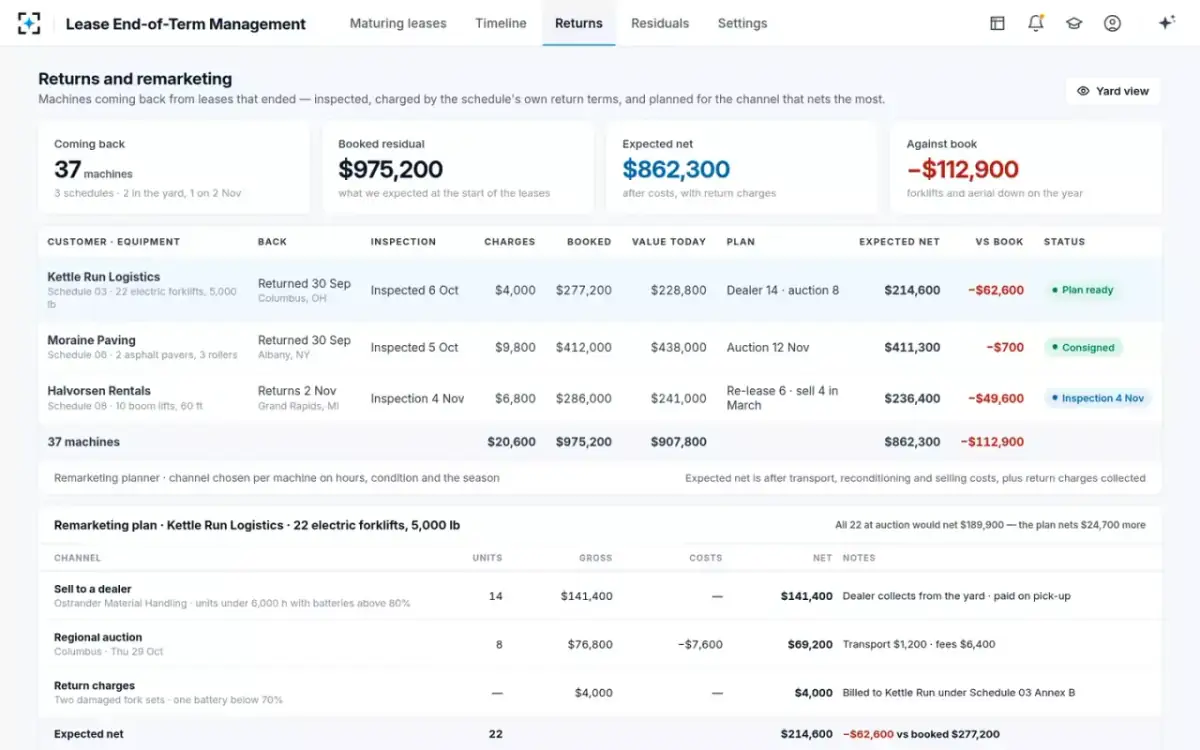
She does not get to skip the decision on anything unusual — a machine whose condition disagrees with its inspection report, or a disposal priced far below book, still needs her eyes specifically — but the mechanical work of chasing transport quotes and auction calendars for every ordinary return no longer competes with that judgment for her week.
The VP of Portfolio and Asset Management: who sees the whole book
Celeste Harmon's job is the book, not any one schedule: how booked residual compares with today's value by equipment category, how leases are actually ending this year against how they were expected to end, and where value is being realized or lost by quarter. Historically that picture arrived after the fact, compiled once a quarter was closed, which meant she was managing a policy from last quarter's results.
Her seat also carries the single largest approval on the desk: any disposal more than $250,000 below its booked residual comes to her alone, above and beyond Luis's below-book sign-off on everything smaller. That threshold is a setting Harrow Peak chose, not a fixed rule, and it stays versioned and visible rather than buried in a policy document nobody reopens. What is different for Celeste is that she can watch the residual position build through the quarter rather than read it afterward, which turns her review from a retrospective into something closer to steering.
The customer service lead: who gets the call when nobody replies
Owen Marsh's seat is the one most exposed to the cost of a missed step elsewhere on the desk. In the old process, his first signal that a renewal reminder had gone unanswered was often the customer calling in confused or angry about a bill for a term they say they never agreed to. By the time that call lands, the lessor is already explaining itself from a weaker position.
What changes for Owen is timing: a customer who has not replied ten days after a letter is handed to him automatically, with the deadline, what was sent and the offer already assembled, so his first conversation with that customer is proactive rather than defensive. The decision of what to say and how to resolve it is still entirely his; the information he needs to have that conversation well no longer has to be assembled live, on the phone, while the customer is already upset.
Where the handoffs actually cost the week
None of the five seats work in isolation, and the real cost in the old process sat less in any one person's desk and more in the handoffs between them — the asset manager waiting on a value before pricing can start, the remarketing manager waiting on a return before a plan can begin, the specialist waiting on both before anything can be sent. An agentic review collapses the sequence of reading, dating, checking, valuing and pricing into a single pass measured in minutes rather than the days a manual handoff chain used to take, while leaving the decisions themselves exactly where they were.
Seven steps, two of them a person's alone
Agent
Lease clause readerReads the master lease and schedule for the end-of-term terms and the governing law.
Agent
Usage and condition checkerReads hour meters and the inspection report against the return terms.
Agent
Asset valuerValues each machine from recent comparable sales.
Agent
Option pricerPrices buy, renew and return against booked residual.
Agent
Notice and offer drafterDrafts the reminder and the option letter in the clause’s own words.
A person decides
Asset manager co-approvalLuis Carvajal signs off any price below booked residual before it goes further.
Never: The agents never offer below book without this signature.
A person decides
Specialist approval and sendDana Whitfield approves what is being sent and sends it.
Never: Nothing reaches a customer without this step.
Where the hours on one schedule go: 20 by hand, 2.7 with the agents reading first
By hand, about 20 hours
- Reading the clause and return annex · 15%
- Dates · 5%
- Hours and condition · 20%
- Valuing · 30%
- Pricing · 20%
- Letters · 10%
With the agents, about 2.7 hours
- Reading the clause and return annex · 19%
- Dates · 7%
- Hours and condition · 18%
- Valuing · 19%
- Pricing · 19%
- Letters · 18%
Who on the desk must say yes, and to what
| Decision | Who | Set in the sample rules |
|---|---|---|
| Any reminder or offer reaching a customer | End-of-term specialist approves and sends | Always |
| Any machine priced below booked residual | Asset manager co-approves | Luis Carvajal, or Celeste Harmon |
| A disposal more than a set amount below book | VP Portfolio and Asset Management | $250,000 (options $100,000 or $500,000) |
| The channel and price for each returned machine | Remarketing manager | Always |
| A customer silent after the lessor’s letter | Customer service lead takes the call | After 10 days (options 7 or 14) |
| An ambiguous clause | Legal, with the page | Always |
The reason the five seats stay in place is the same reason a bank's own model governance keeps people over any model that recommends a dollar figure. The banking agencies' guidance on model risk puts the principle plainly:
"Sound model risk management also involves “effective challenge,” which refers to the critical analysis conducted by objective experts who evaluate model risk and effect appropriate changes throughout the model lifecycle, from model development to ongoing monitoring," the Federal Reserve's SR 26-2 guidance states. An asset valuation or an option price is exactly this kind of model output, and the desk's five seats are where that challenge happens on every schedule, not as an annual audit exercise.
What changes for each seat once the dates and the values arrive already priced
Across all five roles, the shift is the same shape even though the content of each job differs: less of the week goes to finding and compiling facts a clause, a meter reading or a sale record already contains, and more of it goes to the judgment each seat exists to make — whether a price is right, whether a channel is right, whether a customer's silence needs a call. The underlying accounting questions each seat eventually answers do not change. A purchase option, for instance, is still tested the same way it always was under lease accounting:
"At the commencement date, an entity shall assess an option to purchase the underlying asset on the same basis as an option to extend or not to terminate a lease," FASB's ASU 2016-02 states, and nothing about an agentic review changes which test applies, only how quickly the facts that test needs arrive in front of the person applying it.
Three options, each priced against booked residual, for Dana and Luis to decide between
The standards that govern how an organization should define these human roles in the first place increasingly say so explicitly: the National Institute of Standards and Technology's AI Risk Management Framework calls for "policies and procedures ... in place to define and differentiate roles and responsibilities for human-AI configurations and oversight of AI systems" (NIST AI RMF 1.0), which is a close description of what the desk above already does — five named roles, each with a decision an agent is never allowed to make alone. To see the same schedule move through all five seats in one story, read Lease End-of-Term Management; for what each of the seven agents behind those seats does and does not do, see seven agents review a lease end of term.
Questions people ask
What does an end-of-term specialist do all day?
Tracks every maturing schedule's dates, reviews the options priced against each one, and decides what to send and when. The specialist approves and sends every reminder and offer; nothing reaches a customer without that step, whether the pricing behind it was assembled by hand or by an agentic review.
Who approves a price below the booked residual on a lease?
The asset manager, in the desk described here. Any machine priced below what the lease was booked at needs that second signature before it can be offered, and disposals more than $250,000 below book go further still, to the vice president of portfolio and asset management.
What does an asset manager do in equipment finance?
Values equipment against its booked residual and decides, or co-approves, what to do when the market says a machine is worth less than the lease assumed. The judgment is the asset manager's; what changes with an agentic review is that the value arrives with the comparable sales behind it already shown, rather than estimated from a residual curve alone.
Who decides whether to buy out, renew or return equipment?
The customer decides which option to take; the lessor's end-of-term specialist decides which option to lead with in the offer, informed by how each one prices against booked residual. Below-book pricing and large disposals carry their own additional approvals before an offer goes out.
What happens when a customer never replies to a renewal notice?
The file is handed to the customer service lead after a set number of days of silence — ten days in the desk described here — with the deadline, what was already sent, and the offer in front of them, so the first live conversation starts from a position of knowing exactly where things stand rather than reconstructing it on the call.
How many people touch one maturing lease?
Five on the desk described here, each with a different decision: the end-of-term specialist who sends every notice, the asset manager who co-approves below-book pricing, the remarketing manager who approves disposal plans, the vice president who approves the largest disposals, and the customer service lead who handles a customer who has gone quiet.