AI agents for equipment lease end of term management divide one piece of work the same way a careful team already would: reading the contract, turning its clauses into dates, checking usage against the return terms, valuing the equipment, pricing the customer's options, drafting the notices, and planning what happens to anything that comes back. Lease End-of-Term Management, Botminds' agentic solution for this work, runs all seven of those steps as named agents, each with its own limits, on Hudson Ledge Aggregates' Schedule 07 — a nine-machine quarry fleet in the fictional sample portfolio — in one minute and thirty-two seconds. What makes that pace trustworthy is not the speed; it is what each agent is built to never do on its own.
Seven agents, one maturing schedule
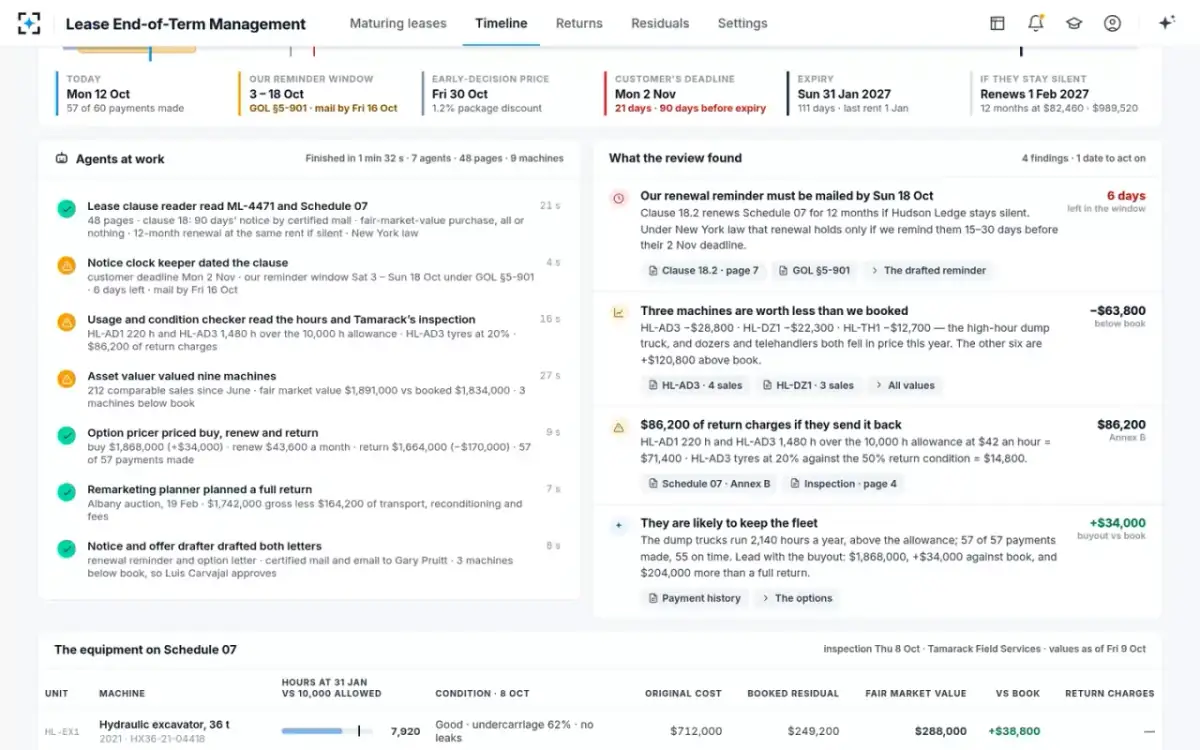
Run "end-of-term review" on a schedule and seven agents work through it in sequence, each reading what the one before it produced. The lease clause reader opens the master lease and the schedule; the notice clock keeper turns its clause into dates; the usage and condition checker reads the hour meters and the latest inspection; the asset valuer prices each machine from recent sales; the option pricer turns those values into a buy, renew and return comparison against booked residual; the remarketing planner plans for anything that comes back; and the notice and offer drafter writes the letters. The clock keeper then keeps watching the dates after the review is done. On the sample fleet this reads a 48-page lease file, dates one clause, values nine machines and prices every option in 1 minute 32 seconds.
Where the 1 minute 32 seconds went on Schedule 07
- Lease clause reader, 48 pages21 s
- Notice clock keeper4 s
- Usage and condition checker16 s
- Asset valuer, 212 sales27 s
- Option pricer9 s
- Remarketing planner7 s
- Notice and offer drafter8 s
Seven agents, and the two points a person decides
Agent
Lease clause readerReads the master lease and schedule for notice periods, purchase options and governing law.
Never: Interpreting an ambiguous clause.
Agent
Notice clock keeperTurns clauses into the customer’s deadline and any reminder the law requires of the lessor.
Never: Sending a notice.
Agent
Usage and condition checkerReads hour meters and the inspection against the return terms.
Never: Charging beyond the schedule’s own rates.
Agent
Asset valuerValues each machine from comparable sales, hours, condition and region.
Never: Using a value older than 90 days.
Agent
Option pricerPrices buy, renew and return against booked residual.
Never: Committing a price, or offering below book alone.
Agent
Notice and offer drafterDrafts the reminder and the option letter in the lease’s own words.
Never: Sending what it drafts.
Agent
Remarketing plannerPlans channel, timing and expected net for anything returning.
Never: Committing a sale.
A person decides
Asset manager co-approvalSigns off any price below booked residual.
Never: Skipped on any below-book price, however small.
A person decides
Specialist approval and sendApproves exactly what is being sent, and sends it.
Never: Nothing reaches a customer without this step.
The lease clause reader: what it extracts, and what it refuses to interpret
The first agent's job is narrow by design: read the master lease, the schedule and any amendments, and extract the expiry date, the notice period and how notice must be given, the purchase option type, what happens if the lessee stays silent, the return conditions, the hours allowance and the governing law. On Schedule 07 that means pulling clause 18's dates and the fair-market-value purchase option language out of 48 pages, each field cited to the page it came from so a person can check it rather than take it on faith.
What it will not do is resolve an ambiguous clause on its own authority. Where a provision could reasonably be read two ways — whether a given improvement counts toward the return condition, say — the agent sends it to legal with the page, rather than picking the reading that is more convenient to automate. A contract's language is a legal fact, not a probability the agent is asked to estimate.
The notice clock keeper: why it never sends a notice itself
Once the clause reader has the dates, the notice clock keeper turns them into a working calendar: the lessee's own deadline, any reminder window the governing law adds for the lessor, the lessor's own policy letters at 180 and 120 days before expiry, and the final expiry itself, watching for a reply once anything goes out. On a New York law schedule that means counting the §5-901 reminder window backward from the lessee's own deadline, not from expiry — the distinction covered in full here.
It never sends what it calculates. A date that has been worked out correctly is still only a date; deciding what to do as a window closes — send the reminder now, escalate, wait for a reply a few more days — stays with the end-of-term specialist. The agent's only obligation when a window is closing is to make sure a person sees it; it never lets a date pass silently, and it never substitutes its own judgment for that person's decision about timing.
The asset valuer: what 'never older than 90 days' actually enforces
The asset valuer prices each machine from auction results, dealer quotes and condition and region adjustments, and shows every comparable sale it relied on. On Schedule 07's high-hour dump truck, that is a median of four sales, adjusted down for hours above the comparables and up for the New York quarry market the fleet sells into — a worked value a reviewer can trace sale by sale, not a black-box number.
The 90-day freshness limit is the rule that keeps that value honest as the market moves. A value is a snapshot, and a snapshot taken too long ago is a claim about a market that may no longer exist. Rather than let a stale value sit in an offer indefinitely, the agent refuses to use one past its freshness window, and above a set appraisal limit it asks for an independent appraisal rather than extending its own estimate past where comparable sales can support it. How to judge whether an AI equipment valuation is right goes further into what to test before relying on one.
The option pricer: why it cannot offer below book alone
The option pricer takes the asset valuer's numbers and the lease's own terms and prices three outcomes against booked residual: a buyout at fair market value less any package discount the lessor's rules allow, a renewal compared at the discount rate, and a return net of remarketing and the return charges the schedule itself sets. On the sample fleet, that produces a buyout at $1,868,000, a twelve-month renewal at $43,600 a month, and a return netting $1,664,000 after $86,200 of return charges — three real numbers, not a single recommendation asserted without its arithmetic shown.
What it cannot do is put any of those numbers in front of a customer when the price sits below what the lease was booked at, without the asset manager's signature, and it never commits any price at all — the end-of-term specialist is the one who sends. The limit exists because a below-book price has a real cost to the lessor the moment it is offered, and that cost belongs to a named person's judgment, not to the agent that calculated it.
What does it mean for an agent to 'never' do something?
Each agent above carries at least one line that reads "never," and the word is doing real work: it names a boundary the agent is built not to cross regardless of how confident its own output is, not a target it usually meets. The asset valuer can be extremely confident in a value and still refuse to use it once it passes 90 days old; the option pricer can calculate a below-book price with full working and still refuse to let it reach a customer without a second signature.
What each agent does, and what it may never do
| Agent | What it does | What it never does |
|---|---|---|
| Lease clause reader | DoesReads every master lease, schedule and amendment for its end-of-term terms. | NeverNever interprets an ambiguous clause — sends it to legal with the page. |
| Notice clock keeper | DoesTurns clauses into dates and watches for replies. | NeverNever sends a notice itself, and never lets a date pass without telling a person. |
| Usage and condition checker | DoesReads hour meters and inspection reports against the return conditions. | NeverNever charges beyond the rates the schedule itself sets. |
| Asset valuer | DoesValues each machine from comparable sales, hours, condition and region. | NeverNever uses a value older than 90 days, and shows every comparable it used. |
| Option pricer | DoesPrices buy, renew and return against booked residual. | NeverNever offers below book without the asset manager, and never commits a price. |
| Notice and offer drafter | DoesDrafts the reminder and the option letter in the contract’s own words. | NeverNever sends — the specialist approves and sends. |
| Remarketing planner | DoesPlans each return: channel, timing, transport and expected net. | NeverNever commits a sale; disposals more than $250,000 below book go to the VP. |
Standards for AI governance increasingly expect exactly this kind of defined boundary rather than a general assurance of accuracy. NIST's AI Risk Management Framework names the discipline directly as its own control: "MAP 3.5: Processes for human oversight are defined, assessed, and documented in accordance with organizational policies from the GOVERN function" (NIST AI RMF 1.0). Each agent's "never" line is that process made specific to one piece of work rather than left as a general policy statement nobody can check against a particular schedule.
Where a person has to decide, every time
Two decisions never move to an agent, however routine a schedule looks. The asset manager co-approves every price below booked residual, without exception for size — on Schedule 07, three machines below book inside the buyout package meant Luis Carvajal signed off before anything was offered. And the end-of-term specialist approves and sends every reminder and offer; the drafter writes in the contract's own words, but nothing leaves the desk without a named person choosing to send exactly that letter, on exactly that day.
What an agent proposes, and what a person still decides
What the agents produce: Extracted fields, each cited to its page.
What a person decides: Whether an ambiguous clause needs a legal read before relying on it.
What the agents produce: A calendar of every deadline and reminder window.
What a person decides: What to do as a window closes — send, escalate or wait.
What the agents produce: A price per machine, with every comparable shown.
What a person decides: Whether a below-book price should be offered at all.
What the agents produce: A reminder and an option letter, drafted and ready.
What a person decides: Whether to send them, and exactly when.
What the agents produce: A remarketing plan with a channel and expected net.
What a person decides: Which channel to approve, and at what price.
Some of what governs the end of a lease was fixed when it was signed, and no agent at lease end can change it. For an advance ruling on a leveraged lease, the IRS requires that "No member of the Lessee Group may have a contractual right to purchase the property from the lessor at a price less than its fair market value at the time the right is exercised" (Rev. Proc. 2001-28): a rule about the rights written into the deal, which the clause reader can find and cite but a person must interpret. The same is true of what counts as a lease at all under the Uniform Commercial Code — "'Finance lease' means a lease with respect to which: (i) the lessor does not select, manufacture, or supply the goods...” (UCC §2A-103) — a classification question answered by the deal's structure, not by anything the agents compute after the fact.
What changes when seven agents run in under two minutes instead of a week
Reading a 48-page lease file by hand, checking nine machines' hours against an inspection report, pricing each against current sales and drafting two letters is about twenty working hours on Botminds' estimate for a multi-machine schedule, spread across days for a specialist working between other schedules. Run as seven agents, the same work finishes in one minute and thirty-two seconds, and the person's remaining work, checking and approving, is estimated at under three hours. The review on Schedule 07 found four things in that pass: the lessor's own reminder had to be mailed by 18 October, six days away; three machines were worth $63,800 less than booked; $86,200 of return charges would apply if the fleet came back; and the customer was likely to keep the fleet, because its dump trucks run 2,140 hours a year, above the allowance, and it has made all 57 payments, 55 on time.
Where the hours go on one maturing schedule, by hand and with the agents
| Task | By hand | With the agents | What the person still does |
|---|---|---|---|
| Finding and reading the end-of-term clause and return annex | 3 h | 0.5 h | Checks the cited pages; sends anything ambiguous to legal |
| Working out the customer’s deadline and the lessor’s reminder window | 1 h | 0.2 h | Confirms the governing law and the dates |
| Checking hours and condition against the return terms | 4 h | 0.5 h | Reads the inspection exceptions |
| Valuing each machine from recent sales | 6 h | 0.5 h | Questions any comparable or adjustment that looks wrong |
| Pricing buyout, renewal and return against book | 4 h | 0.5 h | Chooses the lead offer; gets co-approval below book |
| Drafting the reminder and the option letter | 2 h | 0.5 h | Approves and sends |
| Total | 20 h | 2.7 h |
What one review pass found, each finding cited
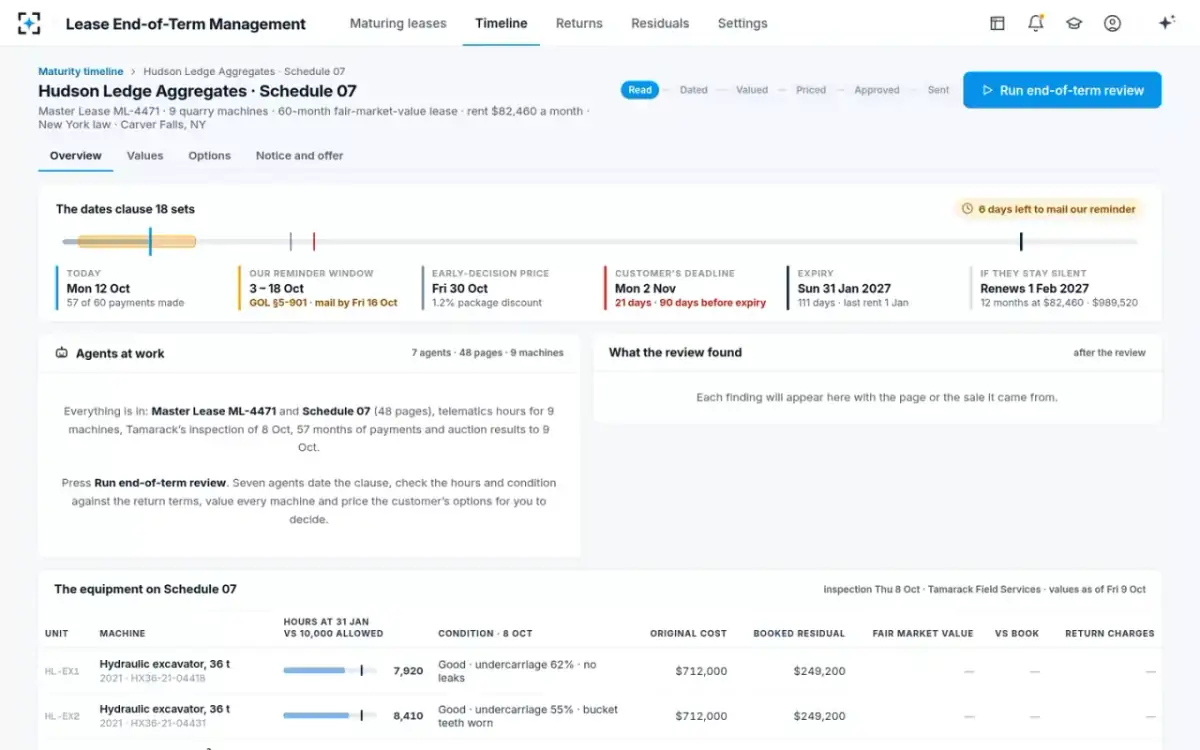
The time saved is real, but it is not the argument for trusting the review; the limits are. A fast answer that skipped the asset manager's signature on a below-book price, or let a stale value stand past 90 days, would be faster and less trustworthy. The seven agents above are fast because each one does one narrow job well and hands off exactly where its "never" line says it must — which is also why the specialist still opens the schedule's own dates strip before deciding what to send.
The schedule's own dates, open alongside the review's findings
To see the same seven agents against the five people who still decide, read who manages a maturing equipment lease; to see the asset valuer's numbers tested against your own closed files, see how accurate is AI equipment valuation at lease end. To see the seven agents run on your own leases, start from Lease End-of-Term Management.
Questions people ask
How does an AI agent read a lease contract?
The lease clause reader extracts the end-of-term terms — expiry, notice period, purchase option, renewal, return conditions and governing law — from a master lease and schedule, citing the page each field came from. It never interprets an ambiguous clause itself; an unclear provision goes to legal with the page it appears on.
Can an AI agent send a renewal notice on its own?
No. The notice and offer drafter writes the reminder and the option letter, but the end-of-term specialist approves exactly what is being sent and sends it. Nothing reaches a customer without that approval, whatever the agents have drafted or calculated.
What is the difference between an agent drafting and a person approving?
Drafting produces a specific letter, value or price with its working shown; approving is a named person deciding whether that specific output is correct and should go out. The agents in this review never skip the second step — a below-book price needs the asset manager's signature, and every notice needs the specialist's.
What happens if a lease clause is ambiguous?
The lease clause reader sends it to legal, with the page the ambiguity appears on, rather than choosing an interpretation on its own. The rest of the review can proceed on the clauses that are clear while the ambiguous one is resolved separately.
Can an agent price a buyout below the booked residual?
It can calculate one, with the comparable sales behind it, but it cannot offer it to a customer without the asset manager co-approving first. The limit applies to every below-book price, regardless of size.
How many agents does it take to review one lease?
Seven in this solution: a lease clause reader, notice clock keeper, usage and condition checker, asset valuer, option pricer, notice and offer drafter, and remarketing planner, each with its own stated limits, plus two points where a person decides before anything is sent.