The cost of missing an equipment lease renewal notice deadline is usually framed as the customer's risk, and where no statute adds a duty it is: a lessee who misses its own deadline lets the lease renew on the clause's terms. In New York, and in Wisconsin for business equipment, the deadline that actually puts a lessor's rent and residual at risk is the lessor's own, because the renewal-on-silence clause itself does not take effect unless the lessor sent its required reminder first. Lease End-of-Term Management, Botminds' agentic solution for lease end-of-term work, puts every schedule's reminder window on one calendar for exactly this reason. The figures below come from Harrow Peak Equipment Finance, a fictional sample lessor the solution's sample portfolio is built around.
What one quarter's missed windows already look like, on a sample book
$1.38M
of rent nobody chose — six schedules renewing by clause now, after the customer missed its own date
47schedules
renewed by clause from January to September, every one after the customer’s own date passed in silence
94%
of booked residual realised in Q3 2025, before every option was priced from current values
The deadline that actually puts your rent at risk is yours
A lessor's attention naturally goes to the deadline it is waiting on the customer to meet, because that is the date on which rent either keeps coming or the schedule needs a different plan. In a reminder-duty state, that is the wrong deadline to watch alone. New York's General Obligations Law §5-901 makes a lease's renewal-on-silence provision inoperative unless the lessor sent its own written reminder 15 to 30 days before the lessee's own deadline — a date set by the lessor's own clock, not the customer's conduct, and the one most likely to be missing from a spreadsheet built to track only expiry.
What a renewal 'by clause' actually means for the book
"Renewed by clause" describes a schedule where nobody, neither the customer nor the lessor, affirmatively chose the outcome booked for the next term; the silence provision simply ran its course. On Harrow Peak's sample book, forty-seven schedules renewed this way between January and September, 4% of the 1,184 that ended, and six more are renewing by clause right now: $1.38 million of rent on those six alone that nobody priced against where the market sits. The sample lessor sent two letters on every one of the 47, so its reminders were not the problem; a lessor that cannot say the same about its own renewals by clause carries the compliance exposure described above as well.
How 1,184 sample leases ended this year: 4% by nobody's choice
January–September 2026
- Bought, 545 · 46%
- Renewed by agreement, 249 · 21%
- Returned, 343 · 29%
- Renewed by clause, 47 · 4%
Why a spreadsheet is the wrong tool for a 15-to-30-day window
A spreadsheet can hold a date; the problem is what has to happen around that date without anyone noticing it slip. A fifteen-to-thirty-day window, counted backward from a lessee deadline that itself depends on reading a specific clause correctly, is two calculations and a lookup away from the single expiry date most tracking sheets are built to hold — and every added calculation in a manually maintained sheet is a chance for a row to go stale, a formula to be copied wrong, or a date to be entered against the wrong schedule.
Research on spreadsheet reliability gives this problem a number, even though it was not built to describe lease administration: across fourteen laboratory studies in which 967 people built spreadsheets alone, "the average across these studies is a cell error rate of 3.9%", Raymond Panko reported to the European Spreadsheet Risks Interest Group in 2015 (EuSpRIG proceedings). Applied illustratively to a tracking sheet carrying a few hundred cells of dates, rates and calculated windows across a portfolio the size of Harrow Peak's, that rate implies several cells are wrong at any given time — and a tracking sheet does not announce which ones.
A 3.9% cell error rate, read against a portfolio's own tracking sheet (illustrative)
How much does one missed reminder cost, in rent and in residual?
A missed reminder's cost has two parts, and they land at different times. The near-term part is the rent itself: Schedule 07's twelve-month renewal, if it rolled over by clause rather than being priced, would run $82,460 a month, $989,520 for the year — a number that is either the right outcome, if a renewal was genuinely the best option, or money the lessor never tested against a buyout or return. The second part is the residual gap: a renewal struck without re-pricing against current fair market value locks in whatever the booked residual happened to be, rather than what the market will actually pay, and on a quarter where realized value ran at 94% of booked residual before every option was priced from current data, that gap is measured in real dollars across the book, not one schedule.
What one missed window can cost, as a sum, not a single number
A year of rent, renewed by clause
$82,460 × 12 = $989,520
Collected regardless of whether a renewal was actually the best option for this schedule.
The residual gap
Booked residual − today’s fair market value
What a buyout or a repriced renewal could have captured instead, had the options been priced before the window closed.
The compliance exposure
Rent collected against an inoperative clause
In a reminder-duty state, if the lessor’s own reminder never went out inside its window.
What happens to a renewal if it turns out not to be enforceable?
General Obligations Law §5-901 states its effect plainly where it applies: a renewal-on-silence provision "shall not be operative" unless the lessor's reminder went out inside its window. Wisconsin's §134.49 is blunter still: the renewal provision "is not enforceable against the customer and the contract will terminate at the end of the current contract term", and a customer who declined and was refused can sue for twice its damages, or twice one periodic payment or $1,000 if less, plus attorney fees (§134.49(3), (6)). Neither statute erases the lease or the rent already billed under the original term; both leave the renewed term open to challenge, and the cost is the weaker position a lessor finds itself in once a lessee's counsel reads the clause against the statute.
The timing can make the exposure worse. A lessee who questions a renewal in its first month leaves both sides an easy way out: negotiate the term afresh. A lessee who raises it in month ten of a twelve-month term, after paying rent for most of the year, raises a harder question, because unwinding that much of a completed term is messier than agreeing new terms up front would have been. Nothing about the statute changes with time; what changes is how much has already happened that both sides now have to account for.
Pricing the gap between booked residual and what the market pays
Booked residual is a number set at the start of a lease, built from assumptions about depreciation and resale that may or may not hold years later. Fair market value at the point of renewal or buyout is whatever current comparable sales actually say the equipment is worth. When a schedule renews by clause instead of being priced, that gap never gets captured either way — not as extra rent reflecting a machine that held its value better than expected, and not as a fair discount reflecting one that depreciated faster. It simply goes unpriced. On Harrow Peak's sample book, value realised ran at 94% of booked residual in the third quarter of 2025, and climbed to 104% by the third quarter of 2026, the first quarter in which every option was priced from current values before the customer's date.
Value realised against booked residual, by quarter, on the sample book
The gap runs in both directions, which is why pricing it matters more than assuming it always favors one side. A machine that has held its value better than its booked residual assumed is a renewal a lessor is underpricing by rolling it over at the old number; a machine that has depreciated faster is a renewal a lessor is overpricing, inviting a buyout the customer will happily decline while the lessor keeps equipment worth less than its books say. Both outcomes trace back to the same cause: nobody repriced the schedule against what the market actually says today, because the window to do so closed in silence rather than by a decision.
What changes when every reminder window sits on one calendar instead of many spreadsheets
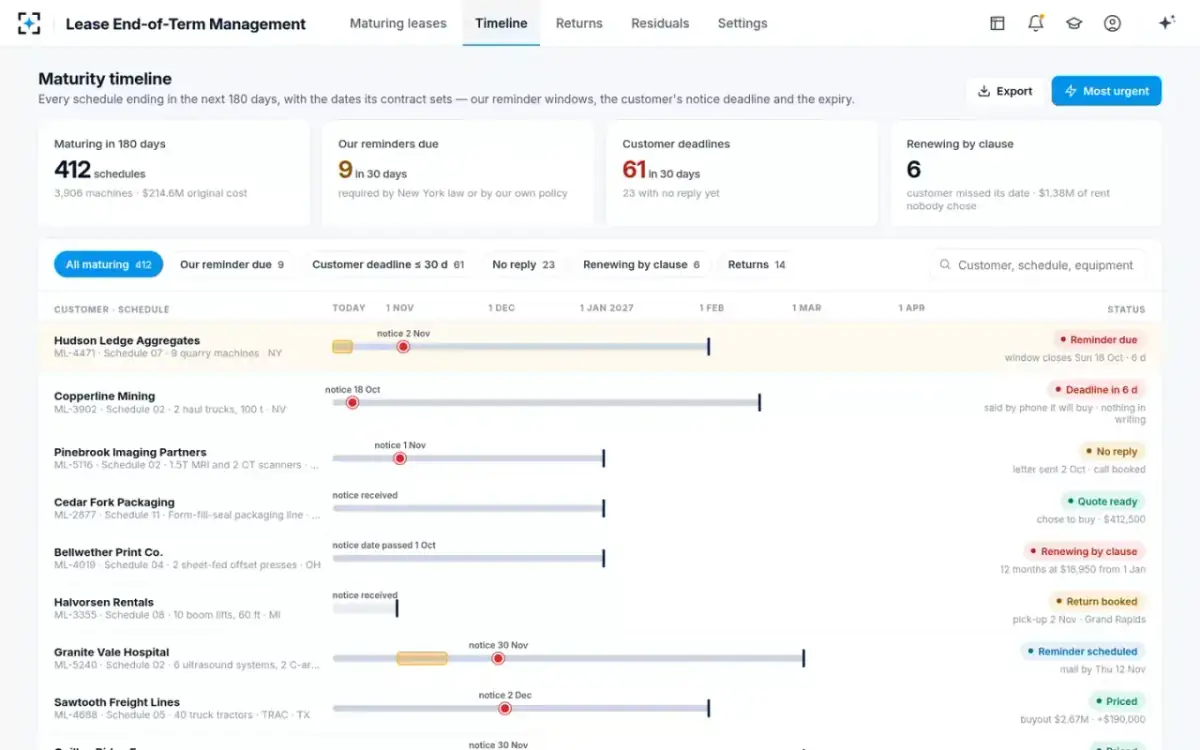
Inside the solution, the notice clock keeper agent reads each schedule's clause and governing law, calculates both the lessee's own deadline and any reminder window the law adds for the lessor, and places both on a single timeline the end-of-term specialist checks every morning rather than reconstructing from a tracking sheet. On the sample book, that timeline shows nine of the lessor's own reminders due inside thirty days, sixty-one customer deadlines in the same window, and the six schedules already renewing by clause — visible as a group rather than discovered one at a time when a customer calls.
Every window on one timeline, with what has already renewed by clause called out
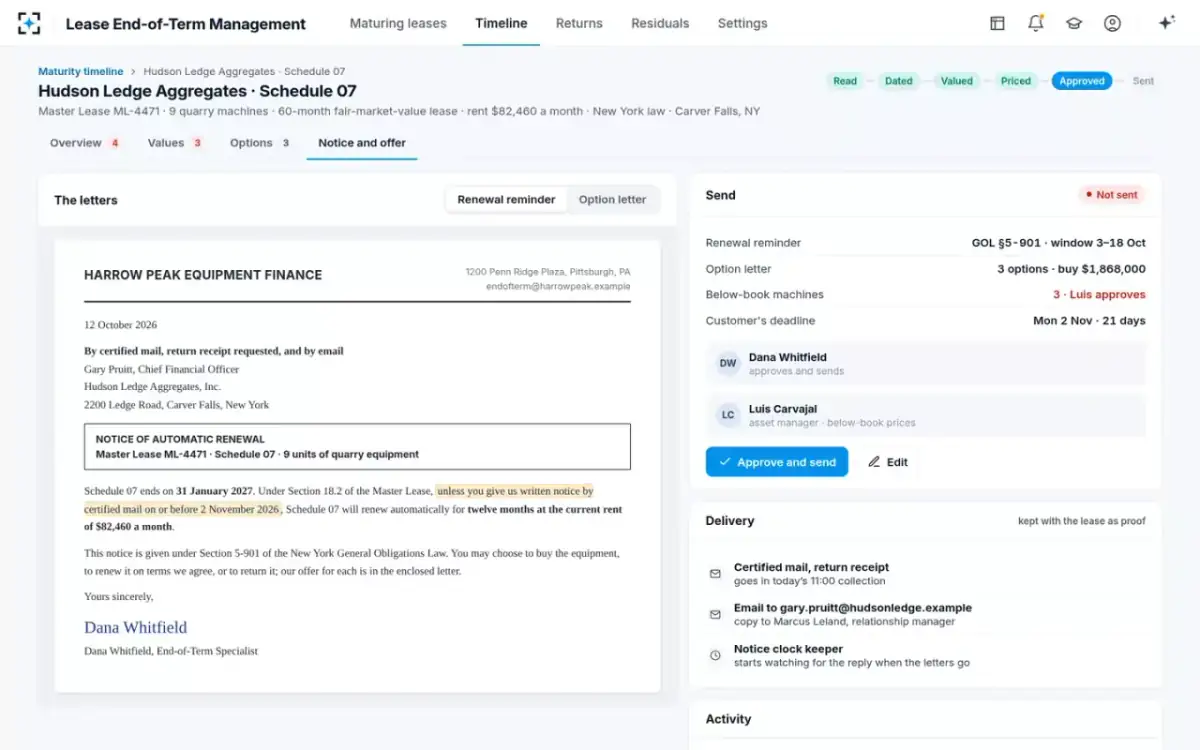
A reminder, drafted and dated against the window it has to meet
None of this changes the underlying tests a schedule has to satisfy once a renewal is properly in effect — what counts as a lease at all is still the Uniform Commercial Code's question, “a transfer of the right to possession and use of goods for a term in return for consideration” (UCC §2A-103) — or how a purchase option is tested for accounting purposes, where "optional payments to purchase the underlying asset should be included in the measurement of lease assets and lease liabilities only if the lessee is reasonably certain to exercise that purchase option" (FASB ASU 2016-02). What changes is whether a lessor ever has to find out the hard way that a clause it relied on never took effect.
How to measure what your own portfolio is losing to this today
A lessor does not need new software to take the first measurement. Pull every schedule that renewed in the last twelve months, and for each one answer three questions: did it renew by clause or by an affirmative decision; if by clause, was the lessor's own reminder, where the governing state requires one, sent and dated inside its window; and was the renewal rent or buyout priced against current fair market value or against the original booked residual. The count of schedules that fail any of the three is the size of the exposure described on this page, on your own book rather than a sample one. Equipment lease renewal notice laws, state by state sets out which governing-law states carry a reminder duty like New York's, and Lease End-of-Term Management shows how the same check runs automatically across a whole portfolio.
Questions people ask
What happens if a lessor misses its own renewal-reminder deadline?
In a state with a statute shaped like New York's, the renewal-on-silence provision the lease relies on does not take legal effect. The lease does not disappear and rent already billed is not automatically refunded, but the specific renewal a lessor is counting on is open to challenge if the lessee disputes it.
Does a missed reminder void the renewal, or just delay it?
Neither, precisely: the statute says the renewal provision "shall not be operative," which means it never took effect on this cycle rather than that it is voided after the fact or merely postponed. The practical consequence is a renewal a lessor cannot assert as settled contract right.
How much rent is at risk when a renewal is forced by clause instead of chosen?
The full renewal term's rent is collected either way; what is at risk is whether that rent, and the residual position behind it, was ever tested against what the market would actually pay. On a fictional sample schedule here, a twelve-month renewal by clause runs $989,520 in rent nobody chose over a priced buyout or renewal.
Is a spreadsheet enough to track reminder windows across hundreds of leases?
It can hold the dates, but every added calculation — counting a window backward from a lessee deadline that itself depends on reading a clause correctly — is another chance for an error research on spreadsheet reliability puts at an average 3.9% cell error rate. Applied to a few hundred schedules, that is a meaningful number of wrong cells at any given time, none of them flagged by the sheet itself.
What does it cost to unwind a lease that renewed by clause instead of being repriced?
There is no fixed figure; the cost is the gap between what the renewal actually charged and what a buyout or a repriced renewal would have captured, plus whatever negotiating position a lessor loses if the renewal's own enforceability is challenged. Measuring it starts with pulling the last twelve months of renewals and checking how many were priced against current values rather than the original booked residual.
Who is liable if a reminder goes out late?
The statute places the reminder duty on the lessor, so a late or missing reminder is the lessor's own exposure, not the lessee's. Nothing in General Obligations Law §5-901 shifts that responsibility to a servicer, an agent or any other party the lessor may have relied on to send it.