Equipment lease automatic renewal notice law is not one rule; it is a question a lessor has to ask state by state, because some states write the law backwards from how most lessors assume it works. The common assumption is that an automatic-renewal clause protects the lessor: the lessee stays silent, the term rolls over, the rent keeps coming. In New York, a personal-property lease's renewal-on-silence clause does not take effect at all unless the lessor sends its own written reminder, inside a narrow window, calling the lessee's attention to the clause; Wisconsin does the same for business equipment leases, with a wider window and a longer list of what the reminder must say. Lease End-of-Term Management is Botminds' agentic solution for the work of taking an equipment lease from the months before expiry to its outcome, including dating that lessor-side reminder correctly under the law that governs each lease.
The examples below use the solution's fictional sample portfolio: Harrow Peak Equipment Finance, and Hudson Ledge Aggregates' Schedule 07, a nine-machine quarry fleet on a New York law lease. The sourced law and research are linked where they appear.
The notice nobody expects to miss is the lessor's own
Every equipment lease with an automatic-renewal clause sets at least one deadline for the lessee: give notice by a certain date, or the lease rolls over. Lessors track that date closely, because it is the date that keeps the rent coming. What a reminder-duty state adds is a second deadline, running the other way, that belongs to the lessor — and it is the one a portfolio desk is least likely to have on its calendar, because nothing about reading the lease's own renewal clause suggests the lessor owes the lessee anything before that clause can work.
New York's General Obligations Law §5-901 is the shortest statute of this kind, and it matters beyond New York because a lease's governing-law clause, not the location of the equipment, decides whether it applies. The statute does not touch the lessee's own deadline. It adds a condition precedent to the clause itself: unless the lessor has already sent the required reminder, the renewal-on-silence provision the parties wrote into the lease is not operative. A lessor who tracks only the lessee's deadline is tracking the wrong half of the clock.
New York: General Obligations Law §5-901 and the 15-to-30-day window
The statute's own words are specific about both the window and what the reminder has to say:
"No provision of a lease of any personal property which states that the term thereof shall be deemed renewed for a specified additional period unless the lessee gives notice to the lessor of his intention to release the property at the expiration of such term, shall be operative unless the lessor, at least fifteen days and not more than thirty days previous to the time specified for the furnishing of such notice to him, shall give to the lessee written notice, served personally or by mail, calling the attention of the lessee to the existence of such provision in the lease."
N.Y. General Obligations Law §5-901
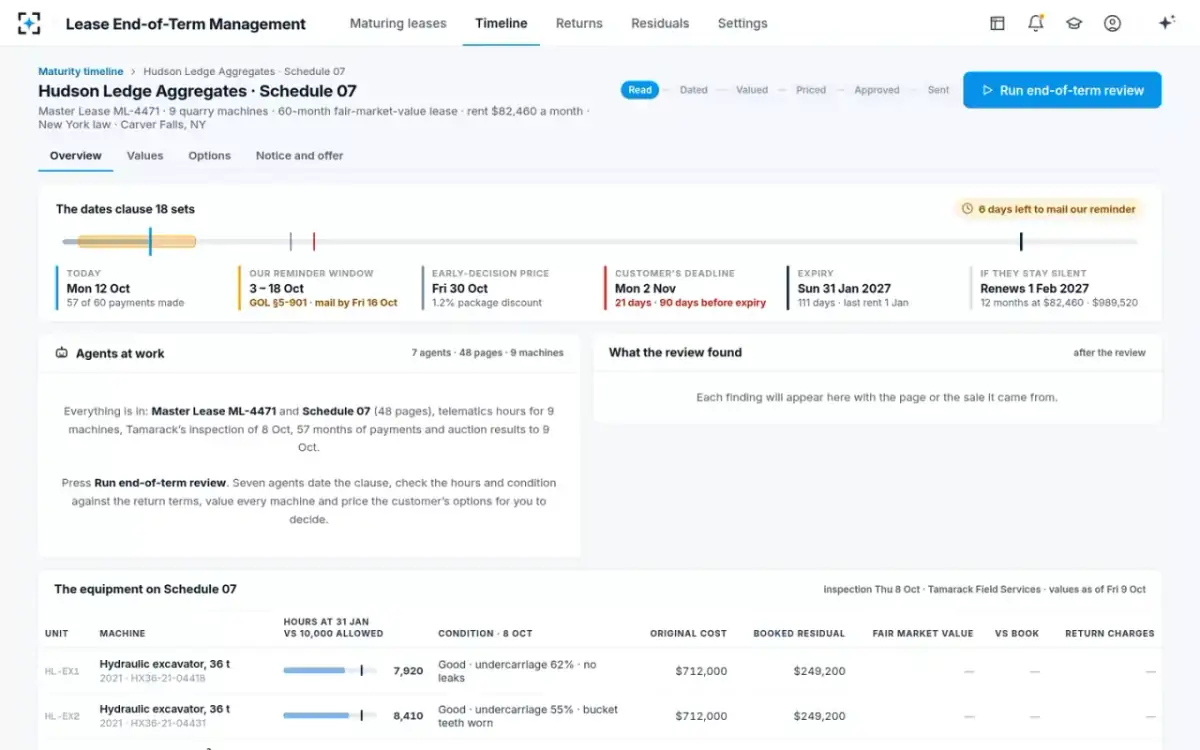
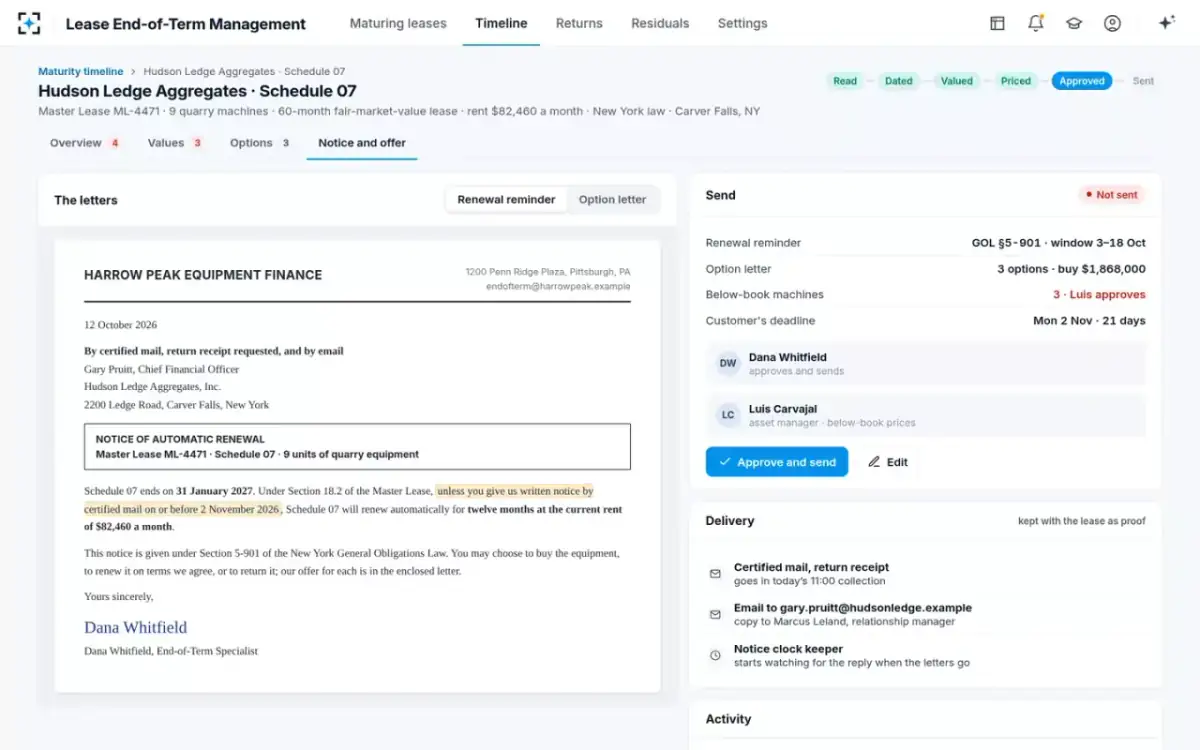
Read in order, the window is set backward from the lessee's own deadline, not from the lease's expiry date. If Schedule 07's renewal clause requires the lessee to notify the lessor by 2 November or the lease renews for another twelve months, the lessor's own reminder has to go out between 3 and 18 October — fifteen to thirty days before 2 November, not before 31 January when the term actually ends. Mail it on 19 October, one day late, and the clause the parties wrote into the lease does not take effect on this cycle.
One schedule's clock under two states' law: the lessor's window comes first
- Lessor’s reminder window, 3–18 Oct15 d
- Window shut; lessee may still give notice15 d
- Lessee’s deadline 2 Nov passed; 90 days to expiry90 d
- Lessor’s reminder window, 3 Sep–18 Oct45 d
- Window shut; lessee may still give notice15 d
- Lessee’s deadline 2 Nov passed; 90 days to expiry90 d
The reminder itself has a narrow job: it has to call the lessee's attention to the existence of the renewal provision, in writing, served personally or by mail. It does not have to restate the rent or negotiate anything, and it is not the same letter as whatever end-of-term notice a lessor's own policy sends at 180 or 120 days before expiry for commercial reasons. A policy letter sent in July does not satisfy a window that opens in October.
What the statute covers, and what it carves out
Two limits in the text matter as much as the window itself. First, the statute speaks to a "lease of any personal property," language broad enough to cover equipment, but the case for relying on it should always be checked against the specific lease's governing-law clause and the equipment's classification — a schedule governed by another state's law does not get New York's protection just because the lessor is based there. Second, the statute carves out short terms:
"Nothing herein contained shall be construed to apply to a contract in which the automatic renewal period specified is one month or less."
N.Y. General Obligations Law §5-901
A schedule that renews month to month on silence sits outside the reminder duty entirely, whatever else the clause says. A schedule that renews for a stated annual term, the shape most equipment leases take, sits squarely inside it. Between those two the statute is silent on everything else: it does not grade how the reminder is worded beyond "calling attention," and it does not say what happens to the underlying equipment or the rent already paid if the lessor was late — only that the clause itself is not operative.
Which states require a reminder, and which also require disclosure at signing?
A multi-state lessor's real question is whether New York's rule is unusual. Wisconsin shows it is not unique, and that a state can ask for more. Wisconsin Statutes §134.49 covers a "business contract", defined as one "entered into for the lease of business equipment, if any of the business equipment is used primarily in this state", or for business services. It imposes two duties. At signing, for any contract entered into, modified or renewed after 1 May 2011 that renews for more than a month on silence, the lessor must either have the customer sign a separate disclosure form or put the disclosures conspicuously in the contract and get the customer's initials on that page; otherwise the renewal clause "is not enforceable, and the contract terminates at the end of the current contract term" (§134.49(2)(c)). And before the deadline, where both the initial term and the renewal term exceed a year, the lessor must send written notice "at least 15 days but not more than 60 days before the deadline for the customer to decline renewal or extension" (§134.49(3)).
New York and Wisconsin, side by side: what each statute asks of the lessor
| New York, GOL §5-901 | Wisconsin, §134.49 | |
|---|---|---|
| Which leases | Any lease of personal property | Leases of business equipment used primarily in Wisconsin, for the end user; consumer leases, titled vehicles, medical equipment and government contracts excluded |
| Renewal terms covered | Renewal period longer than one month | Disclosure: renewal longer than one month. Reminder: initial term and renewal each longer than one year |
| At signing | Nothing | Signed disclosure form, or conspicuous disclosures initialled in the contract |
| The reminder window | 15 to 30 days before the lessee’s deadline | 15 to 60 days before the lessee’s deadline |
| What the reminder must say | Call the lessee’s attention to the renewal provision | That it will renew; the deadline; any increase in charges; how to decline |
| How it is given | In writing, served personally or by mail | Regular mail (unless the lessee must cancel by certified mail), registered or certified mail, by hand to an owner or officer, bold on page one of a monthly invoice, or fax, email or courier if the lessee may use that method |
| If the lessor misses it | The renewal provision is "not operative" | The renewal provision is not enforceable and the lease ends at the current term |
Those are the two statutes this guide has read in full, and they are enough to show that a single national renewal policy is not safe. A lessor should treat any other state as unknown rather than as "no rule", and read that state's code before relying on silence there. The cost of missing a window is the same in both statutes: the clause the lessor is relying on for the rent never took effect.
Counting a reminder window, worked on Schedule 07
The lessee’s deadline
Expiry 31 Jan 2027 − 90 days (clause 18) = Mon 2 Nov 2026
Read from the lease, never from the lease system’s maturity date.
New York window
2 Nov − 30 days = 3 Oct; 2 Nov − 15 days = 18 Oct
Mail between 3 and 18 October, both inclusive.
Wisconsin window (illustrative)
2 Nov − 60 days = 3 Sep; 2 Nov − 15 days = 18 Oct
Same closing date, a month earlier opening.
Safe mailing date
The last business day before the window closes, by a method the statute names
Fri 16 Oct for Schedule 07, so a weekend close is never the test.
What happens when the lessor's own reminder never goes out
Under §5-901's own words, a missed window does not make the lease disappear or forgive the rent already billed; it means the specific renewal-on-silence provision "shall not be operative." The practical consequence a lessor should plan around is that the renewal it was counting on, and the rent it booked against that renewal, is not a right it can simply assert if the lessee disputes it. That turns a revenue-recognition and residual question into a legal one at exactly the moment a portfolio desk has the least slack to deal with it — the schedule has already rolled past its expiry date.
The fix available at that point is usually negotiation, not law: approach the lessee directly, before they realize the clause may not hold, and either confirm the renewal by agreement or price the schedule as a fresh negotiation. Both outcomes are worse for the lessor than simply having sent the reminder on time, because both put a term the lessor once could assert as a matter of contract back onto a footing the lessee can contest.
A 'true lease' under federal tax law, a 'lease' under the UCC, and a renewal under state law — three different tests
Equipment finance paper is also tested as a lease under at least two other bodies of law, and it is worth being precise about which test answers which question, because none of the three answers the others.
Three tests, three different questions about the same lease
| Federal tax (true lease) | UCC Article 2A (is it a lease?) | State renewal notice law | |
|---|---|---|---|
| What is being classified | Whether the arrangement is a true lease or, in substance, an installment sale, for depreciation and tax purposes. | Whether the arrangement transfers the right to possession and use of goods for a term in return for consideration — a lease — or is in substance a sale or a security interest. | Whether a specific renewal provision in an already-formed lease takes legal effect against the lessee at the end of its term. |
| What triggers the test | The lessor’s minimum unconditional at-risk investment, residual value and renewal-option pricing, checked against Revenue Procedure 2001-28. | The structure of the transaction at formation: who selects and supplies the goods, who bears the risk, and what rights transfer. | What the lessor does, or fails to do, in the weeks before the lessee’s own renewal deadline — a question asked and answered state by state. |
| What a failure costs | The lessor loses the depreciation and other tax benefits of ownership; the deal is recast as a financing. | The lease is recharacterized, which can change what law governs a dispute and who bears risk of loss. | In a reminder-duty state, the renewal clause itself does not take effect — the lease does not renew on the terms the clause describes. |
The federal test turns on whether the lessor keeps a genuine stake: for an advance ruling on a leveraged lease, Rev. Proc. 2001-28 requires a minimum unconditional at-risk investment of at least 20 percent of the property's cost throughout the term, and a reasonable estimate that the property will be worth at least 20 percent of its original cost at the end. Renewals enter the test through the definition of the lease term:
"For purposes of this revenue procedure, the lease term includes all renewal or extension periods except renewals or extensions at the option of the lessee at fair rental value at the time of such renewal or extension."
IRS, Rev. Proc. 2001-28
The Uniform Commercial Code's Article 2A asks a narrower, formation-level question — is this a lease at all, as against a sale or a security interest — with its own definition:
"'Lease' means a transfer of the right to possession and use of goods for a term in return for consideration, but a sale, including a sale on approval or a sale or return, or retention or creation of a security interest is not a lease."
UCC §2A-103 (Cornell LII)
Neither test has anything to say about whether a specific renewal clause took effect on a specific date; that is the state notice statute's question alone, and it is the one a portfolio-operations calendar has to answer on a fixed schedule rather than once, at closing.
Reading the renewal clause before the window opens, not after
A clause reading that happens after the lessor's own window has already closed only tells a desk what it missed. The reading that matters happens when a schedule first enters its final 180 days: find the lessee's own notice deadline in the clause, find the governing-law state, and only then check whether that state's law adds a reminder duty and, if so, what window it counts backward from that same deadline. Clause 18 of Hudson Ledge's Schedule 07 sets the lessee's deadline at 90 days before the 31 January expiry — 2 November — which is also the date the New York window counts back from, to 3–18 October.
This is exactly the reading the lease clause reader agent performs inside Lease End-of-Term Management: it extracts the notice period, how notice must be given, and the governing law from the master lease and schedule, and cites the page each field came from, so the specialist checks the agent's reading rather than taking it on faith. Where a clause is ambiguous about which law governs the renewal provision specifically, the agent sends it to legal with the page rather than guessing.
Building one calendar for every state's clock
A lessor with schedules governed by several states' law is really running several different reminder calendars at once, each counting backward from a different lessee deadline under a different statute, and a spreadsheet usually tracks the one date everyone already watches: expiry. In the solution, the notice clock keeper agent turns every schedule's clause into both deadlines — the lessee's and, where a governing-law state adds one, the lessor's own — and puts them on a single timeline the end-of-term specialist opens every morning. New York's rule is configured today as a named, versioned setting rather than hardcoded logic, so a lessor adds another state's reminder rule the same way, once its own statute has been read and confirmed, rather than waiting on a software release.
Every schedule's dates, with the lessor's own reminder window alongside the lessee's
The reminder, drafted in the clause's own words, ready for a named approver
Before relying on one national renewal policy
- Read the renewal clause’s governing-law provision, not the lessor’s own home state
The law that matters is the one the schedule itself names.
- Find the lessee’s own notice deadline first
A reminder-duty window, where one exists, counts backward from that date, not from expiry.
- Check the renewal term’s length
New York excludes renewals of a month or less; Wisconsin’s reminder applies only where the first term and the renewal each run more than a year.
- In Wisconsin, check the signature page as well as the calendar
A business equipment lease signed or renewed after 1 May 2011 needs the disclosure signed or initialled, or the renewal clause fails whatever is mailed later.
- Confirm the current statute, state by state, before relying on it
A policy written once and applied to every schedule is the gap a reminder-duty state finds first.
- Put the reminder on the same calendar as the lessee’s deadline
Two dates tracked in two places is how one of them gets missed.
None of this changes what a lessee owes once a renewal properly takes effect; it only changes whether the clause a lessor is relying on got there lawfully. The cost of missing your own lease-renewal reminder puts a number on what one missed window is worth. To see every schedule's dates on one calendar, start from Lease End-of-Term Management.
Questions people ask
Which states require a lessor to remind a customer before an equipment lease renews automatically?
New York and Wisconsin are two. Under New York's General Obligations Law §5-901, a personal-property lease's renewal-on-silence clause is not operative unless the lessor sends a written reminder 15 to 30 days before the lessee's deadline; Wisconsin's §134.49 requires one 15 to 60 days before the deadline for business equipment leases with terms over a year, plus a disclosure at signing. Any other state should be checked in its own code, not assumed.
What is New York's notice requirement for automatic lease renewals?
Written notice, served personally or by mail, sent 15 to 30 days before the date the lessee itself would have to act to stop the renewal, calling the lessee's attention to the existence of the renewal provision in the lease. The requirement does not apply to a contract whose automatic renewal period is one month or less.
Does the law apply to month-to-month equipment leases?
No. General Obligations Law §5-901 states explicitly that it does not apply to a contract in which the automatic renewal period specified is one month or less. A schedule that rolls month to month on silence sits outside the reminder duty, whatever the rest of the clause says.
What happens if the lessor never sends the reminder?
The statute says the renewal provision "shall not be operative." In practice that puts the renewal a lessor was relying on, and the rent billed against it, on contestable footing rather than settled contract right — a position best avoided by sending the reminder inside its window, not negotiated afterward.
Is a verbal reminder enough, or must it be in writing?
In New York, written notice served personally or by mail; the statute does not mention a phone call or an email alone. Wisconsin lists its methods, and email counts only if the contract lets the customer decline renewal by email. Sending by more than one channel is sensible as long as a method the statute names is among them.
Can a multi-state lessor rely on one national renewal policy?
Not safely. A reminder window, where a state's law creates one, is counted from that lease's own lessee deadline under that state's own statute. A policy written once for every schedule, regardless of governing law, is exactly the gap a reminder-duty state is positioned to expose.