How do you calculate fair market value for an equipment lease buyout? The defensible version starts with a median of real comparable sales, not a guess and not last year's residual curve, and earns every adjustment from there — for hours above or below the comparables, for condition, for the region the machine sits in. A number built this way can be traced back to the sale behind it; a number asserted without comparables cannot, and an asset manager who has to defend a buyout price against a customer's own appraiser needs the first kind. Botminds' Lease End-of-Term Management prices every machine this way, from auction results and dealer quotes, and shows the comparables behind every figure.
The worked example on this page is a fictional sample fleet as it runs through the solution: nine quarry machines on Hudson Ledge Aggregates' Schedule 07, a 60-month lease ending 31 January 2027. One machine, a high-hour dump truck the solution identifies as HL-AD3, carries the calculation all the way through; the other figures on the page are the fleet total around it.
Fair market value starts with a median, not a guess
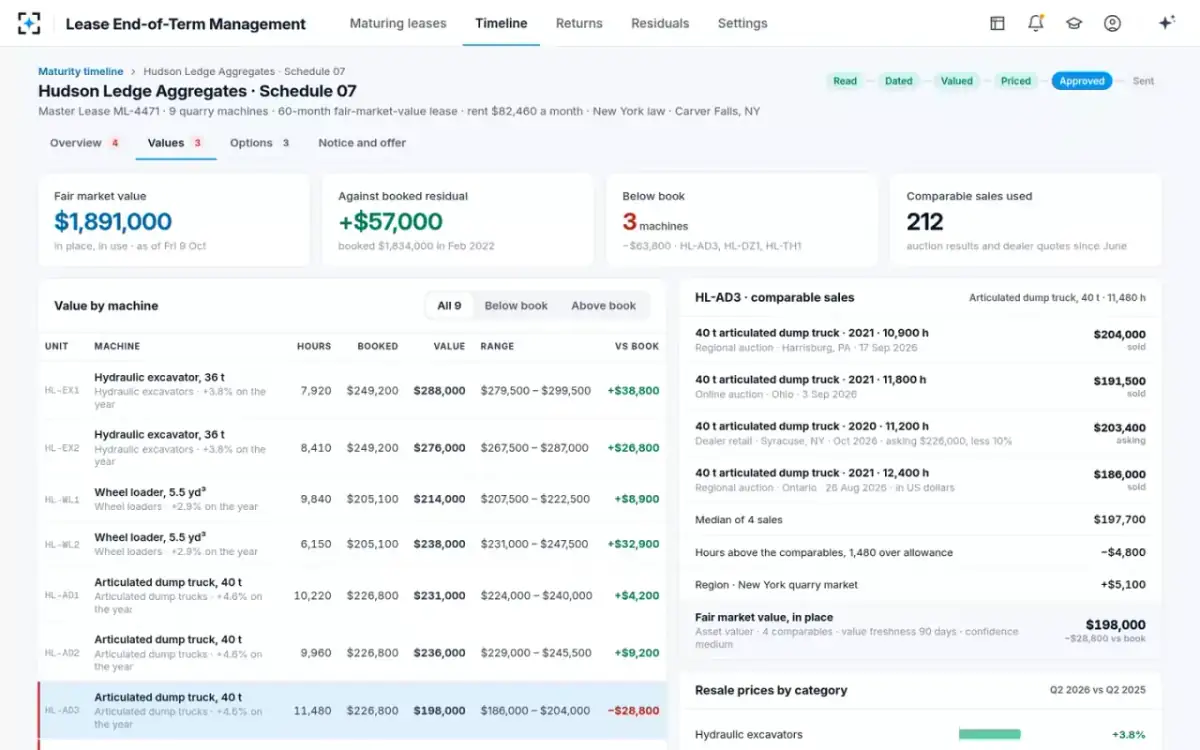
A fair market value that a buyout price can rest on is the median of several real, recent sales of the same or a closely comparable machine, adjusted for the ways this specific unit differs from the comparables. The median, not the average, is the standard choice because one unusually high or low auction result should not move the whole estimate the way it would move a mean. For HL-AD3, a high-hour 40-tonne articulated dump truck, four comparables priced between late August and October 2026 put the median at $197,450 before any adjustment: the starting point, not the answer.
HL-AD3's four comparables: three sold at auction, one a dealer's asking price
| Machine | Where and when | Evidence | Price |
|---|---|---|---|
| 2021, 10,900 hours | Regional auction, Harrisburg PA, 17 Sep 2026 | Sold | $204,000 |
| 2021, 11,800 hours | Online auction, Ohio, 3 Sep 2026 | Sold | $191,500 |
| 2020, 11,200 hours | Dealer retail, Syracuse NY, Oct 2026 | Asking $226,000, less 10% | $203,400 |
| 2021, 12,400 hours | Regional auction, Ontario, 26 Aug 2026 | Sold, in US dollars | $186,000 |
HL-AD3: the median of four sales to a fair market value of $198,000
| Step | What it does | Result |
|---|---|---|
| 1. Four comparables of the same class | 40-tonne articulated dump trucks, 2020–21, 10,900 to 12,400 hours, priced between 26 August and October 2026 | $186,000 · $191,500 · $203,400 · $204,000 |
| 2. Median of the four | The average of the middle two, $191,500 and $203,400 | $197,450 |
| 3. Hours adjustment | For HL-AD3’s use, 11,480 hours, 1,480 over its lease allowance | −$4,800 |
| 4. Regional adjustment | For the New York quarry market where the truck sits | +$5,100 |
| 5. Fair market value in place | $197,450 − $4,800 + $5,100 = $197,750, rounded to the nearest thousand | $198,000 |
| 6. Against booked residual | Fair market value less the $226,800 booked in February 2022 | −$28,800 |
Two things about that table are easy to miss on a first read. The hours adjustment and the regional adjustment move in opposite directions and almost cancel; a value built from one adjustment alone would have been wrong in a different way from a value with none. And the final figure, $198,000, is $28,800 under the $226,800 this machine was booked at in February 2022. A booked residual is an estimate made years before the lease ends; a comparable-sales value is an estimate made the week the lease ends. The two are allowed to disagree, and the gap is exactly the information a lessor needs before it offers a buyout price.
What makes a sale comparable in the first place?
A sale is comparable when it is the same or a closely related make, model and vintage, sold recently enough that the market has not moved meaningfully since, in a transaction that reflects an arm's-length price: an auction result or a dealer's actual sale. A listing price proves what a seller wanted; only a completed sale proves what a buyer paid. HL-AD3's set shows why the label matters: one of its four comparables is a dealer's asking price less 10%, and it sits near the top of the range. A valuer can use such a figure when completed sales are thin, but it should be marked as an asking price, as it is here, so the reviewer can weigh it.
Recency matters as much as the model match. A sale from eighteen months ago is weak evidence of today's price for a mobile asset class where used-equipment values move with commodity and construction activity; a sale from the trailing ninety days is strong evidence. Lease End-of-Term Management enforces this directly: it never uses a value older than its freshness setting, ninety days by default, and shows every comparable sale it relied on, so a reviewer can check the dates as easily as the numbers.
Adjusting for hours above or below the comparables
Hours are often the largest source of disagreement between two machines of the same model and vintage, because they measure how much working life has been used. The adjustment should come from the comparables themselves: what buyers paid for units at different hour counts, applied to the gap between this machine's hours and theirs. HL-AD3's comparables ran 10,900 to 12,400 hours, so the test of its −$4,800 adjustment is whether its 11,480 hours, and the condition report behind them, really put it below the middle of that set. That is a question a reviewer can only ask because every comparable is shown with its hours; an hours adjustment estimated from year-old sales, or from the lease allowance alone, assumes a wear-to-price relationship that may no longer hold.
The same logic runs in the other direction for a lightly used machine. A forklift on a different schedule in the same fleet, run well under its allowance, is adjusted up rather than down against the median — the comparables it is measured against include units with more hours on them, so a lightly used unit is worth more than the unadjusted median would suggest, not less.
Why the same machine is worth more in one region than another
Fair market value is a local number dressed as a national one. The same dump truck model sells for different prices depending on who is bidding for it nearby and what it costs to move it to them, and HL-AD3's comparables were sold in Pennsylvania, Ohio, New York and Ontario. Its regional adjustment, +$5,100 for the New York quarry market, is the solution's estimate of that difference for a truck sitting at a quarry in Carver Falls; a value that ignored where the machine sits would price it as if it were already on a trailer.
Getting the number wrong in one direction costs more than the other. A study of car-lease residual values by Dress, Lessmann and von Mettenheim, written "to aid lessors in their pricing decisions", found that when overestimating a resale price costs twice as much as underestimating it, building that asymmetry into the forecasting model reduced decision costs by about eight percent against a standard model. An equipment lessor faces the same asymmetry at lease end: a buyout priced too low gives value away once, but a value set too high loses the sale and leaves the lessor remarketing the machine itself.
New construction machinery prices are up 40% since 2019: context for any residual set before 2022
How 'reasonably certain to exercise' turns a value into an accounting number
A fair market value only becomes a purchase-option price once someone decides the lessee is actually likely to exercise it, and that judgment has its own standard. Under the US GAAP lease standard, Topic 842, "an entity assesses whether the lessee is reasonably certain to exercise or not to exercise an option by considering all economic factors relevant to that assessment—contract-based, asset-based, market-based, and entity-based factors" (ASC 842-10-55-26). For a quarry fleet running dump trucks beyond their hours allowance, the asset-based factor is the clearest signal: a customer that has already used a machine harder than the lease assumed has shown, by its own usage, that it expects to keep running it.
That is the reasoning behind leading with a buyout offer on Hudson Ledge's fleet rather than a renewal or a return: the customer's own usage pattern is the strongest evidence of intent available, stronger than anything in the lease's original assumptions about residual value.
What the federal true-lease test asks of a buyout price, and why
Where a lease is structured to qualify as a true lease for federal tax purposes rather than a financed sale, the purchase option has to be priced at a genuine fair market value, not a token amount that effectively guarantees the lessee will buy. For an advance ruling on a leveraged lease, Rev. Proc. 2001-28 requires the lessor to demonstrate that a residual of at least 20 percent of original cost is "a reasonable estimate of what the fair market value of the property will be at the end of the lease term," determined "after subtracting from such value any cost to the lessor for removal and delivery of possession of the property to the lessor at the end of the lease term" (IRS Revenue Procedure 2001-28). The subtraction matters in practice: a return estimate that ignores what it costs to pick the machine up and deliver it overstates what the lessor would actually net if the customer walked away instead of buying.
This is one more reason a comparable-sales method, done properly, serves both the commercial and the compliance question at once. A buyout priced from real sales, net of removal and delivery cost where relevant, is both a defensible number to put in front of a customer and evidence that the original lease's residual assumption was a genuine estimate rather than a number picked to force a sale.
Booked residual against today's market: reading the gap
Across Hudson Ledge's nine-machine fleet, three run below their booked residual and six run above it, and the fleet nets out $57,000 ahead of book rather than behind it. Reading only the fleet total would miss the machines that need the most attention; reading only the worst machine would miss that the fleet, taken together, is a win for the lessor.
Six machines above book, three below: the fleet nets $57,000 ahead
Every machine below book, not just the fleet total, has to be priced from its own comparables rather than averaged away, because a below-book price is also the trigger for a second approver. Any machine priced under its booked residual needs the asset manager's co-approval before an offer goes out, and that rule applies machine by machine — the fleet's overall gain does not excuse skipping the check on the three machines that are individually behind.
Comparable sales versus a residual curve: what each one is actually measuring
A residual curve, set at lease signing, is a forecast made years in advance from the equipment class's historical depreciation pattern. A comparable-sales valuation, run at lease end, is a measurement made from what buyers are actually paying this quarter. Both have a place — the curve prices the lease at signing, when no current sale exists to measure from — but only one of them should price the option the day the lease matures.
What a residual curve and a comparable-sales valuation each get right
Residual curve, set at signing: A historical depreciation pattern for the equipment class, projected forward.
Comparable-sales valuation, run at lease end: What buyers actually paid for comparable machines in the trailing 90 days.
Residual curve, set at signing: At signing, when no current sale of this exact machine at this exact age exists yet.
Comparable-sales valuation, run at lease end: At maturity, when real comparable sales of the machine's current age and condition exist.
Residual curve, set at signing: Everything that happens to this specific machine — its actual hours, its actual region, the market it actually matures into.
Comparable-sales valuation, run at lease end: Nothing current, but it is only as good as the comparables available and how recently they sold.
Residual curve, set at signing: The lease itself, and the lessor's reserve for the asset at signing.
Comparable-sales valuation, run at lease end: The buyout, renewal and return options the customer is offered at maturity.
When a value is too old to price an option on
A comparable-sales value is only as good as its freshness, and the freshness that mattered at the moment it was calculated decays the moment new sales happen. Lease End-of-Term Management treats this as a hard limit rather than a reminder: it never prices an option from a value older than the freshness setting, ninety days by default, and when new comparable sales arrive it can reprice every affected schedule in one pass rather than waiting for the next scheduled review.
That matters most for an offer still sitting with a customer. A value calculated correctly three months ago is not wrong, exactly — it is simply no longer current, and an option priced from it is a snapshot of a market that has since moved. What happens when the market moves before the customer replies follows one such repricing through, on a forklift whose lead offer changed overnight.
Every comparable shown, for every machine
The buyout priced against the fleet's booked residual
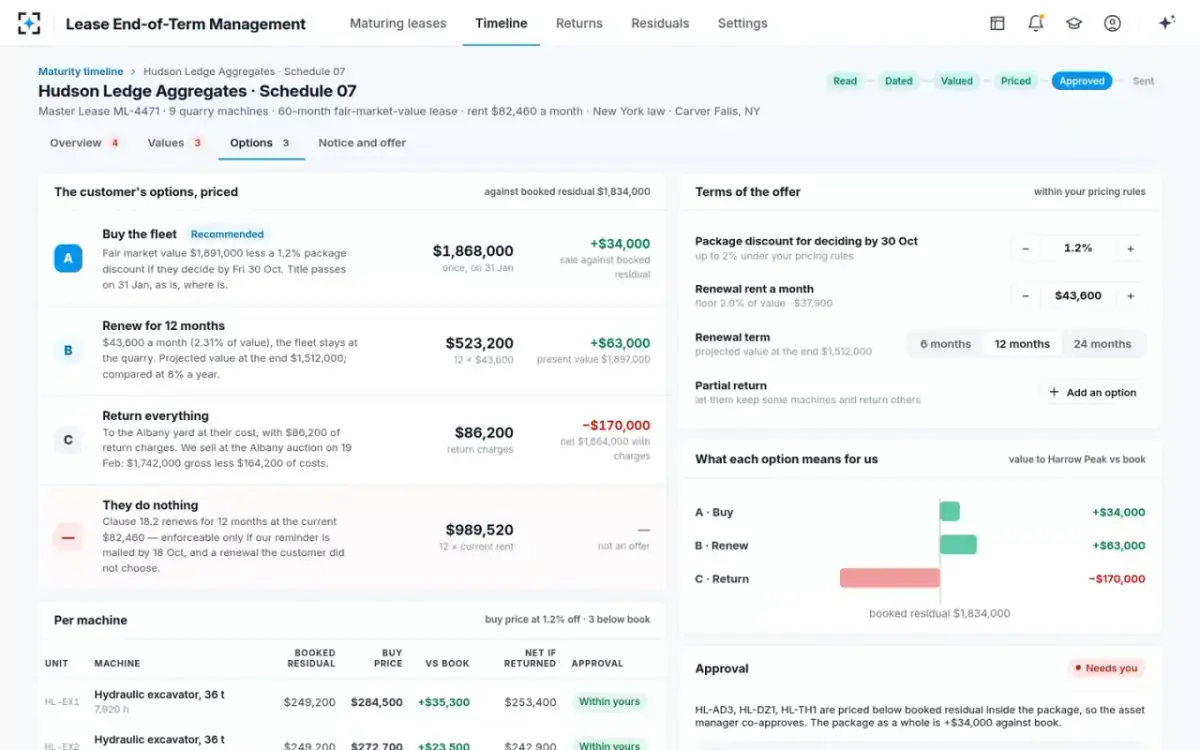
Pricing one machine correctly is a calculation; pricing a fleet of nine, three of them below book, on a six-day notice window is a different kind of problem, and seven agents review a lease end of term follows the whole fleet through that review, start to finish. To see the comparables, the adjustments and the priced options together on this quarry fleet, start from Lease End-of-Term Management.
Questions people ask
How is fair market value calculated for an equipment lease buyout?
Start from the median of several real, recent comparable sales of the same or a closely related machine, then adjust for hours above or below the comparables, for condition, and for the region the machine sits in. The result is the fair market value in place; a buyout price may then apply a discount for an early decision on top of it.
What counts as a comparable sale for heavy equipment?
A completed auction result or dealer sale, not an asking price, for the same or a closely related make, model and vintage, recent enough that the market has not meaningfully moved since. Lease End-of-Term Management never relies on a comparable older than its freshness setting, ninety days by default.
How do you adjust a value for hours above or below the comparables?
By reading the wear-to-price relationship the comparable sales themselves imply at this point in the equipment's life, and applying it to the difference between the machine's own hours and the comparables' average. A machine run harder than its comparables is adjusted down; one run lighter is adjusted up.
Why does region change an equipment's value?
Because buyers for a given equipment class are concentrated regionally, and local demand moves the price a comparable machine actually sells for. A quarry fleet in a region with active quarry demand can sell above the national comparables for the same model; the same machines elsewhere might not.
How fresh does a comparable sale have to be?
Fresh enough that the market has not moved meaningfully since it closed. Lease End-of-Term Management sets a freshness limit, ninety days by default, and never prices an option from a value older than that — if new sales have arrived, the value is refreshed first.
What's the difference between fair market value and booked residual?
Booked residual is an estimate made at lease signing, years before maturity, from the equipment class's expected depreciation. Fair market value is a measurement made at lease end from what buyers are actually paying this quarter. The two can disagree in either direction, and the gap is exactly what a lessor needs to see before pricing an option.