Is a spreadsheet good enough to track equipment lease end-of-term dates? For a handful of schedules, often yes. For a few hundred, the honest answer is that it depends what "good enough" has to catch — a maturity date, a notice window, a hidden state requirement your own reminder has to meet, a machine's value against what buyers are actually paying this quarter. Run the same maturing schedule through a spreadsheet, a lease management system and an agentic review like Botminds' Lease End-of-Term Management, and each one catches progressively more, for a reason worth understanding before choosing between them.
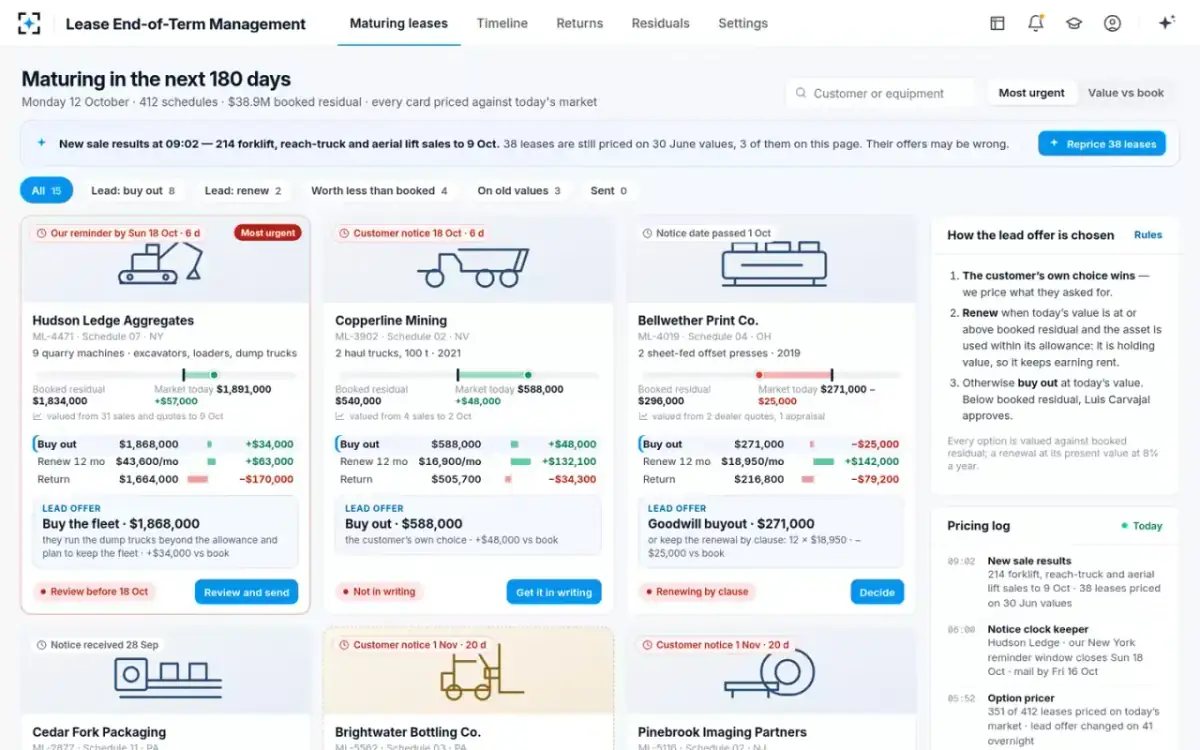
The example below is a fictional sample lessor's book: 412 schedules maturing in the next 180 days, $38.9 million of booked residual, with one schedule — Hudson Ledge Aggregates' nine-machine quarry fleet — run through all three approaches for comparison.
One schedule, three ways to track it
A spreadsheet tracks whatever a person remembers to type into it: often a maturity date, sometimes a notice period, rarely the full end-of-term clause. A lease management system goes further: it stores the schedule's booked residual, the payment history and the maturity date as structured fields rather than typed text. An agentic review goes further still: it reads the lease's own clause, dates every window the clause sets including any reminder a state's law requires of the lessor, values the machine from current comparable sales, and prices every option against today's market rather than a number set at signing.
What each approach holds for one maturing schedule
Spreadsheet: Typed in by hand, as of whenever someone last updated it.
Lease system → agentic review: Structured in the lease system; the agentic review re-reads the clause itself and confirms it against the document.
Spreadsheet: Rarely tracked at all — most spreadsheets hold the customer's deadline, not the lessor's own notice obligation.
Lease system → agentic review: Dated from the governing-law reminder requirement, watched alongside the customer's own deadline.
Spreadsheet: The booked residual set at signing, unchanged until someone manually revises it.
Lease system → agentic review: Priced from comparable sales within a freshness window, repriced when new sales arrive.
Spreadsheet: Not priced at all; a person calculates each option by hand if asked.
Lease system → agentic review: Priced automatically against the booked residual, with the comparables shown.
Spreadsheet: Usually the customer, calling about an invoice on a term nobody meant to renew.
Lease system → agentic review: The notice clock keeper, before the window closes — the point of tracking the date at all.
What a spreadsheet catches, and what the research says it misses
A spreadsheet catches exactly what someone remembers to put in it and keep current, which is also its weakness: nothing in a spreadsheet checks itself. Raymond Panko's review of spreadsheet error research, presented to the European Spreadsheet Risks Interest Group, puts it starkly for spreadsheets with thousands of formulas: "for cell error rates of 1% to 5%, the probability of a calculation error is overwhelming". Across fourteen laboratory studies in which 967 people built spreadsheets, the average cell error rate was 3.9% — not because spreadsheet users are careless, but because a formula, a typed-in date or a stale assumption sits silently correct-looking until something outside the sheet checks it against reality.
How many of 412 maturity rows would carry a wrong cell, at three error rates
The end-of-term specialist on Harrow Peak Equipment Finance's fictional sample desk put the practical version of this plainly: tracking 412 maturing schedules by hand means finding out a lease renewed "when the customer calls about month 61" — the spreadsheet did not fail loudly, it simply never had a mechanism to catch the one cell that mattered before it was too late to act on.
What a lease system adds, and where it still stops
A lease management system is a real improvement over a spreadsheet: a structured maturity date that cannot be mistyped the way a hand-entered one can, a payment history tied to the schedule rather than copied in, a booked residual that lives in one place rather than in several versions of the same file. What it stores, though, are fields; the person still has to read the lease to decide what to do with them.
The gap shows up at exactly the moment end-of-term work begins. A lease system can tell a specialist that Schedule 07 matures on 31 January 2027. A system that holds fields cannot tell the specialist, on its own, that the lease is governed by New York law and therefore carries a lessor notice obligation with its own fifteen-to-thirty-day window, separate from the customer's own deadline — that fact lives in the clause, not in the structured fields most lease systems track. A system that stores the date without reading the clause behind it still leaves the clause-reading work, and the risk of missing something inside it, with a person.
What changes when the review also reads the clause and prices the option
An agentic review adds two things a lease system does not: it reads the end-of-term clause itself, rather than relying on fields a person populated from it, and it prices every option — buyout, renewal, return — against a current valuation rather than leaving that calculation to whoever has time to do it by hand. On Hudson Ledge's fictional sample fleet, that meant finding the lessor's own six-day-remaining reminder window from the clause, valuing nine machines from 212 comparable sales, and pricing three options per machine, in 1 minute 32 seconds.
Schedule 07 through each approach: what the specialist would know on Monday 12 October
| Spreadsheet | Lease system | Agentic review | |
|---|---|---|---|
| Expiry, 31 Jan 2027 | If typed in correctly | Yes | Yes, read from clause 18 |
| Customer’s deadline, 2 Nov | If someone read clause 18 | If someone keyed the notice period | Yes, with the page cited |
| Lessor’s own reminder window, 3–18 Oct, 6 days left | Rarely | Only if the governing law was keyed and a rule exists | Yes, from GOL §5-901 |
| Three machines $63,800 below book | No: booked residuals only | No: booked residuals only | Yes, from 212 comparable sales |
| Buyout $204,000 better than a full return | Only if worked by hand | Only if worked by hand | Yes, all three options priced |
| $86,200 of return charges if the fleet comes back | Only after the inspection is read | Only after the inspection is read | Yes, from the meters and the 8 October inspection |
The pricing side is where the research on asymmetric forecasting costs has a direct bearing. A study of residual-value forecasting for leased vehicles found that "nonlinear forecasting methods outperform linear methods for car resale price forecasting when error costs are asymmetric" (Dress, Lessmann and von Mettenheim, 2017) — in other words, a simple, fixed rule for estimating value performs worse than a method that can weigh several comparable sales, hours, condition and region together, precisely because overestimating and underestimating a buyout price do not cost a lessor the same amount. A booked-residual figure typed into a spreadsheet is the simplest possible version of the weaker method; an agentic review's comparable-sales calculation is closer to the stronger one.
Where each approach still needs a person to decide
None of the three approaches, including the most capable one, decides anything on its own. A spreadsheet never did; a lease system never did; an agentic review is built the same way by design — it drafts the notice, prices the options and recommends a path, and a named specialist approves and sends. Any price below booked residual still needs the asset manager's co-approval, and a disposal more than $250,000 below book still goes to the VP Portfolio and Asset Management, whichever tool surfaced the number. What changes across the three approaches is not who decides, but how much a person has to calculate by hand before there is anything to decide on.
What to test before you believe any of the three
Whichever approach a lessor is evaluating, including its own current spreadsheet, the fair test is the same: run it against a schedule that has already matured, where the real outcome is already known, and check whether the dates, the valuation and the price it produces match what actually happened. Banking supervisors describe the same discipline for any tool a lender puts between itself and a pricing decision, calling for "a risk-based approach to model risk management, tailored to a banking organization's model risk profile and the size and complexity of its operations" (SR 26-2) — in plain terms, test harder where getting it wrong costs more, and scale the testing to the size of the book actually at risk.
Before trusting any tracking approach with a real schedule
- Run it on a schedule that has already matured
Compare its dates, its valuation and its priced options against what the file's own history already shows.
- Check whether it reads the clause, or only stores a field someone typed from it
A reminder-law obligation that lives only in the clause will not appear in a system that never reads the clause.
- Check how current its valuations are
A booked residual set years ago and a comparable-sales value calculated this week are different kinds of numbers, even when they live in the same column.
- Check who has to approve before anything reaches a customer
Every approach should route a below-book price and a large disposal to a named person — ask to see that routing work, not just the number it produced.
- Match the approach to how many schedules you actually carry
A dozen leases on one spreadsheet, checked by hand each month, may be entirely adequate. Several hundred, maturing on their own schedules, is where a spreadsheet's silent failure mode starts to cost real rent.
The questions that matter more than the feature list
A feature list compares what each approach can technically store. The questions that actually decide whether a lessor should switch are narrower: does it catch a missed date before the window closes, or after a customer calls about it; does it know when a lessor's own notice obligation exists, separate from the customer's deadline; and does it reprice an option when the market moves, or leave a stale number sitting in a column until someone remembers to check it. The National Institute of Standards and Technology frames the underlying point generally, for any system a decision depends on: "trustworthiness characteristics ... are inextricably tied to social and organizational behavior, the datasets used by AI systems, selection of AI models and algorithms and the decisions made by those who build them" (NIST AI RMF 1.0) — in other words, the tool matters less than whether the organization running it actually checks its answers against reality, on any of the three approaches compared here.
412 schedules, each one priced rather than just dated
Choosing the approach that matches how many schedules you actually carry
The honest answer to "is a spreadsheet good enough" scales with volume and with how much a missed window actually costs. A handful of schedules, checked by a careful person every month, rarely needs more than a well-kept spreadsheet. A few hundred, each with its own notice dates, its own governing law and its own machine to value, is where the spreadsheet's failure mode — correct-looking until the one cell nobody checked turns out to matter — starts to cost real money, at the scale this fictional sample lessor saw: $1.38 million of rent nobody chose, across six schedules that renewed by clause after a customer missed its own date.
Which approach fits which book: a starting point, not a rule
| Your book | What has to be caught | What usually fits |
|---|---|---|
| A few dozen schedules, one governing law, few machine types | The customer’s deadline and the expiry | A well-kept spreadsheet, reconciled to the lease system monthly and checked against each clause once |
| Hundreds of schedules, one or two governing laws | Both deadlines, and buyout prices from current values | A lease system for the records, with the clause dates and values maintained by a named person |
| Hundreds of schedules, several governing laws, mixed equipment | Every window the clauses and the laws set, values that move by class, every option priced | An agentic review over the lease system, with people approving what is sent |
The rules a lessor sets, whichever approach reads them
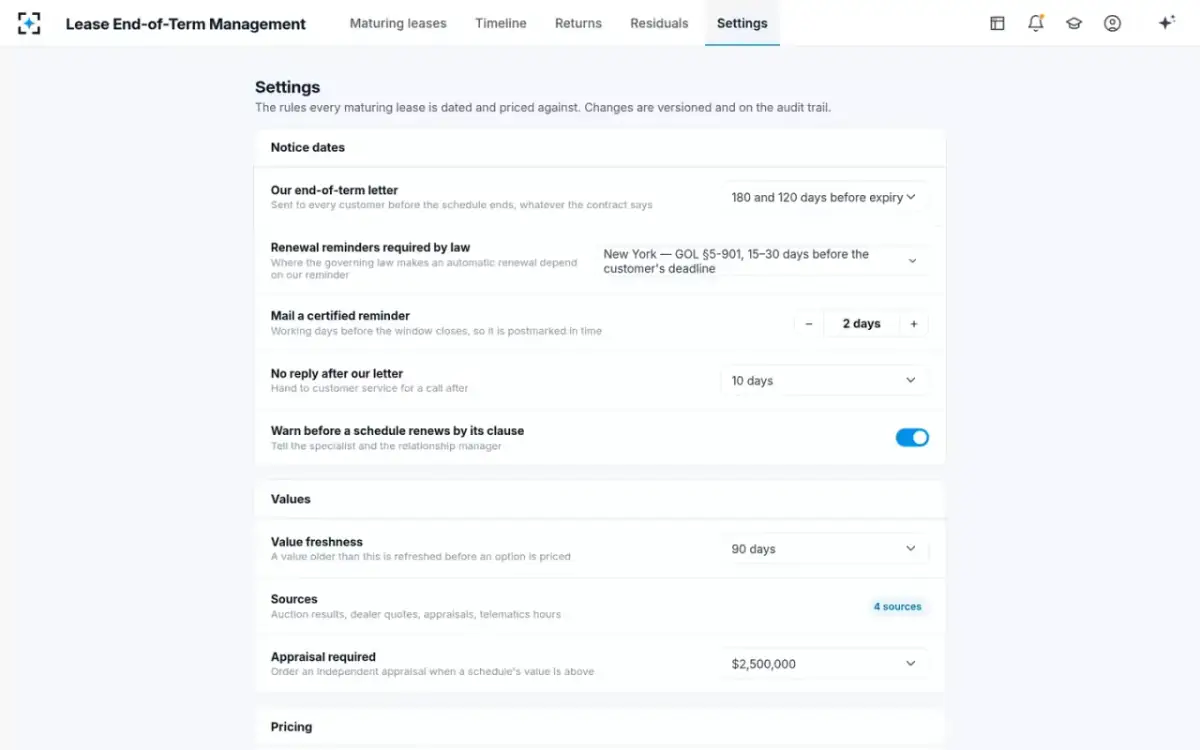
What an agentic review actually does with a lease once it starts reading it — the seven roles involved, and the one thing none of them may do on their own — is set out in seven agents review a lease end of term. To see the fully worked example this page draws its comparison from, start from Lease End-of-Term Management.
Questions people ask
Is a spreadsheet good enough to track equipment lease end-of-term dates?
For a small number of schedules, checked carefully and often, it can be. The risk is not that a spreadsheet is always wrong — it is that nothing in it checks itself, so a missed date or a stale figure looks exactly like a correct one until a customer calls about it.
What does lease management software catch that a spreadsheet doesn't?
Usually a structured maturity date and a booked residual tied to the schedule, rather than typed and retyped by hand. Most lease systems still do not read the end-of-term clause itself, which means a lessor's own notice obligation, something a state's law can require separately from the customer's deadline, often still lives only in the paper.
What can agents do that lease management software on its own can't?
Read the clause directly, date every window it sets including a lessor's own reminder obligation, value the machine from current comparable sales rather than a residual set at signing, and price every option against that current value — all before a person has to calculate any of it by hand.
How error-prone are spreadsheets for tracking deadlines?
Laboratory studies of people building spreadsheets average a cell error rate of 3.9%, Panko's review reports, and at rates of 1% to 5% the chance that a sheet of any real size carries at least one error is high. A spreadsheet does not announce which cell is wrong, which is the practical risk for a maturity date nobody double-checks.
What should I ask before switching from a spreadsheet to software?
Ask whether it reads the lease's own clause or only stores a field someone typed from it, how current its valuations are, and whether it routes a below-book price or a large disposal to a named approver. Then run it on a schedule that has already matured and check its answer against what actually happened.
Do I still need a person if the dates and prices are automated?
Yes. Every approach compared here, including the most capable one, recommends; a named specialist still approves and sends every notice and offer, and a below-book price or a large disposal still needs a second approver. Automation changes how much a person has to calculate by hand, not who decides.