How accurate is AI equipment valuation is the wrong first question, because accuracy on its own hides which direction a valuation's error runs, and the two directions do not cost a lessor the same amount. At lease end, an equipment value set too low prices the buyout too low, and a customer who accepts it buys the machine for less than it is worth. A value set too high prices the buyout above what the machine will fetch, so the customer is more likely to send it back, and the lessor then sells it for less than the value it was carrying. Lease End-of-Term Management's asset valuer, the agent inside Botminds' agentic solution for lease end-of-term work, prices each machine from current comparable sales rather than a single blended estimate, which gives a validation team something more useful to test than one accuracy number: whether its errors run the direction that costs less.
One valuation, two different kinds of wrong
Every forecast of what a machine will sell for can miss in one of two directions, and research on resale-price forecasting in the leasing business treats them as genuinely different costs rather than mirror images of the same error. A valuation that comes in low against the eventual sale gives value away to whoever buys at that price; a valuation that comes in high leaves a lessor holding a price it cannot realise. The asymmetry is the whole reason "how accurate" needs a second question attached to it: accurate in which direction, and by how much.
Why overestimating is usually the error that costs you
The academic literature on this question treats overestimation as the costlier error for a reason grounded in how risk-averse decision-makers actually weigh outcomes. A study on residual-value forecasting for the car-leasing business states the point directly:
"A risk-averse manager will thus consider overestimating to be the more severe error. Prospect theory suggests that decision makers weigh losses higher than gains even if they have the same magnitude and occur with equal probabilities," Dress, Lessmann and von Mettenheim write, drawing on the same prospect-theory research behind much of modern decision science. Their setting is a car lease priced at signing, where an overestimated residual "leads to an unexpected decrease of profit – and maybe a loss – when remarketing the returned car". At equipment lease end the same logic applies to a return: a value set too high means the machine nets less at auction than the books assumed. A value set too low is not free either, because a buyout accepted at that price is a sale below market; it is simply a loss the lessor rarely sees, since nobody re-sells the machine to prove it.
What pricing the asymmetry into a forecast was worth, in one leasing study
2:1
assumed cost of overestimating a resale price, against underestimating it
≈8%
lower decision costs from a forecast built for that asymmetry, against a standard model
More
improvement as the asymmetry grows, the authors report
What 'never uses a value older than 90 days' actually guards against
A value's direction of error is not fixed at the moment it is calculated; it drifts as the market the comparable sales came from moves. The asset valuer's own limit — never relying on a value older than 90 days — exists because a stale value is not simply less precise, it is systematically more likely to have drifted in one direction as new sales accumulate that the old value never saw. Holding a freshness limit converts an open-ended staleness risk into a bounded one: at worst, a value is 90 days behind the most recent sale it could have used.
The limit also forces a specific kind of transparency: because the asset valuer shows every comparable sale behind a value, a reviewer can check not just whether a number is current, but whether it rests on sales from the right equipment class and region, which is a second, independent way a value can be wrong even while being fresh.
Measuring against your own closed returns, not a vendor's claim
The only accuracy figure worth trusting is one measured against a lessor's own history: take every schedule that has already closed, where the actual sale or buyout price is known, and compare it with what the valuation would have said in the weeks before that outcome. That comparison answers the only question that matters — on this lessor's own equipment mix, in this lessor's own regions, does the valuation's error run high or low, and by how much — in a way a vendor's published number, built on somebody else's portfolio, cannot.
What to measure, and what each measurement tells you
| Measure | What it tells you |
|---|---|
| Match rate against your own closed sales | How close the valuation came, on equipment this lessor actually sold or bought out. |
| Split between over- and under-estimates | Whether the errors that remain run the cheaper direction or the costlier one. |
| Staleness rate | What share of valuations in a live book are past the freshness limit at the moment they are used. |
| Comparable count per value | Whether a value rests on enough real sales to be defensible, or on too few to trust. |
Three numbers that describe a valuation's accuracy on closed files
Bias
average of (value − actual price) ÷ actual price
Positive means the valuation runs high; the sign is the point, not the size.
Typical error
median of |value − actual price| ÷ actual price
How far off a single value usually is, whichever way.
Share overestimated
files where value > actual price ÷ all files
Read with the bias: a few large overestimates can hide behind a good median.
How many comparable sales make a value defensible?
There is no single published threshold for how many comparable sales a defensible equipment value needs, and a validation team should treat any flat number offered without its own working skeptically. What matters more than a fixed count is whether the comparables are drawn from the right equipment class, the right region, and a recent enough window, and whether the value shows its work rather than asserting a figure. On Schedule 07's high-hour dump truck, seen in the solution's sample portfolio, the asset valuer starts from a median of four comparables, three auction sales and one dealer asking price marked as such, then adjusts down for hours and up for the New York quarry market: a chain a reviewer can check line by line rather than a number offered on its own authority.
One machine's value, built from a median and two adjustments, not asserted whole
Median of 4 comparables
($191,500 + $203,400) ÷ 2 = $197,450
The middle two of $186,000, $191,500, $203,400 and $204,000.
Hours
−$4,800
HL-AD3 has run 11,480 hours, 1,480 over its lease allowance.
Region
+$5,100
The solution’s adjustment for the New York quarry market where the truck sits.
What a confidence range should show, and what it should never hide
A single point value, however well sourced, understates how much a valuation can reasonably vary given real dispersion in comparable sales, condition grading and regional demand. A useful valuation shows a range alongside its point estimate and shows the comparable sales that produced both ends of it, not just the midpoint. What a range should never do is smooth over a genuine disagreement between sources — if dealer quotes and auction results for the same equipment class diverge meaningfully, that divergence belongs in the range shown, not averaged away into false precision.
The sample fleet shows what that looks like. Six of the seven machines on the first page of the values screen carry a range about 7% of their value wide; HL-AD3, the high-hour truck whose comparables spread from $186,000 to $204,000, carries one 9% wide, and the screen marks its confidence as medium.
Range width as a share of value: the high-hour truck is the least certain
A narrow range built from four tightly clustered sales and a wide range built from four scattered ones are different claims about how well the market agrees on a machine's worth, even if their midpoints happen to land on the same number. A validation team reading only the point value cannot tell the two apart; a validation team that can see the range, and the sales behind each end of it, can tell immediately whether a price is well supported or is a midpoint asserted across real disagreement.
When the asset valuer's value and an independent appraisal disagree
Equipment valuation is not purely a matter of comparable sales once a value moves beyond what recent sales can clearly support; at that point the asset valuer's own limit is to ask for an independent appraisal rather than extend its estimate past the evidence it has. When that appraisal disagrees with the agent's own figure, the disagreement itself is useful information — it usually means the equipment's condition, a regional factor, or a recent development in that equipment class is not yet reflected in the comparable sales the valuer could see. The right response is to treat the independent appraisal as the better evidence for that specific machine, and to ask why the gap exists before trusting either figure on the next one like it.
A validation team should also ask how often the escalation actually fires, not just what happens when it does. An appraisal limit set too high lets an automated value stand on machines where the comparable sales are thin or the equipment is unusual enough that a desk appraiser would genuinely add information; a limit set too low sends routine, well-supported valuations out for an appraisal that will simply confirm what the comparable sales already showed, at real cost and real delay. Tracking how often an escalation changes the final number, not just how often it is triggered, is the more useful measure of whether the limit is set correctly.
The discipline behind that posture matches how federal banking guidance expects any model's output to be treated. The Federal Reserve's guidance on model risk management puts it plainly: "sound validation identifies model limitations and errors and clarifies appropriate use and whether corrective actions may be warranted," SR 26-2 states — a disagreement with an independent appraisal is exactly the kind of limitation a sound validation process should surface and act on, not explain away.
What a validation team should ask for before relying on any of it
A validation or asset-management team evaluating an automated valuation should be able to get a straight answer to each of the questions below before relying on it for a real pricing decision, and a vendor or an internal team that cannot answer one of them has not finished validating the tool.
What to demand before trusting an equipment valuation
- Show every comparable sale behind each value
Not a summary statistic — the actual sales, so a reviewer can check the comparison class and region.
- Show the split between over- and under-estimates on your own closed files
A single accuracy percentage hides which direction the remaining errors run.
- Enforce, and report, a freshness limit
Ask what share of values in the live book are currently past it.
- Escalate to an independent appraisal past a stated limit
Rather than extending an estimate beyond what comparable sales can support.
- Show a range, not just a point value
And show what produced both ends of that range.
None of this requires taking a vendor's word for how precise its own measurement is. The National Institute of Standards and Technology's AI Risk Management Framework makes the point a general one: "human judgment should be employed when deciding on the specific metrics related to AI trustworthiness characteristics and the precise threshold values for those metrics," (NIST AI RMF 1.0) which is exactly what a validation team is doing when it insists on testing against its own closed files rather than a published claim. Where fair market value itself has a legal definition at stake — for instance under the federal tests for a true lease — that definition is explicit about what the number must and must not include: "fair market value must be determined (i) without including in such value any increase or decrease for inflation or deflation during the lease term, and (ii) after subtracting from such value any cost to the lessor for removal and delivery of possession of the property to the lessor at the end of the lease term" (Rev. Proc. 2001-28), a standard any valuation methodology should be checked against directly.
A value, its comparables and its range, together
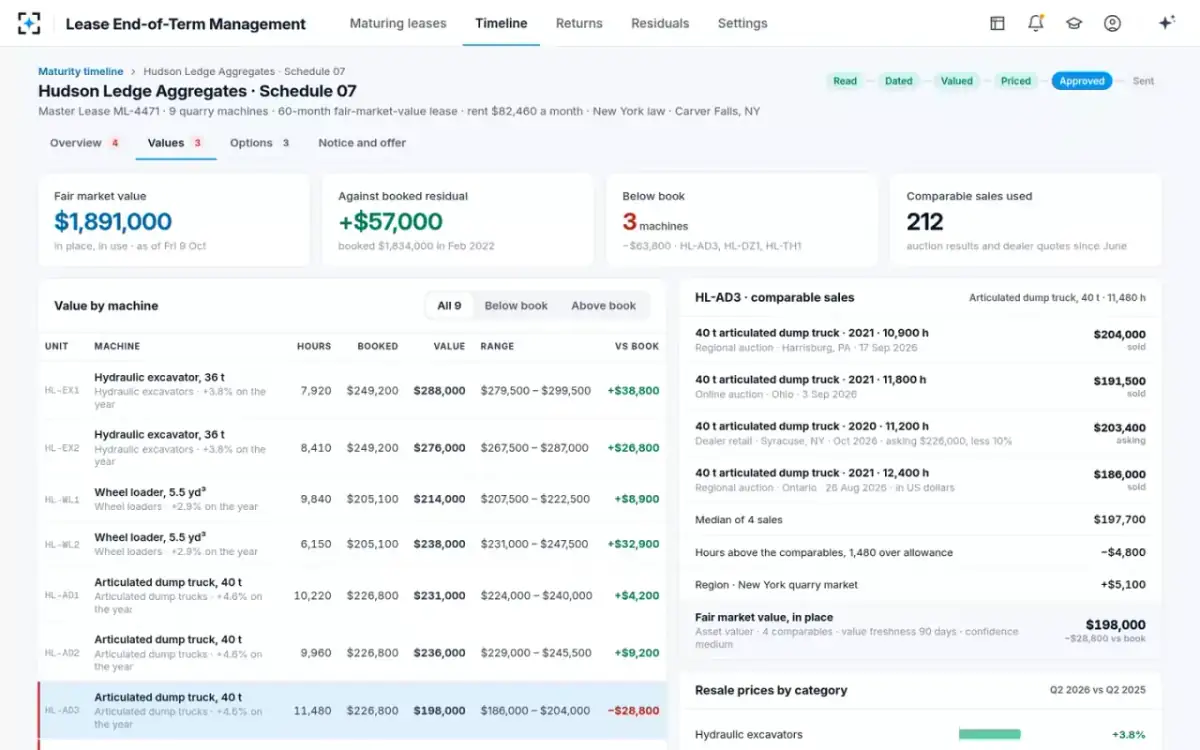
Where a valuation feeds directly into what gets offered
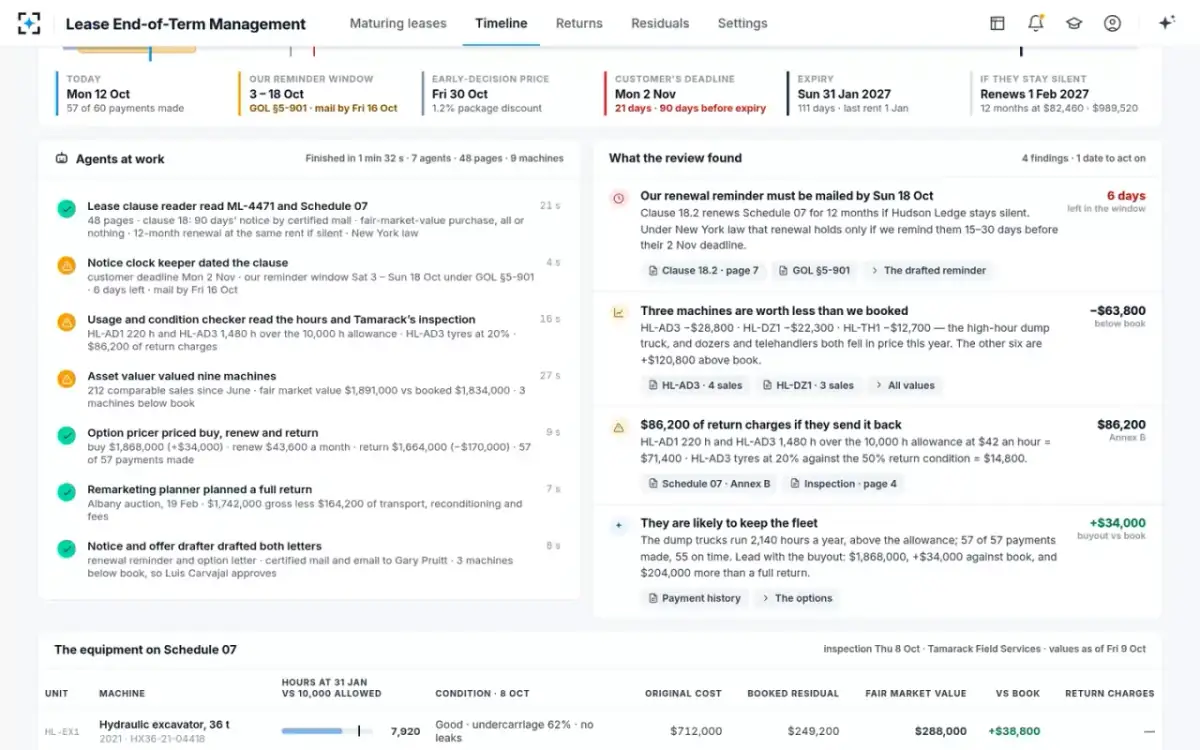
This page describes what to measure and demand; it does not publish a measured accuracy percentage for the asset valuer, because the only figure worth trusting is the one a lessor measures against its own closed files, worked through on the sample fleet above as how fair market value is calculated at lease end. To see the comparables, the range and the escalation rule together, start from Lease End-of-Term Management.
Questions people ask
How do you know if an AI equipment valuation is right?
By testing it against your own closed leases, where the actual sale or buyout price is already known, rather than trusting a published accuracy figure. The test should report both how close the valuations came and which direction the remaining errors ran, since the two directions do not cost a lessor the same amount.
What is the difference between a valuation being wrong high and wrong low?
A valuation set too low prices a buyout too low, and an accepted buyout is a sale below market that nobody re-sells to prove. A valuation set too high makes a return more likely and a lower auction result than the books assumed. Research on resale-price forecasting treats overestimating as the more severe error for a risk-averse lessor, because its loss shows up in the remarketing result.
How many comparable sales are enough to value a machine?
There is no fixed published number; what matters is whether the comparables come from the right equipment class, region and a recent enough window, and whether the value shows which sales it used so a reviewer can check them. A value built from a visible chain of sales and adjustments is more defensible than a larger, unexplained count.
How often should an equipment value be refreshed?
Often enough that it never outlives a reasonable freshness limit — 90 days, in the solution described here — and immediately when new comparable sales arrive for leases still priced on older values. A value's age is itself a risk factor, independent of how accurate it was on the day it was calculated.
What happens if an AI valuation doesn't match an independent appraisal?
The disagreement is informative: it usually means a factor specific to that machine or market is not yet reflected in the comparable sales available to the automated valuation. The independent appraisal should be treated as the better evidence for that machine, and the gap investigated before the next similar valuation is trusted.
Can you test an AI valuation against your own closed leases?
Yes, and it is the only test that answers the question that matters: compare what the valuation would have said in the weeks before each closed lease's actual outcome against what that outcome turned out to be, split by direction of error, on your own equipment mix and regions rather than a vendor's sample.