How long does it take to implement equipment lease management software for end of term? The honest answer is that it depends less on the software than on what a lessor brings to it: master lease templates it can read, the reminder laws and pricing rules it should follow, who approves what, and a sample of schedules that have already matured so the system's dates and prices can be checked against what actually happened. Lease End-of-Term Management is built and deployed from those inputs, and it goes live once every one of those checks has passed. This guide sets out what that sequence looks like, in the order it usually runs.
Nothing on this page is a published implementation date. Botminds does not commit to a fixed number of weeks, because the schedule depends on how many lease forms a portfolio carries and how many states' notice laws it has to configure. What follows is a typical pattern, built from the inputs the solution actually asks for, with each stage's purpose explained so a buyer can judge its own timeline against it.
What you bring before anything goes live
The end-of-term rules a lessor runs on are settings, not code, and every one of them has to exist before the system can date a single lease correctly. Eight of them sit in one place: the end-of-term letter timing, the renewal-reminder laws by state, how long to wait for a reply before handing a file to customer service, how fresh a valuation has to be, the discount allowed for an early decision, the rule for which option leads an offer, who co-approves a price below the booked residual, and the dollar line above which a disposal goes to a senior approver. A lessor that cannot state these eight answers for its own book is not ready to configure the system; it is still writing its own policy.
What a lessor brings to its own go-live
- Master lease templates and the end-of-term clauses they use
The forms the lease-reading step has to learn — notice periods, purchase options, renewal-if-silent language, return conditions and hours allowances.
- Your own end-of-term letter timing
How many days before expiry the lessor sends its own reminders, independent of any law — a policy choice, not a legal minimum.
- Renewal-reminder laws by state
Which states require the lessor to remind the customer before an automatic renewal counts, and the window each one sets.
- The no-reply handoff window
How many days of silence after a letter before the file moves from the end-of-term desk to customer service.
- Value freshness
How old a comparable-sales valuation may be before it has to be refreshed ahead of pricing an option.
- The early-decision discount and the lead-offer rule
How much a buyout may be discounted for a fast decision, and which option — buyout, renewal or return — the system proposes first.
- Approval thresholds
Who co-approves a price below booked residual, and the dollar amount above which a disposal needs a senior sign-off.
- A sample of your own matured schedules
Closed files with a known outcome, so the first run can be checked against what you already know happened, not against a live customer.
The last item on that list is the one a buyer most often underestimates. A matured schedule is the only input with a known right answer: the dates that were actually in force, the price that was actually agreed, the condition charges that were actually billed. Everything else on the list is a rule the lessor already knows; a sample of closed files is the only thing that tells the lessor whether the system learned the rule correctly.
Stage by stage: from your lease templates to the first live notice
A go-live runs in five stages: gathering the inputs, configuring the rules, piloting against closed files, signing off the pilot, and switching on live notices. Each stage has an exit test, and the calendar follows the tests: a book with one lease form and one state's reminder law moves faster than one with a dozen forms and reminder laws in several states.
Five stages from documents to the first live notice, and the test that ends each
| Stage | What goes in | Done when |
|---|---|---|
| 1. Gather | Master lease templates, the eight settings, a sample of matured schedules | Every lease form in the maturing book has a template, and every governing law has an owner |
| 2. Configure | Notice, pricing and approval rules as versioned settings | The owners have signed each setting as written |
| 3. Pilot, read-only | The matured sample, run end to end with nothing sent | Dates, values, prices, routing and evidence pass the five checks below |
| 4. Sign off | The pilot’s differences, each explained | The go-live owner accepts the results in writing |
| 5. Live, narrow | One lease form, one governing law, a handful of schedules | A month of live notices with no date missed and no approval skipped; then widen |
The first two stages are mostly about accuracy, not speed: getting the master lease templates right so the clause-reading step extracts the correct notice periods and purchase-option types, and getting the eight settings right so dates and prices are built on the lessor's own policy rather than a default. The middle stage, piloting on schedules that have already matured, is where most of the real time goes, because it is the only stage with a check against a known outcome. The last two stages are approvals: first that the pilot's results match what happened, then that a narrow first batch of live notices is safe to send.
Why the first run is always on a lease that has already matured
A pilot that runs on live, open schedules has no way to mark its own homework: nobody yet knows whether the dates or the price the system proposed were right, because the lease has not finished playing out. A pilot that runs on a schedule that has already matured has an answer key — the notice that was actually required, the date it was actually due, the price the customer actually paid or the condition charges actually billed — so every date and figure the system produces can be checked against a known fact before the method is trusted on a file that is still open.
This is also where under-tested rules get caught before they cost anything. Raymond Panko's review of spreadsheet error research, the tool many end-of-term desks start from, reports an average cell error rate of 3.9% across fourteen laboratory studies and concludes that "given likely error rates in operational spreadsheets, extensive testing will be needed—more extensive than the testing that was done on operational spreadsheets". The same logic applies to a newly configured rule set: an end-of-term letter timing typed in wrong, or a state's reminder law mapped to the wrong window, behaves exactly like a spreadsheet formula with one cell wrong — correct-looking until it is checked against a result nobody can dispute. A matured schedule is that check.
How many matured schedules is enough? If a pilot finds no wrong date in n independent schedules, the statistician's rule of three (Hanley and Lippman-Hand, JAMA, 1983) puts the upper bound of a 95% confidence interval on the error rate at about 3 ÷ n. A clean run on 60 schedules bounds the rate under 5%; on 300, under 1%. The sample should include the awkward ones: amended schedules, early buyouts, a renewal by clause, and every governing law the book carries.
What a clean pilot proves about the date error rate, by number of matured schedules
Setting your own notice, pricing and approval rules before day one
Every rule a lessor configures changes a date or a price somewhere downstream, which is why the order matters. The notice rules — the lessor's own letter timing and any state reminder law — set the calendar every other step reads from. The pricing rules — value freshness, the early-decision discount, the lead-offer rule — set what an option is worth once the calendar says it is time to offer it. The approval rules — who signs off on a below-book price, what dollar amount escalates to a senior approver — decide who has to look at the answer before it goes out.
Getting the lease term itself right underpins all three. Under the US GAAP lease standard, Topic 842, an entity determines a lease's term having "considered all relevant factors that create an economic incentive for the lessee" to extend or not terminate — contract terms, the asset's importance to the lessee's operations, the cost of moving to a different machine. A configuration that gets the underlying lease term wrong, even by a renewal period, moves every date downstream of it, which is exactly why the lease templates come first on the list of inputs and the pilot on matured schedules comes before any live notice.
What has to pass before anything goes live
A go-live does not happen on a target date; it happens once a short list of checks has passed, in a fixed order, on the pilot's own matured schedules. The checks are not a formality — each one is a specific comparison between what the system proposed and what the file's own history already shows.
What has to pass before the first live notice
Every notice window and expiry date the system reads from a matured lease matches the dates that were actually in force on that file.
Comparable-sales valuations on the pilot's machines fall within the range the lessor's own appraisals or sale prices already showed.
Buyout, renewal and return prices, run through the lessor's own discount and lead-offer settings, land where the lessor's own policy would have put them.
Every price below booked residual is routed to the named co-approver, and every disposal above the escalation threshold is routed to the senior approver — nobody skipped.
Every date, value and price traces back to the page of the lease or the sale it came from, so a reviewer can check the system's reasoning, not just its answer.
"Documentation can enhance transparency, improve human review processes, and bolster accountability in AI system teams," the NIST AI Risk Management Framework observes (AI RMF 1.0), and the fifth check above is exactly that principle applied to one maturing lease: a reviewer who disagrees with a proposed price should be able to open the comparable sale or the clause behind it, not take the number on faith. A pilot that passes checks one through four but cannot show its sources has not passed; it has only produced numbers that happen to look right.
Who signs off on the below-book and VP-escalation thresholds before launch
The approval thresholds are a lessor's own credit policy, not a default the software ships with, and they need a named owner before the first live notice goes out — not because the software requires a signature, but because a price below what the lessor already booked as the asset's residual value is a decision somebody at the lessor has to own.
Who signs off on what, before go-live
| Decision | Typical owner | What they are approving |
|---|---|---|
| End-of-term letter timing and reminder-law settings | Portfolio operations lead | The calendar every notice and deadline is built from. |
| Value freshness and the early-decision discount | Asset management lead | How current a valuation must be, and how much a fast decision is worth giving up. |
| Any price below booked residual | Asset manager | A specific machine priced under what the lessor already carries it at. |
| Disposals beyond the escalation threshold | Senior portfolio or asset management leadership | A return or sale large enough to need a second, more senior look before it is approved. |
| The pilot results themselves | Whoever owns the go-live decision | Whether the five checks above have in fact passed on the sample of matured schedules. |
The model risk guidance the US banking agencies issued in April 2026 says the same about tools it does not cover, generative and agentic AI among them: "a banking organization's risk management and governance practices should guide the determination of appropriate governance and controls for any tools, processes, or systems not covered in this document" (SR 26-2, footnote 3). An equipment lessor is not necessarily a bank, but the principle travels: the software proposes a price; the lessor's own governance decides who is allowed to accept it.
How a pilot on closed files differs from a pilot on live customers
A pilot on matured schedules never reaches a customer. Nothing is mailed, nothing is emailed, and the system's proposed dates and prices sit beside the file's own already-known outcome for comparison. That is what makes it safe to run before any configuration has been proven: a wrong notice window or a mispriced option on a closed file costs nothing but a correction to a setting.
A pilot on live customers, once it starts, is no longer a test in the same sense — a notice mailed under the wrong reminder window, or an offer priced from a stale valuation, has reached someone who will act on it. That is why the sequence runs pilot-then-live and not the other way around, and why the first live batch is usually narrow: a handful of schedules, one lease form, one state's reminder law, so that if a setting still needs a correction the blast radius is a handful of letters rather than a whole book.
What 'live' means the first week, and what changes after
In its first week live, the system is usually narrower than its final scope: one lease form, one jurisdiction's reminder law, a handful of schedules the end-of-term specialist watches closely before anything mails. Every notice and offer still goes through a named person who approves and sends it — that does not change at go-live and does not change afterward. What changes is scope and trust: more lease forms are added as each is checked against its own matured sample, more states' reminder laws are configured as the portfolio needs them, and the specialist spends less time re-checking dates the system has proven reliable on and more time on the judgment calls — a below-book price, an ambiguous clause, a customer who has gone quiet.
By the point a lessor would usually call the rollout finished, the measure that matters is not a week count but a coverage count: how much of the maturing book runs through the configured rules with no date missed and no approval skipped, against how much is still only a target. The eight settings set out above are the inputs that number is built from, and a lessor that has all eight answered, and a sample of matured schedules checked against them, has done the real work of going live — whatever week it happens to land on.
The settings a lessor configures before go-live
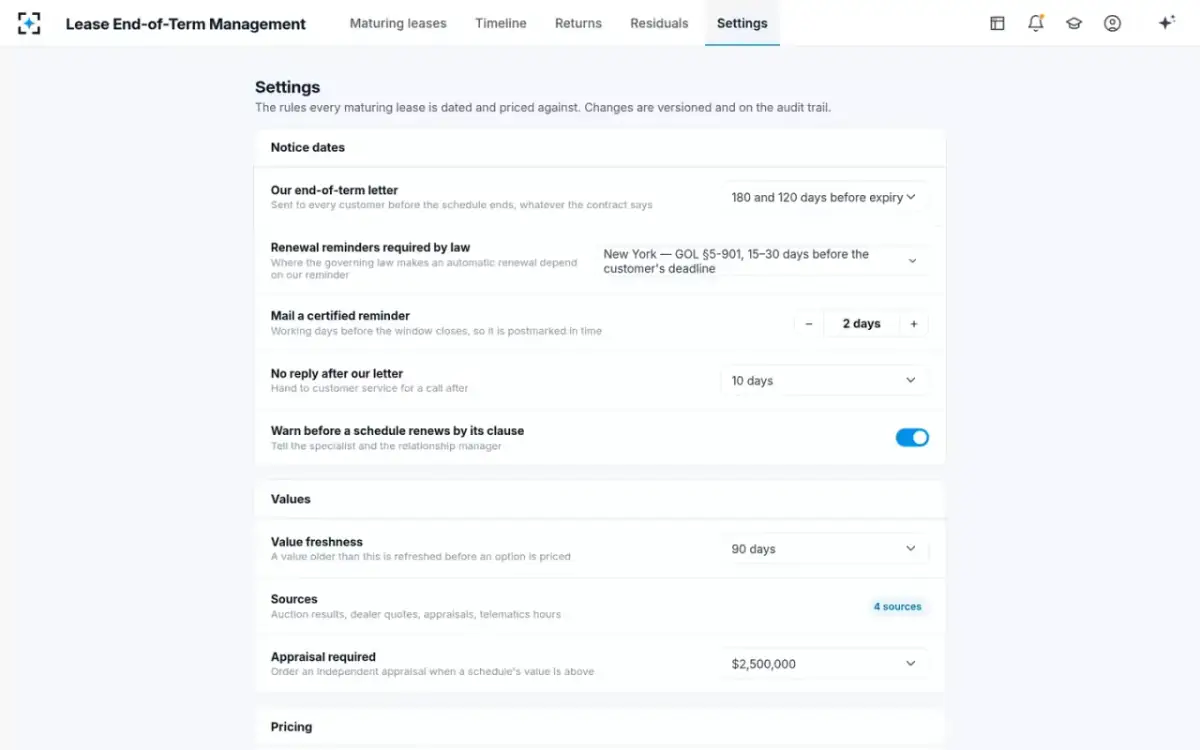
Once those settings are in place, the day-to-day work looks like the gallery every end-of-term specialist opens each morning: every schedule maturing in the next 180 days, priced and dated against the rules the lessor just configured.
The first screen a specialist opens, once live
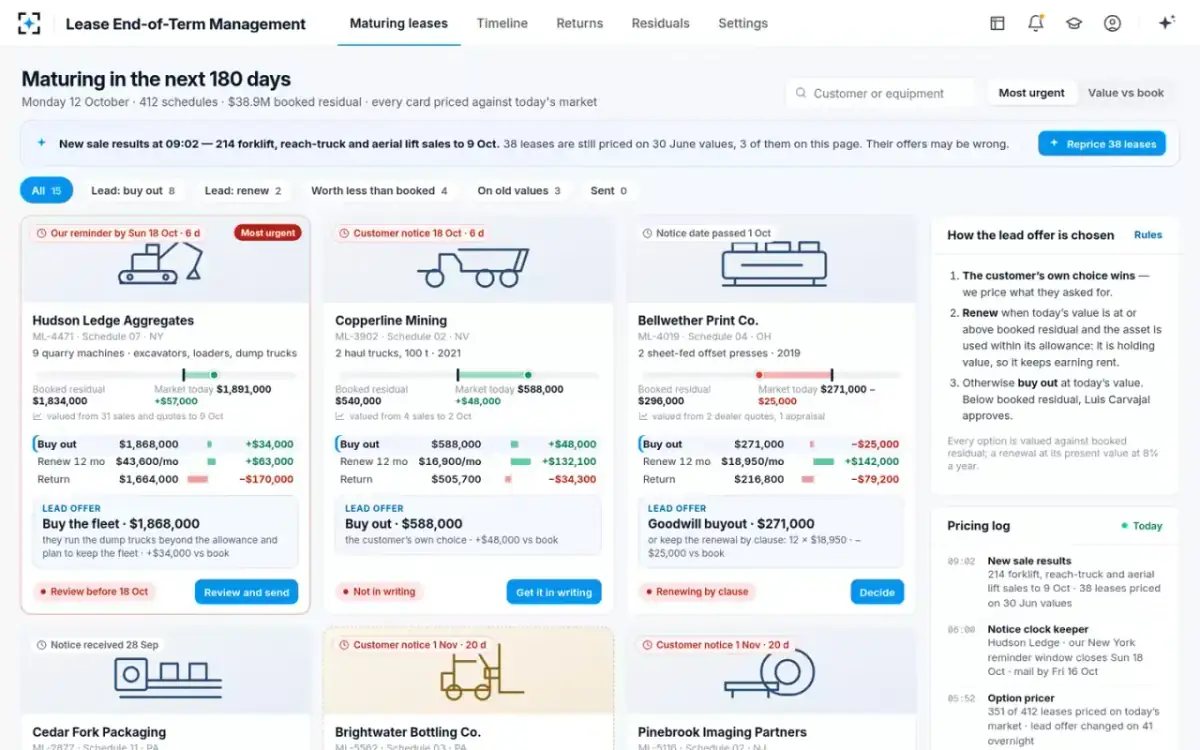
To see the settings, the checks and the first notice working together on one lease from the inside, seven agents review a lease end of term follows one schedule through the same sequence this page describes in general. For the fully worked case of one quarry fleet going from maturing to mailed, start from Lease End-of-Term Management.
Questions people ask
How long does it take to implement equipment lease management software?
Botminds does not publish a fixed duration, because it depends on how many lease forms and how many states' reminder laws a portfolio needs configured. The pattern runs through gathering documents and settings, configuring notice and pricing rules, piloting on schedules that have already matured, approving the pilot's results, and switching on a narrow first batch of live notices — in that order, whatever the calendar turns out to be.
What documents do you need to go live on end-of-term automation?
Master lease templates and their end-of-term clauses, the eight notice, pricing and approval settings a lessor already runs on in some form, and a sample of schedules that have already matured. The templates and settings tell the system the rules; the matured schedules are what let anyone check whether it learned them correctly.
Can you pilot it on leases that have already matured?
Yes, and that is the recommended first run. A matured schedule has a known outcome — the notice that was required, the price that was agreed — so the system's proposed dates and prices can be checked against a fact nobody disputes, before any notice reaches a live customer.
What has to be true before the first automatically drafted notice goes out?
Five things: the dates the system reads match the pilot schedules' own history, its valuations fall inside the lessor's own range, its prices land where the lessor's policy would put them, below-book prices and large disposals are routed to the right approver, and every figure traces back to the clause or the sale behind it.
Who has to sign off before a new pricing rule goes live?
Whoever owns that setting at the lessor. Notice timing and reminder-law settings typically sit with portfolio operations; value freshness and discount rules with asset management; any price below booked residual needs the asset manager by name, and large disposals need a more senior sign-off — the same approval structure a lessor already runs, applied to a new rule before it reaches a customer.
How do you test it without risking a real customer notice?
By running the whole sequence — reading the lease, dating the clauses, valuing the machines, pricing the options, drafting the letters — on a schedule that has already closed, so nothing is mailed or emailed. The draft notice sits beside what was actually sent on that file, for comparison, and nothing reaches a live customer until that comparison has passed.