How long is an equipment residual value quote good for? Long enough to send, and no longer than the next batch of comparable sales that lands for the same equipment class. A fair-market-value offer is a measurement of a market taken on one day; the market itself does not pause while a customer reads the letter and decides. Lease End-of-Term Management treats that as a fact to watch for, not a risk to accept: when new sales arrive, every schedule still priced on the older values can be repriced in one pass, and where the lead offer changes, the old one is struck through rather than quietly updated.
The example below is a fictional sample lease as it runs through the solution: a 2022 electric forklift on a schedule belonging to Brightwater Bottling, repriced the morning after a batch of new sales arrived for its equipment class.
An offer is a snapshot; the market underneath it isn't
Every fair-market-value figure is built from comparable sales that closed by a certain date. The figure itself does not expire the instant a new sale happens somewhere else, but its accuracy does start to erode, because the market it describes has moved on without it. A quote sent on a Monday, based on sales through the previous Friday, is accurate about Friday's market. Whether it is still accurate about Thursday's market, when the customer finally replies, depends entirely on what happened to comparable sales in between.
For most equipment and most negotiations, that gap is small enough not to matter. It starts to matter when a batch of new sales arrives for exactly the equipment class sitting in an open offer, and the two can easily cross paths without anyone noticing unless something is actively watching for it.
What changed for one forklift between the quote and the reply
Brightwater Bottling's 2022 electric forklift was quoted by the lease system at its booked residual, $9,400, with 3,150 of its 4,000 allowed hours used: a lightly run machine. Overnight, 214 forklift, reach-truck and aerial-lift sales through 9 October arrived; 38 leases across the book were still priced on values from 30 June, and one click repriced every one of them against the new sales. Six of the new forklift sales put this machine at $10,800.
Brightwater's forklift, before and after the 9 October sales
Quoted by the lease system: $9,400, the booked residual
Repriced on six new forklift sales: $10,800, $1,400 above book
Quoted by the lease system: $9,400
Repriced on six new forklift sales: $10,800, +$1,400 against book
Quoted by the lease system: Not offered
Repriced on six new forklift sales: $410 a month, +$4,300 against book at present value
Quoted by the lease system: Not priced
Repriced on six new forklift sales: $8,900 net, −$500 against book
Quoted by the lease system: Buy out at $9,400
Repriced on six new forklift sales: Renew 12 months at $410
The repriced value, $10,800, is $1,400 above the booked residual — this forklift, lightly used, turned out to be worth more than the lease assumed, not less. Paired with 850 hours of allowance still unused, the lead offer flipped from a buyout at the old value to a twelve-month renewal at $410 a month: $4,920 of rent plus the forklift a year later, worth $4,300 more than book to the lessor at present value, and $2,900 more than a buyout at the new $10,800. Had the old quote gone out and been accepted, the lessor would have sold a $10,800 machine for $9,400.
One repricing pass, one morning
214
forklift, reach-truck and aerial-lift sales through 9 Oct behind the new values
38leases
still priced on 30 June values before the one-click repricing
+$1,400
Brightwater's forklift, repriced above its $9,400 booked residual
+$2,900
what the renewal is now worth over a buyout at the new value
Which way is the costlier mistake: a stale value too low, or too high?
It depends on which way the market moved, and the two errors cost different things. When values rise, as Brightwater's did, a stale quote is too low: if the customer accepts the buyout, the lessor has sold the machine below its market, and that cannot be undone. When values fall, a stale quote is too high: the customer is more likely to decline the buyout and send the machine back, and the lessor then remarkets it at the lower price. The same 9 October batch did both. Two other schedules in the sample book, Orchard Crest Foods and Kestrel Lift Hire, were repriced below their booked residuals, by $12,000 and $8,400, and their lead offers moved to a buyout at today's value, which under the sample rules needs the asset manager's co-approval.
Research on residual values explains why lessors fear the second case. A study of car-lease residual forecasting by Dress, Lessmann and von Mettenheim notes that overestimating the resale price "leads to an unexpected decrease of profit – and maybe a loss – when remarketing the returned car", so "a risk-averse manager will thus consider overestimating to be the more severe error". Building that asymmetry into the forecast, when overestimating cost twice as much, reduced decision costs by about eight percent in their tests. At lease end the practical lesson is narrower: reprice before the customer's reply, in both directions, because only a current value tells the specialist which mistake an open offer is about to make.
One overnight batch: 38 leases repriced, four lead offers changed
| Schedule | New value against book | Lead offer now | Who approves |
|---|---|---|---|
| Brightwater Bottling, electric forklift | $10,800, +$1,400 | Renew 12 months at $410 | The end-of-term specialist |
| Orchard Crest Foods | $186,000, −$12,000 | Buy out at $186,000 | Specialist, with the asset manager for a below-book price |
| Kestrel Lift Hire | $52,800, −$8,400 | Buy out at $52,800 | Specialist, with the asset manager for a below-book price |
| The other 35 repriced leases | Moved, lead offer unchanged | As before, at today’s value | Sent only if the specialist chooses |
Setting a freshness window that matches how fast your asset classes move
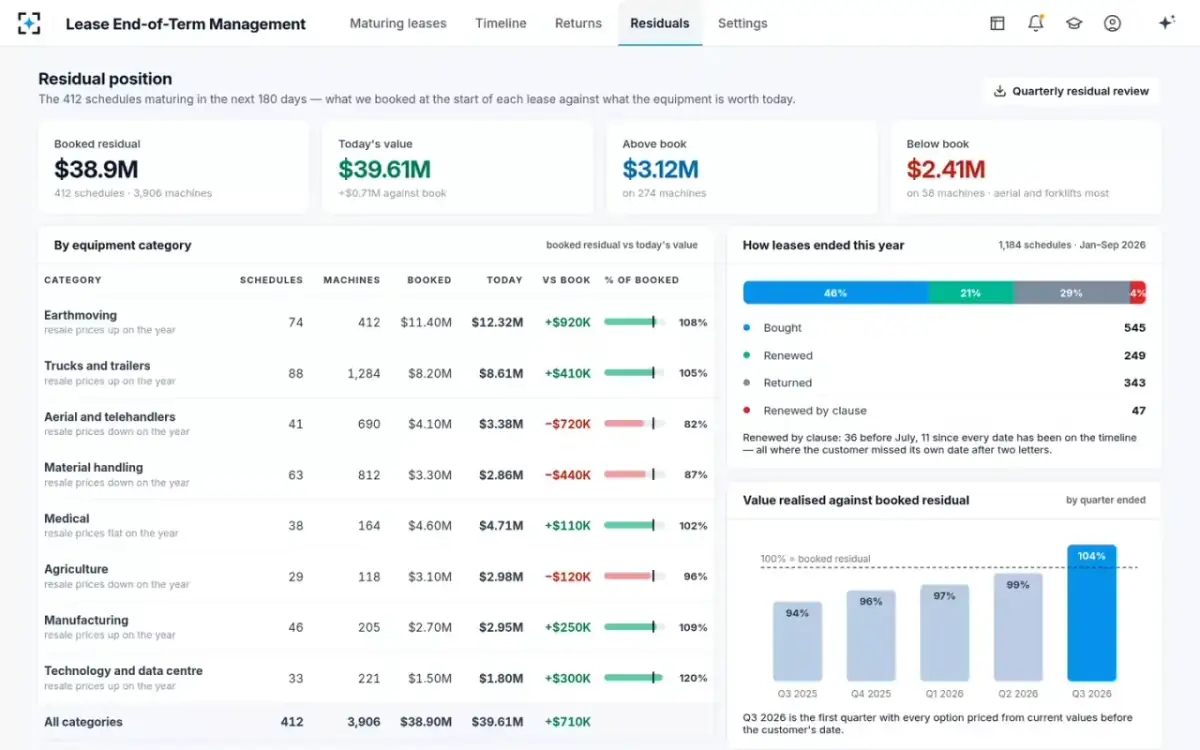
A single freshness setting across an entire equipment book treats a slow-moving asset class and a fast-moving one the same way, and one of the two will be wrong. In the sample book, earthmoving resale values are up on the year and stand at 108% of booked residual, while material handling, where Brightwater's forklift sits, is down and stands at 87%; one machine above book in a category below it is exactly the case a category average misses. Lease End-of-Term Management's default, ninety days, is a ceiling, not a target: a lessor whose book leans toward equipment with thinner, more volatile resale markets can set it shorter, trading more frequent refreshes for less drift between a quote and a reply.
What 'reasonably certain' means once the price behind the option has moved
"The existence of any one factor does not necessarily signify that a lessee is reasonably certain to exercise or not to exercise an option." A repriced value changes one factor in that assessment — what the asset is now worth relative to the option price — without changing the others, such as how the customer has actually used the machine. Brightwater's lightly run forklift kept the same usage signal before and after the repricing; what changed was which option that signal now favored.
What should happen automatically when new sales arrive mid-negotiation
Three things, in order: the new sales should update the comparable-sales value for every affected schedule, not just the one under negotiation; every option price built from that value — buyout, renewal, return — should be recalculated against the new figure; and the change should be visible, not silent, so the person who sent the original offer knows it has moved before the customer replies to it. A system that quietly updates a number in the background without flagging the change creates a different problem: a specialist who still believes the original offer is current.
The National Institute of Standards and Technology's AI Risk Management Framework lists, among practical approaches to AI safety, "rigorous simulation and in-domain testing, real-time monitoring, and the ability to shut down, modify, or have human intervention into systems that deviate from intended or expected functionality" (NIST AI 100-1, 2023). A repricing pass that runs without a visible flag for the one offer that is still live with a customer is exactly the kind of deviation that intervention should catch before anything is sent.
When a repriced offer should go back to the customer, and when it shouldn't
Not every repricing changes anything the customer needs to hear about. A value that moves slightly but leaves the lead offer the same option, at close to the same price, is worth noting internally and leaving alone — resending a letter over a few hundred dollars reads as noise, not care. A repricing that flips which option is best, as it did for Brightwater's forklift, or that moves the price by an amount the customer would reasonably want to know before deciding, is worth a new offer before the old one is accepted.
The specialist, not the repricing itself, makes that call, which is why Lease End-of-Term Management surfaces the change rather than resolving it automatically: the old lead offer stays visible, struck through, next to the new one, so the decision about whether to go back to the customer is made with both numbers in view.
After a repricing: when to send the customer a new offer
| What the repricing did | Customer has not replied | Customer has already accepted |
|---|---|---|
| The lead offer changed, as on Brightwater | Send the new offer, with a line on what changed and why | Honour the accepted offer; the price was a commitment |
| The quoted option moved against the lessor, below book | Hold the offer until the asset manager has seen the new value | Honour it; record the gap for the residual review |
| The quoted option moved in the lessor’s favour | Usually leave it: resending a higher price reads as a retreat | Nothing to do |
| A small move, the same lead offer | Note it; no letter | Nothing to do |
The old offer struck through, the new one beside it
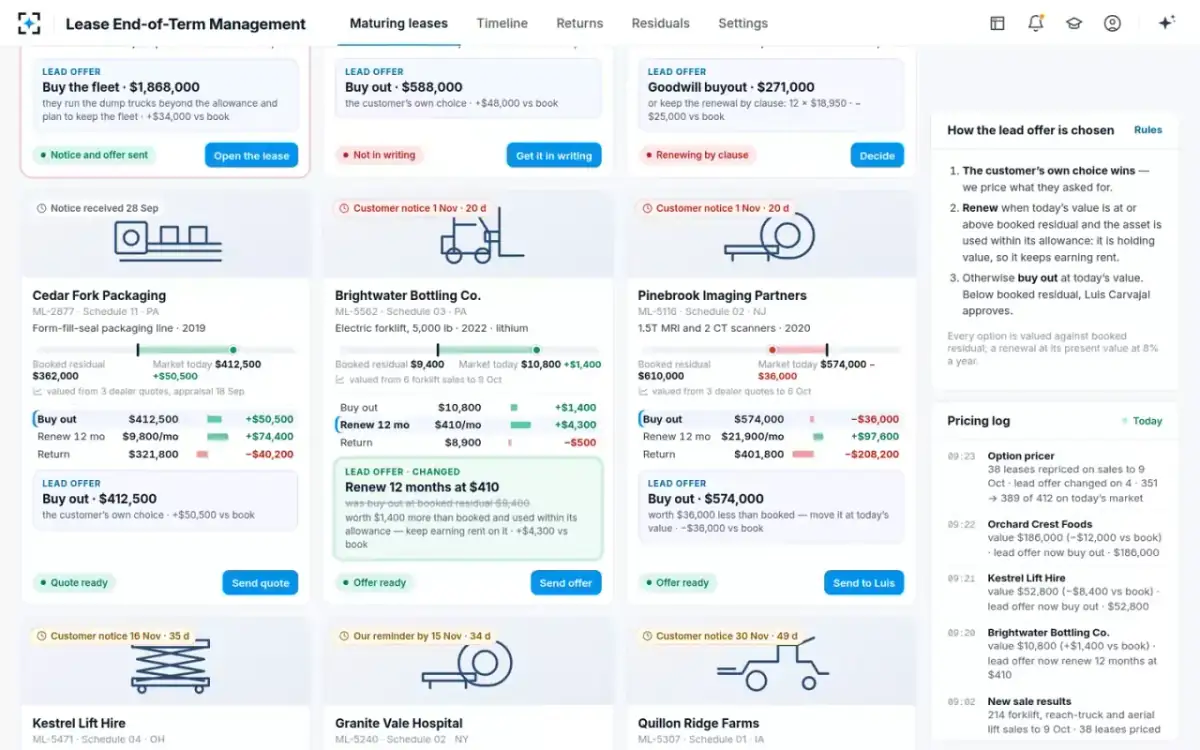
What a repricing batch looks like across a whole book, not just one forklift
Brightwater's forklift is one row in a larger batch, and the batch is usually the more useful unit to look at, because a single repriced schedule can look like an isolated correction when it is really a sign that an entire equipment class moved. The 9 October batch touched 38 leases still priced on 30 June values, across the machine types the new sales covered: forklifts, reach trucks and aerial lifts. Looking at the batch rather than the single schedule answers a different, more useful question: not "was this one offer stale," but "how much of the open book was quietly running on an out-of-date market view until this morning."
That distinction matters for how a portfolio lead reads the result. Thirty-eight repriced leases with four lead offers changed is a routine refresh with four decisions in it. A lead offer that flips, the way Brightwater's did, is the signal worth a second look — not because the repricing did anything unusual, but because a flipped lead offer is exactly the kind of change a customer would want to know about before accepting whatever they were quoted under the old numbers.
The residual position: which categories are moving, and how leases ended
Building a habit of checking a quote, not just setting one
The discipline this page argues for is small and easy to skip: before accepting a customer's reply to an offer that has been open for more than a few days, check whether the value behind it is still the freshest one available, not just whether it is still inside the freshness window. A value ninety days old and a value calculated yesterday can both be technically current under a ninety-day setting, but only one of them reflects this morning's sales.
How that value was built in the first place — the comparables, the hours adjustment, the regional adjustment — is worked step by step in how fair market value is calculated at lease end. To see a whole fleet priced and repriced together, start from Lease End-of-Term Management.
Questions people ask
How long is an equipment valuation good for before it's stale?
Technically, until it passes the freshness setting — ninety days by default in Lease End-of-Term Management. Practically, it is stale the moment a new batch of comparable sales arrives for the same equipment class, which can happen well inside that window.
What happens if new comparable sales arrive after you've already sent an offer?
The value behind the offer can be recalculated against the new sales, and if the lead option changes, the old offer should stay visible for comparison rather than being silently replaced — the specialist decides whether the change is big enough to send the customer a new offer.
Should a lessor reprice an offer the customer hasn't accepted yet?
It is worth checking, especially on an offer that has been open for several days. An open offer is a snapshot of the market on the day it was calculated, and the market does not pause while the customer decides.
Why would a buyout and a renewal switch which one is the better deal overnight?
Because the repriced value changes which option a lightly used machine favors. A forklift that comes in above its booked residual, with hours allowance still unused, can make a renewal worth more than the buyout it was originally quoted against, as happened on Brightwater Bottling's sample schedule.
How often should equipment values be refreshed during a live negotiation?
At minimum whenever new comparable sales arrive for the equipment class involved, and always before accepting a customer's reply on an offer that has been open more than a few days. The freshness setting is a ceiling, not a reason to wait that long.
What's the risk of leaving a stale offer in front of a customer once the market has moved?
If the market rose, a stale buyout quote is too low, and a customer who accepts it buys the machine below its value. If the market fell, a stale quote is too high, the customer is more likely to return the machine, and the lessor remarkets it at the lower price; research on residual-value forecasting treats that overestimate as the more severe error for a risk-averse lessor.