To report a 314(a) match, first confirm that the account or transaction belongs to the subject on FinCEN's list, then, within two weeks of the posting, mark that subject as a positive match in FinCEN's secure portal and submit. FinCEN asks only for that confirmation; the regulation lists what a full report contains (the subject's name, the account number or the date and type of the transaction, and the identifiers the customer gave), and the bank may add detail in a comment. If nothing matches, FinCEN instructs the bank not to reply at all. The difficult parts are the confirmation and the silence around it: no one outside the people who must know may learn that FinCEN asked. Botminds' FinCEN 314(a) Requests is an agentic solution that drafts each reply from a confirmed match, holds it for the BSA Officer's approval and submits it, so no reply goes in on one person's word.
The rules come from 31 CFR 1010.520, FinCEN's 314(a) fact sheet, its 2025 paperwork notice and the FFIEC examination manual. The worked reply is from a fictional sample credit union, Norrell Federal Credit Union, and its sample list.
From a confirmed match to a submitted 314(a) reply
A person decides
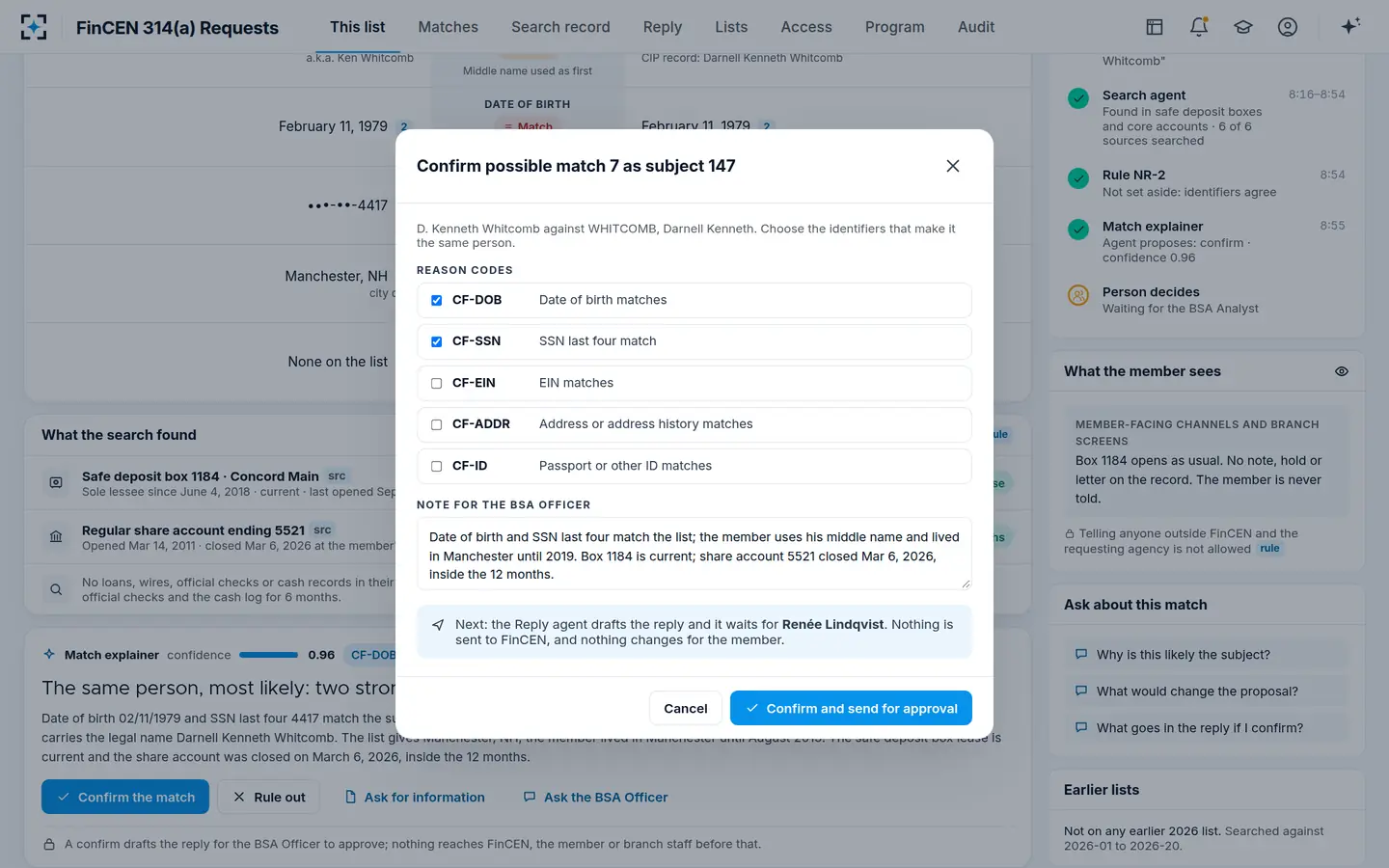
BSA Analyst confirmsDecides that the record is the subject, ticking the identifiers the decision rests on, such as date of birth and SSN.
Agent
Reply agent draftsWrites what the reply will say: the subject, the match type, the account or transaction, the identifiers given at opening.
Never: drafts a reply for a subject nobody confirmed
A person decides
BSA Officer approvesReads exactly what the reply says, then approves it or returns it with a reason; the Deputy approves when the Officer confirmed the match.
Agent
Reply agent submitsMarks the subject as a positive match in FinCEN's secure portal and records FinCEN's receipt.
Never: replies on a list with no match
Agent
Hand-off agentDrafts a restricted internal referral with the guardrail that a list match alone is no reason for a SAR or a closure.
Never: contacts the customer
How do you report a 314(a) match? Confirm, then mark it in FinCEN's portal
A 314(a) match is reported in FinCEN's portal by checking the subject and submitting, after the bank has confirmed the match. FinCEN's 2025 paperwork notice describes the screen: an institution, "presented with a list of one or more subjects per Section 314(a) Request, need only check the box next to any subject for which it can confirm a positive match in its records and click 'submit'". FinCEN estimates the reporting step at 30 seconds per subject, on top of the search.
Those 30 seconds come at the end of everything that matters. The confirmation is the decision; the checkbox only records it. A bank's procedure should therefore put its controls before the click: who may confirm, which identifiers a confirmation needs, who approves before submission, and where the evidence is kept. How a confirmation is reached, and how to test a search for missed matches, is in what counts as a 314(a) positive match.
The reply is the smallest part of a 314(a) match, and the most consequential
30sec
FinCEN's estimate to report a subject, once the search is done
2wks
from the posting date to report every positive match
64,259
positive responses institutions sent in fiscal 2025
114
law enforcement agencies behind the requests in fiscal 2025
What information is reported for a 314(a) match?
The rule lists three items; FinCEN's portal asks for less, and the bank may offer more. Under 31 CFR 1010.520(b)(3)(ii), a bank that finds a match must report "the name of such individual, entity, or organization", "the number of each such account, or in the case of a transaction, the date and type of each such transaction", and any Social Security number, taxpayer identification number, passport number, date of birth, address or similar information "provided by the individual, entity, or organization when each such account was opened or each such transaction was conducted".
FinCEN's practice is lighter. "To minimize burden on financial institutions, financial institutions only must confirm with FinCEN that they have a positive match to the subject," the notice says, "in contrast to the detailed information a financial institution would otherwise be required to report". The FFIEC manual adds that "a bank may choose to provide information in addition to a confirmation of a positive match in the comment section of the bank's response", because the information is valuable to law enforcement.
A 314(a) reply in three layers: what the portal needs, what the rule lists, what a bank may add
| Item | Portal confirmation | Listed in the rule | Optional comment |
|---|---|---|---|
| The subject is a positive match | Required: the checkbox | Implied | Not needed |
| Name of the person or business | Shown on the list | Yes | The name on the bank's record, if it differs |
| Account number, or the transaction's date and type | Not asked | Yes | Often added: the agency's next step depends on it |
| Identifiers the customer gave at opening | Not asked | Yes, as available | Date of birth, TIN, address, ID used |
| Account status and dates | Not asked | No | Open or closed, and when, inside the window |
| Why the bank thinks it is the subject | Not asked | No | Rarely useful; the agency verifies through legal process |
Do you report no match on 314(a)?
No. FinCEN's 314(a) fact sheet says that "if the search does not uncover any matching of accounts or transactions, the financial institution is instructed not to reply to the 314(a) request", and FinCEN's notice repeats that institutions "do not need to reply". Most lists produce no reply from most institutions; at the fictional sample credit union, two of the five lists before the sample one ended with no match and no reply.
The silence has a cost the reply does not: for a list with no match, nothing at FinCEN shows that the bank searched. The proof has to come from the bank, which is why the FFIEC manual passes on FinCEN's recommendation to keep records that show every required search was done and every positive match reported. What those records should hold is the subject of 314(a) record retention requirements.
What is FinCEN's secure information sharing system?
It is the web portal through which FinCEN posts 314(a) lists and institutions answer them, long known as the Secure Information Sharing System, or SISS, and now part of FinCEN's Financial Industry portal. FinCEN's Section 314(a) page told users that the old addresses "will no longer be valid after 5/23/2024" and pointed them to fiportal.fincen.gov. The same portal carries 314(b) registration, and offers an activity report showing a bank's download and response history.
Access is personal. The FFIEC manual states that a bank may not give a third-party vendor direct access to the system, and passes on FinCEN's position that a bank cannot give a vendor its user ID and password. A bank that uses a vendor or software to search still submits its replies through its own designated people.
The 314(a) reply, field by field, on a sample match
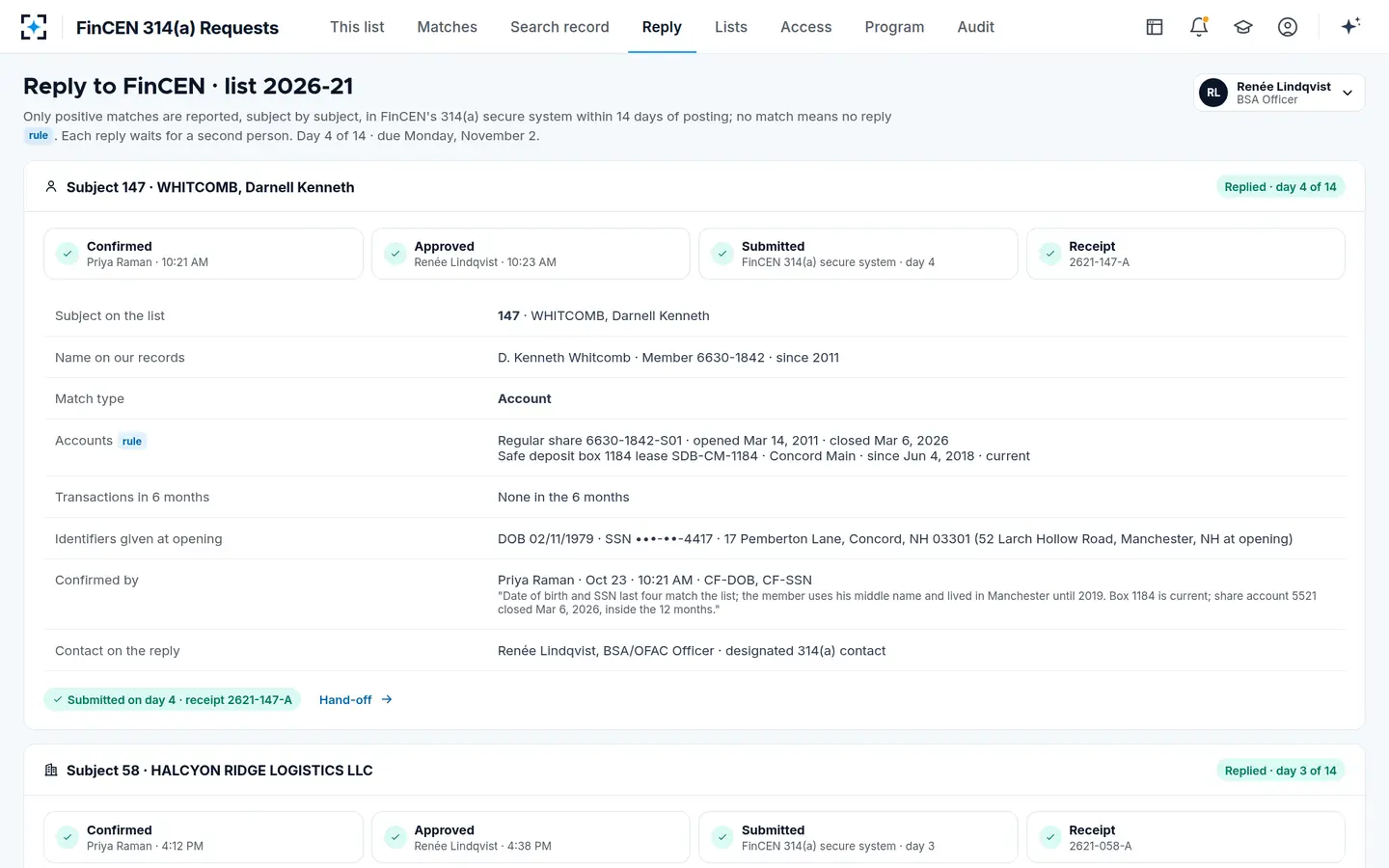
A good reply says what the bank found and nothing it did not. On the fictional sample list, subject 147, WHITCOMB, Darnell Kenneth, matched a member on file as D. Kenneth Whitcomb. The analyst confirmed at 10:21 on day 4 on two identifiers: date of birth and SSN last four. The reply the BSA Officer read before approving held the match type (account), a regular share account opened March 14, 2011 and closed March 6, 2026, inside the twelve months, a safe deposit box lease current since June 4, 2018, no transactions in the six months, and the date of birth, SSN and addresses given at opening.
FinCEN 314(a) Requests: the analyst confirms, with the reasons ticked
FinCEN 314(a) Requests: the reply the BSA Officer approves, field by field
Who do you contact about a 314(a) match?
For questions about a particular request, the person the request names; for the program, FinCEN's 314 Program Office. Every request must "identify one person at the agency who can be contacted with any questions relating to its request", and the rule lets a bank contact that agency, FinCEN or the requesting Treasury component "with any questions relating to the scope or terms of the request". FinCEN's estimates allow for exactly this when a match is ambiguous. The FFIEC manual gives sys314a@fincen.gov as the address for FinCEN's 314(a) FAQs and the 314 Office.
The bank's own contact appears on the reply too. At the sample credit union, the reply carries the BSA/OFAC Officer as the designated 314(a) contact, so an agency that follows up reaches someone who knows the case, not a branch.
Do you file a SAR for a 314(a) match?
Not because of the match alone. The FFIEC manual says "banks are not required to file a SAR solely because accounts or transactions involving Section 314(a) subjects are identified", and that any SAR follows the suspicious activity rules and the bank's own procedures. Its SAR section makes the general point that a law enforcement inquiry does not, on its own, require a SAR, while noting that an inquiry may be relevant to the bank's monitoring of the customer (FFIEC, suspicious activity reporting).
The sensible response is a review on the merits. A confirmed subject's activity is worth a fresh look by the BSA team: if it shows suspicious activity the bank would report anyway, a SAR follows from that activity; if it does not, the match stays a lead for law enforcement and nothing more. The same logic applies to closing the account. The rule says expressly that nothing in it requires a bank "to take any action, or to decline to take any action" on a subject's account, and the FFIEC manual says the list should not be the sole basis for that decision.
Can you tell the customer about a 314(a) match?
No. A bank "shall not disclose to any person, other than FinCEN or the requesting Treasury component, the law enforcement agency on whose behalf FinCEN is requesting information" that FinCEN has requested or obtained information, except as needed to comply; the FFIEC manual also names the bank's primary regulator. That rules out the customer, and in practice it rules out branch staff, account notes, letters and changes the customer could notice and connect to the request.
After a 314(a) match: what the bank does, and what it does not
Does: Reports the positive match within the window, with the detail its procedure allows.
Does not: Report a name-only hit to be safe, or reply on a list with no match.
Does: Keeps serving the customer as before unless its own review says otherwise.
Does not: Tell the customer, hint in a letter, or freeze the account because of the list.
Does: Keeps the evidence of the confirmation and the reply in a restricted place.
Does not: Write the match in an account note, a branch alert or a CRM field.
Does: Opens a restricted internal review of the activity on its merits.
Does not: File a SAR, or close the account, solely because the subject was listed.
Does: Routes any subpoena that follows to the team that handles legal process.
Does not: Send documents to the agency on the strength of the 314(a) request alone.
After the reply: what makes the agency come back
A positive reply tells an investigator where to look; it does not hand over records. FinCEN's fact sheet calls 314(a) lead information only, and says an agency that wants documents from a bank that reported a match "must meet the legal standards that apply to the particular investigative tool that it chooses to use". The next contact is usually a subpoena or other legal process, and it belongs with the team that handles legal process, which needs the case reference, not the list.
The lead also runs one way. In interviews for a 2024 report, the Government Accountability Office heard from bank representatives that "having a positive match for a 314(a) request informs them that law enforcement is interested in the person but does not tell them why" (GAO-24-106301). A bank's review after a match therefore starts from its own records, which is one more reason to keep the evidence of the confirmation with the case.
Before you submit a 314(a) reply: six checks
- The subject is confirmed, not similar
At least the identifiers the procedure requires agree, none conflicts, and the reasons are written down.
- The record is inside its window
An account current or maintained in the past twelve months; a non-account transaction in the past six.
- Every match for that subject is in one reply
Accounts and transactions from every source searched, not only the first one found.
- A second person has read it
The approver sees exactly what will be sent, and is not the person who confirmed.
- It is inside the time frame
Two weeks from posting unless the request says otherwise; note the day it went in.
- Nothing has moved outside the team
No account note, branch alert or letter; the internal referral is restricted and marked confidential.
How FinCEN 314(a) Requests drafts and holds a reply
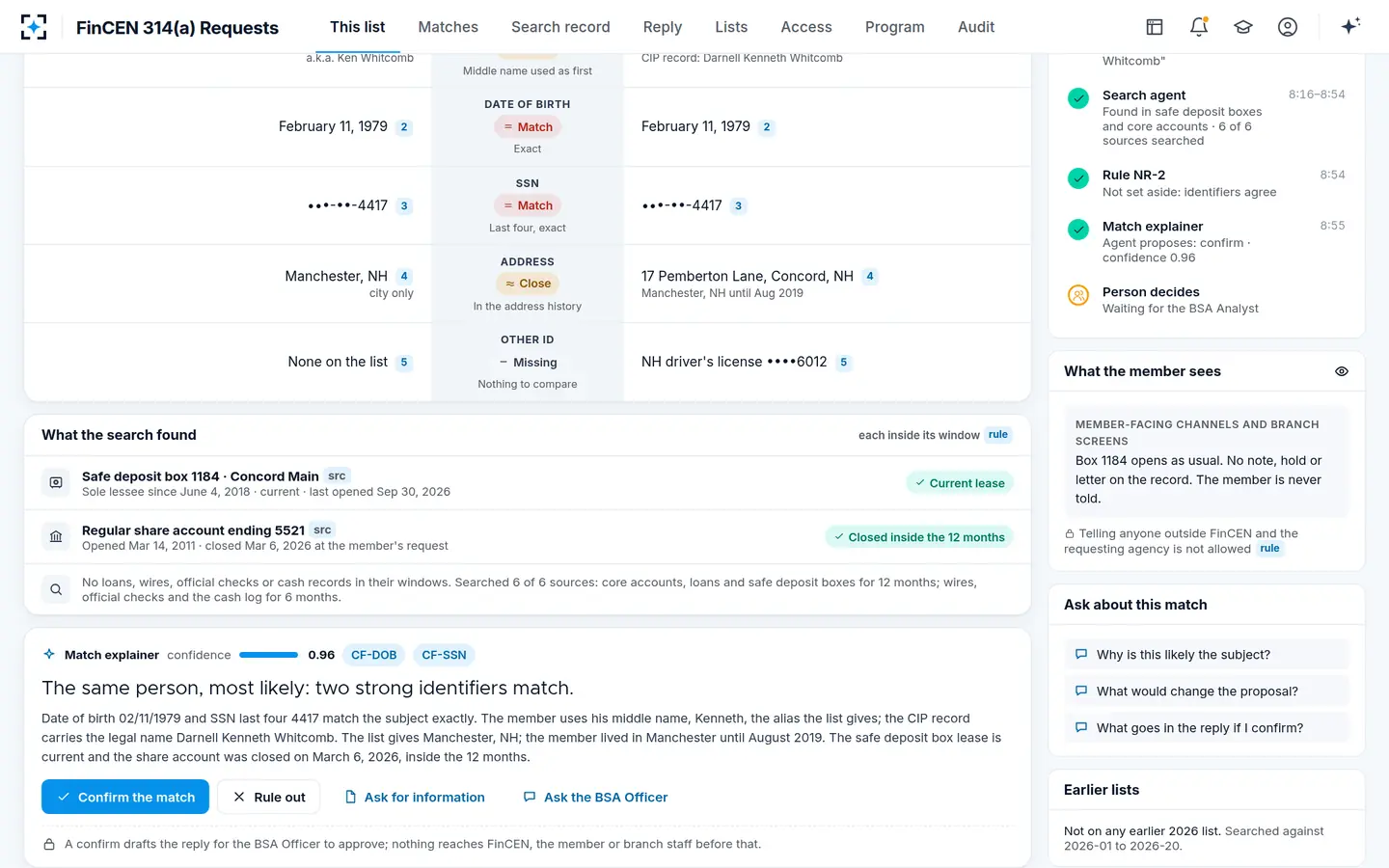
In FinCEN 314(a) Requests a reply cannot exist without a confirmation, and cannot leave without an approval. The analyst confirms with reason codes; the reply agent drafts the reply from the records the search found and the identifiers given at opening; the BSA Officer reads it and approves it or returns it with a reason; and when the Officer confirmed the match herself, the Deputy approves instead. Only then does the agent submit it in FinCEN's secure system and keep FinCEN's receipt.
The guardrails sit on either side. The reply agent never replies for a subject that is not confirmed and approved, and never replies on a list with no match. The hand-off agent drafts the internal referral with the reminder that a match alone is not a reason to file a SAR, close an account or decline a transaction, and never contacts the member. Where the reply sits in the two-week cycle is drawn in 314(a) search dates.
FinCEN 314(a) Requests: what the search found, and the agent's proposal in plain words
Questions people ask
How long do you have to report a 314(a) match?
Two weeks from the date FinCEN posts the request, unless the request sets another time frame. The FFIEC manual states the same window as 14 days from the date of posting; the regulation itself defers to the time frame in FinCEN's request.
What if a list was missed and a match is found later?
The FFIEC manual's guidance is to obtain any request from the past twelve months that was not searched from FinCEN's 314 Program Office, search it retroactively, and report any positive match within 14 calendar days of receiving it. A retroactive search need not cover records created after the original request.
Should a 314(a) reply include extra information?
It may. FinCEN only requires confirmation of the match, but the FFIEC manual notes that a bank may add information in the comment section because it is valuable to law enforcement; the account number or transaction date and type, which the rule lists, is the most common addition.
Who should submit the 314(a) reply?
A designated point of contact with access to FinCEN's portal; a vendor may not use the bank's sign-in. Many procedures add a second person who approves the reply before it is submitted, as the sample credit union does.
Does a 314(a) reply go to the requesting agency directly?
No. The bank answers FinCEN through its secure portal, and FinCEN runs the program on the agency's behalf. An agency that learns of a match and wants records must then use the legal process that applies, such as a subpoena, served on the bank.