The 314(a) search dates are the days FinCEN posts new Section 314(a) requests for banks, credit unions and other financial institutions to search. In 2025 and 2026 they fell every other Tuesday, by FinCEN's own transmission list, and each posting starts a window of two weeks in which every subject must be searched and every positive match reported. The work is hard because the list arrives on FinCEN's schedule, not the bank's: a few hundred names at a time, searched against twelve months of accounts and six months of transactions, compared by eye, and kept confidential. Botminds' FinCEN 314(a) Requests is an agentic solution built for that cycle: agents read each list the day it posts, search every source inside its window and explain each possible match, while a BSA analyst confirms and the BSA Officer approves every reply.
The dates and volumes below come from FinCEN's published list of transmissions, last updated October 13, 2026; the counts are our tally of it. Where the page shows how a list moves through the solution, the example is a fictional sample credit union, Norrell Federal Credit Union, and its sample list.
2026 has already sent more 314(a) requests than all of 2025
26
Tuesday postings in 2025, plus one off-cycle request on a Sunday
1,030
requests in calendar 2025, naming 6,469 subjects
1,066
requests in 2026 to October 13, naming 6,592 subjects
285
subjects in the median 2026 posting, from 41 to 581
When are the 314(a) search dates? Every other Tuesday, by FinCEN's own list
The 314(a) search dates in 2026 have been Tuesdays, two weeks apart: January 6 and 20, February 3 and 17, March 3, 17 and 31, April 14 and 28, May 12 and 26, June 9 and 23, July 7 and 21, August 4 and 18, September 1, 15 and 29, and October 13. In 2025 the same rhythm ran from January 7 to December 23, twenty-six Tuesdays in all. FinCEN publishes these dates after the fact, on its Section 314(a) page, as "Law Enforcement Information Sharing with the Financial Industry".
Two postings broke the pattern. A single request with one subject went out on Sunday, January 5, 2025, and another on Friday, March 6, 2026. The FFIEC examination manual allows for exactly this: "Every two weeks, or more frequently if an emergency request is transmitted, the bank's designated POCs receive notification from FinCEN that new case information has been posted," it says in its section on special information sharing. A calendar that assumes Tuesdays only will one day be wrong.
The list is more useful than a calendar for a second reason. Each line carries a tracking number and a subject count, so a point of contact can check that every transmission the bank should have received was downloaded and searched. The manual says banks "may review this list to verify that Section 314(a) information requests have been received", and an examiner can do the same.
How often are 314(a) lists issued, and how big is each one?
A list is issued every two weeks, and the size swings widely from one to the next. In 2026 the smallest Tuesday posting named 41 subjects across 7 requests (January 6), and the largest 581 subjects across 74 requests (February 17). Each request comes from one investigation, so a posting is really a bundle of investigations, most naming a handful of people or businesses and a few naming dozens.
Subjects per 314(a) posting in 2026: no two cycles carry the same load
The trend is up. FinCEN told OMB in its 2025 paperwork notice that requests rose by more than 75 percent between fiscal 2021 and 2024, from 460 to 818 a year, and credited the move to electronic filing by law enforcement agencies and its own outreach to them. Our tally of the 2026 list shows the rise continuing: by mid-October, 2026 had already passed the whole of 2025 in both requests and subjects. A team staffed for the 2023 cycle is working a heavier one now.
How long does a bank have to search a 314(a) list?
A bank has two weeks from the posting date to search and to report any positive match, unless the request sets another time frame. The two weeks come from FinCEN, not from the regulation's text: 31 CFR 1010.520 requires a report in the form and within the time FinCEN's request sets, and FinCEN's 314(a) fact sheet sets it at "two weeks from the posting date of the request". The FFIEC manual puts the same window as 14 days from the date of posting.
Two practical consequences follow. The days are calendar days, so a posting the Tuesday before a holiday weekend has fewer working days in it. And on FinCEN's regular rhythm, the window for one list closes on the day the next list posts: a list posted October 13 is due by October 27, the day the following posting would arrive if the pattern holds. A team that lets a list run to its last day starts the next one already behind.
One 314(a) cycle drawn to scale: where the fourteen days go
Most of a cycle is waiting, and the work that matters sits in the first week. Searching takes hours; deciding the look-alike names takes days, because each one needs a second screen and sometimes a second person. The sample credit union in FinCEN 314(a) Requests sets its own clocks inside FinCEN's window: analysts decide every possible match by day 7, the BSA Officer approves each confirmed reply within one business day, and an alert goes to the Officer on day 10 and to the Deputy and the Chief Risk Officer on day 12 if anything is still open.
One 314(a) cycle: the work fits in the first week, the second is margin
- List posted, reply window opendays 1–14
- Searchday 1
- Decide every possible matchdays 2–7
- Margin for returns and slow sourcesdays 8–14
- Idledays 1–2
- Approve each reply in a business daydays 3–8
- Alert on day 10days 9–12
- Alert day 12days 13–14
The lane that decides the cycle is the analysts'. A search that finishes on day 1 leaves six working days for the look-alikes, which is enough for a few dozen. A search run by hand across five or six systems often finishes on day 3 or 4, and the look-alikes then compete with every other alert in the queue. The cost of a 314(a) program is set mostly in that lane, and the hours there are what a change of method can return.
Who receives 314(a) lists, and why the point of contact matters
The lists go to the people a bank has named as its 314(a) points of contact, not to the bank in general. The rule requires a bank that receives a request to "designate one person to be the point of contact at the institution regarding the request and to receive similar requests for information from FinCEN in the future", and to "promptly notify FinCEN of any changes" (31 CFR 1010.520(b)(3)(iii)). In fiscal 2025, FinCEN's requests went to 13,887 financial institutions and 20,095 points of contact.
Changing a point of contact is slower than most teams expect, because it runs through the bank's regulator. FinCEN's instructions for updating a 314(a) contact send national banks, state member banks and FDIC-supervised banks to the Call Report, and credit unions to NCUA's CU Online profile. The FDIC's note is the one to plan around: a change made through an amended Call Report is "generally effective within two weeks", and one made through the regular quarterly report takes "approximately six weeks after the report date". A contact who leaves in October can still be the name on the list in December.
Who works a 314(a) list, and who must never see one
Today
Downloads the list, loads it into the core's search, then searches loans, boxes, wires, official checks and the cash log one system at a time.
With agents
Opens a list already searched in every source and narrowed to possible matches, each written as one cited sentence.
Still theirs: every confirm or rule-out, with reason codes
Today
Signs a printout and a checklist for the lists with no match; replies can go in on one person's say-so.
With agents
Reads exactly what each reply says before approving it, and signs the search receipts once every subject is covered.
Still theirs: approval of every reply and every referral
Today
Covers when the officer is away, often without the officer's notes.
With agents
Approves any reply the officer confirmed herself, so no match goes in on one signature.
Still theirs: the second signature
Today
Takes the team's word for the lists with no match, because there was no reply to look at.
With agents
Looks up any subject's receipt, matched or not, on time-limited read access.
Still theirs: the annual test
Today
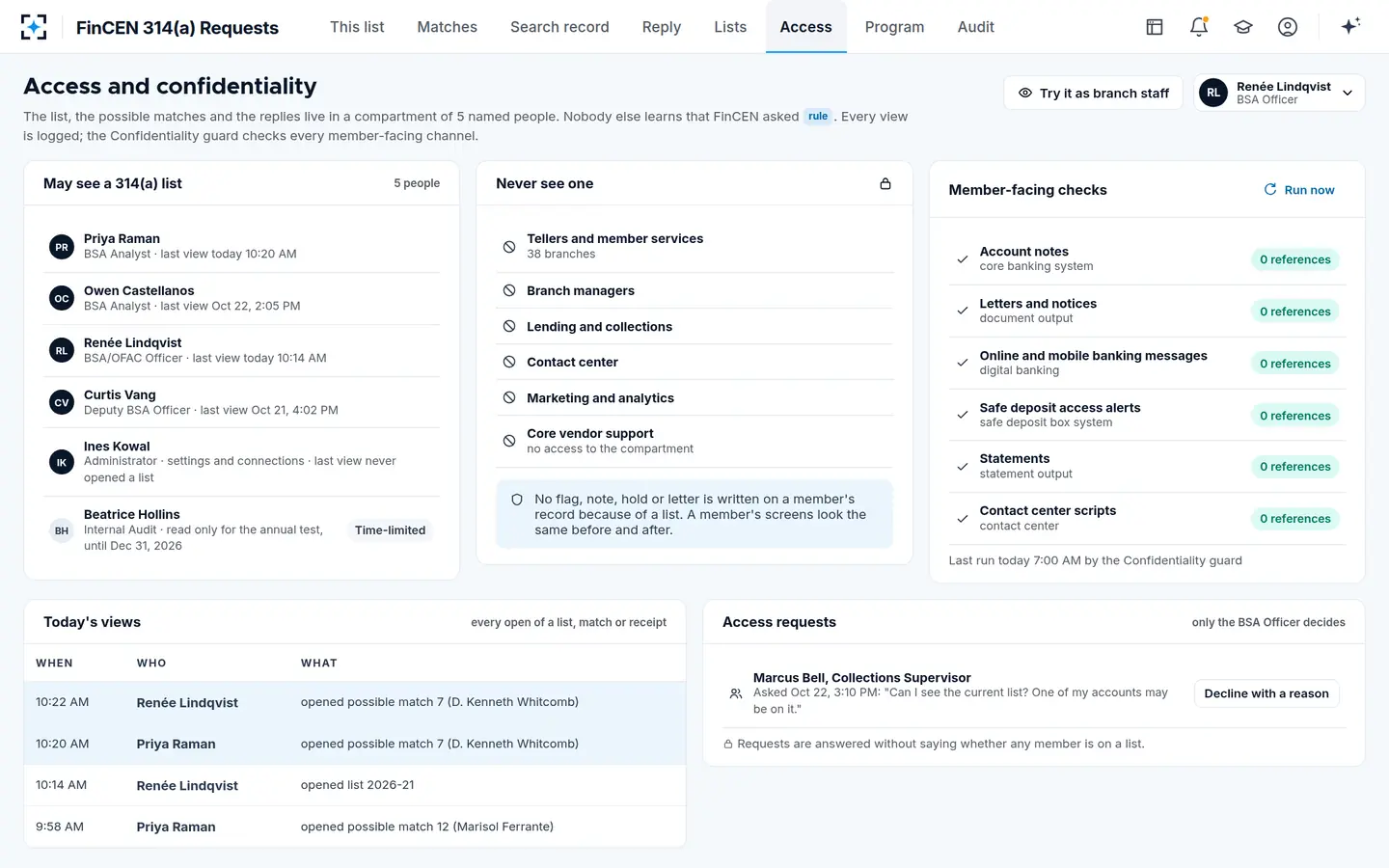
Open accounts and box leases for the same people who may be on a list, where a careless note could tip someone off.
With agents
Never see a list, a match or a reply; a daily check looks for any mention in notes, letters and scripts.
Still theirs: the member relationship
Posting day, hour by hour: download, restrict, search
On posting day the point of contact has three jobs, and the order matters: get the list, lock it down, then search. FinCEN's notification only says that new requests are waiting; the list itself sits in FinCEN's secure portal, now the FI Portal at fiportal.fincen.gov, which replaced the older secure system's web addresses on May 23, 2024. The subject files download in .csv, .txt and .doc formats, which FinCEN offers precisely so banks can feed them to their own search tools.
Locking down comes before searching because the rule's confidentiality duty starts at download. A bank "shall not disclose to any person" other than FinCEN, the requesting agency and, by the FFIEC manual's reading, its primary regulator, "the fact that FinCEN has requested or has obtained information". A list saved to a shared drive, printed at a branch printer or emailed to the core vendor for a custom report is the commonest way that duty is breached.
In the sample cycle, the list intake agent reads list 2026-21 from the secure system at 8:14 AM, counts 318 people and 94 businesses and restricts the list to five named people before anyone searches. The search across six sources then runs from 8:16 to 8:54 AM, including a retry of the safe deposit box system after it timed out. By nine o'clock the analysts have their possible matches and the whole of the reply window ahead of them.
FinCEN 314(a) Requests: the reply window as a bar, on the list's first screen
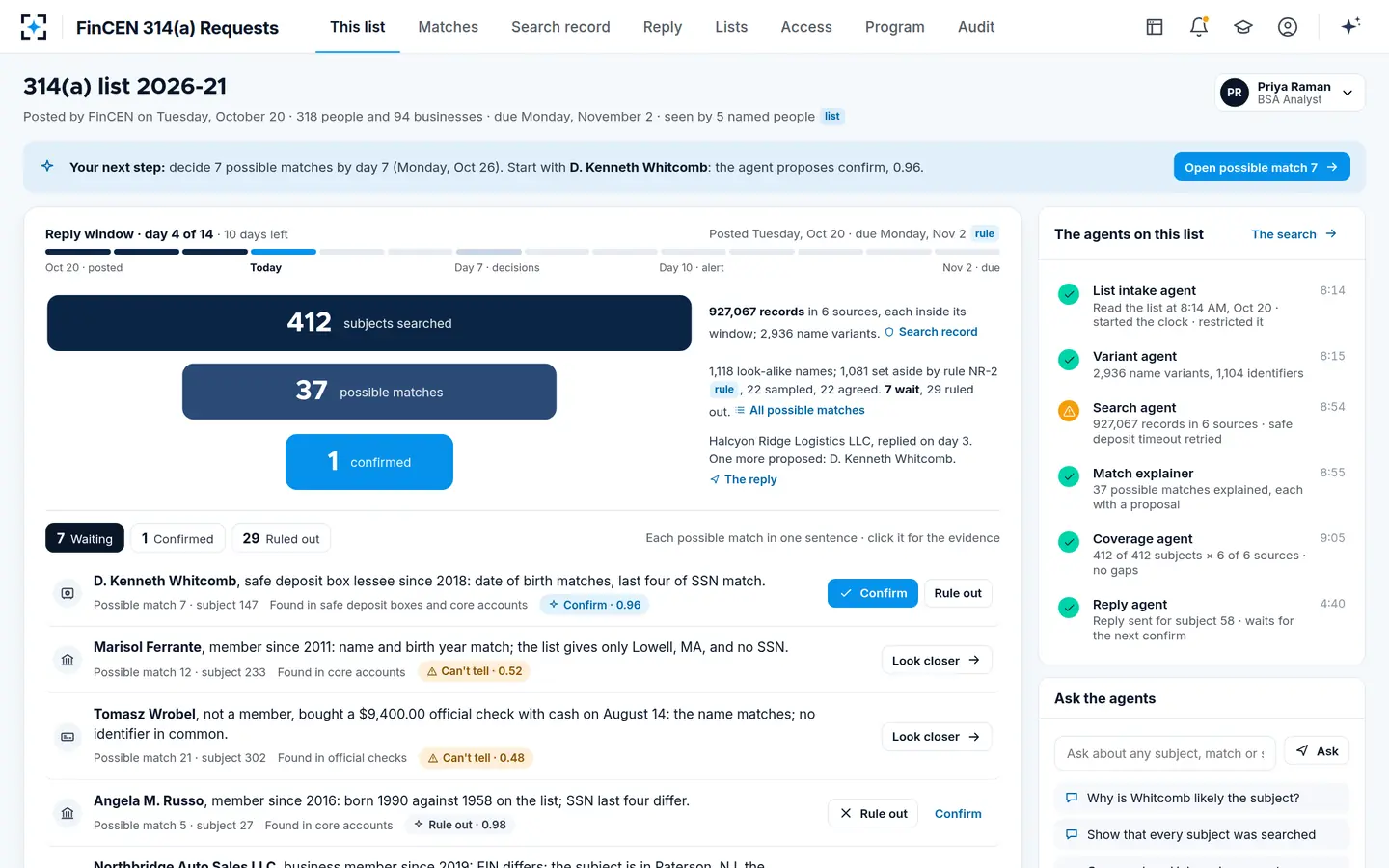
Days two to seven: the look-alikes take the time
After the search, the cycle's time goes to names that might be the subject and might not. FinCEN's own estimate shows the spread: an unambiguous result takes two to five minutes per subject, while a match that needs verifying takes from 15 minutes to two hours and fifteen minutes, sometimes with a call to the requesting agency. The calendar risk is not the list's length but the number of hard cases in it, and that is unknown until the search has run.
That is why the first search should finish on posting day. A team that knows by day 1 that it has seven hard cases can spread them across the week, ask the agency a question early and still leave the BSA Officer time to read each reply. A team that finds them on day 5 has two people and three days. What counts as a match, and how to test a search for both kinds of error, is the subject of what counts as a 314(a) positive match.
What happens if you miss a 314(a) deadline?
A missed list must be searched retroactively, and a pattern of misses is an examination finding. The FFIEC manual, drawing on FinCEN's 314(a) FAQs, says that if a bank fails to perform or complete searches on requests received in the previous 12 months, it "must immediately obtain these prior requests from FinCEN and perform a retroactive search", and must respond with any positive match within 14 calendar days of receiving the prior request. Requests more than 12 months old need not be searched, and a retroactive search need not cover records created after the original request.
How the examiner treats the miss depends on whether it repeats. The manual's guidance on developing conclusions lists "consistently failing to complete searches on 314(a) information requests" among the systemic or repeat violations that go to the board, and "failure to complete a 314(a) information request that is inadvertent or nonrecurring" among the isolated or technical ones. One missed Tuesday, found and fixed, is a different conversation from a calendar nobody owns.
Keeping the 314(a) calendar: seven checks for the point of contact
- Check every posting against FinCEN's transmission list
Match each tracking number on FinCEN's list to a download in the bank's own log; a gap is a missed request.
- Count the window from the posting date, in calendar days
Two weeks from posting, unless the request says otherwise; holidays and weekends count.
- Set the team's own target well inside it
A decision target at day 7 leaves a week for returns, slow sources and the officer's reading.
- Expect an off-cycle posting
Emergency requests arrive outside the Tuesday rhythm; the notification, not the calendar, starts the clock.
- Keep at least two people able to sign in
Holidays and departures are when lists go unread; confirm each contact's FI Portal access works.
- Update a departing contact through the regulator early
Call Report changes can take about six weeks to reach FinCEN; NCUA credit unions use CU Online.
- If a list was missed, search it now
Obtain it from FinCEN's 314 Program Office, search retroactively and report any match within 14 calendar days.
Where FinCEN 314(a) Requests fits the 314(a) calendar
FinCEN 314(a) Requests is built so that the expensive part of the cycle, finding out what the list holds, is done on posting day. The agents read the list the morning it posts, start the two-week clock, search each source inside the window the rule sets, and write a receipt for every subject in every source. A possible match arrives with the subject and the record side by side and every value cited, so the analyst's week goes to deciding, not to searching.
The calendar is also where the solution keeps people in charge. The clocks, the alert days and the people alerted are settings the BSA Officer approves; the agents never confirm a match, send a reply or sign anything. What they cannot do is pick the dates: FinCEN posts when it posts, and a solution is only as good as its point of contact's access to the portal. How a confirmed match becomes a reply is set out in how to report a 314(a) match to FinCEN.
Who may see a 314(a) list in FinCEN 314(a) Requests, and who never does
Questions people ask
Where do I find the FinCEN 314(a) request dates?
FinCEN posts a list titled "Law Enforcement Information Sharing with the Financial Industry" on its Section 314(a) page. It gives each transmission's date, tracking number and number of subjects for the current and prior year and is updated after each transmission; the version of October 13, 2026 covers January 2025 onward.
How do you download the 314(a) list?
A designated point of contact signs in to FinCEN's FI Portal at fiportal.fincen.gov, where the subject lists are posted, and downloads the files in .csv, .txt or .doc format. A bank may hand the files to a vendor that runs the search under a confidentiality agreement, but it may not give the vendor its portal sign-in.
What is a 314(a) point of contact?
It is the person a bank designates to receive FinCEN's requests and answer them; the rule requires at least one, and the FFIEC manual allows several. FinCEN notifies these people when a new list is posted, so a stale contact means a list nobody reads; changes go through the bank's primary federal regulator.
Do the 14 days include weekends and holidays?
Yes. FinCEN sets the window as two weeks from the posting date, and the FFIEC manual's guidance on retroactive searches speaks of 14 calendar days. A list posted before a holiday has fewer working days, which is one reason to finish the search on posting day.
Can FinCEN set a different deadline for one request?
Yes. The regulation requires a report "in the time frame specified in FinCEN's request", and a request can also change the records to be searched. The two-week window is FinCEN's standard, so each list's instructions are worth reading before the search runs.