There are no 314(a)-specific record retention requirements: the FFIEC examination manual states that "banks are not required to maintain records related to Section 314(a) information requests", and FinCEN's 2025 paperwork notice says the same. FinCEN's 314(a) FAQs recommend instead that banks keep records showing every required search was performed and every positive match reported, and examiners test a 314(a) program by sampling requests and reviewing that documentation. So the real requirement is evidence: for each list, enough to show it was received, searched in every source inside its windows, decided and, where there was a match, answered in time, kept for a period the bank sets by policy, without exposing the confidential list itself. Botminds' FinCEN 314(a) Requests is an agentic solution that writes that evidence as it works: a receipt for every subject in every source, every decision with its reasons, every reply with its approval.
The rules quoted come from the FFIEC manual and its examination procedures, the regulations at 31 CFR Chapter X and FinCEN's notices. Where the page shows the solution, the example is a fictional sample credit union, Norrell Federal Credit Union, and its sample list.
One 314(a) list's evidence, item by item: what to keep, and what each item proves
Transmission received
What is keptTracking numbers, posting date, the date downloaded and by whom
What it provesThe bank received every request FinCEN sent
Who sees itBSA team; examiner
Scope used
What is keptSources searched, the window for each, name rules and their version
What it provesThe search reached the records the rule requires
Who sees itBSA team; examiner; audit
Per-subject receipts
What is keptFor every subject in every source: when searched, the window, the result
What it provesEach subject was searched, including on lists with no match
Who sees itBSA team; examiner; audit
Possible matches decided
What is keptEach look-alike, the identifiers compared, the decision, the reason and who made it
What it provesMatches were confirmed and ruled out on evidence
Who sees itBSA team; examiner
Replies
What is keptWhat was reported, who approved it, when it went in, FinCEN's portal history
What it provesEvery positive match went in within the time frame
Who sees itBSA team; examiner
Access log
What is keptWho opened the list, a match or a reply, and when
What it provesThe request stayed with the people who needed it
Who sees itBSA Officer; audit
Sign-off
What is keptThe BSA Officer's signature on the list's search, with the date
What it provesSomeone accountable reviewed the cycle
Who sees itExaminer; audit
What are 314(a) record retention requirements? None of their own
No regulation sets a retention period for 314(a) records, because no regulation requires them. The FFIEC manual's section on special information sharing says so under the heading Documentation, and FinCEN's 2025 paperwork notice explains why it assigns no recordkeeping burden to the reply: "financial institutions are not required to maintain records related to Section 314(a) Requests. Nevertheless, some Respondent FIs may choose to maintain records as part of their broader compliance program."
The manual's next sentence is the one that matters in practice. "FinCEN's 314(a) FAQs recommend that banks maintain records to demonstrate that all required searches have been performed and positive matches reported." Banks may get an activity report from FinCEN's portal showing download and response history, may keep a manual log of requests received and matches reported, and, if they keep copies of the requests themselves, "must maintain the information in a secure and confidential manner".
314(a) retention in four numbers
0yrs
of retention set for 314(a) records by any rule: none is required
5yrs
the period for records the BSA does require, a natural policy choice
4h
a year FinCEN budgets per institution to document how 314(a) fits its AML program
12mo
of missed requests that must be searched retroactively, so evidence of each search matters
How long do you keep 314(a) records?
As long as the bank's policy says, and five years is the period most easily defended. The BSA's general rule, 31 CFR 1010.430(d), requires every record the BSA rules call for to be kept for five years and stored so it can be retrieved within a reasonable time (the guide to BSA record retention sets the rules side by side). 314(a) evidence is not a required record, so the rule does not bind it; but a bank that keeps all its BSA evidence on one schedule avoids explaining why one kind expires sooner.
Two other clocks argue against a short period. Examinations look back over the period since the last one, and an examiner sampling a request from eighteen months ago will want its evidence. And some of the records searched for 314(a) have their own five-year rule: the log of monetary instruments sold for cash must be kept five years under 31 CFR 1010.415(c). The fictional sample credit union keeps its search receipts, decisions and replies for five years, as a setting the BSA Officer approved.
What documentation is required for 314(a)?
None is required by rule, but examiners expect documentation that proves compliance with each sampled request. The FFIEC's examination procedures list what that "may include": "copies of Section 314(a) information requests and documentation that verifies the bank searched appropriate records for each information request received"; "activity reports from the SISS showing a log of the bank's download and response history, including any positive response dates, or a log that records the tracking numbers, date of review, records and time frames reviewed, reviewing party, and review results"; and "records and supporting documentation of the positive matches reported to verify that a response was provided to FinCEN within the required time frame".
What the examiner may review, and the evidence that answers it
| Examination procedure item | Evidence that answers it |
|---|---|
| Copies of requests and proof the bank searched appropriate records for each | The scope used for each list and a receipt per subject per source; a copy of the list only if kept securely |
| FinCEN portal activity report: download and response history | The portal report, or the bank's own log reconciled to it |
| A log of tracking numbers, review dates, records and time frames, reviewer and results | One line per list with exactly those fields, and the per-subject receipts behind it |
| Records of positive matches reported, showing a timely response | Each reply with its approval, the date submitted and the portal's confirmation |
| Use only for permitted purposes; information kept secure and confidential | Access controls, the access log, and restricted case files for any internal review |
How do examiners test 314(a) compliance?
By checking the procedures, then testing a sample. The examination procedures direct examiners to determine whether the bank's procedures designate points of contact, search the right records in the right windows and protect the list; to verify that the bank is receiving requests and, if it uses a vendor, that the vendor works under a confidentiality agreement and without direct access to FinCEN's system; and then, "on the basis of a risk assessment, prior examination reports, and a review of the bank's audit findings", to "select a sample of Section 314(a) information requests" and review the documentation for each.
The sample is where lists with no match matter most. A list that produced a reply has a FinCEN timestamp; a list that produced none has only what the bank kept. An examiner can also work the other way: FinCEN publishes a list of every transmission with its date and tracking number, so a bank's log can be checked against what FinCEN actually sent. A tracking number with no evidence behind it is a missed search until shown otherwise.
FinCEN 314(a) Requests: the evidence for a list with no match, kept and signed
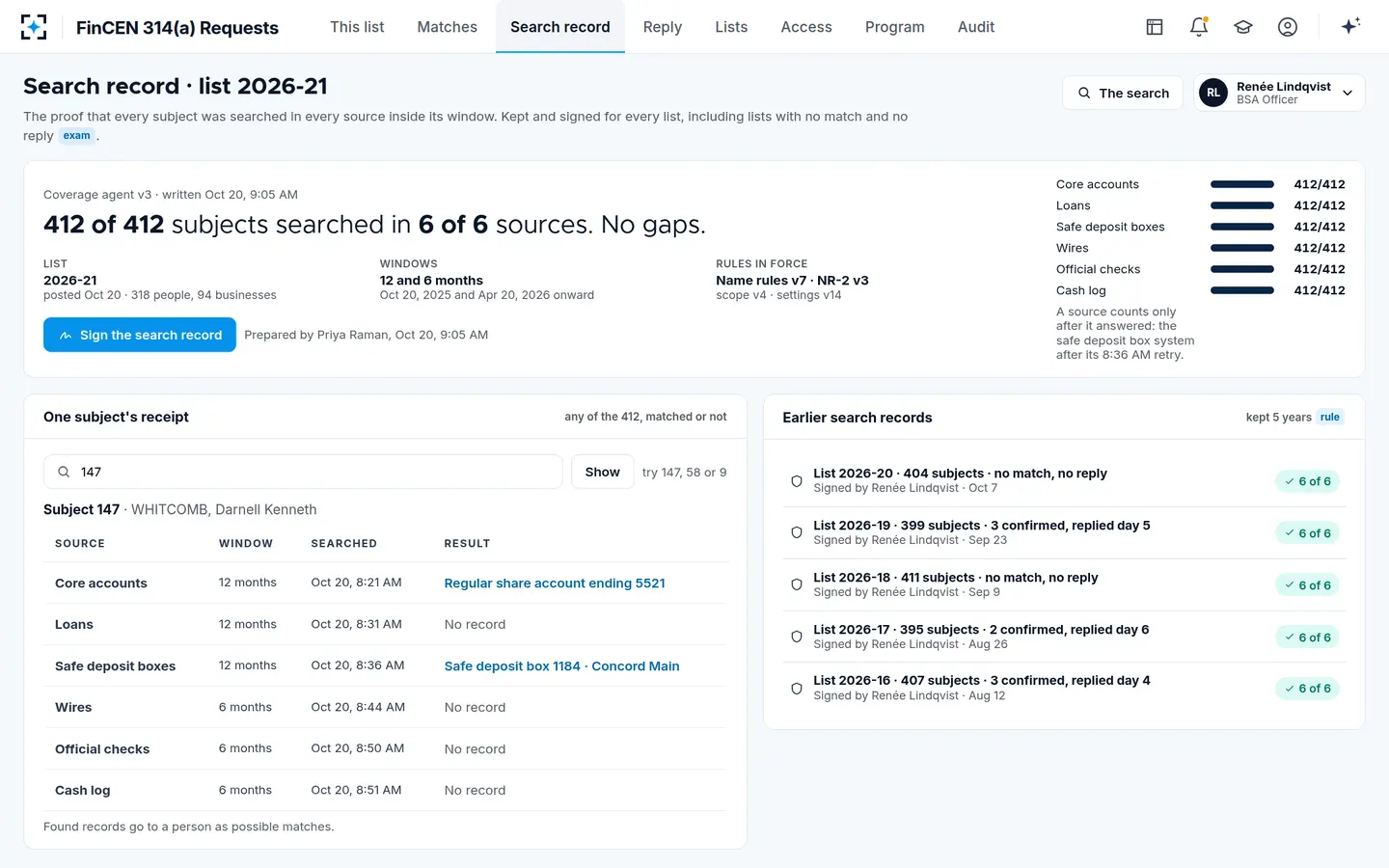
One cycle's evidence, item by item
The evidence for one list fits the frame at the top of this page, and every item answers one question an examiner or auditor will ask. The order follows the cycle: was the list received, what was searched, was every subject covered, how was each look-alike decided, did the reply go in on time, who saw the list, and who signed for it. FinCEN's paperwork notice budgets four hours a year per institution for documenting how 314(a) requests are reviewed and folded into the AML program, and a bank that keeps these items as it works spends most of those hours on the reading, not the writing.
Two items are easy to leave out and expensive to miss. The scope used, with the version of the name rules in force, is what lets a bank show months later that a search reached closed accounts and walk-in transactions; the 314(a) lookback period sets out what that scope must cover. And the per-subject receipt is what turns "we searched the list" into "we searched this person, in these six sources, at these times".
The list itself: keep it, or keep proof of it?
Keep proof of it; keep the list only if there is a reason, and then securely. The FFIEC manual says that "if a bank elects to maintain copies of the Section 314(a) information requests, the bank must maintain the information in a secure and confidential manner", and the rule requires adequate procedures to protect the requests, a duty the bank's existing safeguards for customers' nonpublic personal information are deemed to meet. Every extra copy of a list, in a binder, a shared drive or an email thread, is another place the bank must protect.
Keeping a 314(a) list against keeping the proof of its search
A copy of the list itself: Who FinCEN asked about.
The proof of the search: That every subject was searched in every source, and what was found.
A copy of the list itself: No.
The proof of the search: No, but recommended by FinCEN and sampled by examiners.
A copy of the list itself: High: it discloses that FinCEN asked, which the rule forbids.
The proof of the search: Lower, if subject identifiers are cut to what the reader needs.
A copy of the list itself: Rarely anyone; FinCEN can resend a prior request.
The proof of the search: Examiners, internal audit and the BSA Officer.
A copy of the list itself: Encrypted, restricted, never printed or emailed.
The proof of the search: Restricted, with redacted views for each audience.
Can 314(a) lists be shared internally?
Only with the people who need them to search and respond, under the bank's confidentiality procedures. The rule bars disclosing "to any person" other than FinCEN, the requesting agency and the named contacts that FinCEN has requested or obtained information, "except to the extent necessary to comply with such an information request", and limits use of the information to reporting to FinCEN, deciding whether to open or keep an account or engage in a transaction, and BSA compliance. The FFIEC manual adds that lists may go to domestic subsidiaries and affiliates whose records are in scope, never to a foreign office, branch or affiliate unless the request says so.
Inside a bank that usually means a short, named list. At the fictional sample credit union, five people may see a 314(a) list: two BSA analysts, the BSA/OFAC Officer, the Deputy and the administrator; internal audit has time-limited read access for its annual test. Retention multiplies the question, because evidence kept for five years will be read by people who were not there: each audience needs its own view, with identifiers cut to what it needs.
FinCEN 314(a) Requests: a sealed export for the examiner, redacted for its reader
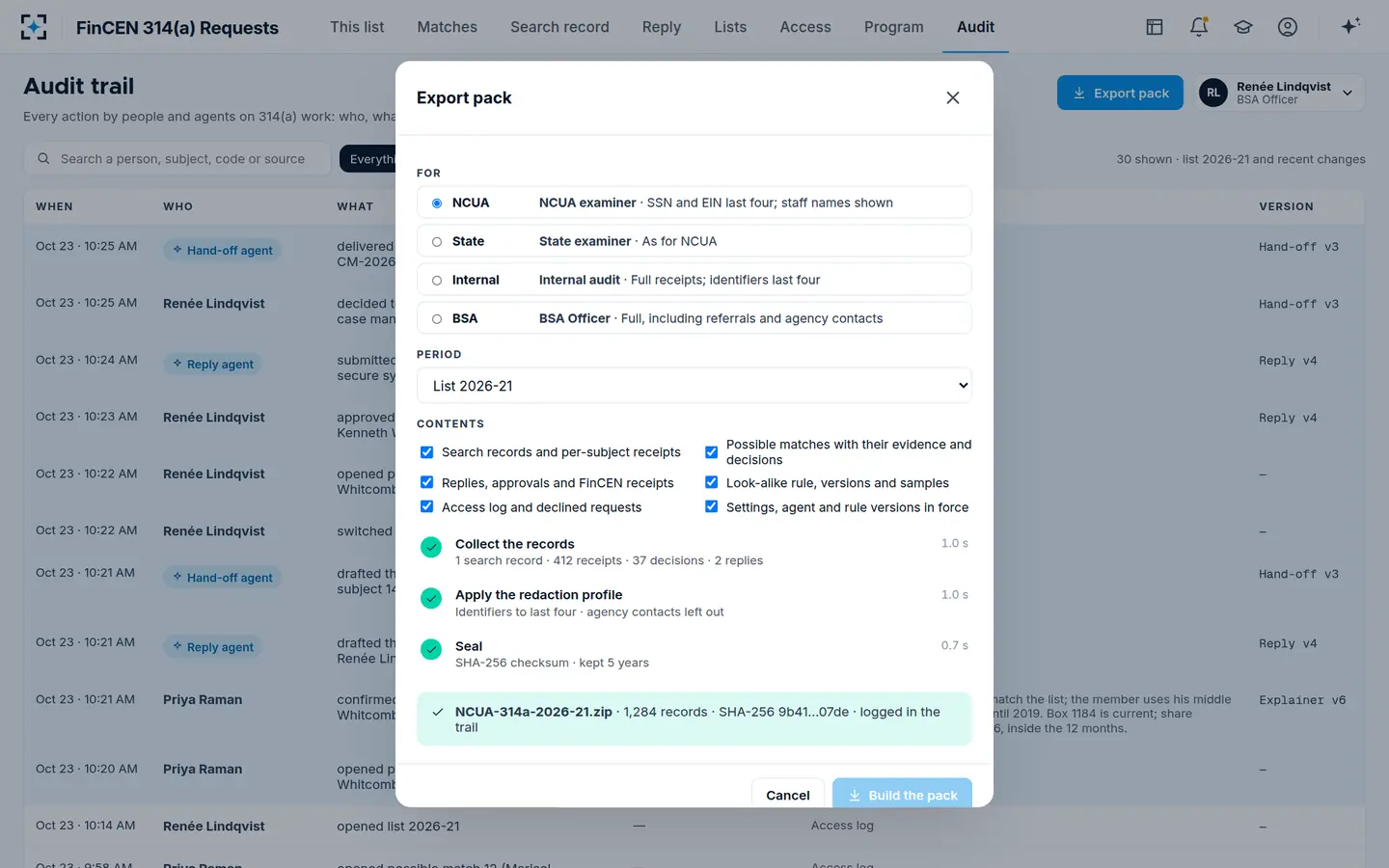
What are 314(a) procedures? A one-page outline
314(a) procedures are the written steps that make the evidence above appear without anyone remembering to create it. They belong in the AML program's internal controls, are covered by its training and independent testing, and are what examiners read before they sample. A one-page outline covers seven points.
314(a) procedures on one page
- Points of contact
Who receives requests, who backs them up, and how changes reach FinCEN through the bank's regulator.
- Scope
Every system searched, its window (12 months for accounts, 6 for non-account transactions), name rules, and how a request's own scope overrides them.
- Decisions
What confirms a match, what rules one out, who decides, and when to ask the requesting agency.
- Replies
Who prepares, who approves, the internal deadline inside FinCEN's two weeks, and no reply on no match.
- Confidentiality and use
Who may see a list, where it is held, what may never go into account notes or to branches, permitted uses only.
- Missed requests
How the bank checks its log against FinCEN's transmission list, and the retroactive search if a gap is found.
- Evidence and retention
The items kept for each list, where, for how long by policy, and who may read them.
How FinCEN 314(a) Requests keeps the proof
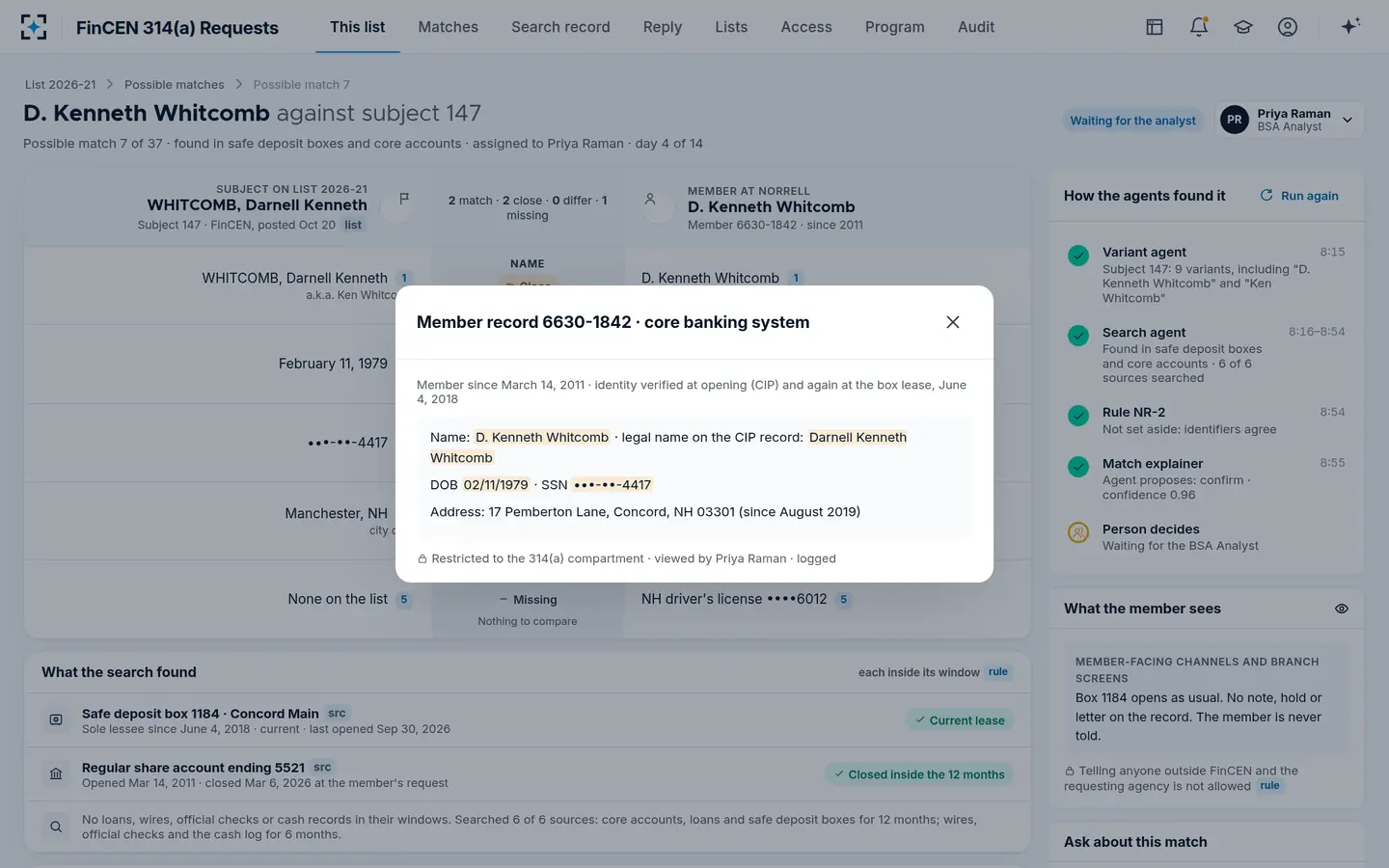
FinCEN 314(a) Requests is built around the evidence a list with no match leaves behind, because that is the evidence a manual process most often lacks. Its coverage agent writes a receipt for every subject in every source, with the time, the window and the result, and will not call a list searched until every cell is covered; a source that failed counts only after it answers. The BSA Officer signs the receipts for each list, and the agent never edits a receipt once it is signed. Every value the agents cite opens the record it came from, and opening it is itself logged.
The rest follows the same pattern. Each decision carries its reason codes, each reply its approval and FinCEN's receipt, and every action by a person or an agent is on the audit trail with the version of the rules in force. Retention is a setting, five years at the sample credit union, and an export for a particular reader, an NCUA or state examiner, internal audit or the BSA Officer, applies that reader's redaction and is sealed with a checksum. What the solution cannot supply is the bank's policy: how long to keep, and who may read, are decisions for the BSA Officer. How a reply is drafted and approved is covered in how to report a 314(a) match to FinCEN.
FinCEN 314(a) Requests: every cited value opens its source, and the view is logged
Questions people ask
What is 314(a) recordkeeping?
It is the evidence a bank keeps to show it handled each 314(a) request: receipt, search, decisions, replies and confidentiality. No rule requires it, but FinCEN's FAQs recommend it and examiners review it on a sample of requests, so a program without it has little to show when the sample is drawn.
Does the BSA's five-year retention rule apply to 314(a) records?
Not directly. 31 CFR 1010.430(d) applies to records the BSA rules require, and the FFIEC manual states that 314(a) records are not required. A bank may still choose five years so that all its BSA evidence follows one schedule.
Is FinCEN's portal activity report enough documentation?
It shows downloads and responses, which proves receipt and timely replies. It does not show what the bank searched, in which systems and windows, or why a look-alike was ruled out, so on its own it leaves the lists with no match largely unproven.
Should lists with no match be documented?
Yes. They are the lists for which FinCEN has no reply from the bank, so the bank's own log and receipts are the only proof of the search. The examination procedures' sample can fall on any request, matched or not.
Should a bank keep 314(a) records after a retroactive search?
Yes, with the date the gap was found, the date the prior request was obtained from FinCEN, the scope searched and any match reported within 14 calendar days. That record is what distinguishes an isolated, corrected miss from a pattern.