A 314a program, the procedures, people and systems an institution uses to answer FinCEN's Section 314(a) requests, costs most respondents far more than the 44 hours a year that headlines FinCEN's paperwork notice. That figure covers only requests from state, local and foreign law enforcement and from FinCEN itself; the federal requests that make up most of the program add, by FinCEN's own estimate, about 408 hours per institution in 2024. The unit that explains the cost is the subject: about four minutes each to search and answer, on a list of a few hundred names every two weeks, with a few hard cases that take hours. Botminds' FinCEN 314(a) Requests is an agentic solution that moves the search and the evidence-gathering to agents on posting day, so the paid hours go to deciding the hard cases.
The national figures below are FinCEN's and the Bureau of Labor Statistics'. The pricing of one year is our arithmetic on them. The split of one cycle's hours is Botminds' estimate for a fictional sample credit union, Norrell Federal Credit Union, with about 520,000 members; it is labelled where it appears.
FinCEN's own price for 314(a): the headline leaves out most of it
44h
a year per respondent, for requests covered by the Paperwork Reduction Act
408h
a year per institution for federal requests in 2024, outside that count
$637M
estimated private-sector cost of federal requests in 2024
4min
per subject: 3.5 to search and review, 0.5 to report
What is a 314(a) program, and what does FinCEN count in it?
A 314(a) program is everything an institution does to receive, search, answer and protect FinCEN's requests: a designated point of contact, written procedures, the searches themselves, the replies, confidentiality controls and the records that prove each list was handled. FinCEN's 2025 paperwork notice prices it in two parts. Responding is about 3.5 minutes per subject to search, including any manual review, plus 30 seconds to report. Running the program is five hours a year per institution: one to keep the point of contact current and four "to document how it reviewed and incorporated Section 314(a) Request information into its broader compliance with AML/CFT program requirements".
It is also part of the AML program, not a side task. In its April 2026 proposal to reform AML/CFT programs, still a proposal, FinCEN wrote that it "considers information sharing to be an important element of an effective AML/CFT program" and named responding to 314(a) requests among the ways to share (91 FR 18704). A 314(a) program sits under the same internal controls, independent testing and training as the rest.
How many 314(a) requests are there each year?
About a thousand, and rising fast. FinCEN counted 460 requests in fiscal 2021, 515 in 2022, 558 in 2023 and 818 in 2024, an increase of more than 75 percent that it credited to electronic filing by law enforcement and its own outreach; its Year in Review reports 1,065 in fiscal 2025, from 114 law enforcement agencies, naming 6,883 subjects. Each request is one investigation and averages five to six subjects, aliases counted separately.
314(a) requests per fiscal year: up 132% in four years
The rise lands on every respondent at once: FinCEN's estimates assume that each institution on the distribution searches every subject of every request. In 2024, FinCEN sent requests to 12,839 institutions, about 2.2 percent of the 575,873 it could reach; roughly a third were banks or credit unions. A bank on the distribution for every posting would have searched about 6,469 subjects across calendar 2025 by our tally of FinCEN's transmission list, and 6,592 in 2026 by mid-October.
How long does a 314(a) search take?
About three and a half minutes per subject on average, by FinCEN's estimate, but the average hides two very different jobs. "In cases where automated search results are relatively unambiguous, search time may range from two to five minutes per subject on average," the notice says; where verifying a match "is more labor-intensive, search time may range from 15 minutes to two hours and fifteen minutes". FinCEN's weighting gives most subjects about three minutes and a small minority about two hours.
That spread is the budget problem. A list of 285 subjects, the median 2026 posting, costs about 19 hours at four minutes each, but the hours are not spread evenly: a handful of hard cases can take as long as all the easy ones together. A program sized on the average is short-staffed on the weeks that matter, which are the weeks with the ambiguous names.
How much does 314(a) compliance cost? FinCEN's own arithmetic
FinCEN puts the cost at about $67.5 million a year for the requests the paperwork rules cover and about $637 million in 2024 for the federal requests they do not: $629 million in labour and $8 million in technology and data security. Its labour rate is a composite of $120.07 an hour, which assumes senior management takes part. The Bureau of Labor Statistics' mean wage for compliance officers in May 2023 was $38.55 an hour before benefits, so the true figure for a bank depends on who does the work.
One institution's 314(a) year, priced FinCEN's way
| Line | Arithmetic | Result |
|---|---|---|
| Subjects searched, 2026 to October 13 | From FinCEN's transmission list, every posting | 6,592 |
| Search, review and report | 6,592 subjects × 4 minutes | 439 hours |
| Program upkeep | Point of contact 1 hour + documentation 4 hours | 5 hours |
| Labour at FinCEN's composite rate | 444 hours × $120.07 | $53,300 |
| Labour at the BLS mean compliance officer wage | 444 hours × $38.55, wages only | $17,100 |
| Technology and data security | 6,592 responses × $0.10 | $660 |
Two things move the result more than the wage. The first is the share of hard cases: a bank with a large, mobile customer base or many walk-in transactions meets more look-alikes per subject. The second is how many systems the search must cover by hand. FinCEN's minutes are a national average, and a bank whose loans, box leases, wires and monetary instrument logs sit in separate systems spends its minutes switching screens, not deciding.
One cycle's minutes, by task: the look-alikes, not the search
Inside one cycle, most of the paid time goes to comparing look-alike names, not to running searches. Botminds' estimate for one list of about 400 subjects at a credit union of the sample's size puts the cycle at about 11 hours by hand: half an hour to download and load the list, two and a half to search loans, boxes, wires, official checks and the cash log one system at a time, seven to compare about 35 look-alikes at roughly twelve minutes each across two or three screens, and an hour to mark replies and print and sign the checklist.
Where one 314(a) list's hours go, by hand and with FinCEN 314(a) Requests
By hand · about 11 hours
- Compare look-alikes · 64%
- Search other systems one by one · 23%
- Load, mark replies, print and sign · 13%
With the solution · about 2.5 hours
- Compare look-alikes · 82%
- Everything else: load, search, mark, sign · 18%
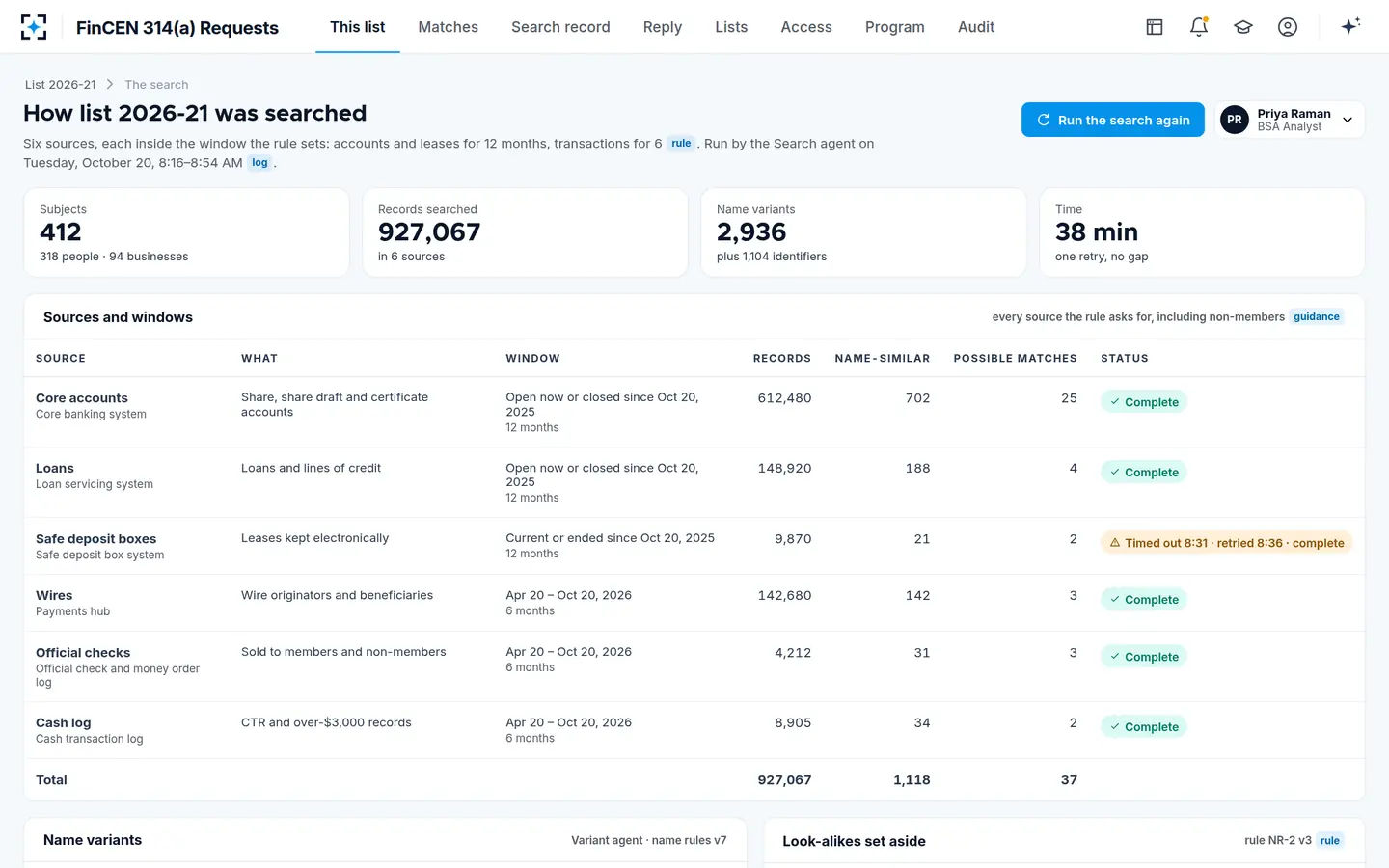
Read the second bar for what it says about people. The share of time spent comparing look-alikes goes up, from about two thirds to four fifths, because the agents take the search and the paperwork and leave the judgement. The hours fall because each look-alike arrives with the subject and the record side by side and every value cited, which is what turns twelve minutes of screen-switching into a few minutes of reading. On the sample list, the search itself, 412 subjects across 927,067 records in six sources, took 38 minutes.
FinCEN 314(a) Requests: the whole search on posting day, source by source
Should 314(a) searches be outsourced?
The search can be; the decision and the duty cannot. The FFIEC manual allows a bank to give the subject lists to a vendor to run or support the searches, under an agreement that keeps them confidential, but not to give the vendor direct access to FinCEN's portal or its sign-in (FFIEC, special information sharing). The bank still owns the outcome: a missed match or a late reply is the bank's finding, whoever ran the query.
Three ways to run a 314(a) program, and what each leaves the bank
In-house, by hand, or an outsourced search: An analyst system by system, or a vendor on the files it is given; sources outside the vendor's reach stay manual.
Agents search and explain; named people decide: Agents, inside each source's window, on posting day, with a retry when a source fails.
In-house, by hand, or an outsourced search: An analyst, comparing screens; with a vendor, an analyst reading the vendor's hit report.
Agents search and explain; named people decide: An analyst, reading one cited sentence per possible match and the agent's proposal.
In-house, by hand, or an outsourced search: A printout and a signed checklist, or the vendor's run log.
Agents search and explain; named people decide: A receipt per subject per source, signed by the BSA Officer.
In-house, by hand, or an outsourced search: Copies on drives and in email are common; a vendor adds a party to the agreement.
Agents search and explain; named people decide: The list stays in a restricted area of named people; every view is logged.
In-house, by hand, or an outsourced search: Analyst hours per subject; vendor fees per list or per year.
Agents search and explain; named people decide: Analyst hours per possible match; the subscription.
Pricing a 314(a) program with FinCEN 314(a) Requests
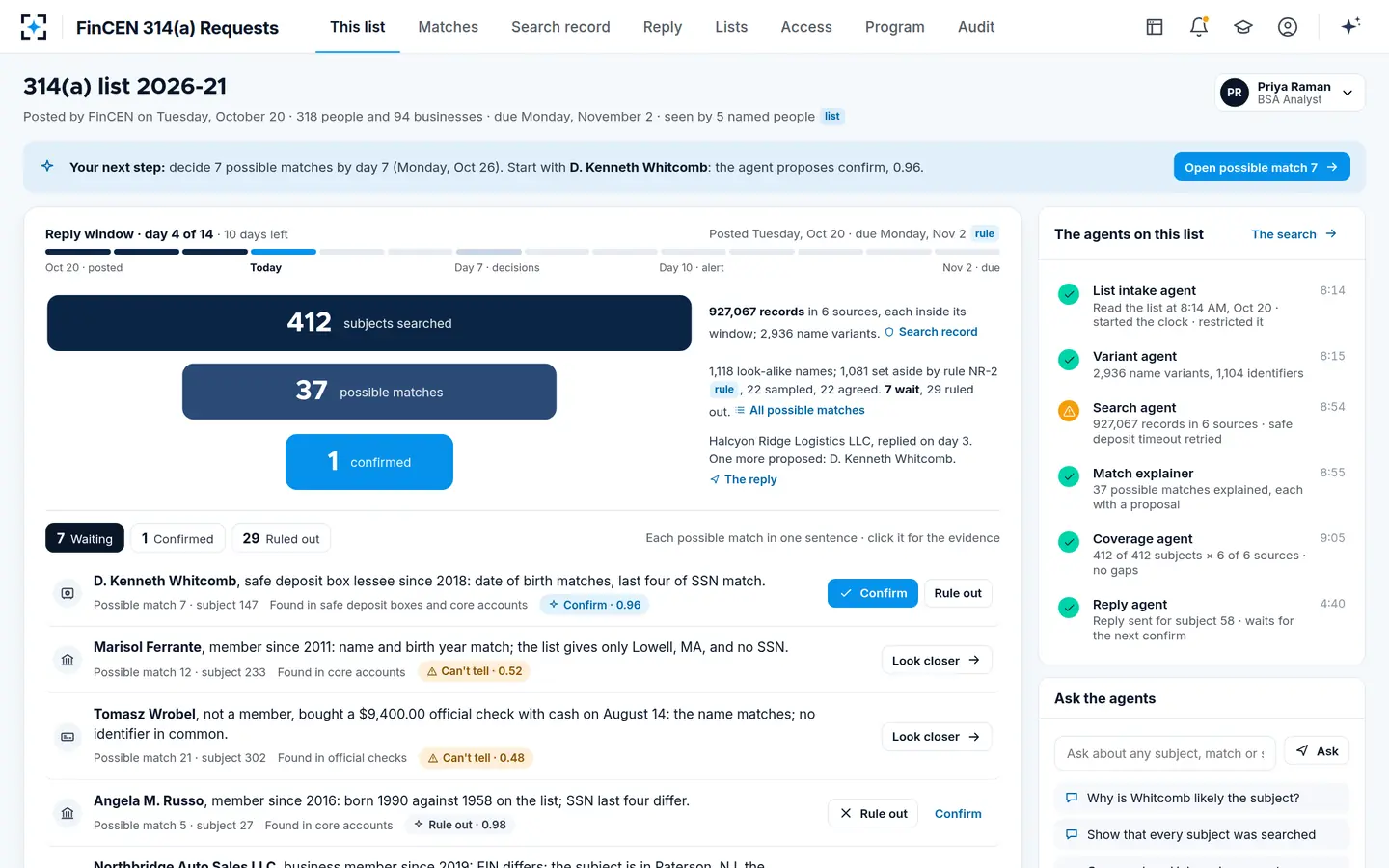
FinCEN 314(a) Requests changes the cost per subject, not the cost per decision. The search across every source, the name variants, the per-subject receipts and the draft replies are agent work, done on posting day. What remains paid by the hour is the analyst's decision on each possible match and the BSA Officer's approval of each reply, the two steps the solution is designed never to take on its own. On the sample list that was 37 possible matches out of 412 subjects.
The honest comparison is therefore built from a bank's own numbers: subjects per year from FinCEN's list, its current minutes per subject, and its own count of look-alikes per list. A bank with one core system and few walk-in customers already searches quickly and gains mostly on proof and confidentiality. A bank with five or six systems, many closed accounts and a busy teller line gains on hours too. Where a cycle's time goes week by week is drawn in 314(a) search dates, and how to replace a search method without missing a list in 314(a) screening: switching search methods.
FinCEN 314(a) Requests: what is left for people, one sentence per possible match
What to measure before and after a change
Measure a 314(a) program on four numbers, all of which a bank can collect from its own lists. The first is minutes per subject, from download to the last reply, which can be set against FinCEN's four. The second is possible matches per list and minutes per possible match, which is where the cost actually sits. The third is the posting-day share: how many lists were fully searched on the day they arrived. The fourth is proof: for how many lists with no match can the bank show, subject by subject, which sources were searched and when.
Two numbers do not belong on the list. The count of positive matches is set by law enforcement, not by the bank, and rises or falls with the lists. And a fall in look-alikes after a change of method is good news only if a planted-name test shows that true matches are still found; how to run one is in what counts as a 314(a) positive match.
Questions people ask
What is the burden of 314(a) requests?
FinCEN's 2025 estimate is about 44 hours a year per respondent for the requests covered by the Paperwork Reduction Act, plus about 408 hours per institution for federal requests in 2024. In money, about $67.5 million a year for the first group and $637 million in 2024 for the second, across all respondents.
What is a 314(a) compliance program?
It is the part of an AML program that handles FinCEN's information requests: at least one designated point of contact, procedures to search the right records in the right windows, timely replies, confidentiality controls and documentation that every list was searched. Examiners test it by sampling requests and reviewing the bank's documentation.
How many institutions receive 314(a) requests?
In 2024 FinCEN sent requests to 12,839 institutions, about 2.2 percent of the 575,873 the rule could reach; about a third were banks or credit unions. In fiscal 2025 its requests reached 13,887 institutions and 20,095 points of contact.
Do small banks spend less on 314(a)?
Less in total, not per subject. FinCEN's estimates assume every respondent searches every subject it is sent, so a small bank on the distribution can face the same 6,000 to 7,000 subjects a year as a large one; it usually has fewer records and look-alikes per subject, but also fewer people to cover a heavy week.
How many 314(a) subjects does a bank search in a year?
An institution that received every posting searched about 6,469 subjects in calendar 2025 and 6,592 in 2026 by mid-October, by our tally of FinCEN's transmission list. At FinCEN's four minutes each, that is about 430 to 440 hours a year before any hard case runs long.