314(a) screening, often written 314a screening, is the search a bank or credit union runs on each FinCEN 314(a) list: every subject against accounts held in the past twelve months and transactions outside an account in the past six, with every positive match reported within two weeks. Switching how that search is done is risky because the lists never stop: a method that fails on its first live list leaves a lead unreported and a gap an examiner will find. The same rhythm makes a safe switch possible. Because a list arrives every two weeks, a new method can run beside the old one on two or three real lists, with the results compared subject by subject, before it replaces it. Botminds' FinCEN 314(a) Requests is an agentic solution that searches each source on posting day, explains every possible match and keeps a receipt per subject; this guide is the plan for putting it, or any new method, live.
The examination steps quoted come from the FFIEC BSA/AML manual. The plan and the reconciliation are ours. Where the page shows the solution, the example is a fictional sample credit union, Norrell Federal Credit Union.
Switching 314(a) screening methods: the cut-over, cycle by cycle
- Before the first list: scope, rules, access
Write down every source and its window, the name rules and the confirm and rule-out reasons; restrict the new tool to the named team; sign any vendor agreement.
- Before the first list: a planted-name test
Run fictitious subjects planted in a copy of the records, and fix what the test finds while nothing is live.
- Cycle 1: the new method shadows the old
The old method answers FinCEN as usual; the new one searches the same list the same day, and nothing it finds is sent.
- Cycle 1: reconcile subject by subject
Every difference in possible matches, sources searched or windows applied is explained in writing before the next list.
- Cycle 2: shadow again, with the differences closed
Same list, both methods; the reconciliation should now show only differences the new method gets right.
- Cycle 3: the new method answers, the old one checks
Replies to FinCEN come from the new method; the old one runs once more as a backstop.
- Cycle 4: retire the old method, keep its records
The BSA Officer signs the switch; the parallel-run file joins the program records for audit and examination.
What is 314(a) screening, and what must a new method match?
314(a) screening is a search with fixed edges: the subjects on the list, the bank's records, two windows and a two-week clock. Under 31 CFR 1010.520(b)(3)(i) a bank searches for any current account of a named subject, any account maintained in the preceding twelve months, and any transaction outside an account, including funds transfers, in the preceding six months that it must record or keeps electronically. It reports what it finds; when nothing matches, FinCEN instructs it not to reply.
A new method has to match the old one on all of that and beat it on at least one thing worth the risk of switching: more sources reached, fewer hours, better proof or tighter confidentiality. It also has to fit the calendar. FinCEN posted 26 regular lists in 2025 and 21 by mid-October 2026, plus one off-cycle request in each year, by its transmission list. There is no quiet month to switch in.
The constraints a 314(a) cut-over works inside
2wks
between postings, and the reply window for each list
26
regular postings in 2025: no list can be skipped while a method changes
12mo
of missed requests that must be searched retroactively if a gap is found
8wks
for a four-cycle parallel run on FinCEN's regular rhythm
What are 314(a) screening requirements, as an examiner tests them?
The requirements a new method must meet are the ones the FFIEC's examination procedures test. Examiners determine whether the bank's procedures "designate points of contact", "establish a process for responding to Financial Crimes Enforcement Network (FinCEN's) requests in the manner and in the time frame specified" that searches the right records in the right windows, and "protect the security and confidentiality of the Section 314(a) subject list". Then they sample requests and review the bank's documentation for each one.
What an examiner checks, and what the parallel run must prove
| The examination step | What the new method must show by cycle 3 |
|---|---|
| Points of contact are designated and requests are being received | The same contacts still download each list; the new method reads the list from them, not from a vendor's sign-in. |
| A process searches current accounts, accounts in the past 12 months and transactions in the past 6 | Every source in the written scope searched, each inside its window, with the window shown per subject. |
| The subject list is kept secure and confidential | Fewer copies than before: no exports to email or shared drives, every view logged. |
| A vendor, if used, works under an agreement and without direct access to FinCEN's system | The agreement signed before cycle 1; no portal credentials shared at any point. |
| A sample of requests is documented: searches done, responses on time | For any subject on any list, a record of when each source was searched, in which window, with what result. |
| Information is used only for permitted purposes | Matches go to a restricted internal review, not to account notes, branches or marketing. |
What systems need to be searched for 314(a)?
Every system that holds an account or a recorded non-account transaction in the windows, whatever team owns it. In most banks that is more than the core: loan servicing, because a credit account is an account under the rule; a payments hub or wire module for funds transfers where the bank was the sender's or the recipient's institution; the monetary instrument log for official checks and money orders sold for cash; currency transaction records; and any other system where walk-in transactions are kept electronically. Some banks also search safe deposit box leases; whether they do is a scope decision for their procedures.
A cut-over is the moment to write the list down, because it is the moment differences surface. If the old method searched four systems and the new one six, the extra two will produce look-alikes the old one never saw, and the reconciliation has to show whether any of them is a true match the bank has been missing. The 314(a) transaction screening guide maps each record type to the prong of the search that finds it.
Can you run 314(a) searches in parallel?
Yes. Nothing in the rule limits how many times or ways a bank searches its own records for a request; the limits are on disclosure and use. A parallel run is two searches of the same list by the bank's own staff and tools, and one reply to FinCEN. What needs care is the second copy of the list: the new tool must sit inside the same confidentiality controls as the old process from the first day, and a vendor running it must be bound by an agreement that keeps the list confidential.
A four-cycle cut-over: two shadow lists, one backstop, then the switch
- Answers FinCENcycles 1–2
- Backstop onlycycle 3
- Retiredcycle 4
- Shadow, nothing sentcycles 1–2
- Answers FinCENcycles 3–4
- Subject by subjectafter each shadow list
- Backstop checkcycle 3
- Signed and filedcycle 4
Reconciling one shadow list: what to compare, old method against new
Old method: All on the list, per the checklist.
New method: All on the list, with a receipt for each subject in each source.
Old method: As the procedures name them; often the core plus manual checks.
New method: Each source named, with its window and the time it answered.
Old method: The hits the analyst reviewed.
New method: Every possible match, and every look-alike set aside with its reason.
Old method: Reported to FinCEN.
New method: Would have been reported; any difference is examined before the next list.
Old method: Hours from download to last decision.
New method: Hours from download to last decision, on the same list.
Treat a difference in confirmed matches as the most important result of the run. If the new method finds a true match the old one missed on a list whose window is still open, report it in time. If the list's window has closed, follow the bank's procedure for a missed match and ask FinCEN's 314 Program Office how to proceed; the FFIEC manual sends banks to that office for prior requests when searches were not performed.
How do you test a new 314(a) search tool?
In two ways, and the order matters: first with planted names, then with real lists. A planted-name test uses fictitious subjects planted in a copy of the bank's records under the variations real customers produce, so the bank knows the right answer in advance and can measure both missed matches and wrongly proposed ones; the method is set out in what counts as a 314(a) positive match. The shadow lists then test what a planted test cannot: the real mix of names, the real systems' timeouts and the real hours.
Two outcomes should stop a cut-over. A source that fails silently, counted as "no match" when it never answered, means the new method cannot prove coverage. A look-alike set aside on a name alone means it can lose a true match. Both are visible in a well-kept parallel-run file and invisible in a summary that reports only the confirmed matches.
FinCEN 314(a) Requests: a receipt for every subject in every source
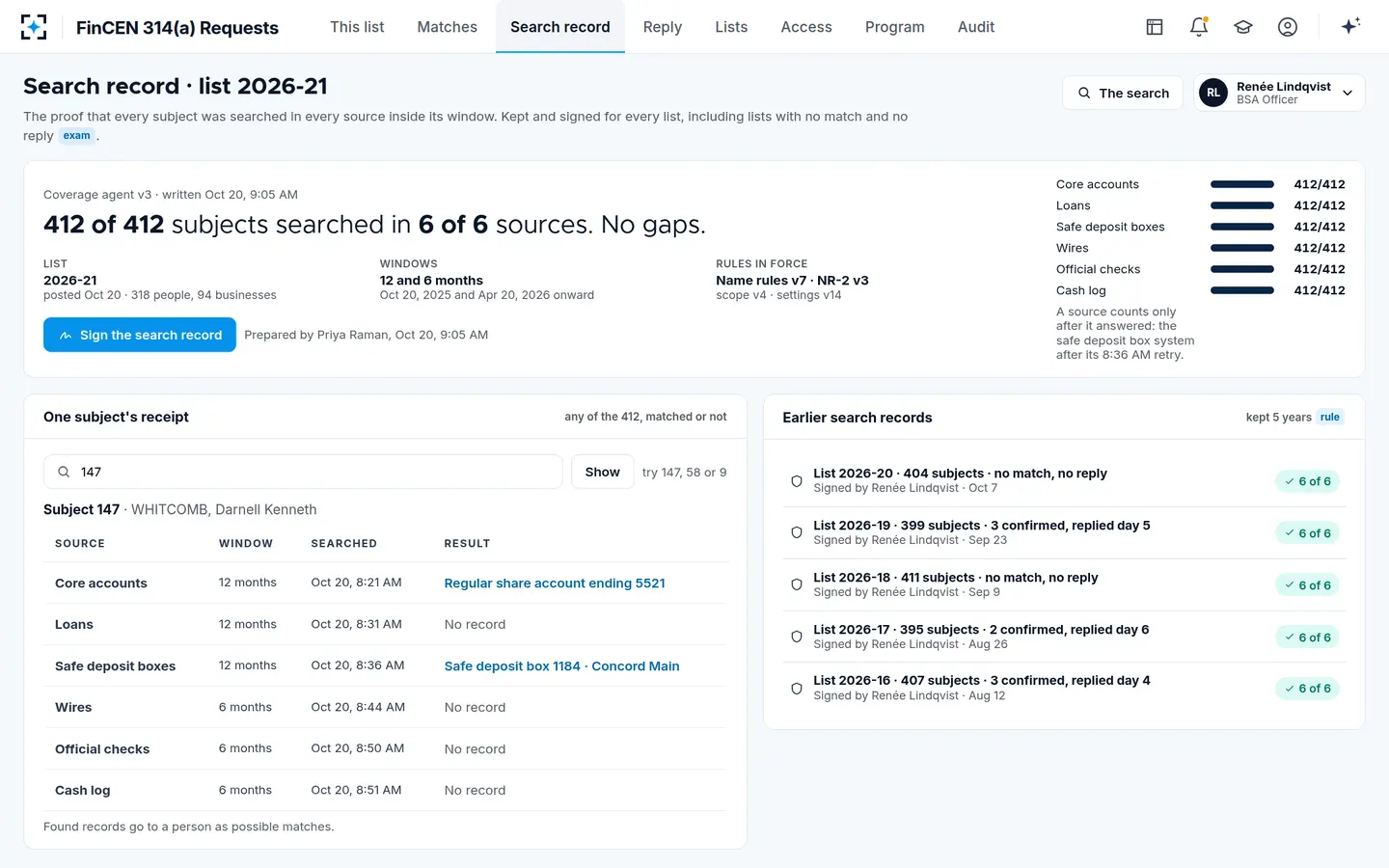
Confidentiality during the switch: who sees the list
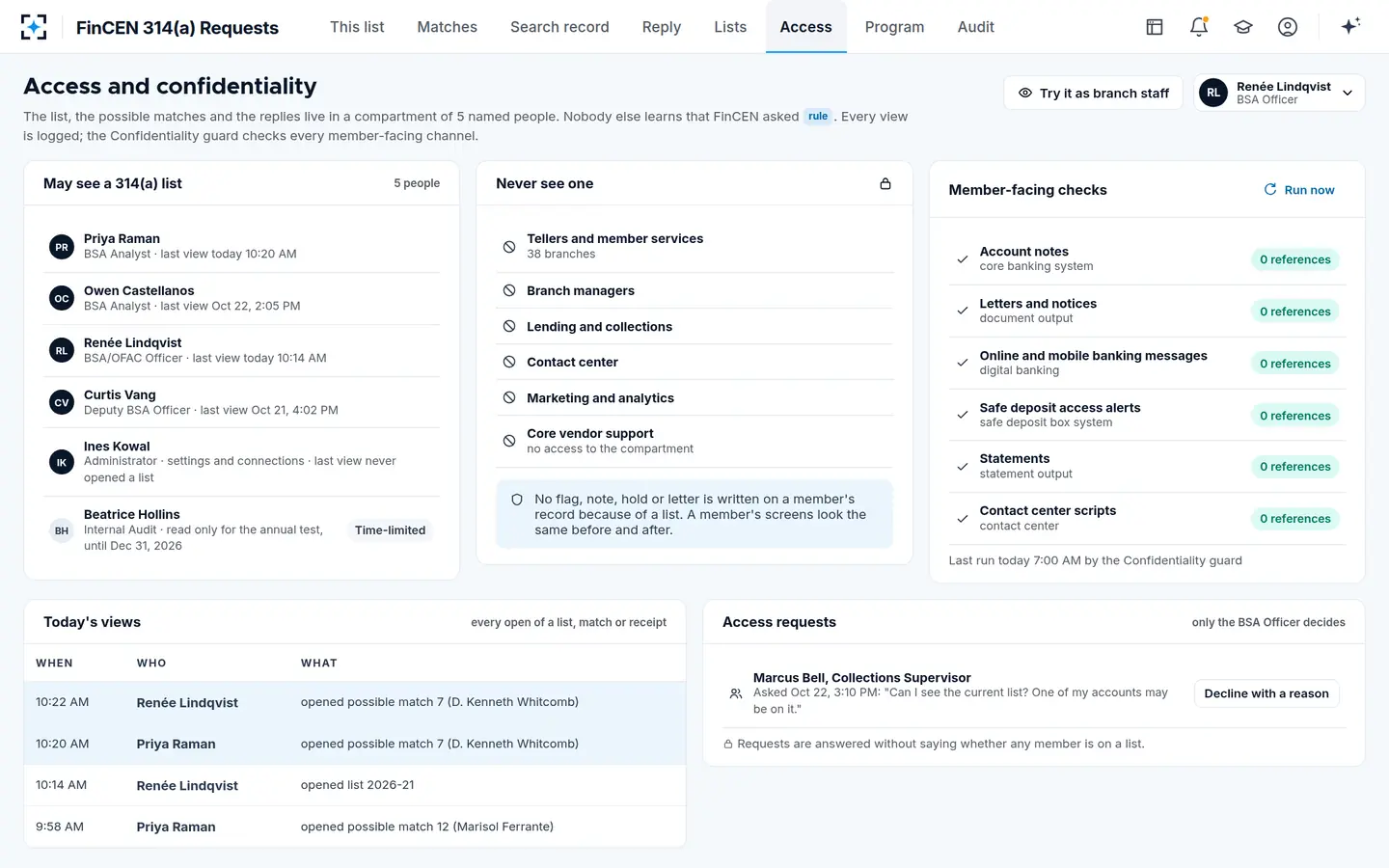
A cut-over is when copies multiply: a test export for the vendor, a spreadsheet for the reconciliation, an email to the project manager. The rule's duty does not pause. A bank "shall not disclose to any person" other than FinCEN, the requesting agency and, in the FFIEC manual's reading, its primary regulator, that FinCEN has requested information, and must "maintain adequate procedures to protect the security and confidentiality" of the requests. The planted-name test is the place for project staff and vendors to work freely, because its subjects are invented.
Access to FinCEN's portal is a separate line. FinCEN moved its secure system to a Financial Industry portal with multi-factor sign-in, and its fiscal 2026 budget justification describes the portal as enabling MFA for institutions answering 314(a) and 314(b). The FFIEC procedures ask examiners to verify that a bank "is not providing direct access to the Secure Information Sharing System (SISS) to a third-party vendor". A new method fetches lists through the bank's own contacts, never through a vendor's sign-in.
FinCEN 314(a) Requests: five named people may see a list, every view logged
When to retire the old method
Retire the old method when two shadow lists reconcile with every difference explained, the backstop cycle shows nothing the new method missed, and the BSA Officer signs the switch. Keep the old method's last records with the program file; an examiner sampling a list from before the switch will want the old evidence, and one sampling a list from the parallel run will want both.
Plan for the case where something slips. If a list goes unsearched during the change, the FFIEC manual's guidance applies: obtain the prior request from FinCEN, search retroactively, and report any positive match within 14 calendar days of receiving it. A single miss found and fixed is a different finding from a pattern, and the parallel-run file is what shows which one the bank has.
Going live with FinCEN 314(a) Requests: what the bank brings
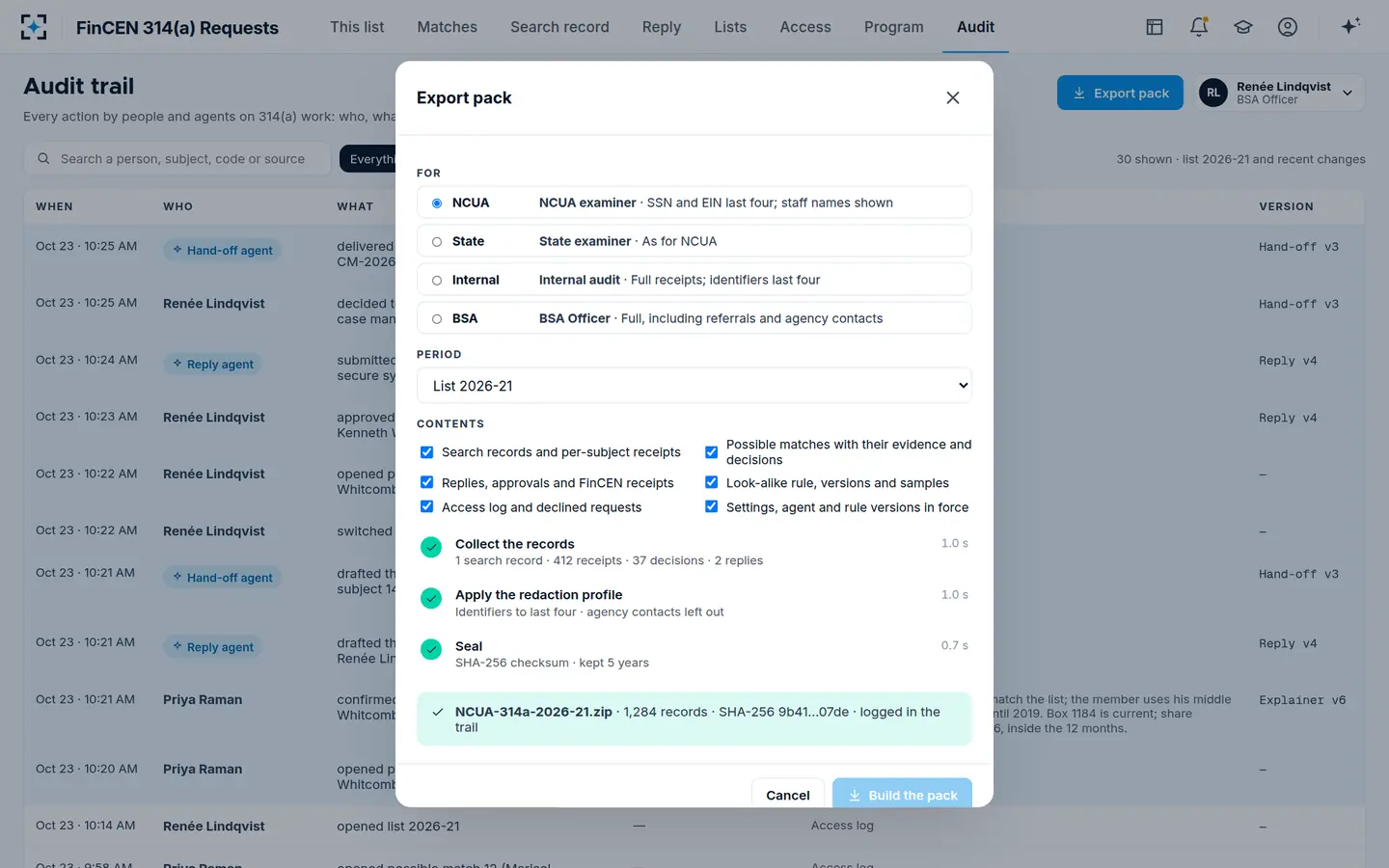
Going live with FinCEN 314(a) Requests starts from the bank's own procedures, not from a template. The bank brings its search scope, the systems where its records live and how to reach them, its name rules and its confirm and rule-out reasons, the people who may see a list and who approves a reply, and its clocks inside FinCEN's window. Each becomes a setting the BSA Officer approves; each save is a new version, and the audit trail records which version was in force for every action.
The parallel run then works as described above, with one advantage: the solution's receipts make the reconciliation a lookup rather than a reconstruction. What it does not remove is the bank's judgement. The agents propose; an analyst confirms or rules out; the BSA Officer approves each reply and signs the record for each list. The cost case for the switch is set out in the 314(a) program, priced per list and per subject.
FinCEN 314(a) Requests: every action on the audit trail, with the version in force
Questions people ask
How do you implement 314(a) screening for the first time?
Designate the points of contact through the bank's primary regulator, write procedures naming every system to search and its window, set confidentiality controls for the list, and decide how each search will be documented. Then run a planted-name test before the first live list, because a first list leaves no time to fix a method.
What is FinCEN 314(a) screening?
It is the search a financial institution runs when FinCEN posts a 314(a) request: each subject against current accounts, accounts in the past twelve months and non-account transactions in the past six. Positive matches go back to FinCEN through its secure portal within two weeks; if nothing matches, there is no reply.
Does an examiner have to approve a new 314(a) search tool?
The FFIEC procedures describe no approval step for a tool. Examiners assess the bank's procedures, sample requests and review documentation, so the parallel-run file and the evidence for each list are what they will see.
How long does a 314(a) cut-over take?
On FinCEN's two-week rhythm, two shadow lists, a backstop cycle and the switch take about eight weeks. Add the time to write the scope and run a planted-name test beforehand, which depends on how many systems the search must reach.
Can the old and new methods both reply to FinCEN?
They should not. One reply per subject, from one method, keeps the response clear and the records simple; in our plan the old method answers in cycles one and two and the new one from cycle three.