The 314(a) lookback period is two windows set by 31 CFR 1010.520: a bank must search for any current account of a named subject and any account maintained for the subject in the preceding twelve months, and for any transaction outside an account, including funds transfers, conducted in the preceding six months, counted from the date of the request. Closed accounts are in scope if they were open at any point in the twelve months. Most search gaps come not from misreading the rule but from systems that do not hold one of the windows: a core report that shows only open accounts, a monetary instrument log kept on paper, a migrated system whose history sits elsewhere. Botminds' FinCEN 314(a) Requests is an agentic solution that searches each source inside its own window and records, for every subject, which window each source was searched in.
The rule text is quoted from the eCFR and the FFIEC examination manual. The system-by-system map is ours. Where the page shows the solution, the example is a fictional sample credit union, Norrell Federal Credit Union, and its sample list.
Every system against the two 314(a) windows: twelve months for accounts, six for transactions
Deposit accounts, open or closedAccount
Loans, lines and card accountsAccount (credit)
Safe deposit box leasesThe bank's scope choice
Walk-in wires, as sender's or recipient's bankTransaction
Checks and money orders sold for cashTransaction
Currency transactions outside an accountTransaction
Payments made from a customer's own accountFound through the account
What is the 314(a) lookback period?
It is the stretch of the bank's records a 314(a) search must reach, and the rule sets it in three parts. Unless FinCEN's request says otherwise, a bank "shall only be required to search its records for: (A) Any current account maintained for a named suspect; (B) Any account maintained for a named suspect during the preceding twelve months; and (C) Any transaction ... during the preceding six months", the last limited to transactions the bank must record or records and keeps electronically (31 CFR 1010.520(b)(3)(i)).
The first part is easy to overlook: a current account is in scope however long ago it was opened. The second reaches back a year for accounts that have since closed. The third covers a shorter period for a different kind of record, transactions not made through an account, which the definitions section expressly separates from account activity for this purpose (31 CFR 1010.505(d)).
The 314(a) lookback in four numbers
Any
current account of a named subject, however old
12mo
for accounts maintained in the past year, including closed ones
6mo
for transactions outside an account, including funds transfers
12mo
the oldest missed request that must be searched retroactively
How far back do you search for 314(a)?
Twelve months for accounts and six for transactions outside an account, counted back from the date of the request. FinCEN's 2025 paperwork notice spells out the starting point: accounts maintained "during the preceding twelve months from the date of the Section 314(a) Request", and transactions "during the preceding six months from the date of the Section 314(a) Request". A request can widen or narrow either window; the rule's limits apply "except as otherwise provided in the information request".
A worked date shows how the windows sit. For a list posted on Tuesday, October 13, 2026, the account search reaches every account open on or after October 13, 2025, and every account open today; the transaction search reaches non-account transactions on or after April 13, 2026. A checking account closed on November 2, 2025 is in scope. One closed on September 30, 2025 is not, unless the request says otherwise.
One posting, two windows: the dates for a list posted October 13, 2026
- Accounts maintained in the past 12 months, open or closedOct 13, 2025 – Oct 13, 2026
- Not in scopebefore Apr 13, 2026
- Transactions outside an accountApr 13 – Oct 13, 2026
Do closed accounts need to be searched for 314(a)?
Yes, if the account was maintained at any time in the twelve months before the request. This is where many search gaps begin, because a core system's standard search often looks at open relationships, and closed accounts sit in an archive or a separate history table. FinCEN's fact sheet puts the duty plainly: institutions "must query their records for data matches, including accounts maintained by the named subject(s) during the preceding 12 months".
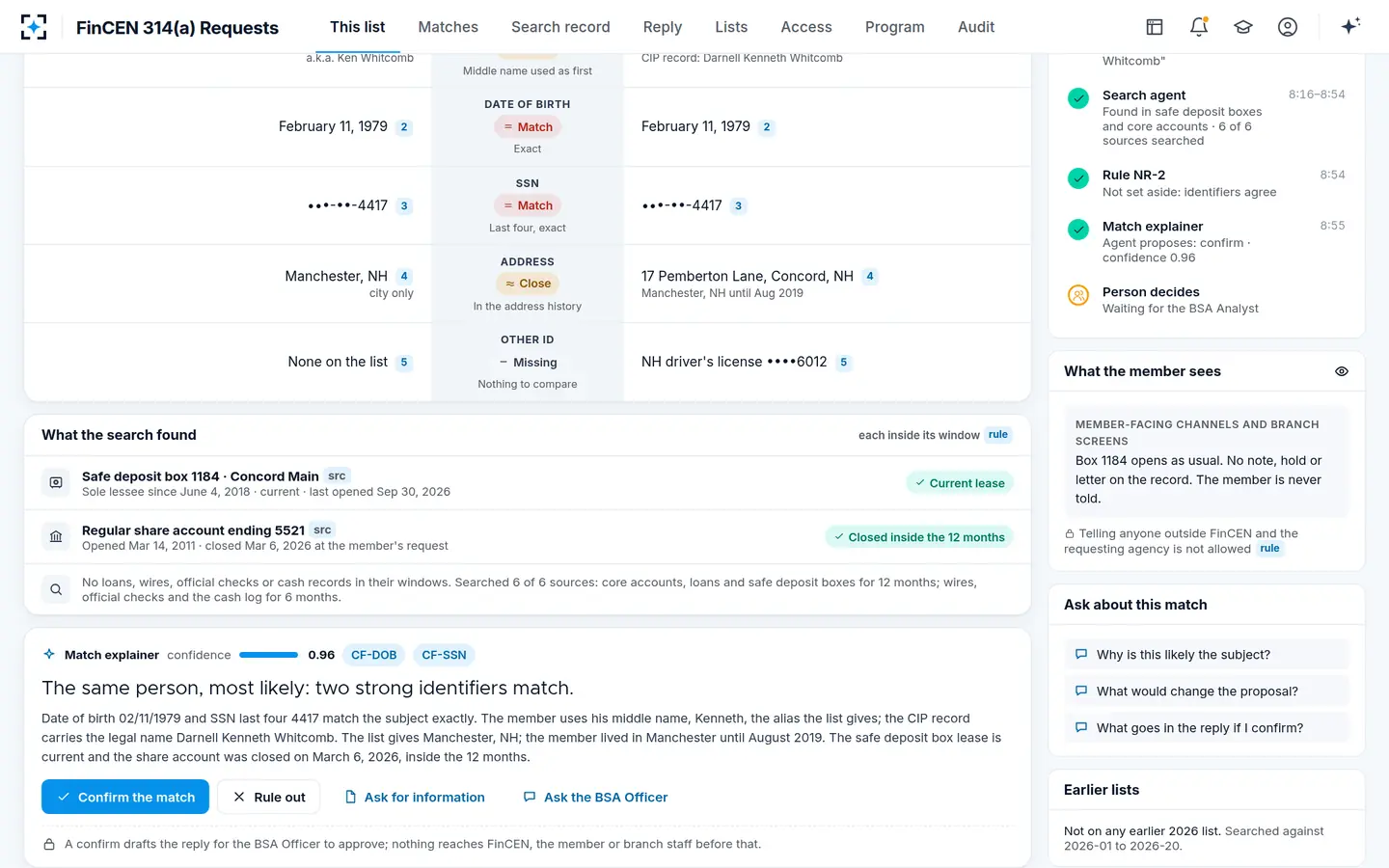
The sample list shows why it matters. Subject 147 matched a member whose share account had been closed at his request on March 6, 2026, more than seven months before the posting. The only other record was a safe deposit box lease. A search of open deposit accounts alone would have found nothing in the core; the share account, with the identifiers given when it was opened in 2011, is what the reply was built on.
FinCEN 314(a) Requests: a closed account, flagged as inside the twelve months
What transactions are searched for 314(a)?
Transactions outside an account in the past six months that the bank must record by law or regulation, or that it records and keeps electronically, including any funds transfer in which the subject was the sender or the recipient. A transaction through a customer's own account is not a "transaction" for this rule; it is reached through the account search instead. For funds transfers, the FFIEC manual passes on FinCEN's clarification that banks search the records they keep as the sender's or the recipient's institution.
The second condition is the one that catches procedures out. "Required under law or regulation to be recorded" reaches records a bank keeps on paper, such as a branch's monetary instrument log, as well as electronic ones; "recorded and maintained electronically" reaches records no rule requires, such as a teller system's log of checks cashed for non-customers. Which record types fall in which prong is mapped in detail in 314(a) transaction screening.
What is in the 314(a) lookback, and on what basis
| Record | Window | Basis |
|---|---|---|
| Any account open on the posting day | Whenever opened | The rule: "any current account" |
| Deposit account closed in the past year | 12 months | The rule: account maintained in the preceding twelve months |
| Loan or line of credit, open or paid off in the past year | 12 months | The definitions: an account includes a credit account or other extension of credit |
| Walk-in wire, bank as sender's or recipient's institution | 6 months | The rule (transmittal of funds); FFIEC manual on which records |
| Official check sold for $3,000–$10,000 in cash | 6 months | A record the bank must keep, paper or electronic |
| Check cashed for a non-customer, logged electronically | 6 months | Recorded and maintained electronically by the bank |
| Safe deposit box lease | Bank's procedure | Not named in the public rule; a scope decision |
| Records created after the request date | Not in scope | Past activity only; future activity is not reported unless the request asks |
Do you search safe deposit boxes for 314(a)?
The public rule does not name them, so whether to search box leases is a decision for the bank's written procedures. The question turns on whether a lease is an "account" for this purpose. The definitions section describes an account as a formal banking or business relationship established to provide regular services, and lists deposit and credit accounts as examples without limiting the term to them. FinCEN's 314(a) FAQs, which the FFIEC manual says are available to institutions that receive requests, are the place to check FinCEN's current view.
A lease is cheap to search and costly to miss. A subject with no deposit account may still rent a box, and a box is a place investigators care about. The fictional sample credit union in FinCEN 314(a) Requests treats leases kept electronically as within its twelve-month scope, and its sample match shows why: the box lease was current, the share account was already closed. The bank that excludes leases should say so in its procedures, with the reason, so an examiner reads a decision and not an omission.
Where 314(a) lookback gaps come from
Gaps come from systems that cannot answer for one of the windows, and they are found by asking each system the same question: for the past twelve months, or six, can you show every record that might belong to this person? The answer is often no, for reasons that have nothing to do with the 314(a) procedure.
Six common lookback gaps, and how to close each
- The core search shows open relationships only
Add closed accounts maintained in the past twelve months, from history tables or the archive, and test it with a planted closed account.
- A system was converted inside the window
Records from before the conversion sit in the old system or an export; search both until twelve months have passed.
- The monetary instrument log is on paper
It is a required record and in scope; name who searches it, how, and how the search is evidenced.
- Walk-in wires sit in the payments hub, not the core
Search originator and beneficiary names in the hub for six months, where the bank was their institution.
- Name history is not searched
Former names and addresses in the customer file are how a married name or a move is found.
- Subsidiaries and affiliates are left out
FinCEN recommends giving requests to domestic subsidiaries offering accounts in scope; any matches are reported by the bank. Foreign offices may not receive the list.
Retroactive searches: the lookback when a list was missed
A missed list has a lookback of its own. The FFIEC manual, drawing on FinCEN's FAQs, says that a bank that failed to search requests received in the previous twelve months must obtain them from FinCEN and search them retroactively, and need not search requests sent more than twelve months before it found the gap. In a retroactive search, "a bank is not required to search records created after the date of the original information request."
The windows therefore run from the original request date, not from the day the gap was found. A list posted in March and found unsearched in October is searched for accounts maintained in the twelve months before March and non-account transactions in the six months before March; any positive match is reported within 14 calendar days of receiving the prior request. That makes old records matter: a system that has already purged closed accounts from early in the year cannot answer a retroactive search properly. How to keep the evidence of each search, current or retroactive, is covered in 314(a) record retention requirements.
How FinCEN 314(a) Requests holds each window
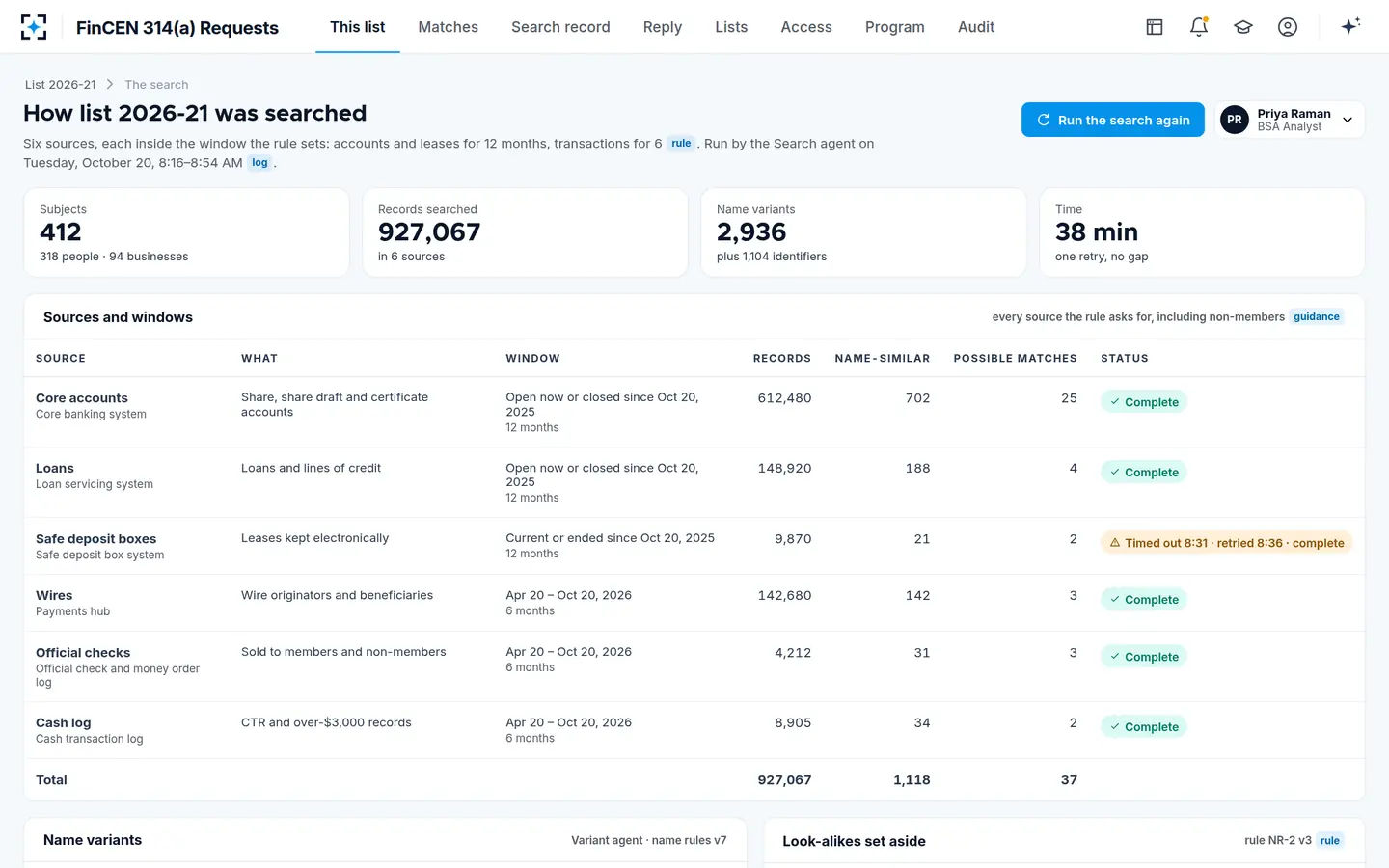
FinCEN 314(a) Requests treats the windows as settings, source by source: twelve months for accounts, loans and safe deposit box leases at the sample credit union, six for wires, official checks and the cash log, and FinCEN's own scope and deadline whenever a special request says otherwise. The search agent never searches outside a window, and the receipt for each subject shows, for each source, the window applied and the time it was searched.
The windows show on the search screen as dates, not only as months, so an analyst can see that "12 months" on a list posted October 20 means accounts open now or closed since October 20, 2025. Changing a window is a versioned setting the BSA Officer approves. What the solution cannot do is search records a bank does not hold electronically, or records a system has already purged; those are gaps to close in the bank's own scope, as the checklist above sets out.
FinCEN 314(a) Requests: each source with its window, as dates
Questions people ask
Is the 314(a) lookback 12 months?
For accounts, yes: any account maintained in the twelve months before the request, plus any current account. For transactions outside an account, including funds transfers, it is six months. A request can set a different scope.
What records are in scope for 314(a)?
Accounts, deposit and credit, current or maintained in the past twelve months, and non-account transactions in the past six months that the bank must record or keeps electronically. Activity through a customer's own account is reached through the account search, and future activity is out of scope unless the request asks for it.
Do you search loans for 314(a)?
Yes. The definition of account for this rule includes a credit account or other extension of credit, so loans and lines open now or maintained in the past twelve months are in scope. A paid-off loan closed eleven months before the request still counts.
Do paper records count for the 314(a) lookback?
Records the bank is required by law or regulation to keep count whether they are on paper or electronic, so a paper monetary instrument log within six months is in scope. Records no rule requires count only if the bank keeps them electronically.
Can a 314(a) request change the lookback period?
Yes. The rule's windows apply "except as otherwise provided in the information request", so FinCEN can ask for a longer or shorter period or other records. Read each request's instructions before the search runs, and record the scope actually used.