314(a) transaction screening is the part of a 314(a) search that checks each subject on FinCEN's list against transactions made outside an account in the preceding six months: funds transfers the subject sent or received through the bank, checks and money orders sold over the counter, and other transactions the bank must record or keeps electronically. It sits beside the account search, which covers any account the subject has held in the past twelve months. It is hard because those records live in five or six systems with different name rules, and a search that only queries the core misses the walk-in customer entirely. Botminds' FinCEN 314(a) Requests is an agentic solution that runs both searches on the day a list posts, inside each window, and writes a receipt for every subject in every source, so a person decides each possible match and nothing goes unsearched.
The trace below follows one subject through the solution on a fictional sample credit union's list: Norrell Federal Credit Union, list 2026-21, 412 subjects. The rules quoted come from the regulation and the FFIEC examination manual, linked where they appear.
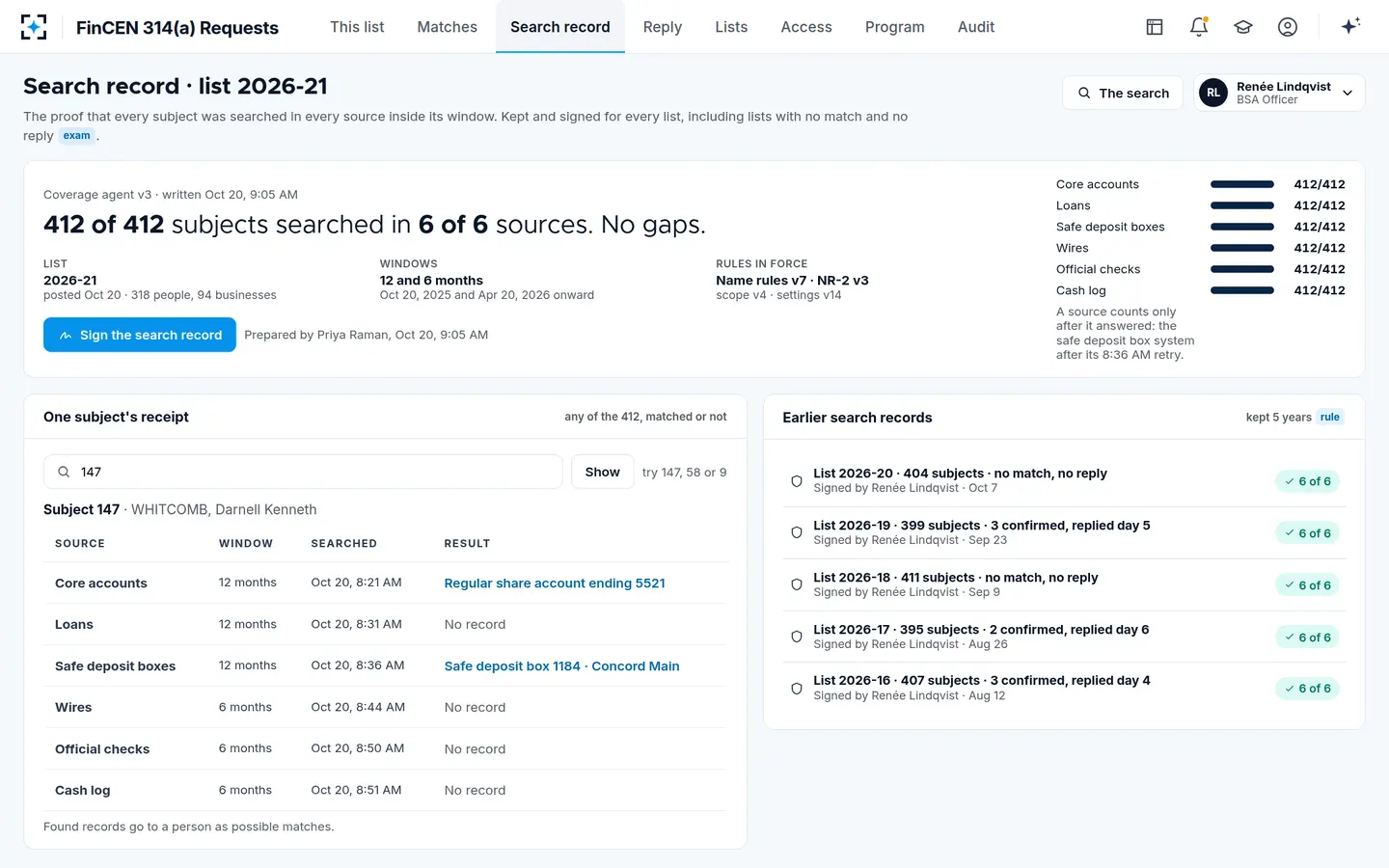
One subject traced through six sources: every search answered, two records found
Core accounts
Window12 months
Searched8:21 AM
ResultRegular share account ending 5521, closed March 6, 2026
What this line provesClosed inside the window, so in scope: a report of open accounts alone would have missed it.
Loans
Window12 months
Searched8:31 AM
ResultNo record
What this line provesA credit account counts as an account under the rule; searched even when the core finds nothing.
Safe deposit boxes
Window12 months
Searched8:36 AM
ResultBox 1184, sole lessee since 2018, current
What this line provesCounted only after a retry: the system timed out at 8:31 and answered at 8:36.
Wires
Window6 months
Searched8:44 AM
ResultNo record
What this line provesOriginators and beneficiaries where the credit union was their institution.
Official checks
Window6 months
Searched8:50 AM
ResultNo record
What this line provesIncludes checks and money orders sold to people who are not members.
Cash log
Window6 months
Searched8:51 AM
ResultNo record
What this line provesCurrency transaction reports and the $3,000 monetary instrument records.
What is 314(a) transaction screening? The six-month search outside accounts
Transaction screening is the second of the rule's search duties, and it is narrower than its name. Under 31 CFR 1010.520(b)(3)(i), a bank must search for any transaction "conducted by or on behalf of a named suspect, or any transmittal of funds conducted in which a named suspect was either the transmittor or the recipient, during the preceding six months", if the transaction is one the bank must record by law or regulation, or one it records and keeps electronically.
The word that does the work is in the definitions. For this section, 31 CFR 1010.505(d)(2) says that "a transaction shall not mean any transaction conducted through an account." A customer's card payments, deposits and transfers from her own account are found through the account search, which looks back twelve months. The six-month transaction search exists for everything else: the person with no account who buys an official check with cash, sends a wire from the counter or cashes a check. FinCEN's fact sheet says it plainly: "transactions not linked to an account conducted within the past 6 months".
That is why a bank's transaction screening is only as good as its records of people who are not its customers. The account search runs against a core system that knows every customer's identifiers. The transaction search runs against logs kept for other reasons, often by other teams, where the purchaser's name may be typed by a teller and the identifiers sit in a separate field or an imaged form.
What records must be searched for 314(a)?
The records that must be searched are any current account, any account maintained in the past twelve months, and any recorded non-account transaction from the past six, unless FinCEN's request says otherwise. "Account" is broad: the same definitions section calls it "a formal banking or business relationship established to provide regular services, dealings, and other financial transactions", including deposit accounts and "a credit account or other extension of credit". Loans and lines of credit are therefore in scope, not only deposits.
Which prong of the 314(a) search finds which record
| Record | Searched under | Window | Why |
|---|---|---|---|
| Checking, savings, share, certificate account, open or closed | Account search | 12 months | A deposit account is an account; closed accounts count if maintained in the window |
| Loan, line of credit, credit card account | Account search | 12 months | "A credit account or other extension of credit" is an account |
| Card payment or transfer made from a customer's own account | Account search | 12 months, through the account | A transaction through an account is not a "transaction" for this section |
| Wire sent or received for a walk-in, where the bank was the sender's or recipient's bank | Transaction search | 6 months | A transmittal of funds in which the subject was transmittor or recipient |
| Official check or money order sold for $3,000 to $10,000 in cash | Transaction search | 6 months | A record the bank must keep under 31 CFR 1010.415 |
| Currency transaction over $10,000, customer or not | Transaction search, if not through an account | 6 months | A report the bank must make and keep |
| Teller log of a check cashed for a non-customer, kept electronically | Transaction search | 6 months | Recorded and maintained electronically by the bank |
The monetary instrument log deserves its own line in every procedure. For a purchaser without an account, 31 CFR 1010.415 requires the bank to record the name and address, Social Security or alien identification number, date of birth, the instruments' serial numbers and the identifying document examined, and the FFIEC manual's monetary instruments section adds that those records are kept for five years. A 314(a) list often gives a date of birth or a Social Security number; the log may be the only place in the bank where a walk-in's are written down.
Do you search wire transfers for 314(a)?
Yes, but only the records the bank keeps as the sender's or the recipient's institution. The FFIEC manual's special information sharing section passes on FinCEN's clarification that "banks are only required to search funds transfer records maintained pursuant to 31 CFR 1010.410 to determine whether a named subject was an originator/transmitter of a funds transfer for which the bank was the originator/transmitter's bank, or a beneficiary/recipient of a funds transfer for which the bank was the beneficiary/recipient's bank."
Two consequences follow for screening. A bank that sits in the middle of a wire, as an intermediary, is not asked to search it under this guidance. And a wire to or from a customer's own account is found through the account search anyway, so the six-month wire search earns its keep on walk-in wires and on the counterparty names a payments hub holds that the core does not.
One subject traced through FinCEN 314(a) Requests
A traced search shows what a bare yes or no hides: which sources answered, inside which window, and what each found. Take subject 147 on the sample list, as the trace above shows. The core found a share account closed in March, inside the twelve months. The safe deposit box system first timed out, so the solution did not count it as searched until it answered five minutes later. The wire, official check and cash sources found nothing, and each "no record" carries the time it was checked.
How FinCEN 314(a) Requests traces a list, and where a person takes over
Agent
List intake agentReads the list from FinCEN's secure system on posting day, counts people and businesses, starts the clock and restricts the list to the BSA team.
Never: prints, emails or shares the list
Agent
Variant agentBuilds name variants (middle name as first, initials, nicknames, spellings, business suffixes) and normalises dates of birth, SSNs, EINs and addresses.
Never: drops an identifier the list gives
Agent
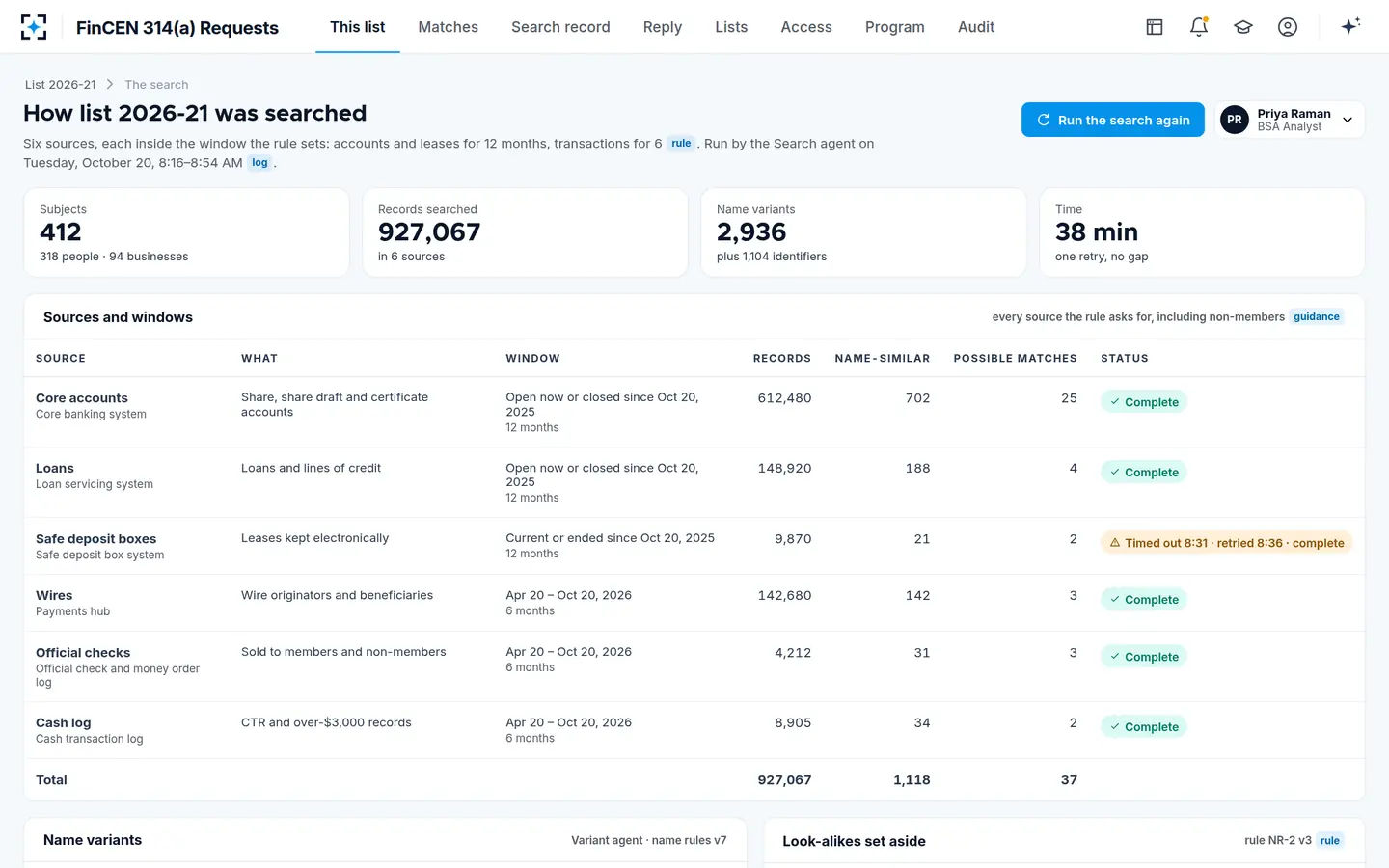
Search agentSearches each source inside its window, 12 months for accounts and 6 for non-account transactions, and retries a source that fails.
Never: sets a record aside on a name alone
Agent
Coverage agentWrites a receipt for every subject in every source and refuses to call the list searched until every cell is covered.
Never: marks a failed source as searched
Agent
Match explainerPuts subject and record face to face, cites every value and proposes confirm or rule out with a confidence.
Never: confirms or rules out itself
A person decides
BSA AnalystConfirms or rules out each possible match with reason codes, or asks for information.
A person decides
BSA OfficerApproves each reply before it goes to FinCEN and signs the search receipts for the list.
The trace also shows a subject the agents would not take further on their own. Possible match 21 on the same list is a non-member who bought a $9,400.00 official check with cash on August 14. The name matches; nothing else on the list matches anything in the log. The match explainer marks it "can't tell" at 0.48 and sends it to a person. Because a non-member's cash purchase of that size is one the rule requires the bank to record with a date of birth and an identification number, the analyst can open the log entry and compare; an agent that guessed would be guessing about a stranger.
The search in FinCEN 314(a) Requests: six sources, each inside its window
Name variants: why an exact-match search report misses people
Most core search reports match a name exactly or by how it begins, and the people on a 314(a) list do not always use their legal name. Subject 147 is listed as Darnell Kenneth Whitcomb, also known as Ken Whitcomb; the member uses his middle name and is on file as D. Kenneth Whitcomb. A query for "WHITCOMB, DARNELL" finds the box lease only if the box system stores the legal name, and the share account not at all.
Variants multiply the hits, and the hits are where the hours go. On the sample list, 2,936 variants across 927,067 records produced 1,118 name-similar records, about 2.7 per subject. The solution's set-aside rule then removes a look-alike only where a date of birth or an SSN or EIN exists on both sides and every one conflicts, never on a name alone; that left 37 possible matches, and an analyst re-checked a 2% sample of the 1,081 set aside.
Where the sample list's 1,118 look-alikes came from, by source
Can 314(a) searches be automated, and what must stay with a person?
The search can be automated, and FinCEN assumes it is. In its 2025 paperwork notice, FinCEN says the subject files come in .csv, .txt and .doc formats "to allow for ingestion into various software", and that it "presumes that all Respondent FIs first conduct an automated search", followed by "additional manual review" to verify each apparent match. What the rule asks for at the end is a judgement: that an account or transaction is identified with the named subject.
The judgement is where automation should stop. A match reported in error puts an innocent customer in front of an investigator, and a match missed leaves a lead unreported. The line that holds up in an examination is simple to state: software may search, normalise, compare and propose; a named person decides each possible match, and a second approves each reply. That is the line FinCEN 314(a) Requests draws, and the one to ask any vendor to show in its audit trail.
Can a vendor run 314(a) searches for a bank?
Yes, under conditions. The FFIEC manual says a bank "may provide the Section 314(a) subject lists to a third-party service provider or vendor to perform or facilitate record searches as long as the bank takes the necessary steps, using an agreement or procedures, to ensure that the third party safeguards and maintains the confidentiality of the information." It adds a hard line: "A bank cannot provide direct access to the SISS to a third-party vendor", and FinCEN's FAQs say a bank cannot hand over its user ID and password.
In practice that means the point of contact downloads the list and passes it on, or a tool the bank operates fetches it under the bank's own control. Either way the vendor relationship belongs in the bank's third-party risk file, with the confidentiality terms written down, because the examiner's procedure is to verify that the bank is not giving a vendor direct access to FinCEN's system.
What to look for in 314(a) transaction screening software
Look for software that proves coverage, not software that promises speed. A search that finishes in minutes but cannot show which sources answered is worse than a slow one that can, because the lists with no match leave nothing else behind. The checklist below is the one we would use in a demonstration; the order is deliberate.
Eight questions to put to any 314(a) transaction screening tool
- Does it search non-account transactions, by source?
Wires as sender's or recipient's bank, monetary instruments sold for cash, currency records, teller logs: name each source and its window.
- Does it hold the two windows separately?
Twelve months for accounts, including closed ones; six for non-account transactions; FinCEN's scope when a request differs.
- What happens when a source fails?
A timeout should leave the subject unsearched in that source until it answers, not quietly counted as "no match".
- How does it build name variants?
Middle names, initials, nicknames, spellings, word order and business suffixes, with the rules written down and versioned.
- Does it ever set aside a look-alike on a name alone?
The safe answer is no: only when identifiers exist on both sides and conflict.
- Can it show a receipt for any one subject?
Source, window, time searched and result, matched or not, for the lists with no reply.
- Who decides, and who approves?
The tool proposes; a named analyst confirms with reasons; a second person approves the reply.
- How is the list kept confidential?
Restricted access, every view logged, no copies in email or shared drives, and no vendor sign-in to FinCEN's portal.
Where FinCEN 314(a) Requests fits, and where it does not
FinCEN 314(a) Requests fits a bank or credit union whose records sit in several electronic systems and whose analysts spend their cycle on look-alikes. It searches the sources it is connected to inside their windows, explains each possible match with every value cited, and writes the receipts that prove the lists with no match were searched. On the sample list it searched 927,067 records in 38 minutes; that is a measurement on sample data, not a promise about any bank's systems.
It does not decide, and it cannot search what is not electronic. A monetary instrument log kept on paper at a branch is still a record the bank must search, and no agent can read a binder; the scope a bank sets has to say who searches it and how. Nor does the solution choose the scope: which systems count, and whether, say, safe deposit box leases are searched as accounts, are the bank's procedures, approved by its BSA Officer. The 314(a) lookback period maps those choices system by system, and switching search methods before the next list covers how to replace an old search without missing a cycle.
One subject's receipt in FinCEN 314(a) Requests, matched or not
Questions people ask
What is 314(a) screening, compared with transaction screening?
314(a) screening usually means the whole search of a FinCEN list: accounts for twelve months and non-account transactions for six. Transaction screening is the second half. A transaction made through a customer's account is found through the account search, because the rule excludes it from "transaction" for this purpose.
How do you document a 314(a) search?
Keep, for each list, the tracking numbers, the date searched, the records and time frames searched, who searched and the result, plus evidence of any positive match reported on time. The FFIEC's examination procedures name exactly these items as documentation an examiner may review; a per-subject, per-source receipt covers them for lists with no match too.
Does a 314(a) list have to be screened against future transactions?
No. Unless the request says otherwise, the rule does not require a bank to report on future account opening or transactions, and says the list is not to be treated as a government list for customer identification purposes. Some banks choose to watch for named subjects afterwards; that is their policy, and the list's use limits still apply.
Do currency transaction reports have to be searched for 314(a)?
A currency transaction the bank must report is one it must record, so one made outside an account in the past six months falls within the transaction search. Cash deposited to a customer's account is found through the account search instead. The sample credit union searches its cash log, which holds both CTR and $3,000 monetary instrument records, for six months.
How long does an automated 314(a) search take?
It depends on the systems, not the list. On the fictional sample list, 412 subjects across six sources and 927,067 records took 38 minutes, including one retry. FinCEN's own estimate for the whole job, search plus review, is about three and a half minutes per subject on average.