The difference in 314a vs 314b comes down to who asks and who must answer. Under Section 314(a) of the USA PATRIOT Act, FinCEN sends financial institutions the names of people and businesses that law enforcement is investigating for money laundering or terrorism, and each institution must search its records, report any match within two weeks and tell no one that FinCEN asked. Under Section 314(b), institutions that have registered with FinCEN may choose to share information with each other about activity they suspect, protected from liability by a safe harbor. One is a duty with a deadline; the other is a permission with conditions. Botminds' FinCEN 314(a) Requests is an agentic solution for the first: agents search each list and explain every possible match, and people decide and approve every reply.
The rules quoted come from the regulations at 31 CFR 1010.520 and 1010.540, FinCEN's fact sheets and the FFIEC examination manual. FinCEN replaced its 314(b) fact sheet on June 12, 2026; older summaries on the web predate it.
314(a) against 314(b), row by row
Section 314(a): government to institution: A federal, state, local or certain foreign law enforcement agency, through FinCEN, or FinCEN itself.
Section 314(b): institution to institution: Any participating financial institution or association of institutions.
Section 314(a): government to institution: Yes. An institution sent a request must search and report matches.
Section 314(b): institution to institution: No. Participation is voluntary; FinCEN "strongly encourages" it.
Section 314(a): government to institution: Institutions FinCEN sends requests to: 12,839 in 2024.
Section 314(b): institution to institution: Institutions with an AML program requirement, and their associations, that have registered: 7,200+ in fiscal 2025.
Section 314(a): government to institution: None; the bank designates points of contact through its regulator.
Section 314(b): institution to institution: A notice to FinCEN through the FI Portal, effective for one year and renewed annually.
Section 314(a): government to institution: Names and identifiers in; a confirmation of each positive match out.
Section 314(b): institution to institution: Any information about suspected money laundering or terrorist activity, including fraud, except SARs.
Section 314(a): government to institution: Two weeks from posting, unless the request says otherwise.
Section 314(b): institution to institution: None set by the rule; real-time sharing is allowed.
Section 314(a): government to institution: The bank may not disclose that FinCEN asked, except to FinCEN, the requesting agency and its regulator.
Section 314(b): institution to institution: Information must be kept secure and confidential and used only for permitted purposes.
Section 314(a): government to institution: Reports are treated as required by federal rule for privacy-law purposes.
Section 314(b): institution to institution: A safe harbor from liability for the sharing, lost if the conditions are not met.
314(a) and 314(b) in one sentence each
314(a) is how law enforcement, through FinCEN, asks thousands of institutions at once whether they hold accounts or recent transactions for named subjects; 314(b) is how those institutions ask each other about activity they suspect. FinCEN's 314(a) fact sheet describes the first as a way for an investigator "to canvas the nation's financial institutions for potential lead information that might not otherwise be identified"; its 2026 314(b) fact sheet describes the second as a way to "prevent bad actors from exploiting gaps between institutions".
They differ in direction, in duty and in what they produce. A 314(a) match tells law enforcement where to send a subpoena. A 314(b) exchange tells a bank what the counterparty bank saw, which may lead to a SAR, a decision to close an account, or a conclusion that the activity was innocent after all.
Two programs of similar scale, running in opposite directions
1,065
314(a) requests in fiscal 2025, naming 6,883 subjects
64,259
positive 314(a) responses from institutions in fiscal 2025
7,200+
institutions registered for 314(b) in fiscal 2025
65,480+
SARs in fiscal 2025 whose narrative referred to 314(b)
Is 314(b) mandatory? No, and 314(a) is not optional
314(b) is voluntary; 314(a) is not. The 314(b) fact sheet says it directly: "Participation in information sharing pursuant to section 314(b) is voluntary," while FinCEN "strongly encourages financial institutions to participate in the program". A 314(a) request, by contrast, is a requirement: the rule says that upon receiving one, a financial institution "shall expeditiously search its records" and report what it finds in the manner and time FinCEN specifies (31 CFR 1010.520(b)(3)).
Neither replaces the bank's own monitoring, and FinCEN made that point sharply in October 2026. Its consent order with Bank of America found that more than a third of the bank's investigations were driven by "promotion" events, "much of which consisted of outreach from law enforcement and external stakeholders", including 314(a) and 314(b) requests, "rather than its own internal controls". FinCEN wrote that such cooperation and "participation in Section 314(b) information sharing ... remain important", but that the extent of the bank's reliance on them resulted in it "contravening two of the BSA's key purposes" (FinCEN consent order 2026-03).
Who can share information under 314(b)?
Financial institutions that FinCEN's rules require to keep an AML program, and associations made up of them, once each has registered and checked the other's registration. The 2026 fact sheet lists banks, casinos and card clubs, money services businesses, broker-dealers, mutual funds, insurance companies, futures commission merchants and introducing brokers, dealers in precious metals, stones or jewels, operators of credit card systems, loan or finance companies and housing government-sponsored enterprises. An association can be formed and run by a firm that is not itself a financial institution, such as a compliance services provider, as long as its members all are.
The June 2026 fact sheet widened what may be shared without changing who may share. Institutions may share information about fraud, because fraud offences are predicate crimes for money laundering; may share about attempted transactions and money mule recruitment; may share in real time, while the activity is still happening; and may share even when the receiving bank has no relationship with the person concerned. The one fixed exception is the SAR itself, which 314(b) gives no authority to share (the guide to 314(b) registration covers the rest of the rule).
Do you need to register for 314(b)?
Yes. The safe harbor protects only an institution that has submitted a notice to FinCEN and verified that the other party has too. Under 31 CFR 1010.540(b)(2), a notice lasts one year from its date, and an institution that wants to keep sharing must file a new one. Registration now runs through FinCEN's FI Portal; registrations "are processed automatically", and the portal holds a searchable directory of participants for the verification step.
314(a) has no registration. FinCEN chooses which institutions receive requests, and a bank designates its 314(a) points of contact through its primary federal regulator. A bank that has never received a 314(a) request may still be a 314(b) participant, and a bank that receives every 314(a) list may never have registered for 314(b). Renewal, lapses and the counterparty check are the subject of 314(b) registration renewal.
SARs that refer to 314(b) sharing have nearly quadrupled since 2020
Is 314(a) confidential, even from a 314(b) partner?
Yes. A bank may tell a 314(b) partner what it knows about a person named on a 314(a) list, but never that the person was on one. The 314(a) rule bars a bank from telling anyone other than FinCEN, the requesting Treasury component or the law enforcement agency behind the request that FinCEN has asked for or obtained information, and then makes one allowance for 314(b), with a limit attached.
A financial institution authorized to share information under § 1010.540 may share information concerning an individual, entity, or organization named in a request from FinCEN … However, such sharing shall not disclose the fact that FinCEN has requested information concerning such individual, entity, or organization.
31 CFR 1010.520(b)(3)(iv)(B)(2)
In practice the line falls between facts and their source. An analyst may ask another registered bank about wires from a business that happens to be a 314(a) subject, and share the bank's own transaction data. The request cannot say "this business is on a 314(a) list", hint at it, or forward any part of the list. The FFIEC manual adds that 314(a) subject lists cannot be shared with a foreign office, branch or affiliate unless the request says otherwise.
Can 314(b) information be used in a SAR?
Yes, and FinCEN wants to know when it was. Information received under 314(b) may be used to identify and report suspected money laundering or terrorist activity, and the FFIEC manual notes that institutions sharing under 314(b) "may work together to file joint SARs". FinCEN's SAR filing instructions ask that a SAR containing information from another institution under 314(b) say so in its narrative with the statement "This SAR contains 314(b) data."
What 314(b) does not do is relax SAR confidentiality. A bank may share the transactions and customer information behind a SAR, but not the SAR or its existence; institutions considering or filing a joint SAR together may discuss it among themselves. A 314(a) match works differently again: the FFIEC manual says a match on its own does not require a SAR, and any SAR follows the bank's own review (see how to report a 314(a) match).
How 314(a) and 314(b) meet in one investigation
The two programs meet most often when a 314(a) match leads a bank to look harder at a customer's activity, and the trail runs into another institution. The order of steps matters, because confidentiality runs one way: the 314(a) request stays inside the bank, while what the bank learns from its own records can travel under 314(b).
One subject, both programs: a 314(a) match that leads to a 314(b) request
Agent
Search and explainThe 314(a) list is searched on posting day; a possible match arrives with every identifier cited.
Never: tells anyone outside the BSA team that FinCEN asked
A person decides
BSA Analyst and BSA OfficerConfirm the match and approve the reply to FinCEN within the two-week window.
Agent
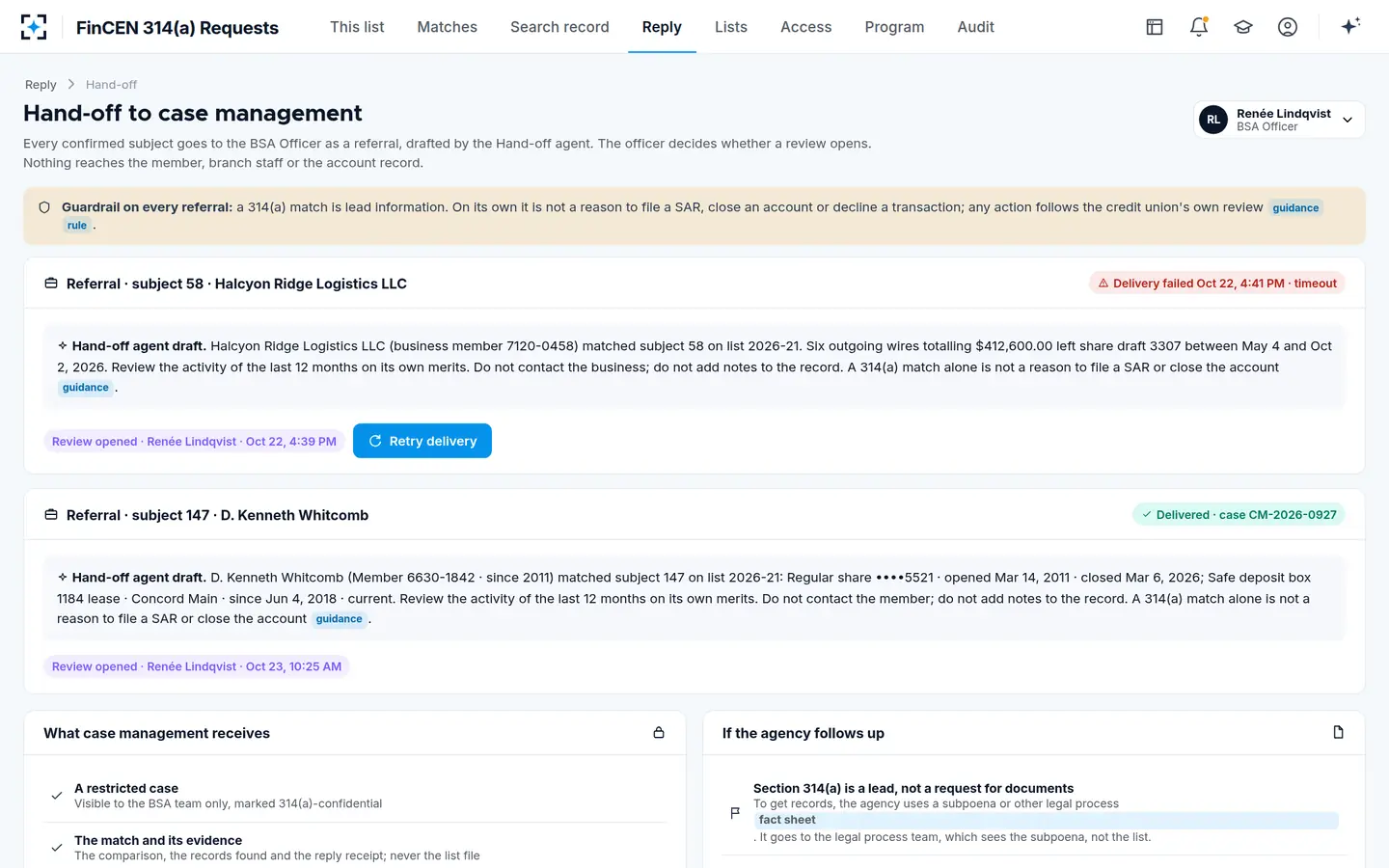
Referral draftedA restricted internal review is drafted, with the reminder that a list match alone is no reason to file a SAR or close an account.
Never: contacts the customer or writes on the account
A person decides
BSA Officer opens a reviewLooks at the customer's activity on its own merits; wires to another bank raise questions.
A person decides
314(b) contactChecks the other bank's registration, then asks about the wires, sharing the bank's own transaction data and never the 314(a) request.
A person decides
DecisionA SAR if warranted, noting "This SAR contains 314(b) data"; or a documented conclusion that no SAR is needed.
Where FinCEN 314(a) Requests stops and 314(b) begins
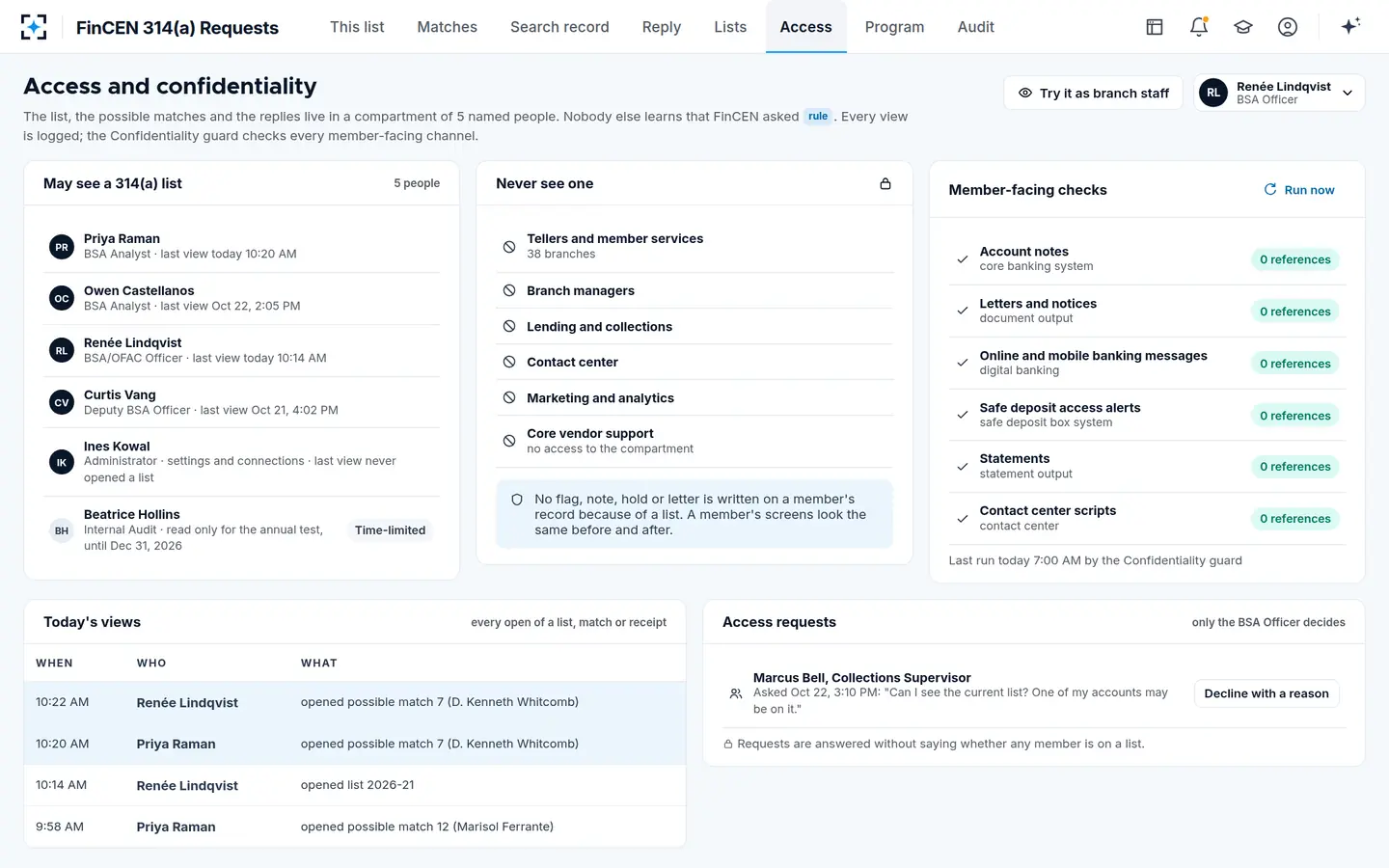
FinCEN 314(a) Requests handles the mandatory side: it reads each 314(a) list on the day it posts, searches every source inside the rule's windows, explains each possible match and drafts the reply that an analyst confirms and the BSA Officer approves. It keeps the list inside a restricted area of named people, logs every view, and checks member-facing channels daily for any mention of a list. Its last step is a referral into the bank's case management, restricted to the BSA team and marked confidential.
That referral is where 314(b) may begin, and where the solution stops. It does not register the bank for 314(b), send or answer 314(b) requests, or decide SARs. What it contributes is a clean starting point: a confirmed match with its evidence, a reminder of what may not be said, and a record that nobody outside the team learned of the request. The reply itself is covered in how to report a 314(a) match to FinCEN.
FinCEN 314(a) Requests: a confirmed subject goes to review with a guardrail
FinCEN 314(a) Requests: who may see a 314(a) list, and the daily check for any trace
Questions people ask
What is 314(b) information sharing?
It is voluntary sharing between registered financial institutions, under Section 314(b) of the USA PATRIOT Act and 31 CFR 1010.540, of information about activity that may involve money laundering or terrorism, including fraud. Institutions that register, verify their counterparty and protect the information are shielded from liability for the sharing.
Can you share a SAR under 314(b)?
No. 314(b) does not authorize sharing a SAR or revealing that one exists. A bank may share the underlying transactions and customer information, and institutions working on a joint SAR may discuss it among themselves.
Does 314(b) cover fraud?
Yes. FinCEN's June 2026 fact sheet confirms that fraud offences are specified unlawful activities for money laundering, so information about suspected fraud may be shared under the safe harbor. The sharing institution need not have identified specific proceeds being laundered.
Can law enforcement get documents through 314(a)?
No. FinCEN's fact sheet says 314(a) provides lead information only and "is not a substitute for a subpoena or other legal process". An agency that learns of a match must use the legal process that applies to obtain records.
Who inside a bank may know about a 314(a) request?
Only the people who need to in order to search and respond, under the bank's confidentiality procedures. The rule limits use of the information to reporting to FinCEN, deciding whether to open or keep an account or engage in a transaction, and BSA compliance; branch and customer-facing staff usually have no need to know.