314(b) registration renewal is an annual task: under 31 CFR 1010.540(b)(2), a notice to FinCEN that an institution intends to share information is "effective for the one year period beginning on the date of the notice", and to keep sharing after that year the institution "must submit a new notice", now through FinCEN's Financial Industry portal. A lapsed registration does not stop anyone sharing; it quietly removes the safe harbor from liability for whatever is shared while it is lapsed, and the same happens if the institution on the other side has lapsed and nobody checked. Botminds' FinCEN 314(a) Requests is an agentic solution for the mandatory side of information sharing, FinCEN's 314(a) lists; it does not file 314(b) notices, but the restricted review that follows a confirmed 314(a) match is often where a 314(b) request begins, so the two routines need to fit together.
The rules quoted come from 31 CFR 1010.540, FinCEN's Section 314(b) fact sheet of June 12, 2026, which replaced the December 2020 version, and the FFIEC examination manual. The routine and the template are ours.
A 314(b) renewal routine that cannot lapse quietly
- Record the date on every notice
The year runs from the date of the notice, not the calendar year; keep the portal's acknowledgment letter with it.
- Renew a month early, every year
A new notice on day 330 or so leaves time to fix a portal access problem before day 365.
- Keep at least two people with FI Portal access
Renewal runs through the portal; a single user who leaves takes the bank's ability to renew with them.
- Update the contacts when people change
Changes, updates and deletions are made in the portal; the directory is what other banks check you against.
- Check the other bank before every exchange
Search the portal's directory, or confirm directly that its notice is on file, and note the date checked.
- Pause sharing on the day a notice lapses
Until the new notice is filed, nothing shared is protected; tell everyone who shares under the bank's name.
- File the evidence with the program
Notices, acknowledgments, verification checks and the requests themselves are what an examiner samples.
How do you renew 314(b) registration?
You renew 314(b) registration by submitting a new registration through FinCEN's FI Portal before the current one's year runs out. The 2026 fact sheet gives the steps: request access to the Financial Industry Portal through the FI Access Request on FinCEN's website; once approved, sign in at fiportal.fincen.gov, open the 314(b) tile and submit the registration. "Registrations are processed automatically," it says, and institutions "will have the option to generate an acknowledgment letter for their records."
The regulation does not use the word renewal. It treats each year as a new notice: "In order to continue to engage in the sharing of information after the end of the one year period, a financial institution or association of financial institutions must submit a new notice" (31 CFR 1010.540(b)(2)). The practical difference is small, but it explains why there is no grace period: a notice is either within its year or it is not.
How often must 314(b) registration be renewed?
Every year, counted from the date of the last notice. A bank whose notice is dated March 18 is covered through March 17 of the next year, and an examiner will look for exactly that: the FFIEC's examination procedures direct examiners to "verify that the bank has filed a notification form with FinCEN and that the effective date for voluntary information sharing is within the previous 12 months".
One 314(b) registration year: renew before the anniversary, not on it
- Notice effective, sharing protectedmonths 1–11
- Last monthmonth 12
- Verify each counterparty before each exchangeall year
- Renewmonth 11
What happens if 314(b) registration lapses?
The safe harbor stops covering what the bank shares, though nothing on the screen tells it so. The regulation's limitation is short: the safe harbor "shall not apply to a financial institution or association of financial institutions to the extent such institution or association fails to comply with paragraphs (b)(2), (b)(3), or (b)(4)", that is, the notice, the verification and the use and security conditions (31 CFR 1010.540(b)(5)(ii)). The FFIEC manual puts it as plainly: "Failure to comply with the requirements of 31 CFR 1010.540, however, results in loss of this safe harbor protection."
What the bank loses is protection from liability to the person the information was about. With the safe harbor, an institution that shares under the conditions is protected "for such sharing, or for any failure to provide notice of such sharing, to an individual, entity, or organization that is identified in such sharing". Without it, the bank is left with whatever other law applies to disclosing customer information, which is the exposure 314(b) exists to remove.
The same 314(b) exchange, with a current registration and with a lapsed one
Both registrations current, counterparty checked: Applies to the sharing and to not telling the person about it.
Either registration lapsed, or no check: Does not apply to the institution that failed the condition.
Both registrations current, counterparty checked: Anything relevant to suspected money laundering or terrorist activity, including fraud; never a SAR.
Either registration lapsed, or no check: The same information, now shared without the protection.
Both registrations current, counterparty checked: Notice dated within the past 12 months; verification on file for sampled requests.
Either registration lapsed, or no check: A finding on the bank's 314(b) procedures.
Both registrations current, counterparty checked: Renew on schedule.
Either registration lapsed, or no check: File a new notice now, stop sharing until it is in, and record what was shared in the gap.
How do you check if a bank is 314(b) registered?
Search the participant directory in FinCEN's FI Portal, or confirm directly with the other institution that its notice is on file. The regulation allows either: an institution may satisfy the verification duty "by confirming that the other financial institution ... appears on a list that FinCEN will periodically make available", or "by confirming directly with the other financial institution ... that the requisite notice has been filed" (31 CFR 1010.540(b)(3)). The 2026 fact sheet says the portal "contains a searchable directory of contact information for all participating financial institutions".
The check belongs before each exchange, not once a year, because the other bank's registration has its own anniversary. A short note in the case file, with the date and the method of verification, is what the examination procedures ask examiners to look for when they sample 314(b) requests "initiated and received".
Institutions registered for 314(b): about 7,000, and back above it in 2025
What is the 314(b) safe harbor, and what does it cover since June 2026?
The safe harbor is protection from liability for sharing information under 314(b), for an institution that has registered, verified its counterparty, shared only for permitted purposes and kept the information secure. The FFIEC manual lists exactly those four conditions. What may be shared under it widened on June 12, 2026, when FinCEN replaced its 2020 fact sheet.
The new fact sheet makes four points that change daily practice. Fraud is covered: because fraud offences are specified unlawful activities for money laundering, an institution that suspects fraud may share, and "need not have identified specific proceeds of fraud being laundered". Real time is covered: institutions "may share information in real time as activity is occurring". Attempts are covered, including attempts "to induce others to engage in transactions, such as in a money mule scheme". And the receiving bank need not have any relationship with the person; it may use what it receives, for example, in its transaction monitoring. One thing has not changed: 314(b) "does not authorize financial institutions to share SARs or reveal their existence".
The four conditions of the 314(b) safe harbor, and the evidence for each
| Condition | Where it comes from | Evidence to keep |
|---|---|---|
| Notify FinCEN of the intent to share | 31 CFR 1010.540(b)(2): a notice effective one year | Each year's notice with its date and the portal acknowledgment |
| Verify the other institution has notified FinCEN | 31 CFR 1010.540(b)(3): the FinCEN list or direct confirmation | Date and method of the check, per exchange |
| Share only for permitted purposes | 31 CFR 1010.540(b)(4)(i): identifying and reporting ML or terrorist activity, account decisions, BSA compliance | The request and its stated purpose |
| Keep the information secure and confidential | 31 CFR 1010.540(b)(4)(ii): procedures equal to customer-information safeguards | Access controls on case files; the procedure itself |
Is there a 314(b) request template?
Not an official one. FinCEN's 2026 fact sheet says that neither section 314(b) nor its regulation "specify the method by which information must be shared", and that institutions may share "in writing or verbally, as well as through electronic platforms". A template is therefore the bank's own, and a good one carries the conditions of the safe harbor on its face, so the person filling it in cannot skip them.
A 314(b) request, field by field: a template a bank can adapt
| Field | What goes in it |
|---|---|
| Requesting institution and contact | Legal name, the 314(b) contact's name, and the date of the bank's current notice |
| Counterparty verified | The other institution's name, the date its registration was checked and how (portal directory or direct confirmation) |
| Subject | Names and identifiers of the people or businesses concerned, limited to what the question needs |
| Activity in question | Accounts, transactions, dates and amounts the bank can see from its own records |
| What is suspected | Possible money laundering or terrorist activity, including fraud or another specified unlawful activity |
| What is asked | The specific information wanted, such as account holder, activity, related parties |
| Use and confidentiality | A reminder that the information may be used only for permitted purposes and must be kept secure |
| What is never included | Any SAR or hint of one, and any mention that a person was named in a 314(a) request |
Are 314(b) requests confidential?
Yes, within limits the rule sets. Each institution that shares "shall maintain adequate procedures to protect the security and confidentiality of such information", and procedures that already protect customers' nonpublic personal information under the Gramm-Leach-Bliley Act are deemed to satisfy that duty. Information received may be used only to identify and, where appropriate, report money laundering or terrorist activity, to decide whether to open or keep an account or engage in a transaction, or to comply with BSA requirements.
Two confidentiality rules from elsewhere sit on top. A 314(b) request must never disclose a SAR or its existence, though the facts behind it may be shared. And it must never disclose that FinCEN asked about a person under 314(a): the 314(a) rule lets a bank share information about a listed subject under 314(b), but that sharing may never reveal that FinCEN asked about the person. The side-by-side rules are in 314(a) vs 314(b).
Where FinCEN 314(a) Requests meets a 314(b) request
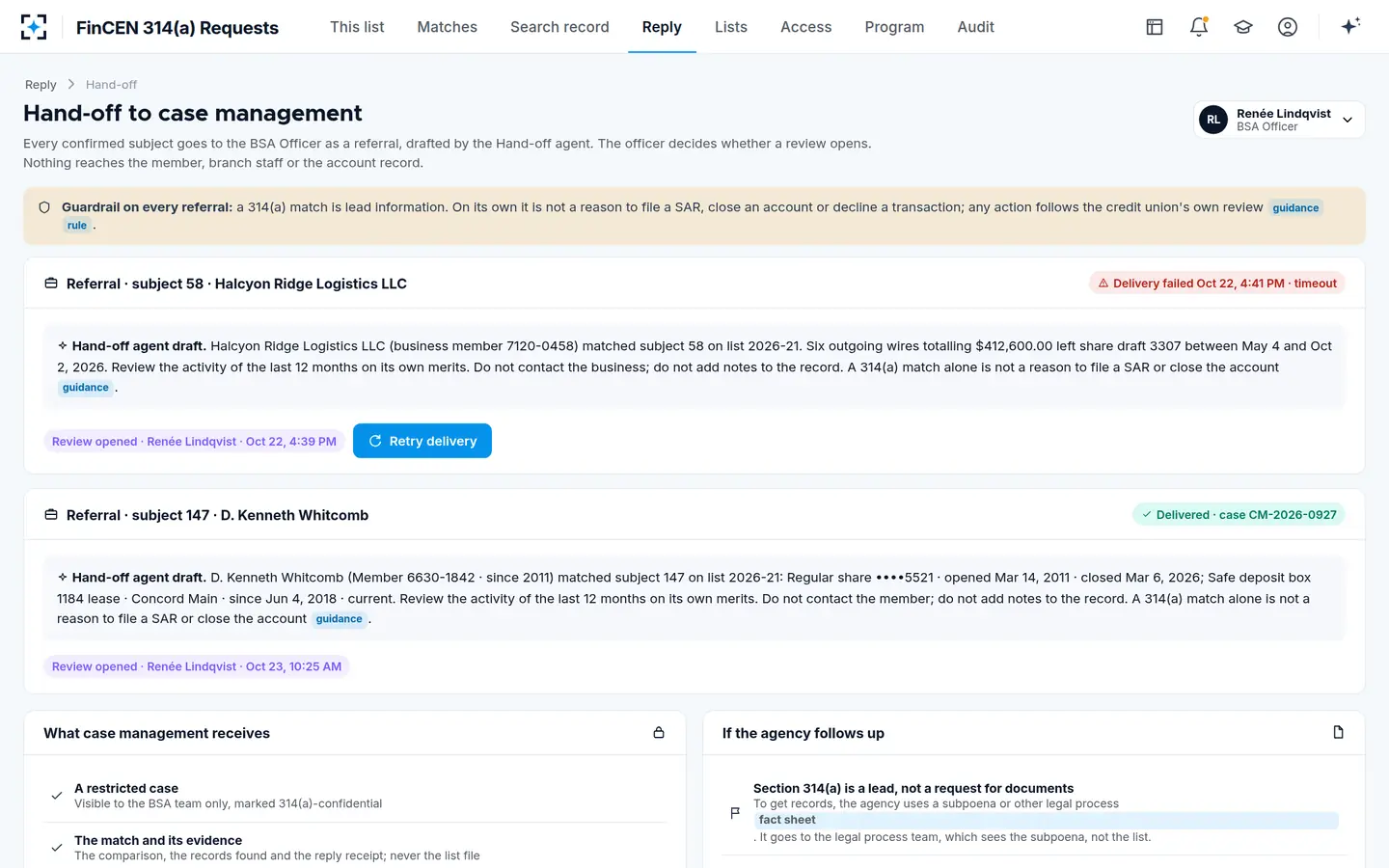
FinCEN 314(a) Requests ends where a 314(b) request often starts: at a confirmed 314(a) match that the BSA Officer decides to review. The solution's hand-off agent drafts a referral restricted to the BSA team, with the reminder that a list match alone is no reason to file a SAR or close an account and the instruction not to contact the customer. If the review then finds activity running through another institution, the bank's 314(b) contact takes it from there, under the bank's own registration. How the match itself is confirmed and answered is set out in how to report a 314(a) match to FinCEN.
Two things carry across. The referral holds the bank's own evidence, the accounts and transactions it found, which is what a 314(b) request may share. And it does not hold the 314(a) list, which the request may never mention. The solution does not file 314(b) notices, check registrations or send requests; the renewal routine above belongs with whoever owns the bank's 314(b) program.
FinCEN 314(a) Requests: the BSA Officer opens a review, where a 314(b) request may begin
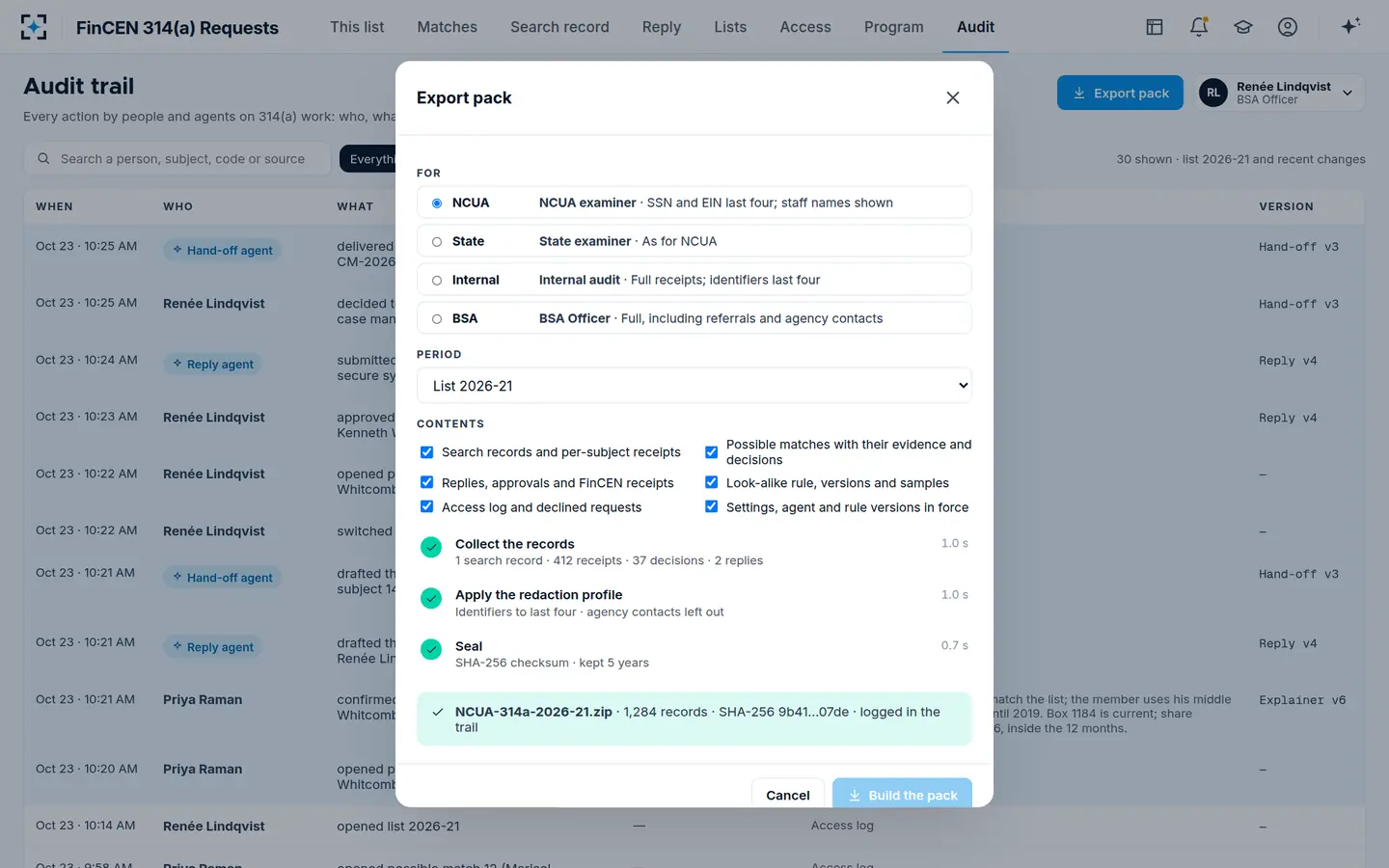
FinCEN 314(a) Requests: every action on the trail, with who, when and the version in force
Questions people ask
Who is eligible to register for 314(b)?
Financial institutions that FinCEN's rules require to keep an AML program, and associations made up entirely of them. The 2026 fact sheet lists banks, casinos and card clubs, money services businesses, broker-dealers, mutual funds, insurers, futures firms, dealers in precious metals, stones or jewels, credit card system operators, loan or finance companies and housing GSEs.
Can a bank name more than one 314(b) contact?
Yes. A registration needs at least one point of contact, and the fact sheet says institutions may designate more than one; other employees may take part in sharing under the bank's policies and procedures.
Is the portal's acknowledgment letter proof of registration?
It is the bank's own record that a registration was submitted and processed, which is why the fact sheet offers it "for their records". Keep each year's letter with the notice date; an examiner will check that the effective date falls within the previous twelve months.
Can 314(b) information be shared with a foreign affiliate?
Not under the safe harbor's protection. The rule protects sharing between institutions and associations that have filed a notice with FinCEN and verified each other, and a foreign affiliate cannot file one, so any onward sharing falls outside 31 CFR 1010.540 and under privacy and foreign law instead. Treat it as a separate decision for counsel, not as part of the 314(b) exchange.
What do examiners check on 314(b)?
Whether the bank participates; if it does, that its notice is dated within the past twelve months, that it has a contact and written procedures, and, on a sample of requests sent and received, that the counterparty's registration was verified and the information was used and kept as the rule requires.