A deviation in pharmaceutical manufacturing is a departure from an approved procedure, specification or limit: a filter integrity test that fails, a fill weight that drifts below its range, a cold room that warms past its alarm. Two sentences of US GMP create it. One says that any deviation from the written procedures shall be recorded and justified; the other says that any unexplained discrepancy, or any failure to meet a specification, shall be thoroughly investigated. Everything else a plant calls deviation management — three severity words, a thirty-day clock, a fishbone diagram, a second signature — is the plant's own rule written on top of those two sentences. The work is hard because the evidence that would explain the departure sits in a dozen systems and the clock starts the day it is reported. Botminds' Deviation & CAPA Management reads those records for the event window, fills the root-cause bones from what they say, and hands a named quality person a cause with the evidence for and against it.
Knowing which half of your procedure is law and which half is local has one practical use: you can change the local half. A plant that believes the thirty-day clock is a regulation cannot discuss it.
The worked example is the sample plant the solution ships with: Plant 3 in Leiden, aseptic filling Line 1, a vial that fills light on nozzle 4. The plant, people, products, batches and records are fictional. The rules come from regulators and inspectorates, linked where they appear.
What the regulation fixes, and what your plant fixed
2
sentences of US GMP at the core of deviation management — 21 CFR 211.100(b) and 211.192
3
classes an inspectorate uses for a GMP deficiency: Critical, Major and Other — the third word is not Minor
45days
to report a biological product deviation in a distributed product to the FDA — a reporting deadline, not a closure deadline
30days
the usual plant target to close an investigation — a number the plant chose, not a rule
What is a deviation in pharmaceutical manufacturing? The two sentences that define it
The first sentence sits in the part of US GMP about written procedures. "Written production and process control procedures shall be followed in the execution of the various production and process control functions and shall be documented at the time of performance," it reads. "Any deviation from the written procedures shall be recorded and justified" (21 CFR 211.100(b)). The laboratory controls carry a twin sentence for specifications and test procedures (211.160(a)), and a few narrower ones cover time limits and stock rotation; the duty for production is two words long.
The second sentence is the one every investigation report quotes, and it is not about deviations at all. It is about discrepancies and specification failures, and it is far more demanding.
"Any unexplained discrepancy … or the failure of a batch or any of its components to meet any of its specifications shall be thoroughly investigated, whether or not the batch has already been distributed. The investigation shall extend to other batches of the same drug product and other drug products that may have been associated with the specific failure or discrepancy."
21 CFR 211.192, Production record review
Read together, the shape of the law appears. A departure from a procedure is recorded and justified. A departure whose cause you cannot explain, or that broke a specification, is investigated thoroughly and pursued into every other batch and product that might share the cause. Most plants answer both with one record and one word, which is slightly misleading: the second duty is the expensive one, and it does not wait for anybody to call the event a deviation.
The rest of the world says the same in its own vocabulary. For active ingredients, "any deviation from established procedures should be documented and explained", and "critical deviations should be investigated" (ICH Q7 §2.16). EU GMP asks that "any significant deviations are fully recorded, investigated with the objective of determining the root cause and appropriate corrective and preventive action implemented" (Chapter 1 §1.8(vii)). Note the qualifiers — critical, significant. Neither text says where the line falls; your procedure draws it.
Which record am I opening? Four events that look alike and are not
A written procedure was not followed
A deviation
21 CFR 211.100(b)
Recorded, and justified. The sentence asks for no severity word, no method and no deadline.
A result fell outside its specification, or a figure cannot be explained
An investigation
21 CFR 211.192
Thorough whether or not the batch has shipped, extended to other batches and products, written up with its conclusions and followup.
Somebody outside the plant complained
A complaint file entry
21 CFR 211.198(b)(3)
Either an investigation, or a written reason one was not necessary and the name of whoever decided.
You want to work differently from now on
A change, approved first
Change control
The effect on product and marketing authorisation, assessed before the first batch is made the new way. Not a deviation.
What is the difference between a planned and an unplanned deviation?
The difference is when the approval happens, and therefore whether anyone could weigh the risk before the product was at stake. A planned deviation is approved in advance: somebody knows the procedure cannot be followed as written for a named batch or period, says so, has the effect on the product assessed, and signs before the work starts. An unplanned deviation is found afterwards — at an in-process check, in batch record review, when a reading comes back wrong — and its risk assessment is retrospective by construction.
Planned and unplanned: the same form, two different pieces of work
Planned: Before the departure, for a named batch or a stated period.
Unplanned: After the event, once somebody has noticed it.
Planned: Every option, including not doing it.
Unplanned: Only the evidence the plant happens to have kept for that window.
Planned: Decided in the approval itself, with conditions.
Unplanned: A separate decision, usually with the batch on hold while it is made.
Planned: The reason, scope, duration, product-effect assessment and the limits of the permission.
Unplanned: All of that, plus what happened, when it was found, the immediate actions and a cause.
Planned: A temporary change, which many quality systems would rather see in change control.
Unplanned: A genuine deviation, and what the regulations were written for.
Two things are worth knowing before you write planned deviation on a form. The European rules do not use the phrase: their provision is headed handling of unexpected deviations, and governs what a Qualified Person may do once something has already gone wrong (Annex 16 §3). There is no European category for a departure you intend. And the drift is the real risk — a planned deviation renewed quarter after quarter is a change that was never filed, and the same provision warns a deviation "may require the submission of a variation to the MA for the continued manufacture of the product."
Is a deviation the same as an out-of-specification result?
No. A deviation is a departure from how the work was meant to be done; an out-of-specification result is a test result outside an acceptance criterion. They are found by different people and do not always travel together. The distinction matters because an out-of-specification result pulls the investigation duty behind it automatically — a specification failure is one of the two triggers in 211.192 — while a procedural deviation does not, unless its cause is unexplained.
It follows that an out-of-specification result needs the laboratory half of an investigation before the manufacturing half. FDA is explicit about the standard: "To be meaningful, the investigation should be thorough, timely, unbiased, well-documented, and scientifically sound," and its first phase is an assessment of the accuracy of the laboratory's own data, done wherever possible before the test preparations are discarded (Investigating Out-of-Specification Test Results, May 2022, Revision 1). A plant that opens a manufacturing deviation on every stray assay result and skips that phase will find causes on the shop floor that were never there.
Three relationships turn up: a result outside specification with no departure behind it; a departure with every test in range, whose product-effect assessment concludes nothing reached the batch; and both at once, where one investigation answers both. The sample case is the third kind — vials from nozzle 4 weighed 1.95 to 1.98 grams against a 2.00 to 2.10 gram limit, and the departure behind it, a seal change that fell due and was deferred, was four records away.
What is the difference between a deviation and a change control?
Intent, and the direction of time. Change control is how a plant decides to work differently from now on: the proposal is assessed for its effect on the product, the marketing authorisation and the validated state, and approved before the first batch is made the new way. A deviation is a departure that has already happened. The clue is in the wording of 211.100(b) — a deviation is "recorded and justified", which is something you can only do about the past.
This matters because an inspector reads the two records differently. A change file that should have been a deviation looks like a plant rewriting history; a deviation that should have been a change looks like a plant running an unapproved process on purpose, which is worse. Where one event opens both, the deviation closes with its cause and its corrective action, and the change carries the permanent alteration and the validation behind it.
A third record sits beside these. A complaint from outside the plant goes into the complaint file, and the rules then allow a decision not to investigate — but only in writing: where no investigation is carried out, the complaint record has to give the reason one was found unnecessary and name the responsible person who decided so (21 CFR 211.198(b)(3)). There is no equivalent sentence for a deviation. The option to decide an investigation is unnecessary, and sign for it, exists for complaints and not for an unexplained discrepancy in your own batch record.
How are GMP deviations classified as critical, major or minor?
By your own procedure. No US or EU GMP rule gives a plant a severity scale for its deviations, and the one set of internationally standing definitions belongs to the inspectors: they classify the deficiencies written about a site, not the deviations the site opens. That document is PIC/S PI 040-1, and it repays reading because so many plant scales are modelled on it without quite copying it.
It names three classes, and the third is the surprise. A Critical deficiency is "a deficiency which has produced, or leads to a significant risk of producing either a product which is harmful to the human or veterinary patient"; it also covers fraud, misrepresentation or falsification. A Major deficiency is not Critical but "has produced or may produce a product which does not comply with its Marketing Authorisation", or "does not ensure effective implementation of the required GMP control measures". And the third is not Minor: "Other Deficiency — a deficiency that is not classified as either 'Critical' or 'Major', but indicates a departure from Good Manufacturing Practice" (PI 040-1 §4, 1 January 2019).
Three words the inspectors define, and what a plant hangs on each
| Class | How PI 040-1 defines it for an inspection finding | What the word usually sets in a plant procedure |
|---|---|---|
| Critical | Has produced, or risks producing, a product harmful to the patient — or the manufacturer has engaged in fraud, misrepresentation or falsification. | The shortest clock, the head of quality signing, the batch on hold. |
| Major | Not Critical, but produces or may produce a product outside its marketing authorisation, or does not ensure effective implementation of the required GMP control measures. | The standard clock, a full investigation, an action with an effectiveness check. |
| Other | Not Critical or Major, but a departure from GMP — and a finding may be judged Other because there is too little information to classify it higher. | Usually written Minor: a short clock, one approver, a cause recorded without the full apparatus. |
| An aggregate | Several related findings, none Critical or Major alone, may together be reported as a Critical or Major deficiency or a systems failure. | Rarely written down, and the most useful clause here for anyone drafting a scale. |
Two clauses repay the time. The aggregation rule means a scale with no way to say that forty identical Minor deviations are one Major problem has a reporting hole, and whether a corrective action actually held is where it shows. The second is the admission that a finding may be Other simply because there is too little information to classify it. Classification under uncertainty is normal; pretending to certainty at intake is not.
Who decides the classification, and when it may be changed
The quality unit decides, by statute rather than by courtesy. US GMP requires "a quality control unit that shall have the responsibility and authority to approve or reject all components, drug product containers, closures, in-process materials, packaging material, labeling, and drug products, and the authority to review production records to assure that no errors have occurred or, if errors have occurred, that they have been fully investigated" (21 CFR 211.22(a)). Fully investigated is the quality unit's test to apply, which makes the severity word the quality unit's to set, whoever typed it in first.
Reclassification is therefore ordinary and should be easy. The first class is assigned within minutes by whoever is on the floor, on the least information anybody will ever have; the last when the cause is known. PI 040-1 builds the same movement into the inspectors' own method — an initial rating, an evaluation of the factors that raise or lower risk, then a decision whether to upgrade or downgrade. What matters is not that the word changed but that the file says who changed it, when, and on what new fact.
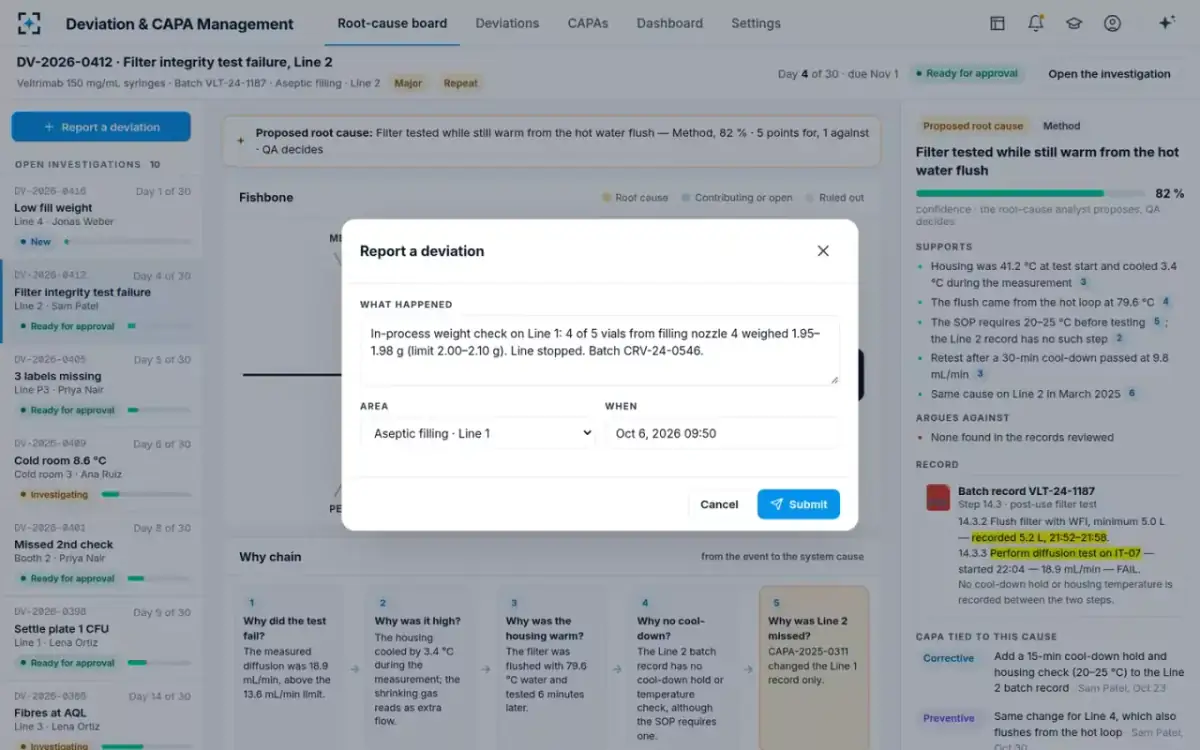
In the solution the first class is a proposal. The clock keeper reads the plant's classification rules, proposes a class at intake and starts the clock from it; in the sample case it proposes "Minor — every light vial rejected by 100 % weighing", due 5 November against a 30-day target. It cannot extend that clock: it warns the owner at day 20 and drafts an extension request at day 25 for the head of quality to approve or refuse. What a signature on an investigation attests is a page of its own.
Reporting a deviation in Deviation & CAPA Management: one sentence, and the clock starts
Can a batch be released while a deviation is still open?
In Europe, yes, and the conditions are written down. "Provided registered specifications for active substances, excipients, packaging materials and medicinal products are met, a QP may consider confirming compliance or certifying a batch where an unexpected deviation concerning the manufacturing process and/or the analytical control methods from details contained within the MA and/or GMP has occurred. The deviation should be thoroughly investigated and the root cause corrected" (EU GMP Annex 16 §3). The provision then requires the effect of the deviation to be assessed through a quality risk management process, starting with its potential effect on the quality, safety or efficacy of the batches concerned.
Read it slowly: it is narrower than it is usually quoted. Registered specifications must be met — a batch that fails one is not in this provision at all. The departure must be unexpected, which excludes the planned deviation renewed for the fourth time. And the investigation and the correction of the cause are not extras attached to the release; they are the condition the Qualified Person's judgement rests on.
In the United States the framing differs and the answer is less comfortable. 211.192 makes the duty independent of the batch's whereabouts — "whether or not the batch has already been distributed" — so release closes nothing, and a cause found after shipment reaches back into batches already on the market. In the sample case the product-effect assessment is the simple kind: no light vial reached the batch, because the check-weigher weighs every vial and rejected all 1,212 below 2.00 grams. That conclusion is worth something only because the rejection data exists and is cited, which is why a cause is only as good as the record behind it.
The thirty-day clock nobody wrote down
There is no closure deadline for a deviation in US or EU GMP. Thirty days is a common convention that is easily mistaken for a rule, and the mistake shapes behaviour badly: files close on day twenty-nine with a cause nobody believes, and an extension request becomes a quiet admission of failure rather than ordinary project management.
What the regulators ask for is timeliness without a number. FDA's inspection programme lists, among the things an investigator checks, that discrepancy and failure investigations are "documented; investigated in a timely manner using scientific evidence to identify the root cause; corrective actions and preventive actions (CAPAs) are included and effectiveness of the CAPAs is evaluated" (Compliance Program 7356.002, 16 September 2022). Timely is judged against the risk and the evidence, not a calendar you chose.
Reporting deadlines do exist, and none of them is a closure deadline. A licensed manufacturer of a biological product "should report a biological product deviation as soon as possible but you must report at a date not to exceed 45-calendar days from the date you … acquire information reasonably suggesting that a reportable event has occurred" (21 CFR 600.14(c)). Forty-five days to tell the FDA, counted from when you learned enough to suspect — and silent on when your investigation ends.
Thirty days on one deviation, and where the days go in Deviation & CAPA Management
- Report and classify1 d
- Pull batch, equipment and room logs6 d
- Search past cases2 d
- Fishbone and 5-Why5 d
- Write it up3 d
- Review and sign2 d
- Report, records and past cases1 d
- Fishbone and 5-Why2 d
- Write it up1 d
- Review and sign1 d
If the number is yours, ask what it is for. A clock exists to make the quality unit look at an open file before the memory of the event has gone — the room data rolled off, the operator moved shift, the part replaced. Against that purpose one number for every class is a poor instrument: a plant that writes thirty days for a Critical deviation and thirty for a mislabelled carton has set no priority at all.
What a thorough investigation has to contain, in the regulator's own list
The regulation names three things: the investigation is thorough, it extends to other batches and products that may share the cause, and "a written record of the investigation shall be made and shall include the conclusions and followup". That is thin guidance for a document that runs to twenty pages. The best public expansion is in FDA's out-of-specification guidance, which says a full-scale investigation's written record should include a clear statement of the reason for the investigation; a summary of the aspects of the manufacturing process that may have caused the problem; a documentation review, with the assignment of actual or probable cause; a review made to determine if the problem has occurred previously; and a description of corrective actions taken.
Written for laboratory results, that is a practical specification of an investigation record, and the fourth item is the one most easily skipped. A review to determine whether the problem has occurred before is not a courtesy search; it is how the duty to extend the investigation to other batches gets discharged, and it is where a repeat failure is caught or missed. In the sample case it is the step that surfaced a 2025 deviation with the same worn seal on another line, whose corrective action had changed that line's maintenance plan and no other.
Does a deviation have to be reported to the FDA?
For a drug product, not as a deviation. A GMP deviation is recorded, investigated and closed inside the plant's own quality system, and the FDA reads it at inspection, where the investigation and its conclusions are evidence of how that system works. Nothing in part 211 asks a manufacturer to notify the agency that a deviation occurred. What the event involves can still compel a report: for a product under an approved application, the applicant must send a field alert report within 3 working days of receiving information about bacteriological contamination, a significant change or deterioration in a distributed product, or a distributed batch failing its specification (21 CFR 314.81(b)(1)).
For a licensed biological product the answer is yes when the event may affect safety, purity or potency and involves a distributed product, with the forty-five-day limit above and a defined trigger: the duty bites when the manufacturer acquires information reasonably suggesting a reportable event has occurred, and the clock runs from that moment rather than from the end of the investigation. Plants making both kinds of product under one procedure sometimes discover this the hard way.
Outside GMP, other duties can be triggered by what an investigation finds rather than by the record — a recall, a notification to a market, a variation where the change turns out to be permanent. Each has its own rule and clock, and the file's job is to establish the facts early enough that somebody can tell which has been triggered. That is the practical argument for refusing a conclusion that explains nothing: a cause of operator error cannot tell you whether another market needs to be told.
Ten open investigations, each on its own clock
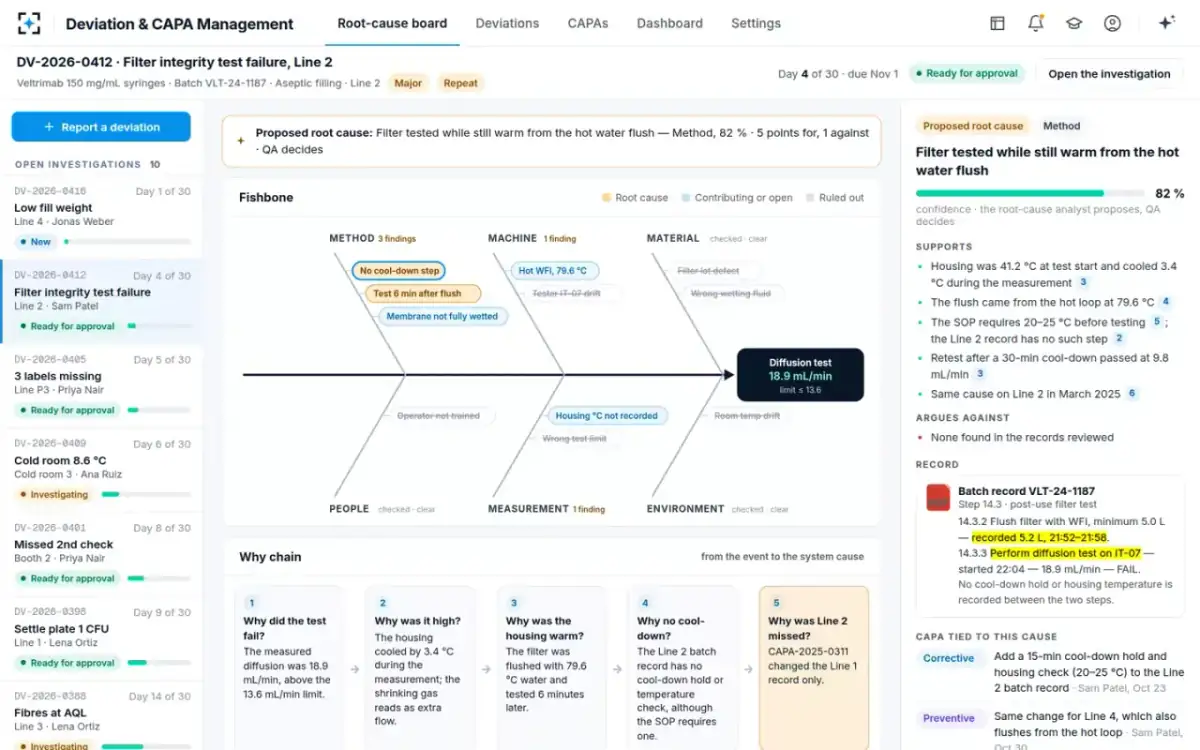
To see the classification, the clock and the evidence trail on one case, start from Deviation & CAPA Management.
Questions people ask
What is an example of a deviation in pharmaceutical manufacturing?
In the sample case, four of five vials drawn at a 09:50 in-process weight check from one filling nozzle weighed 1.95 to 1.98 grams against a 2.00 to 2.10 gram limit, and the line stopped four minutes later. Common real examples: a filter integrity test that fails, a batch step performed out of sequence, a room that drifts outside its range, a hold time exceeded, a label reconciliation that does not balance, a missing signature on a batch record step.
Who can open a deviation?
Anyone who sees the departure; a procedure that restricts reporting to the quality unit buys itself slow, second-hand accounts. What belongs to the quality unit is the record and the judgement — 21 CFR 211.22(a) gives it authority to review production records and decide whether errors have been fully investigated. The fastest systems let the person on the floor open the file in one sentence and leave classification, plan and closure to the quality unit.
What is the difference between a deviation and a non-conformance?
Mostly vocabulary, and which standard your quality system grew up on. EU GMP uses the two words together — its product quality review asks for "a review of all significant deviations or non-conformances, their related investigations, and the effectiveness of resultant corrective and preventive actions taken" — without distinguishing them. Where a plant does draw a line, deviation usually means a departure from a procedure and non-conformance a product or material that fails a requirement. What matters is that your procedure says which is which and sticks to it.
Does every deviation need a CAPA?
No, and a system that raises a corrective action for every deviation will soon have more actions than it can track or verify. US GMP asks for a deviation to be recorded and justified; EU GMP attaches corrective and preventive action to significant deviations. The decision is a risk judgement your procedure should describe, and the test is whether anything in the plant would be different if the action were not taken.
What happens if a deviation is not recorded?
You have two problems rather than one. The departure remains, and the plant has also failed the requirement that production procedures be followed and "documented at the time of performance" — a records failure, and arguably the graver one, because the batch record no longer describes what happened. It also removes the search 211.192 requires: nothing exists to find when the same failure returns.
Is a deviation the same as an inspection finding?
No, and conflating the two may be why plant scales so often use a different third word. A deficiency is what an inspector writes about your quality system, and PI 040-1 classifies those as Critical, Major or Other. A deviation is what your plant records about a departure in its own process. One deviation handled well produces no deficiency at all; a hundred handled badly produce one about the investigation system rather than any single event.