CAPA management software holds the corrective and preventive actions that come out of an investigation — each with its type, owner, due date, status and effectiveness check — and ties them back to the event that caused them. Every product in the category can do that. What separates them is whether the actions are aimed at the cause or at the record that failed, and the only way to find out is to replay cases you have already closed. Botminds' Deviation & CAPA Management offers exactly that as its starting point: run it on a sample of your own closed investigations. This guide is the honest version of that offer — the plan, the acceptance criteria to set before anyone looks at a result, and the two ways a pilot in this category produces a number that is not true.
The figures describing the sample plant on these screens are from a demonstration on sample data, and the solution's published figures of five days to a root cause and 94% closure within a thirty-day target are design goals rather than measured results. The six weeks below is a plan this page proposes, not a duration anyone has measured.
A six-week replay, and the shortcut that skips half of it
- Measure your baseline, agree acceptance criteriaWk 1
- Connect the record systemsWk 2
- Split and lock the test setWk 3
- Replay and scoreWk 4–5
- Read the four numbers and decideWk 6
- Skipped: baseline, criteria, connections, locked test setskipped
- Replay and scoreWk 4–5
- Decide, with nothing to compare againstWk 6
What is CAPA management software, and what a pilot has to prove
It is the system that carries an action from the investigation that raised it to the check that says whether it worked. The minimum is a register: action, type, owner, due date, status, the deviation it came from, and a review. The useful version adds two things the minimum does not — a scope that follows the cause rather than the document, and an effectiveness criterion that is a measurement with a window rather than a date in a diary.
A pilot therefore has exactly three things to prove, and a demonstration cannot prove any of them. Does it reach the records your investigations actually run on? Does it propose causes your quality unit recognises, with what argues against them? And does it scope an action across everything that shares the cause? The first is an integration question, the second is a judgement question, and the third is the one that decides whether you keep paying for repeat investigations.
There is a fourth thing a pilot is often asked to prove and should not be: speed. Time to a proposed cause is worth measuring, but it is the easiest number to flatter — with a specialist in the room, a clean case and a connection that was hand-built for the demonstration. Measure it, record the conditions, and weight it last.
How do you pilot capa management software on your own closed cases?
Take thirty investigations your plant closed, where the cause was approved, the actions ran and you now know whether the failure came back. Hand the system only what the investigator had on day one — the deviation report as first written, and read access to the records — and withhold the conclusions. Then compare what it produces with what your people produced, case by case.
Thirty is a working number rather than a statistical one, chosen so that the set can span the classes you actually investigate and still be read by humans inside two weeks. Spread it deliberately: Critical, Major and Minor in roughly the proportions your plant sees; at least two cases you know turned out to be repeats; at least two where the cause was never firmly established, because how a system behaves on an ambiguous case is more informative than how it behaves on a clear one; and at least one from each product line and each major equipment class, so the evidence connections are all exercised.
The replay has to be blind in the direction that matters. The system gets the report and the records; it does not get the approved cause, the actions, the effectiveness rating or anything written after day one. Someone has to check that, because closed-case records are full of back-references — a maintenance work order raised by the CAPA, an amended procedure with the deviation number in its change history — and a search that finds those has read the answer.
The rule that says the new way must beat the way you measured
The draft European annex on AI under GMP contains one clause that is worth the whole document to anyone running a pilot, because it forbids the comparison everyone is tempted to make: against an imagined ideal, or against nothing at all.
The clause is headed "No decrease", and it makes two points in two sentences: a model's acceptance criteria should be no lower than the performance of the process it replaces, and that in turn means the performance of the process being replaced has to be known (draft EU GMP Annex 22 §4.3 — a consultation draft, not in force).
Read the second point twice. The requirement is not primarily about the model; it is about you. If you cannot say how often your own investigators reach a cause that holds, how often your own CAPAs are rated effective at the first check, and how long your own cases take to a proposed cause, you have no acceptance criterion and the pilot cannot pass or fail — it can only produce impressions.
The same section says who owns the criteria and when: "A process subject matter expert (SME) should be responsible for the definition of the acceptance criteria, which should be documented and approved before the start of acceptance testing." Before. That single word is what separates a pilot from a demonstration, and it is the discipline easiest to skip. FDA's draft guidance reaches the same place by a different route, scaling the stringency of credibility evidence and the performance acceptance criteria to the model's risk and the specific job it is doing (FDA draft guidance, January 2025) — which is to say the criteria depend on what you are going to rely on the output for, and so have to be written before you rely on it.
Week 1 of the plan above is therefore the week the pilot is won or lost, and it contains no software at all. It is your quality unit reading thirty of its own files and writing down four numbers.
Keeping the cases away from the people tuning the system
The draft annex is unusually specific about test-set hygiene, and the specificity is useful because it names failure modes that are easy to fall into with good intentions.
On independence: controls should ensure "that data which will be used to test a model, is not used during development, training or validation of the model", either by capturing test data only after training is complete or by splitting it from the pool before training starts. On the split: if test data is split from a pool before training, "it is essential that employees involved in the development and training of the model have never had access to the test data", the test data should be protected by access control and an audit trail over accesses and changes, and there should be no copies outside that repository. On selection: test data "should be representative of and expand the full sample space of the intended use", stratified, including all subgroups and the rare variations, with the criteria and rationale for the selection documented.
Translated into a vendor pilot, those three clauses mean: your people choose the thirty cases, and write down why those thirty; the vendor's people never see them before the replay; and the chosen cases are not also used to configure anything. That is awkward to arrange and worth the awkwardness, because the alternative is a result nobody can defend to a validation lead six months later.
What you bring to the pilot
- Your deviation and CAPA procedures, and your classification rules
The system is configured to your rules, not to a generic workflow. Hand over the rules as written, including the ones that are inconsistent — a pilot is a good place to find out.
- Your investigation report template
A drafted report in a template nobody recognises cannot be judged. In the same template, your reviewers can read it the way they read any other report.
- Thirty closed cases, spanning Critical, Major and Minor
With at least two known repeats, at least two where the cause stayed uncertain, and coverage of each product line and equipment class.
- Read access to the six classes of record
Deviation reports, batch records, equipment and process data, maintenance, environmental and utility logs, closed deviations and CAPAs. Whatever cannot be connected in week 2 is a limit on what the pilot can show.
- The four baseline numbers, measured first
Your own days to a proposed cause, your own match rate against the approved cause, your own repeat rate, your own share of CAPAs rated not effective at the first check.
- The names of the people who will approve and sign
A pilot that nobody signs is not testing the part of the workflow that matters. Put the real approvers in it.
- A written reason for the thirty cases you chose
One paragraph. It is what makes the result defensible, and the draft annex asks for exactly this about test-data selection.
What do you bring to a capa software implementation?
Everything in that list, and then the decisions. Before a replay can start, somebody has to settle the rules the system runs on, and in this solution they are explicit settings rather than behaviour: the closure target (30, 45 or 60 days), the day the owner is warned (15, 20 or 25), whether the agents start automatically or an investigator starts them, who approves the root cause and the CAPA plan, who approves Critical deviations and clock extensions, who rates effectiveness, how far back the search looks (24, 36 or 60 months), the confidence a cause must clear before it is called most likely (50%, 60% or 70%), and whether the cross-line scope check is on.
Settle all of them in week 2 and write them down. Changing any of them after you have seen the answers is the first of the two ways a pilot lies, and it is almost never done dishonestly — it is done because a result looked wrong and somebody adjusted a threshold to fix it. The adjustment may well be right. Making it after the fact destroys the test anyway, which is why the sequence matters more than the values.
How much formality to apply to all this is itself a judgement, and ICH Q9(R1) is helpful on it: formality in quality risk management is not binary but a continuum, and the degree applied should follow from the uncertainty, importance and complexity of what is being decided (ICH Q9(R1) §5.1). A pilot that will inform a purchase and a later validation sits toward the formal end. A pilot that is really a demonstration for a budget conversation can sit lower — as long as everyone knows which one they are in.
How long does it take to implement a CAPA system?
Nobody can answer that from outside your plant, and the variable is not the software. The effort sits in the connections and the agreements, and the ordering below is our estimate of where it goes for a plant connecting the six record classes, configuring the settings above, qualifying the system for its intended use, and training the five seats the solution is built around.
Where the implementation effort goes, longest first
Two of those five are usually underestimated in the same way. Connecting the maintenance system is the hardest and the most valuable, because work orders, preventive maintenance plans and supplier manuals are where equipment causes live — and a plant that cannot reach them will see a thinner machine bone on every fishbone. Validation is underestimated because the question is not whether the vendor has documentation but what remains yours: the intended use statement, the qualification against it, and the change control that follows every release.
Do you need to validate capa management software?
Yes, on the same basis as any system holding GMP records: 21 CFR 11.10(a) requires validation to ensure accuracy, reliability, consistent intended performance and the ability to discern invalid or altered records (21 CFR 11.10). The pilot is not validation and does not substitute for it. What the pilot does do, if it is run the way this page describes, is produce most of the evidence validation will later want: a documented intended use, acceptance criteria approved by a subject matter expert before testing, a defensible test-set selection, and a recorded result against a measured baseline.
That overlap is the strongest argument for running the longer pilot rather than the shorter demonstration. A six-week replay with written criteria is also the first three deliverables of a validation package. A two-day demonstration is nothing you can reuse.
Where model outputs are relied on, the draft annex adds items a traditional qualification plan will not have: the intended use statement with the input sample space and its rare variations, the confidence logging and threshold, the records kept from human review, and change control over the model as well as the system. What those clauses say, and what the two drafts permit is worth settling with your validation lead before the pilot rather than after it.
The four numbers to read at the end, and the two ways a pilot lies
Four numbers come out of a replay, and each needs a target written in week 1 and an answer to the question "what would make us stop".
Four acceptance criteria, written before the replay starts
Causes that matched
How it is measuredOf the thirty cases, how many proposed causes match the cause your quality unit approved at the time?
The targetSet against your own baseline, not against 100%. A system that matches your conclusion on every case has told you nothing you did not know.
What would make you stopIt matches on the easy cases and misses every one where your investigator needed an engineering study.
CAPA scope, wider or narrower
How it is measuredFor each case, is the proposed action’s scope wider, equal to or narrower than the one you approved — and where it is wider, is it right?
The targetWider and right on the cases you later saw repeat. Equal elsewhere. This is the metric most likely to pay for the project.
What would make you stopWider on everything. An action that always covers the whole plant is not a scope decision; it is an absence of one.
Claims traceable to a record passage
How it is measuredSample claims from each drafted report and open the source. Count the ones where the exact passage supports the exact claim.
The targetClose to every claim, and a visible statement of what could not be reached. Decide the threshold before you look.
What would make you stopConfident prose with a document name behind it rather than a line, or a claim that the record does not quite say.
Days to a proposed cause
How it is measuredElapsed time from handing over the first report to a proposal a QA person could review, against the same measure taken from your own closed files.
The targetWhatever beats your measured baseline by enough to matter. The solution publishes five days as a design goal; your number is the one that counts.
What would make you stopA time that only holds when a specialist from the vendor is in the room.
Then the two ways a pilot in this category produces a number that is not true. The first is configuring after seeing the answers: a threshold raised, a look-back widened, a classification rule amended, because a case came out wrong. The second is letting the people who tuned the system choose the cases — including the softer version, where the vendor is "helping to select a representative set". Both are easy to avoid and easy to slip into, and either can leave a pilot result that the first year of live use does not repeat.
A third, quieter distortion is worth naming. If the same person both scores the replay and wants the project approved, the marginal cases will score generously. Score with two readers, at least on the cases where the proposed cause differs from the approved one, and record the disagreements — they are the most informative output of the whole exercise.
What to put side by side at the end of week 6
Your baseline, from the same thirty cases: Measured from your own closed files, with the waiting time included.
The replay, on the same thirty cases: Measured the same way, under conditions you record — including who was in the room.
Your baseline, from the same thirty cases: By definition, the conclusion you reached. The question is how long it took and how contested it was.
The replay, on the same thirty cases: How many match, and more usefully: on the ones that do not, is the difference a miss or a better answer?
Your baseline, from the same thirty cases: What your actions covered, and which of those cases you later saw repeat.
The replay, on the same thirty cases: Wider, equal or narrower, case by case — and whether the extra lines were the right ones.
Your baseline, from the same thirty cases: Sample your own closed reports the same way; the number may surprise you.
The replay, on the same thirty cases: The same sample, on the drafted reports, with a stated threshold.
Your baseline, from the same thirty cases: Your own ambiguous cases, and what the investigator did about them.
The replay, on the same thirty cases: How many fell below the confidence threshold, and whether they were the right ones.
What data do you need to migrate CAPAs?
For each open action: the action itself, its type, the deviation it came from, the owner, the due date, the current status, the approvals already given, and the effectiveness check with its criterion and review date. The effectiveness check is the field most often lost in a migration, because it is the one most legacy systems hold as free text, and losing it means a year of actions whose checks nobody can run.
For closed actions, migrate enough to make them findable and to support a scope decision later: the deviation, the failure mode, the equipment, the cause, what the action changed, which lines or products it covered, and whether it was rated effective. That last field is what lets a new system tell you, two years from now, that this cause has been fixed before and the fix did not hold.
Decide three things before anything moves, and write them into a change-controlled plan: which system is the record of truth for an action that spans the move; how long the old system stays readable and who can read it; and what the reconciliation evidence is — typically a count by status before and after, with the differences explained one by one. None of this is specific to CAPA software, and all of it is specific enough to go wrong.
A CAPA plan the pilot can be scored against
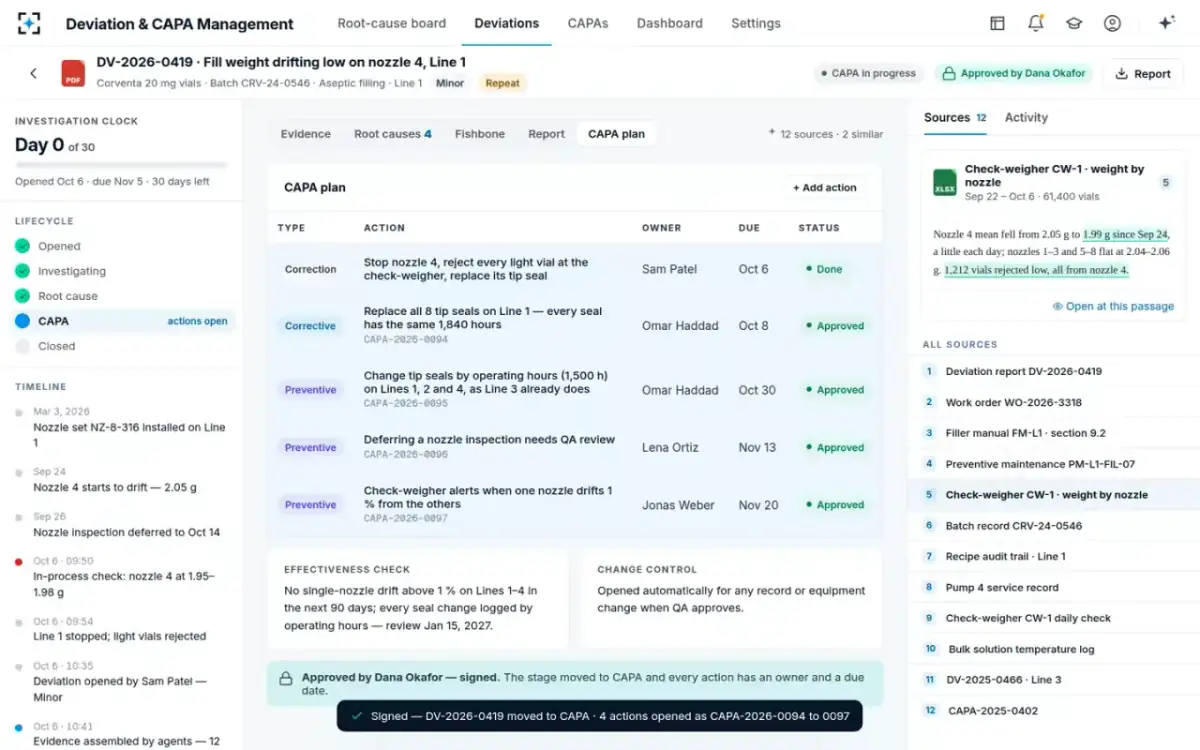
One last argument for doing the harder version of this. FDA's own work on quality management maturity puts the difference between a mature and an immature quality organisation in exactly these terms: less mature organisations spend on corrective action after a failure and put nothing into preventive action against failure modes that have not yet happened (CDER, Quality Management Maturity white paper, 2023). A replay scored on scope and effectiveness rather than on speed is a direct measurement of where your plant sits on that line — and it is worth having whether or not you buy anything.
The four tiles a pilot will eventually be read on
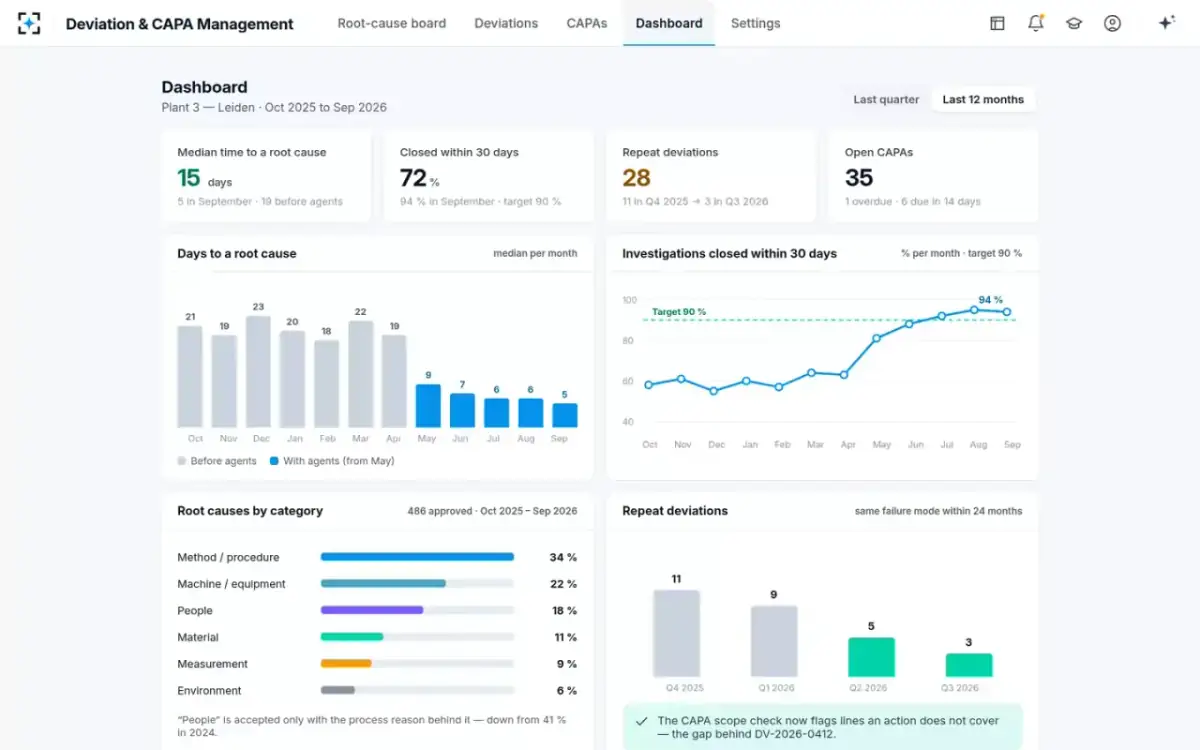
Run the replay on thirty of your own closed cases, with criteria written before anyone looks, cases chosen by your people and settings fixed in advance, and the decision will make itself. To start one, or to see the evidence board, the scope check and the effectiveness criteria on real screens, go to Deviation & CAPA Management; to prepare the questions for the vendors on the shortlist, read the eight that separate a workflow from an investigation.
Questions people ask
How many closed cases does a pilot need?
Thirty is a workable number for a judgement exercise rather than a statistical one: large enough to span Critical, Major and Minor and to include a couple of known repeats, small enough for two readers to score inside two weeks. If you need a result with statistical confidence rather than a decision, the draft European annex is clear that the test set and each of its subgroups must be sufficient in size to calculate the metrics — which usually means considerably more than thirty.
Can the vendor help choose the pilot cases?
No, and this is the one place to be inflexible. The draft annex requires that test data be kept away from anyone involved in developing or tuning the model, and the same logic applies to a vendor-run pilot. Let them explain what a representative spread looks like; choose the actual cases yourself, and write down why you chose them.
What if we have never measured our own baseline?
Then week 1 is the pilot's most valuable week, and you should run it even if you buy nothing. Reading thirty of your own closed files for days to a proposed cause, match rate, scope and traceable claims tells you a great deal about your quality system, and without it there is no criterion a new system can be held to.
Should the pilot run on live deviations instead?
Not for the comparison, because a live case has no known answer to score against and no baseline from the same case. Run the replay on closed cases to decide, then a short shadow period on live ones to test the operational reality — access, timing, who gets notified — with the quality unit's own process still being the one of record throughout.
Does a pilot count towards validation?
It is not validation, but a well-run one produces evidence validation will want: a documented intended use, acceptance criteria approved before testing, a justified test-set selection, and a result against a measured baseline. Agree with your validation lead in week 1 what will be reusable, and record it in the form they will want rather than converting it afterwards.
What happens to the pilot configuration if we go ahead?
Treat it as a starting point under change control, not as a settled state. The settings fixed before the replay — the clock, the approvers, the look-back, the confidence threshold, the scope check — were chosen without evidence; the replay is the first evidence you have about them. Review each one deliberately after the result, record the reasoning, and then leave them alone long enough to learn something.