Root cause analysis in pharmaceutical manufacturing is the work of turning a departure into a cause somebody can act on, and it is done with two borrowed tools: a fishbone diagram that forces you to look in six places rather than the first one, and a chain of whys that keeps asking until the answer names something the plant controls. Neither is required by any regulation. Both are worth nothing on their own, because a bone is only as good as the record you checked it against, and a why chain only ends when the last why names something a plant can change — a maintenance plan that counts months instead of hours, a procedure that allows a deferral without review. Botminds' Deviation & CAPA Management fills the six bones from the records for the event window, ranks the candidate causes with the evidence for and against each, and builds the chain down to a system cause for a named quality person to accept or reject.
The worked case below is the solution's sample data: a fictional plant in Leiden, aseptic filling Line 1, four of five vials from one nozzle filling light at a 09:50 in-process check. Every batch, work order and person in it is invented. The regulatory material is quoted from the regulators.
How do you do a root cause analysis in pharmaceutical manufacturing?
In five steps, and the first one is the easiest to skip. Establish what actually happened, in time order, from records rather than from accounts — when the signal started, what else moved with it, what did not. Then check every bone against its own record, including the ones you are sure are clear, because a bone you did not check is not a bone you cleared. Then list the causes that survive and rank them, with the evidence that argues against each. Then drive the best candidate down a why chain until it reaches something the plant controls. Then write a cause statement an action can aim at.
The order matters because of what it protects against. An investigator who starts from a hypothesis checks the bone that confirms it and declares victory; an investigator who checks all six in a fixed order arrives at the same hypothesis having also established that the other five are clean, which is the difference between a conclusion and a hunch. ICH Q10 asks for exactly this discipline without naming a tool: "a structured approach to the investigation process should be used with the objective of determining the root cause," with the effort, formality and documentation "commensurate with the level of risk" (ICH Q10 §3.2.2).
What are the six bones of a fishbone diagram?
Method, Machine, Material, People, Measurement and Environment — the six categories of a cause-and-effect diagram, drawn as ribs off a spine that points at the problem. They are a prompt, not a taxonomy: their only job is to stop you looking in one place. What turns them from a brainstorming device into evidence is attaching a record to each, so that a bone can be marked clear on something a reviewer can open.
The six bones, the record each is actually checked against, and the question that closes it
Method
Checked againstThe recipe audit trail, the batch record steps as executed, and the procedure version in force that shift
Closes whenWas the approved method actually the one that ran?
Machine
Checked againstEquipment run logs, maintenance work orders, the preventive plan and the supplier's manual
Closes whenHad this equipment reached a limit somebody wrote down?
Material
Checked againstComponent and lot records, goods receipt, the certificate of analysis and any earlier use of the same lot
Closes whenWas anything in the product different from the last good batch?
People
Checked againstTraining records, shift and staffing records, and the account of whoever was present
Closes whenCould a competent person following the procedure have produced this?
Measurement
Checked againstCalibration certificates and the daily checks of the instrument that found the problem
Closes whenIs the reading itself trustworthy, or is the instrument the fault?
Environment
Checked againstRoom, product and utility data with their alarms, for the hours around the event
Closes whenDid any condition move outside its limit, or toward one?
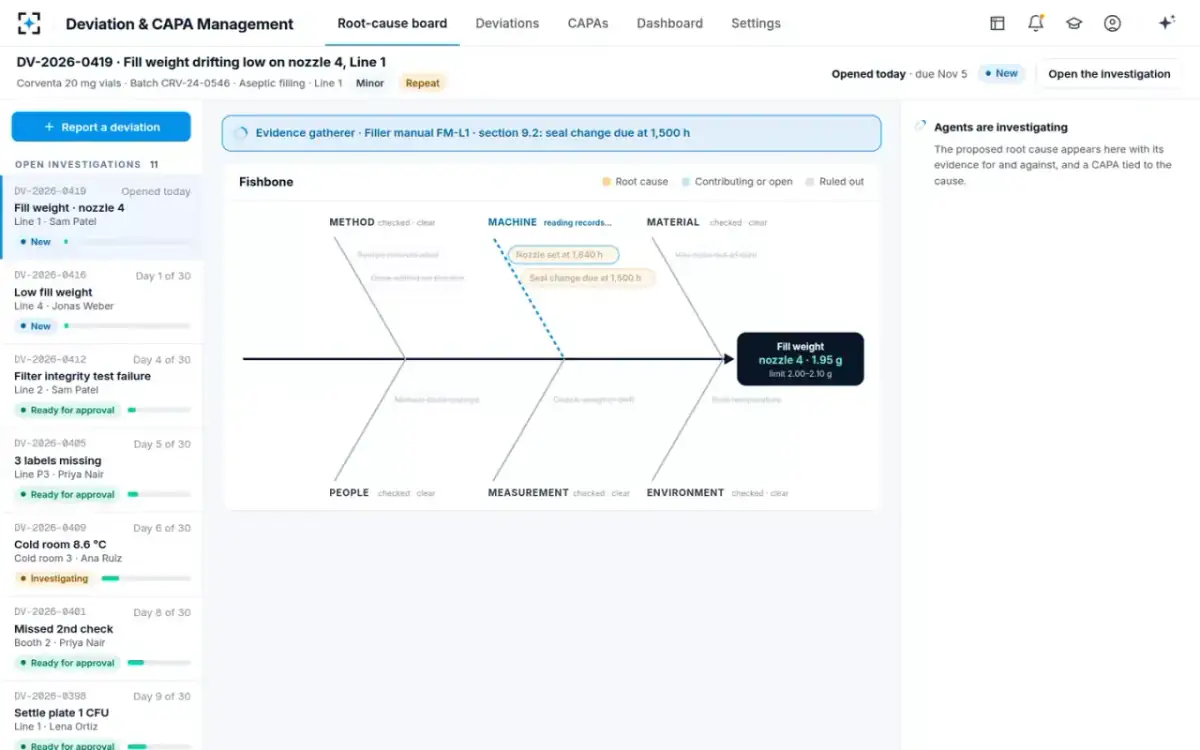
In the sample case five of the six closed quickly and the sixth carried the cause. Method: the recipe audit trail showed version CRV-20-V3 verified at 06:12 at 2.02 millilitres on all eight pumps — the right recipe, loaded to every nozzle, so a recipe error could not produce a drift on one. Measurement: the check-weigher's daily check passed, so the instrument that raised the alarm was not itself the fault. Environment: bulk solution held at 20.6 to 20.9 degrees with no alarms. Material and People came back clear. Then Machine filled from the maintenance records, and it filled quickly.
Is a fishbone diagram required by the FDA?
No. No US or EU GMP regulation names the fishbone, the five whys, fault tree analysis or any other technique, and a plant that uses none of them breaks no rule. What the FDA does is more interesting than a requirement: its own inspection programme lists the effective use of these tools among the indicators that distinguish an advanced quality system from a merely compliant one.
"Investigations — Effective use of standardized tools (e.g., FMEA, DOE, 5 Whys, fishbone diagram) to determine a potential root cause"
FDA Compliance Program 7356.002, Attachment B — Examples of Indicators of an Advanced Quality System
Read the qualifier. The indicator is not the presence of a fishbone in the file; it is the effective use of a standardised tool. A six-bone diagram with five bones left blank and the sixth asserted is evidence of the opposite of what the plant hoped to show. The European rule is framed the same way, asking for "an appropriate level of root cause analysis" determined by quality risk management principles rather than for a named method (EU GMP Part I, Chapter 1 §1.4(xiv)).
What tools are used for deviation investigation, and when each earns its keep
Four appear in the FDA's own list, and they do different jobs. A fishbone is for breadth, at the start, when you do not yet know where to look; it is cheap and its failure mode is shallowness. A why chain is for depth, after a candidate has emerged; it is cheap and its failure mode is a straight line through a branching problem. Failure mode and effects analysis is for a system you are designing or re-examining, not for a single event; it earns its keep when the same equipment keeps producing different symptoms. Design of experiments is for the case where the records genuinely cannot settle it and you need to produce new evidence — expensive, slow, and the only honest answer when every bone is clear.
The choice should follow the risk rather than the habit. ICH Q9 makes formality itself a variable: it "is not a binary concept (i.e. formal/informal); varying degrees of formality may be applied during quality risk management activities," a continuum rather than a switch. A minor labelling discrepancy investigated with the full apparatus wastes the same hours that the next Critical case will need.
The order of checking in Deviation & CAPA Management, with the bone that holds the cause arriving last
Agent
Build the windowFixes the hours around the event and pulls every record that covers them, so each bone is checked against the same slice of time.
Never: Never reads outside the plant, batch and equipment named in the deviation.
Agent
MethodReads the recipe audit trail and the batch record as executed against the procedure version in force.
Never: Never writes to a GMP record.
Agent
MeasurementChecks the calibration and daily checks of the instrument that found the problem before trusting its reading.
Agent
Environment and MaterialReads room, product and utility data with their alarms, and the component and lot records for the batch.
Agent
PeopleChecks training and shift records for whoever was present, and looks for the same act elsewhere.
Never: Never concludes human error without the process reason behind it.
Agent
MachineReads run logs, work orders, the preventive plan and the supplier manual, and compares hours run against the limit the supplier set.
Agent
Rank and chainScores the surviving candidates with the evidence for and against each, and drives the leader down a why chain to a system cause.
Never: Proposes only — a named quality person approves or rejects.
A person decides
Accept, reject or send backThe quality unit decides whether the chain is evidenced well enough to carry an action.
Every bone checked against the records for the event window
How many whys do you need in a 5 why analysis?
As many as it takes to reach something the plant controls, which is sometimes three and sometimes seven. Five is a mnemonic, not a count, and treating it as a count produces two opposite failures: chains padded to five with restatements of the same fact, and chains stopped at five while still describing the weather.
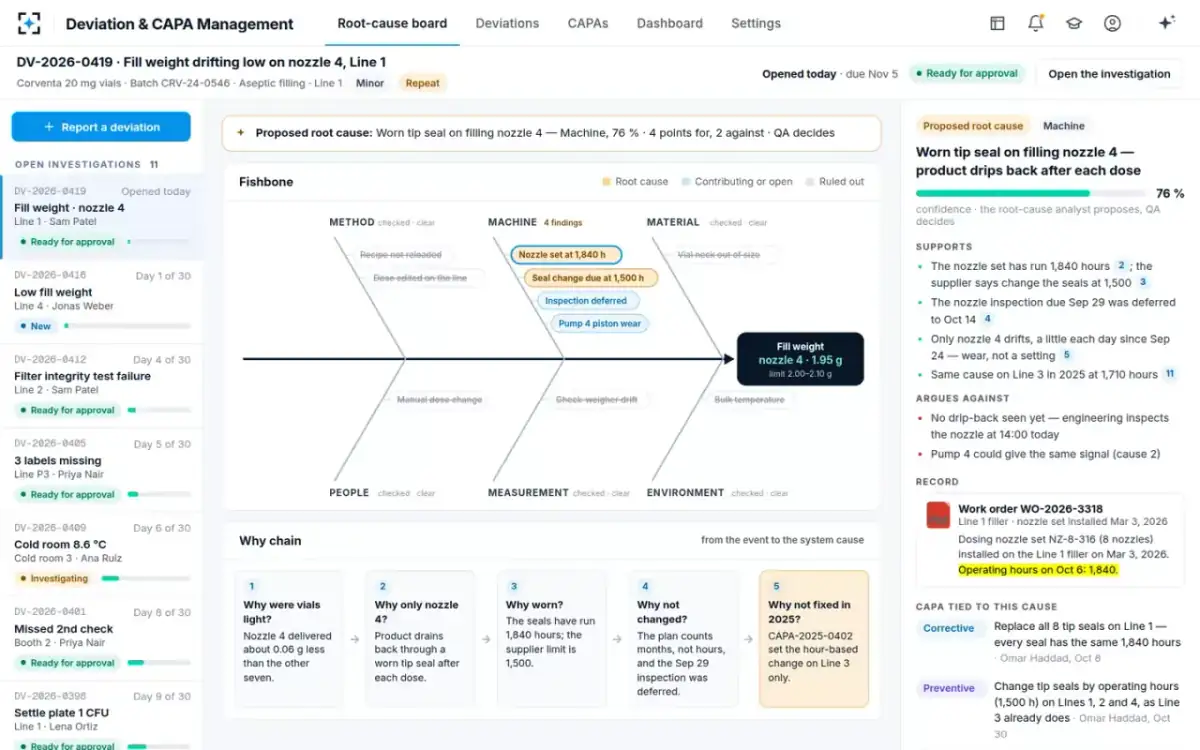
The sample case needed four. Why were the vials light? The tip seal on nozzle 4 was worn. Why was it worn? The nozzle set had run 1,840 operating hours. Why had it not been changed? The supplier's manual specifies a change every 1,500 operating hours, and the preventive plan schedules it by calendar month. Why did the calendar schedule not catch it? The September inspection was deferred, and nothing required a quality review of the deferral. The chain ends there because the last answer names two things a plant can change — a plan that counts the wrong unit, and a deferral that nobody had to approve — and because the next why would be about budgets rather than about the process.
The honest limitation of the technique is worth stating, and the clearest statement of it comes from the patient-safety literature rather than from pharmaceutical manufacturing. "The first problem with RCA is its name," argue Peerally and colleagues in BMJ Quality & Safety. "By implying—even inadvertently—that a single root cause (or a small number of causes) can be found, the term 'root cause analysis' promotes a flawed reductionist view" (BMJ Quality & Safety 26(5), 2017). The same paper notes that techniques such as timelines and the five whys "tend to favour a temporal narrative rather than a wider systems view" — which is exactly what a fishbone is there to counterweight.
Five tests of a why chain, and what each one catches
- Does each why follow from the one above it on evidence, not on assumption?
Name the record that makes the link. A chain whose third link is "presumably" is a story.
- Does it stop at something the plant controls?
A chain ending on supplier variability, operator attention or the weather has not finished. Those are conditions, and the question is what the plant does about them.
- Would fixing this have prevented it?
Run the chain backwards at the last link. If the answer is not yes, the chain has drifted onto a contributing factor.
- Does it name a system rather than a person?
Not out of kindness: a person is not a thing you can change, and an action aimed at one will not hold when they leave.
- Is every link citable?
Someone reading the file in two years should be able to open the record behind each why without asking you.
Direct cause, contributing cause, root cause: three different sentences
Investigations go round twice when these three are written as one. The direct cause is the thing that immediately produced the effect: the tip seal on nozzle 4 was worn, so the dose fell. A contributing cause made it more likely or harder to catch: the drift was gradual, about a hundredth of a gram a day, so no single check looked alarming. The root cause is the system condition that allowed the direct cause to exist unnoticed: the maintenance plan counts calendar months while the supplier specifies operating hours, and a deferral needed nobody's review.
Each gets a different kind of action. The direct cause gets a correction — replace the seal, and in the sample case all eight seals, because every one of them has the same 1,840 hours. The contributing cause gets detection: an alert when one nozzle drifts a per cent away from the others. The root cause gets the preventive action: change seals by operating hours on every line that runs the same nozzle set, and require a quality review before any nozzle inspection may be deferred. A file that writes only the first sentence will produce only the first action, and the effectiveness check ninety days later will have nothing to measure.
The record behind every bone, and what "checked" has to mean
Checked means one of three things, and the file should say which. The bone was examined and nothing in its records is inconsistent with the normal case. Or the bone was examined and something in it is inconsistent but does not explain the effect — that is a contributing cause and belongs in the chain. Or the bone could not be examined because the record does not exist, is illegible, or covers the wrong window. The third verdict is the valuable one and the one that disappears, because writing "not available" feels like an admission. It is in fact one of the most useful lines an investigation produces: it names a gap that will defeat the next investigation too.
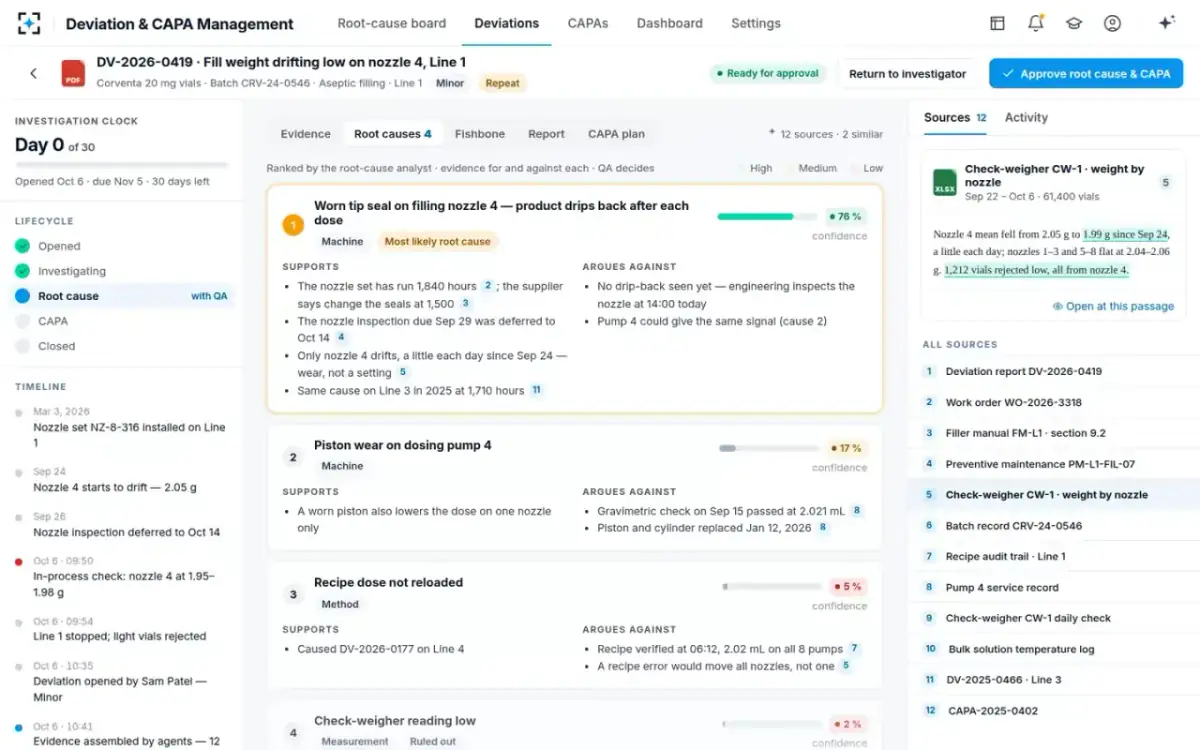
The sample case gives a good example of an argument running the other way. Piston wear on dosing pump 4 would produce the same symptom as a worn seal, and it ranks second at 17 per cent — but a gravimetric check passed on 15 September at 2.021 millilitres and the piston had been replaced in January. Neither fact proves the pump innocent. Both are evidence against, and a candidate that survives with its counter-evidence shown is worth more than one asserted without it.
Four candidate causes, each with the evidence that argues against it
The proposed cause with its why chain and the record behind it
What if you cannot find the root cause?
You say so, and you act on the most likely one anyway. This is one of the few places where the European rules give a direct instruction: "in cases where the true root cause(s) of the issue cannot be determined, consideration should be given to identifying the most likely root cause(s) and to addressing those" (EU GMP Part I, Chapter 1 §1.4(xiv)). FDA's language points the same way, asking a full investigation record to include a documentation review "with the assignment of actual or probable cause" (Investigating Out-of-Specification Test Results, Revision 1). Probable is an allowed answer.
What is not allowed is the quiet version of the same thing: a cause written with the confidence of a finding when the file contains no evidence for it. An undetermined conclusion, stated as undetermined, with the two best candidates addressed and an effectiveness check that would catch either returning, is a stronger file than a confident one that nobody believes. It also behaves better over time, because the next occurrence can be compared against a documented list of what was ruled out.
How do you write a root cause statement a CAPA can aim at?
Write the condition, not the event, and write it so that a reader can name the action without being told. The test is mechanical: read the statement aloud and ask what you would change. If the answer is nothing, or a person, it is not a cause statement yet.
The same finding written twice: one you cannot act on, one you can
What gets written: "Operator error during the fill."
What an action can aim at: "Four of five vials from nozzle 4 filled below the lower weight limit while the other seven nozzles held, and the drift had been growing since 24 September."
What gets written: "Seal not changed."
What an action can aim at: "The nozzle set had run 1,840 operating hours against a supplier limit of 1,500."
What gets written: "Maintenance to review the plan."
What an action can aim at: "The preventive maintenance plan schedules tip seal changes by calendar month while the supplier specifies operating hours, and a scheduled nozzle inspection was deferred without quality review."
The third row is the one worth studying. It names two independent system conditions — the wrong unit of measure in a plan, and an unreviewed deferral — and each produces a different action. A statement that had merged them into "inadequate maintenance planning" would have produced one vague action and no way of telling, later, which half had been fixed.
Where subjectivity gets in, and the four things that hold it down
Every step of this work is a judgement, and ICH Q9 is unusually candid about it: "subjectivity can impact every stage of a quality risk management process," introduced "through differences in how risks are assessed and in how hazards, harms and risks are perceived by different stakeholders, (e.g., bias)," and also "when risk questions are inadequately defined, and when tools have poorly designed risk scoring scales" (ICH Q9(R1) §5.3). The guideline is clear that it cannot be eliminated, only controlled.
Four practices hold it down, and none of them is a tool. Check every bone, including the ones you are sure of, so the search is not steered by the hypothesis. Record the evidence against each candidate as deliberately as the evidence for it, so a reviewer can see what the author discounted. Define the question before scoring it — "what caused the weight drift on nozzle 4 between 24 September and 6 October" rather than "what caused the deviation". And make somebody who did not write the conclusion decide whether it is good enough. In the solution the first three are how an agent is required to present a cause, and the fourth stays a named person's job.
Four causes, weighed for and against, on the ranked-causes screen
To see the six bones filled from real records on one case, start from Deviation & CAPA Management.
Questions people ask
What is the difference between 5 Whys and a fishbone diagram?
Breadth against depth. A fishbone opens the search across six categories at once and is used at the beginning, when nobody knows where the cause is. A why chain drills a single line downward and is used after a candidate has emerged. Used alone, a fishbone tends to produce a wide list nobody prioritises and a why chain a narrow story that missed a branch; used in that order they correct each other.
Is "5M and E" the same as the six bones?
Yes — Method, Machine, Material, Manpower (usually written People now), Measurement and Environment. Some industries use four categories, some use eight, and some manufacturing sites add a seventh for management systems. The number is not important. What matters is that the set is fixed before the investigation starts, so the categories are not chosen to fit the answer already in mind.
Can an investigation have more than one root cause?
Often, and saying so is usually the more accurate answer. The sample case has two system conditions behind one symptom: a plan that counts the wrong unit and a deferral nobody had to approve. Fixing either alone would have left the failure reachable by the other route. The peer-reviewed criticism of this field is precisely that the singular in "root cause" invites investigators to stop at one.
How long should a root cause analysis take?
The regulators tie effort to risk rather than to a clock: ICH Q10 asks that the level of effort, formality and documentation be commensurate with the risk. In practice the clock-driven answer is the wrong one to optimise, because much of the elapsed time in a GMP investigation goes on retrieving records and waiting for people, not on reasoning about cause.
What is the difference between a root cause analysis and an investigation?
The analysis is one part of the investigation. An investigation also establishes what happened, assesses whether any product was affected, checks whether the same thing has occurred before, proposes corrective and preventive action, and is approved and signed. A file containing only a cause has answered the most interesting question and none of the ones a regulator will ask first.
Do you have to re-test to confirm a root cause?
Not always, and reaching for new testing before the records are exhausted is a common way to lose a fortnight. Design of experiments and confirmatory testing earn their place when every bone has been checked and the records genuinely cannot distinguish between two candidates. In the sample case they were not needed: the maintenance records settled it, and a physical inspection of the seal the same afternoon was the confirmation.