CAPA effectiveness criteria are the statement, written before the action is taken, of what would have to be true afterwards for the action to count as having worked. A real one contains four things: a measure with a number in it, a window with a start and an end, a data source that already exists and is not produced by the people being assessed, and a named person who is not an action owner to rate it. The work is hard because almost everything about an effectiveness check is easier to fake than to do — a second signature costs nothing and looks identical on an index. Botminds' Deviation & CAPA Management carries the criterion on the plan itself, from the moment the actions are signed to the day somebody rates each one effective or not effective.
The example used throughout is the solution's own, on fictional sample data: no single-nozzle drift above 1 % on Lines 1 to 4 in the next 90 days, review 15 January 2027. The regulatory material is quoted from the regulators.
Five tests of a real effectiveness criterion
- Is there a number?
A threshold a reader could apply without asking you what you meant. "Improved", "reduced" and "no issues" are not numbers.
- Is there a window, with a start and an end?
Open-ended checks are never failed, only forgotten. The window should start when the action is in place, not when the file was signed.
- Does the data source already exist?
A check that depends on new collection usually does not happen. The strongest criteria read something the plant was already producing for another reason.
- Is the data produced by someone other than the people being checked?
A measure fed by the team whose work is in question is not independent, whatever anyone's intentions are.
- Could the criterion have come out "not effective"?
The decisive test. If no realistic outcome in that window would have failed it, the check is theatre and the file will say so to anyone reading it later.
What are CAPA effectiveness criteria, and what a check is for
A corrective action is a hypothesis. It says: this cause produced this failure, and changing this thing will stop it happening again. An effectiveness check is the experiment that tests the hypothesis, and like any experiment it has to be designed before the result is known, or the result can be read whichever way is convenient.
That framing explains what a check is not. It is not a second approval of the action, which was already approved. It is not confirmation that the work was done, which is a separate and much easier question. And it is not a review of the investigation, which was closed at signature. It is one narrow question asked some months later: did the thing we changed produce the change we predicted?
ICH Q10 sets the ambition for the whole system in one sentence: "CAPA methodology should result in product and process improvements and enhanced product and process understanding" (ICH Q10 §3.2.2). Understanding is the half that only the check can deliver. An action implemented and never measured leaves the plant exactly as knowledgeable as it was before.
What is the difference between verification of implementation and effectiveness?
Verification of implementation asks whether the action was done. Effectiveness asks whether doing it worked. They are different questions, they are answered at different times, and conflating them is a common defect in a CAPA procedure.
Verification is a documentary check made as soon as the action is complete: the procedure was revised and issued, the eight seals were replaced on this work order, the alert was configured and fired on a test. It can be done by the action owner, because nothing is being judged. Effectiveness is a measurement made after enough time has passed for the change to have had the opportunity to fail, and it cannot be done by the action owner, because something is.
The practical consequence is that a plan needs two dates and two signatures, not one. A programme that records only completion has a healthy-looking dashboard and no evidence that anything improved, which is the kind of condition FDA's quality maturity work says it looks at.
How do you write capa effectiveness criteria with a number in them?
Start from the failure, not from the action. Ask what the plant would have seen if the failure were recurring, name the measurement that would have shown it, and set the threshold at the point where you would want to know. Writing it in that order produces a number almost automatically, because you are describing a signal you have already observed once.
Four criteria as they are usually written, and the same four with a number in them
As written: "All affected operators trained on the revised procedure."
With a number, a window and a source: "Across the 90 days after issue, zero batch records on Lines 1 to 4 show the step performed in the superseded sequence, read from the batch record review already done on every batch."
As written: "No recurrence of the deviation observed."
With a number, a window and a source: "No deviation with the same failure mode and equipment class opened on any of the four lines in 180 days, counted from the deviation index."
As written: "Procedure revised and approved."
With a number, a window and a source: "In the 90 days after issue, every nozzle inspection either happened on schedule or carries a recorded quality review of its deferral — no exceptions, counted from the maintenance system."
As written: "Operators understand the change."
With a number, a window and a source: "The drift alert fires on a deliberate test at the threshold, and the first three real firings are each closed with a recorded disposition inside one shift."
Two habits make the rewriting easier. Count things rather than describing them, even when the count is expected to be zero — "zero batch records showing the old sequence" can fail, while "operators follow the new sequence" cannot. And name the system the number will be read from while you are writing the criterion, not afterwards, because the discipline of naming it is what reveals the criteria that have no source at all.
Is a CAPA effectiveness check required by the FDA?
There is no regulation in part 211 that uses the phrase, and there is no doubt whatever about the expectation. FDA's inspection programme lists, among what an investigator reviews in the quality system, that for discrepancy and failure investigations "corrective actions and preventive actions (CAPAs) are included and effectiveness of the CAPAs is evaluated" (Compliance Program 7356.002). Europe puts it in the governing clause on investigations: corrective and preventive actions should be identified and taken, and "the effectiveness of such actions should be monitored and assessed, in line with Quality Risk Management principles" (EU GMP Part I, Chapter 1 §1.4(xiv)).
What no text gives you is a template, and the reason is worth understanding rather than resenting. The only criterion that works is one built from the specific failure, so a published form would be filled in identically across every case and measure nothing. FDA's own maturity work says as much by naming what it looks at: among the elements that may be assessed is "the rationale governing how a corrective or preventive action is determined to be effective", alongside the observation that "less mature organizations may invest in corrective actions in reaction to failures, but do not devote resources to preventive actions to mitigate potential failure modes" (CDER Quality Management Maturity white paper). The rationale, not the form.
How long should a capa effectiveness check run?
Long enough that the failure would have had a fair chance to recur, which is a question about the process rather than about the calendar. Ninety days is a common default and a reasonable one for a failure that appears weekly or monthly. For a failure that appears twice a year it proves nothing, and a ninety-day pass on it is worse than no check at all, because the file now records a verdict nobody should rely on.
Three things set the window honestly. The frequency of the failure: at least two or three expected opportunities for it to recur, or the check cannot distinguish success from quiet. The time for the change to take hold: a procedure issued today is not in practice for some weeks. And the data's own rhythm: a measure read monthly needs several months before it has a trend. ICH Q9 supports scaling the whole apparatus this way, treating formality as "a continuum (or spectrum), ranging from low to high" rather than a switch (ICH Q9(R1) §5.1).
Stopping at implementation, and what the rules ask for
- Actions implemented and verified14 d
- Actions implemented and verified14 d
- Check window runs on data already being collected90 d
- Rated effective, or not7 d
- Carried into the annual product quality reviewyear end
Who performs the capa effectiveness check, and who may not
Someone other than the person who performed the action, and someone other than the person whose process is being measured. Beyond that, the choice is the plant's, and the useful rule is to put the rating with whoever would have had to deal with the failure if it returned — they have the strongest reason to be sceptical.
Who may not: the action owner, because they are assessing their own work; the author of the investigation, because they are assessing their own hypothesis; and anyone who would be measured by the data. In the solution the rater is a setting — in the sample plant a named specialist in microbiology and aseptic, with the quality lead as the alternative — and the action owners are three different people, so no one is rating their own item.
One more constraint is easy to miss: the rater needs the authority to make the verdict stick. A not-effective rating has consequences — the cause goes back on somebody's desk, an action that was reported as complete is now in question, and the clock on the original file effectively restarts. A rater who can be talked out of that verdict by the action owner is not performing a check. This is the one place where putting the rating high in the organisation is worth the scheduling cost.
A CAPA plan carrying its effectiveness check from the day it is signed
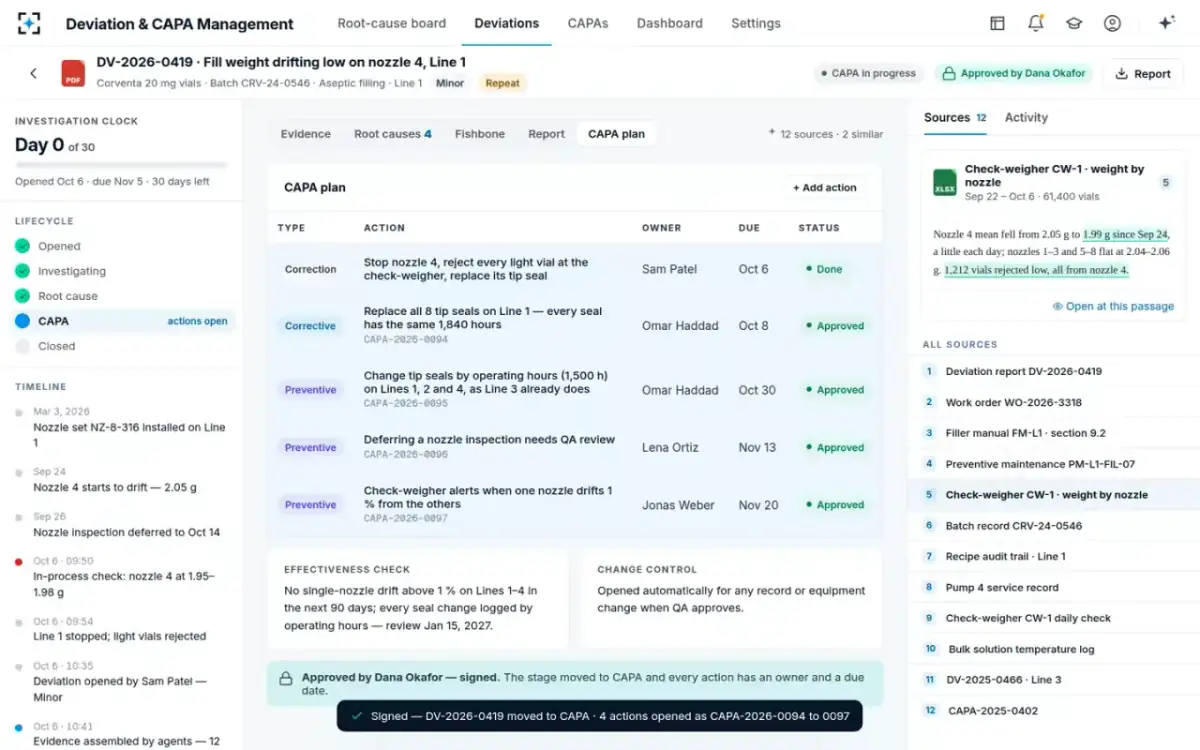
The criterion that could not have failed
The quickest audit of a CAPA programme is to read ten closed effectiveness checks and ask, of each, what result in that window would have produced a verdict of not effective. If the answer is none, the plant has a procedure that generates records and no mechanism that generates learning.
Four patterns produce unfailable criteria. A criterion that measures the action rather than the outcome — training completed, procedure issued — is always met, because it was met the day the action closed. A criterion with no data source is rated on impression, and impressions after ninety days are favourable. A criterion whose evidence is the absence of a report measures reporting, not performance. And a window so short the failure could not have recurred passes by arithmetic.
One criterion written out in full, and what happens on each of the two verdicts
The measure
Single-nozzle drift: the difference between any one nozzle's mean fill weight and the mean of the others on the same line.
The limit
No single nozzle above 1 %.
The scope
Lines 1 to 4 — every line running the same nozzle set, not only the line that failed.
The window
90 days from the date the actions were signed, with a review date of 15 January 2027.
The data source
Check-weigher data, which already weighs every vial and is what found the original drift. No new collection, and nothing produced by the people being assessed.
The rater
A named person in microbiology and aseptic — not an action owner, and set as a configuration rather than assumed.
If it passes
The actions are rated effective, the verdict is recorded against each one, and the result is carried into the annual product quality review.
If it fails
The actions are rated not effective. The cause is reopened rather than the action reissued: either the cause was wrong, or the action did not reach it.
Read the data-source row again, because it is the one that makes the rest workable. The check-weigher was already weighing every vial; it is what detected the original drift. A criterion read from it costs nobody an hour, which is why it will still be running in ninety days. Criteria that require somebody to start counting something new are the ones that quietly lapse, and a lapsed check is indistinguishable from a passed one on a report.
It is also worth separating two numbers that look related and are not. A plant may close most of its investigations inside its target — the sample plant's own design goal is 94 % within 30 days, and that is a target, not a measurement of anything that has happened. Closing on time says nothing about whether the actions held. They are different questions with different evidence, and a programme that reports only the first has reported the easier one.
What happens if a CAPA is not effective?
You reopen the cause, not the action. A not-effective verdict says one of two things, and the file should decide which: either the cause was wrong, in which case repeating a better version of the same action is pointless; or the cause was right and the action did not reach it, in which case the question is what sits higher in the hierarchy of fixes. The common failure here is a reflex re-issue — more training, a sterner reminder — which answers neither question and consumes the next ninety days.
Repeatedly ineffective action is also something regulators escalate. In a 2026 warning letter the FDA required an independent assessment and remediation plan for a firm's CAPA programme, specifying a report "that evaluates whether the program includes effective root cause analysis, ensures CAPA effectiveness, analyzes investigation trends, improves the CAPA program wherever needed, ensures final QU decision authority, and is fully supported by executive management" (Warning Letter to Pharmathen International, 27 May 2026). Three of those six are about the system around the check rather than the check itself.
Where a plan's actions fall, and the plan this case did not get
The sample case · 4 actions · demo
- Equipment change 25% · 25%
- Procedure change 25% · 25%
- Added detection 25% · 25%
- Added review step 25% · 25%
The plan it did not get · illustrative
- Symptom adjustment 50% · 50%
- Training 50% · 50%
There is a third possibility worth keeping in the procedure, because leaving it out forces files into one of the other two dishonestly: the criterion itself was wrong. A window too short for the failure's frequency, a threshold set where normal variation crosses it, or a measure that turned out to track something else — all three produce a verdict that says nothing about the action. The right response is to record that finding plainly, fix the criterion, and run the window again, rather than to accept a pass or a fail that the file cannot support.
Where the effectiveness answer turns up again a year later
In the annual review of the product, where the rules ask for it by name. The European product quality review must cover every significant deviation or non-conformance, the investigations behind them, and how effective the resulting corrective and preventive actions were (EU GMP Part I, Chapter 1 §1.10(iv)). That requirement is the quiet reason to insist on real criteria throughout the year: twelve months of honest verdicts make the annual review a half-day of reading, while twelve months of unfailable ones make it an exercise in reconstructing what actually happened.
The year-end view is also where a pattern becomes visible that no single check can show: actions that pass their own criterion while the same failure mode keeps appearing somewhere else. That is usually a scoping problem rather than an effectiveness problem — the action was real and was aimed at one line — and it is why the sample case's criterion covers four lines rather than the one that failed. Deciding which system condition the chain actually ended on is what sets that scope.
Every action traced to its deviation, with its check due date
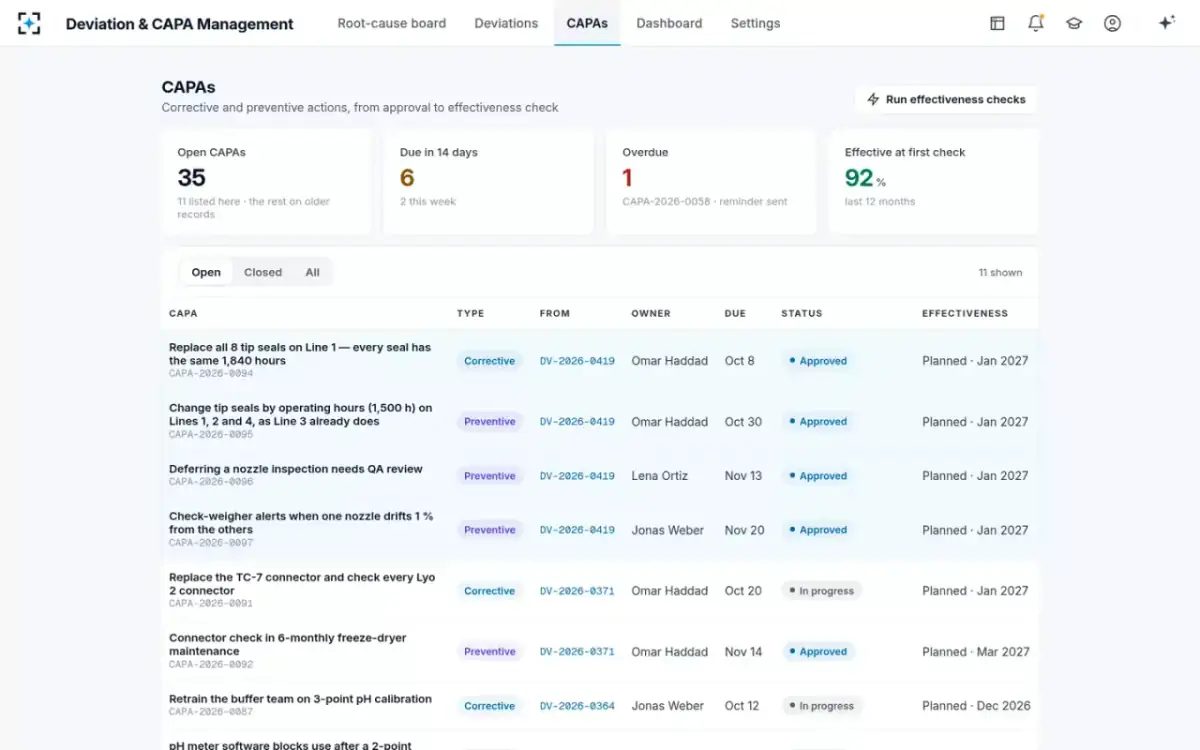
To see a criterion written on the plan at the moment of signature, start from Deviation & CAPA Management, or read why a training-only plan has nothing to measure.
Questions people ask
What is a good CAPA effectiveness check example?
The one on this page is a fair model: no single nozzle drifting more than 1 % from the others on any of four lines, over 90 days from signature, read from check-weigher data that already weighs every vial, rated by a named person who owns none of the actions. It has a number, a window, a scope wider than the failure, a source that costs nothing to read, and an outcome that could have gone the other way.
Can an effectiveness check be a document review?
Sometimes, where the thing you changed is documentary. If the action required a quality review before any deferral, then reviewing every deferral in the window and counting those without a recorded review is a legitimate check with a number in it. What does not qualify is reviewing the revised procedure to confirm that it says what it says — that is verification of implementation, dressed up.
Who signs off that a CAPA was effective?
A named person who is neither an action owner nor the investigation's author, and whose role is written into the procedure rather than chosen case by case. In the solution it is a configuration with two named alternatives, so the question of who rated an action is answerable from the file years later without anybody's recollection.
How many CAPA effectiveness checks should fail?
There is no standard figure, and the number is not the point; the distribution is. A programme where nothing is ever rated not effective is not succeeding, it is not measuring — the criteria are almost certainly unfailable. The useful internal metric is the share of closed checks whose criterion a reviewer agrees could have failed, which you can assess on a sample of ten in an afternoon.
What is the difference between a correction, a corrective action and a preventive action?
A correction fixes the instance: replace the worn seal. A corrective action stops the same cause producing it again: change the seal interval from calendar months to operating hours. A preventive action addresses a failure mode that has not happened yet here: apply the same interval to the other lines running the same equipment, before one of them drifts. Only the second and third can be meaningfully checked for effectiveness.
Do effectiveness checks apply to preventive actions too?
Yes, and they are harder to write, because the thing you are looking for has not happened on that line. The usual approach is to measure the leading indicator rather than the failure: for a preventive change to a maintenance interval, the measure is whether the interval is actually being met on the other lines and what condition the parts are in when they come out — not whether another line also failed.