Repeat deviations are the same failure arriving twice: one failure mode, one equipment class, two investigations, often on two different lines and two years apart. They are often not a failure of analysis. In many repeats, the first investigation found the cause correctly and then wrote a corrective action against the record in front of it — this line, this batch, this procedure — rather than against the thing that produced it. Botminds' Deviation & CAPA Management is built for exactly that boundary: five specialist agents read the plant's own records, search the closed cases for the same failure mode, and test every proposed action against each line that shares the equipment, so the scope decision is made in writing before a QA approver signs it.
The worked example on this page is the solution's own sample plant — fictional products, people, lines and batches, running on sample data. The regulations, guidance and research quoted are real, and linked where they appear.
The same seal, past the same limit, on two different lines
- Replace the tip seals at 1,500 hours1,500 h
- Inside the supplier limit1,500 h
- Past it+210 h
- Inside the supplier limit1,500 h
- Past it+340 h
What is a repeat deviation?
A repeat deviation is a deviation whose failure mode has already been investigated and acted on, inside a window the plant has defined, where the earlier corrective and preventive action did not reach the new event. That definition has three moving parts, and each one is a decision somebody has to make and write down: what counts as the same failure mode, how far back you look, and what "did not reach" means.
The first part is the one that gets argued about. A worn tip seal on Line 1 and a worn tip seal on Line 3 are plainly the same failure mode. A filter integrity test failure caused by testing a filter while it is still warm, and a filter integrity test failure caused by a damaged membrane, are not — same symptom, different mechanism. Matching on the symptom produces a repeat count nobody believes; matching on the mechanism produces one a head of quality can take to a board. In practice a usable match needs at least two of three things in common: the mechanism, the equipment class, and the procedure or plan that allowed it.
The second part is the window, and it is a setting, not a fact. The third is the part most quality systems never record at all: whether the earlier action was ever supposed to cover this line. If the 2025 action deliberately stopped at Line 3 — because Line 3 was the only line then running that product, say — the 2026 event is a scope failure, not a repeat. If nobody decided, it is a repeat. The difference matters, and it only exists if the decision was written at the time.
Why do deviations keep repeating?
Deviations keep repeating because corrective actions inherit the boundary of the document they were written on. An investigation is opened against one deviation number, one batch, one line. The report, the cause and the action plan all sit inside that file, and the action is drafted by someone looking at that file. Nothing in the paperwork asks the question that would widen it: what else in this plant has the same nozzle set, follows the same maintenance plan, or runs under the same procedure?
The pattern is not peculiar to pharmaceutical manufacturing, which is the useful part — it means the remedy is known. In a peer-reviewed review of root cause analysis in healthcare, Peerally and colleagues identify the same structural fault: "The current RCA approach favours analysis of individual incidents in isolation and within bounded organisations. The consequent tendency to generate localised action plans that are not shared more widely may result in failure to disseminate painfully acquired learning and to address deeper, institutionally engrained patient safety concerns" (BMJ Quality & Safety, 2017). Localised action plans that are not shared more widely is a precise description of a CAPA that changed one line's maintenance plan.
Two other habits compound it. The first is the symptom fix: an action that moves the number back without touching the mechanism — raising a dose setting on a drifting nozzle rather than changing the seal that is leaking. The second is the action whose effectiveness check can only look where the action looked. If the 2025 check asked whether Line 3 had drifted again, it would have passed every month while Lines 1, 2 and 4 ran their seals past 1,500 hours. A check scoped as narrowly as the action it tests cannot tell you the action was too narrow, which is why what a CAPA effectiveness criterion has to measure is a scope question as much as a statistics question.
What does 21 CFR 211.192 say about other batches?
It says the investigation does not stop at the batch that failed. The regulation requires that any unexplained discrepancy or failure to meet specification "shall be thoroughly investigated, whether or not the batch has already been distributed", and then adds the sentence that governs scope, carrying the investigation to other batches of the same drug product and to other drug products that "may have been associated" with the failure (21 CFR 211.192). Two phrases there do the work. Other drug products means the boundary is not the product. May have been associated means the test is possible association, not proven impact — the burden runs the other way from the one most investigations apply.
FDA's guidance on out-of-specification results makes the same point about where an investigation may stop. Even when the laboratory phase has confirmed the result and found its cause, "a failure investigation that extends to other batches or products that may have been associated with the specific failure must be completed (§ 211.192)" (FDA, Investigating OOS Test Results, 2022). Finding the cause does not close the scope question; it opens it.
For active pharmaceutical ingredients, ICH Q7 repeats the requirement almost word for word: written procedures should be established for investigating critical deviations, and "the investigation should extend to other batches that may have been associated with the specific failure or deviation" (ICH Q7 §6.53). Three rulebooks, one instruction. None of them mentions a line, a suite or a site — the units a CAPA is usually written in — which is why a plant that scopes by document number can satisfy its own procedure and still miss the regulation.
Inspectors cite the gap in those terms. In a 2025 warning letter to a sterile manufacturer, FDA wrote of the firm's complaint investigations that they "were not thorough, did not appropriately expand in scope, and lacked a scientifically supported determination of root cause(s)", and separately that "you did not extend your investigations to other batches to determine the full scope and impact of the deviations on the product" (FDA warning letter, 7 May 2025). Scope is cited on its own, apart from the quality of the analysis.
The scope decision Annex 1 makes you write down
The European rulebook for sterile manufacture goes one step further than the US regulation, and it is the step that makes repeats visible. It is not enough to extend the investigation; the reasoning about what was left out has to exist as a document.
The investigation should determine the potential impact upon process and product quality and whether any other processes or batches are potentially impacted. The reason for including or excluding a product or batch from the scope of the investigation should be clearly justified and recorded.
EU GMP Annex 1 §3.2 (in force 25 August 2023)
Read it as an instruction to a writer rather than a principle. Something has to be excluded — no investigation covers the whole plant — and the exclusion needs a reason and a place to live. A quality unit that applies this clause to equipment as well as to batches has, by accident, built the repeat-prevention control it was missing: a list of everything that shares the cause, each item marked in or out, each exclusion with a sentence behind it. The next inspector can read that list. So can the next investigator, fourteen months later, when the same seal fails on a different line.
Annex 1 governs sterile products, and the clause sits in its pharmaceutical quality system chapter. Nothing stops a plant applying the same discipline to a non-sterile line; it is a procedure, not a privilege. What it costs is one page per investigation, and what it buys is the only durable answer to an inspector who asks why the earlier action stopped where it did.
How do you scope a CAPA across lines?
You scope it by naming the thing that caused the failure and then listing everything in the plant that has it. The cause is never "Line 1". It is a component with a life, a plan that counts the wrong unit, a procedure that permits a deferral, or a specification nobody holds. Each of those has a population, and the population is the scope.
In the sample case the cause is a plan that counts months while the component wears by hours. The population is therefore every line running that nozzle set on a calendar plan — which is three of the four lines, including one that makes a completely different product.
The scope matrix behind one CAPA in Deviation & CAPA Management
Line 1
Equipment classNZ-8-316 nozzle set
ProductCorventa 20 mg vials
ProcedureNozzle inspection may be deferred
Maintenance planCalendar months
In or out, and whyThe failure. Seals replaced, plan changed to hours.
Line 2
Equipment classNZ-8-316 nozzle set
ProductVeltrimab 150 mg/mL syringes
ProcedureNozzle inspection may be deferred
Maintenance planCalendar months
In or out, and whySame seal, same plan, different product. In scope.
Line 3
Equipment classNZ-8-316 nozzle set
ProductCorventa 20 mg vials
ProcedureNozzle inspection may be deferred
Maintenance planOperating hours since 2025
In or out, and whyAlready on hours — the 2025 action, and the only one.
Line 4
Equipment classNZ-8-316 nozzle set
ProductCorventa 20 mg vials
ProcedureNozzle inspection may be deferred
Maintenance planCalendar months
In or out, and whyNothing had been changed here at all.
Written out that way, the scope answers itself, and the 2025 decision looks different too. In 2025 the plant changed Line 3's plan and left the other three alone. Nothing in the file says why. Had the matrix existed then, the row for Line 1 would have had to carry a sentence — and there is no sentence that survives being written, because Line 1 ran the same nozzle set on the same calendar plan.
The solution's root-cause analyst drafts the actions against the cause rather than the event, and its cross-line scope check flags any line that shares the equipment class but is not covered by a proposed action. In the sample case it produces four actions: replace all eight tip seals on Line 1 because every seal has the same 1,840 hours; change tip seals by operating hours on Lines 1, 2 and 4, as Line 3 already does; require QA review before a nozzle inspection can be deferred; and alert when one nozzle drifts 1% from the others. A fifth proposal — raising the nozzle 4 dose by 0.06 mL — is shown struck out with its reason, because it moves the number back and leaves the worn seal in place.
A CAPA scoped to the record that failed, and the same CAPA scoped to its cause
Scoped to the record: The seals on the nozzle that drifted, and the plan for the line it sits on.
Scoped to the cause: The seals on the nozzle that drifted, and the unit every equivalent plan counts in.
Scoped to the record: One — the line named on the deviation.
Scoped to the cause: Every line with the same nozzle set, named individually, including the one running a different product.
Scoped to the record: Untouched; a deferral can still be signed off on the floor.
Scoped to the cause: Amended: deferring a nozzle inspection needs QA review, wherever it happens.
Scoped to the record: Drift on the line that failed. It will pass while three other lines run past the limit.
Scoped to the cause: Single-nozzle drift above 1% on all four lines for 90 days, plus every seal change logged by hours.
Scoped to the record: Two investigations of one failure mode, and no document explaining why the first stopped where it did.
Scoped to the cause: One list of everything that shared the cause, each line marked in or out, each exclusion with a reason.
How far back should you search for similar deviations?
Far enough back to cover the life of the thing that failed. That is the honest answer, and it means the window is a property of the equipment, not of the calendar. A tip seal that reaches its limit after about a year of running makes a 24-month search adequate and a 12-month search useless. A filter housing, a cleanroom door seal or a utility loop can go three or four years between events, and a search that stops at two years will report, truthfully and uselessly, that nothing similar has happened.
Many plants settle on one window for everything, because one window is what a procedure can state and an investigator can be trained on. If you do that, set it from the longest-lived class of equipment you have rather than the average, and accept that most searches will return a few old cases nobody needs. The cost of a search that is too wide is a minute of reading. The cost of one that is too narrow is a second investigation.
Two windows get confused and should not be. The search window decides what an investigator can find. The counting window decides what the plant calls a repeat in its own reporting — the sample plant's dashboard counts the same failure mode within 24 months, while its similarity search looks back 36. Those are different questions and they can legitimately have different answers, but a quality system that uses one number for both will either under-report repeats or over-search every investigation. Ask which one a system means before you believe its repeat rate.
How a repeat is actually found: failure mode, equipment class, product
A text search on the deviation title does not find repeats. Nobody writes the same title twice, and the words that matter are usually in the body — the component name, the hours, the manual section — not the headline. What finds a repeat is a search across three axes at once: the failure mode as a mechanism, the equipment class, and the product or procedure.
In the sample investigation the similarity finder searches 36 months of closed deviations and CAPAs on those axes, scores each match and shows the reason for the score, and then does the thing that actually matters: it checks whether the earlier CAPA covered the line now in front of it. For DV-2026-0419 it returns DV-2025-0466 — the same worn seal on Line 3, at 1,710 hours — and reports that its CAPA-2025-0402 changed the Line 3 plan only. That single sentence converts a new investigation into a repeat and rewrites the scope of the action.
The evidence board, with the earlier case the similarity search found
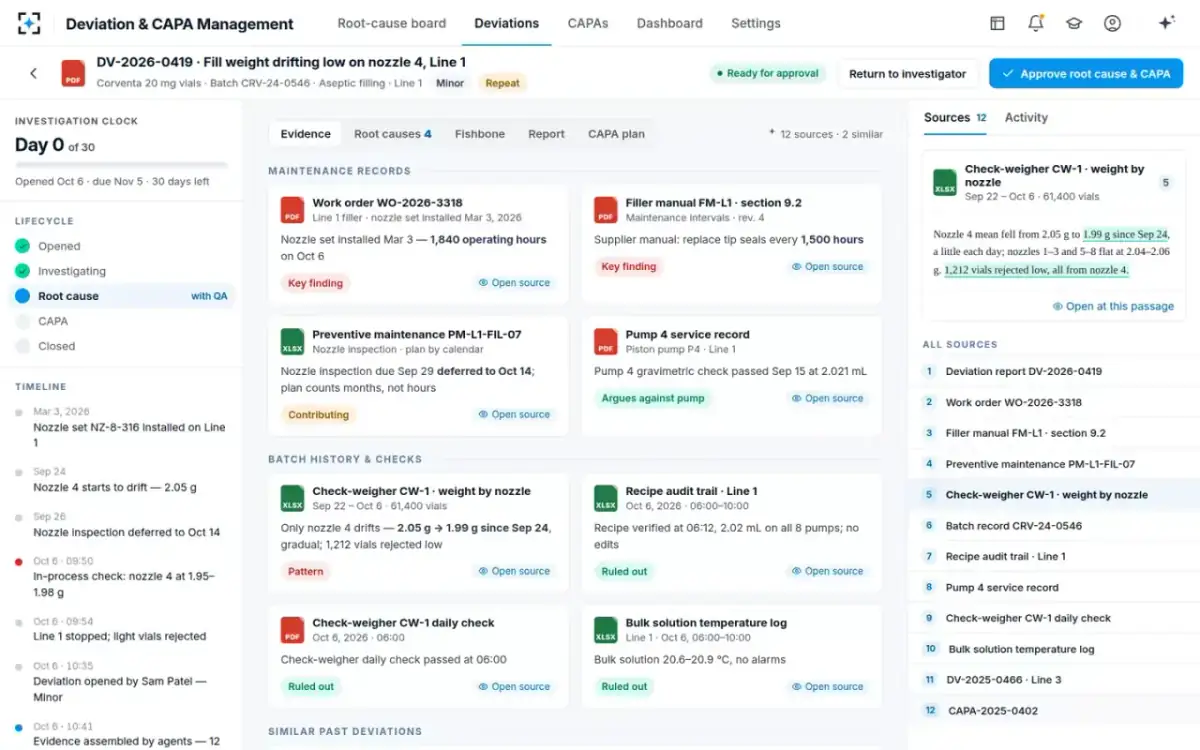
The tag that matters most on that screen is the one on the maintenance plan: contributing. The seal wore out because the plan counts months. That is the sentence a scope is built from, and it is the sentence a text search would never surface, because the 2025 deviation was titled after its symptom.
How do you trend deviations, and the difference between a trend and a repeat
A trend is a rate over time; a repeat is a relationship between two specific events. They need different reporting and prompt different work. A rising count of environmental excursions in one suite is a trend, and the response is a review of the suite. Two worn seals on the same nozzle set twenty months apart are a repeat, and the response is a scope correction on an action that already exists.
Useful deviation trending starts from categories you can act on. Counting deviations per month tells you how busy the quality unit is. Counting them by assigned root-cause category, by equipment class and by area tells you where to put engineering money. The sample plant's board carries both: 486 approved root causes over twelve months, split method and procedure 34%, machine and equipment 22%, people 18%, material 11%, measurement 9% and environment 6% — with people down from 41% two years earlier, because the analyst now accepts human error only with the process reason behind it. Whether that last number is a real improvement or a change in labelling is a question worth asking of any such chart, including this one; the answer is in the written causes, not in the bar.
Repeat deviations at the sample plant, by quarter
The chart that is worth a board slide is not the count but the count beside its cause: repeats by equipment class, with the earlier action named. A plant that reports eleven repeats and cannot say which three pieces of equipment produced seven of them is reporting a number. A plant that can is reporting a work list. Where the days inside each of those investigations actually go, and what they cost, is a separate measurement with its own arithmetic.
Who decides a deviation is a repeat, and what that decision costs if it is wrong
The quality unit decides, and in a GMP system it has to be a named person rather than a rule or a model, because calling something a repeat changes the classification, the approval path and often the product impact assessment. In the sample plant the root-cause analyst proposes and the QA lead approves; agents never move an investigation forward on their own. The flag on the screen says Repeat, and it is the approver who signs that it is one.
Both errors are expensive, in opposite directions. Calling a genuine repeat a new event hides the thing the quality system most needs to see, and leaves the earlier action standing with its scope unchallenged. Calling an unrelated event a repeat does something subtler and worse: it reopens a closed CAPA's effectiveness, invites a wider product impact review than the evidence supports, and trains investigators to argue about labels instead of mechanisms. The defence against both is the same — write the match reason down. "Same failure mode, same nozzle set, earlier action covered Line 3 only" is a decision a reviewer can disagree with. "Flagged as repeat" is not.
The scope test to run before an action is signed
- Name the cause as a thing, not as a place
A component with a life, a plan that counts the wrong unit, a procedure that permits a deferral. If the cause is written as a line number, the scope has already been decided wrongly.
- List every line, suite and product with that equipment class
Including the ones making a different product. The regulation extends the investigation to other drug products that may have been associated with the failure, and equipment does not care what is in the vial.
- Name the procedure that allowed it, and every product that procedure governs
A deferral rule, a sampling plan or a set-up instruction usually reaches further than the equipment does.
- Say in writing why each one is in or out
Annex 1 asks for the reason for including or excluding to be clearly justified and recorded. One sentence per row is enough, and it is the only thing that will still be readable in two years.
- Check the earlier CAPA on every match the search returns
Not whether it existed — whether its scope covered the line in front of you now. That is the question that turns a search result into a repeat.
- State which effectiveness measure would catch you being wrong
If the check only looks where the action looked, it cannot tell you the action was too narrow. Measure across the whole population you just named.
The action drafted against the cause, on every line that shares it
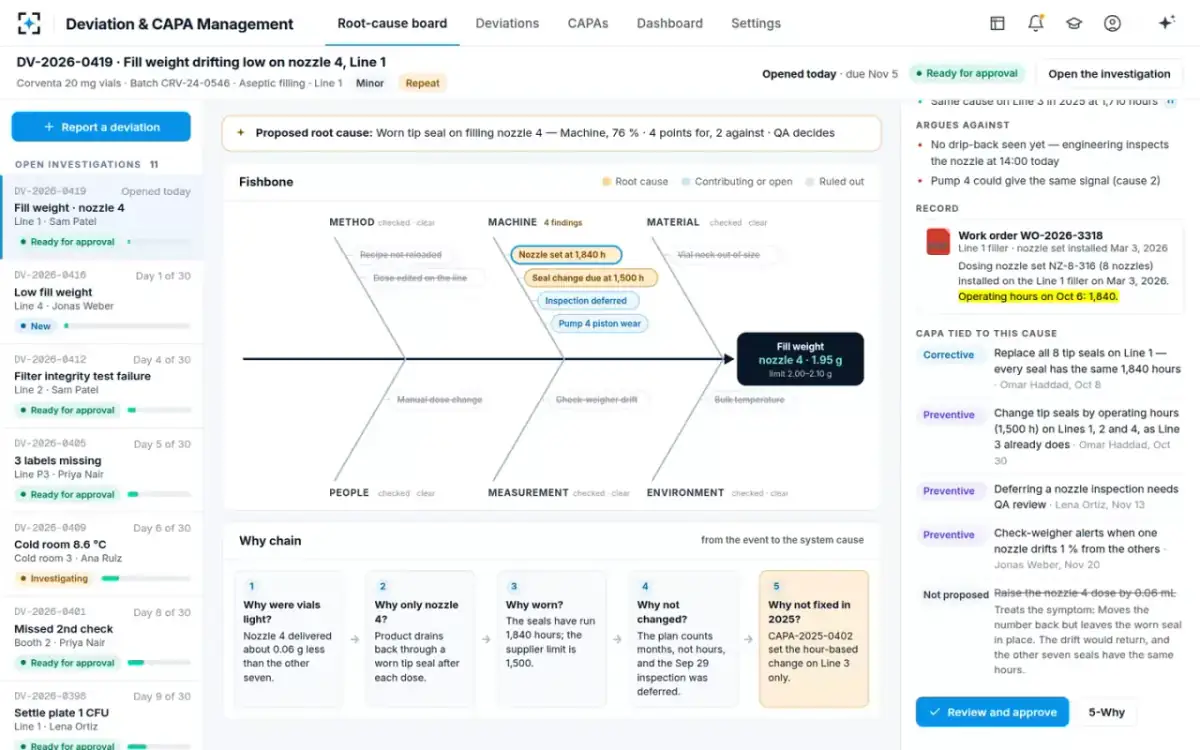
None of this is an argument for a bigger CAPA. A wide action with no mechanism behind it is worse than a narrow one, because it consumes engineering time and produces no measurable change. The argument is for a written scope test applied to a precisely named cause — and for doing it before the signature rather than after the second investigation. How that cause is named in the first place, bone by bone, is the subject of its own guide; to see the search, the scope check and the signature together, start from Deviation & CAPA Management.
Questions people ask
What is a repeat deviation threshold?
It is the number of matching events, inside the plant's defined window, at which an investigation must be escalated — typically a second occurrence of the same failure mode on the same equipment class. No CGMP regulation sets one; it is written in the plant's own procedure, and it should name the window and the matching rule as well as the count, because a threshold of two means nothing until "two of what, within how long" is defined.
Does a repeat deviation mean the earlier CAPA was not effective?
Not necessarily, and the distinction is worth preserving. An action can do exactly what it was scoped to do and still leave a repeat, because the scope was too narrow — that is a scope failure. An action that covered the right population and failed anyway is an effectiveness failure, and needs a different fix. Record which one it was; the two have different owners and different remedies.
Should a repeat reopen the earlier investigation?
Usually no. The earlier investigation is closed and its conclusions normally still stand; what needs revisiting is the action it produced. The practical approach is to open the new deviation, cite the earlier one, and raise the widened action under the new investigation while recording against the old CAPA that its scope was found insufficient. That keeps both records readable and leaves a clear trail for the next reviewer.
What is the difference between a repeat deviation and a recurring deviation?
In most quality systems they mean the same thing, and both are used for the same failure mode happening again. Where a plant distinguishes them, repeat usually means a second occurrence and recurring a continuing pattern of three or more. What matters is that the procedure defines whichever word it uses, with the matching rule and the window, so two investigators reading the same two events reach the same answer.
How do you prove to an inspector that a CAPA's scope was right?
By showing the list you made at the time: every line, product and procedure that shared the cause, each marked in or out, each exclusion with its reason. EU GMP Annex 1 §3.2 asks for exactly that for products and batches — the reason for including or excluding should be clearly justified and recorded — and the same document answers the question for equipment. A scope defended after the fact is an argument; a scope recorded before the signature is evidence.
Can a search find repeats across different products?
It has to. 21 CFR 211.192 extends the investigation to other drug products that may have been associated with the failure, and shared equipment is a common way an association crosses a product boundary. In the sample plant the second line in scope fills a different product with the same nozzle set — a match on equipment class and maintenance plan, and no match at all on product.