Human error is a valid root cause in the narrow sense that no rule forbids writing it, and rarely a sufficient one. European GMP states the test in a single clause: where human error is suspected or identified as the cause, this should be justified having taken care to ensure that process, procedural or system-based errors have not been overlooked. FDA regulations do not contain that sentence, but the agency enforces the same standard one warning letter at a time — naming human performance without identifying the specific error, without evidence that it was the sole reason, and without a design remediation is read as a failure to investigate thoroughly. The work is hard because the honest alternative takes longer and costs more than a line of retraining. Botminds' Deviation & CAPA Management will not let the conclusion stand on its own: the root-cause analyst accepts human error only with the process reason behind it, and shows what argues against the conclusion as well as what supports it.
The worked example is the solution's sample data — a fictional plant in Leiden, a nozzle filling light, and a set of actions aimed at a maintenance plan rather than at a person. The warning letters and the hierarchy of controls are real and are linked where they appear.
What is written down about human error, and what is not
1
clause of EU GMP governs whether you may write human error at all — Chapter 1 §1.4(xiv)
0
cause categories in the FDA and MHRA inspection data sets, which count deficiencies by regulatory reference rather than the causes plants wrote
5
levels in the hierarchy of controls — and retraining sits at the fourth, among the administrative controls
45–70%
the range peer-reviewed estimates give for how often an action plan from a root cause analysis is actually implemented
Is human error a valid root cause?
Yes, conditionally, and the condition is the whole of the answer. People do make slips, and an investigation that is forbidden to conclude one will produce a different fiction instead. What the rules require is that the conclusion be earned: that the specific act be identified, that the conditions around it be examined, and that the system explanations be ruled out rather than skipped. Written that way, human error is rarely the end of the chain — it is the point at which the chain turns toward the system that made the act available.
The reason to be strict is not moral. An action aimed at a person does not survive that person leaving, and the plant has bought nothing durable. An action aimed at the condition that made the act possible holds for whoever is standing there next year. That is the practical case, and it is why quality units are right to send this conclusion back.
Why is human error not a root cause on its own?
Because on its own it names an effect and calls it a cause. "The analyst misread the plate" describes what happened; it does not say why a misreading was possible, why nothing caught it, or why it had not happened before. Every one of those questions has an answer in the plant's design, and each of those answers is a thing that can be changed.
The European rule makes the demand explicit, in the same paragraph that tells you what to do when no cause can be found at all.
"Where human error is suspected or identified as the cause, this should be justified having taken care to ensure that process, procedural or system-based errors or problems have not been overlooked, if present."
EU GMP Part I, Chapter 1 §1.4(xiv), Pharmaceutical Quality System
Three words carry the weight. Justified — the conclusion needs an argument, not an assertion. Taken care — the burden is on the investigator to have looked, and a file that does not show the looking has not discharged it. Overlooked — the failure the clause anticipates is not dishonesty but convenience: the system explanation was not refuted, it was never examined.
How do you justify human error as a root cause?
By answering, on the record, the questions the clause implies. What exactly was the act, described precisely enough that somebody could repeat it? What did the procedure say at the moment it was performed, in the version then in force? Was the information the person needed in front of them when they needed it? Has anyone else done the same thing, on this line or another? What would have stopped it without depending on a person being careful? And what will show, at the end of the check window, that it is gone?
Six questions to answer before you may write human error
- What exactly was the act, and what made it available?
Not "an error during testing" but the specific action, and the design that permitted it to be taken without anything objecting.
- What did the procedure say at that moment?
In the version in force on the day. A procedure revised since is evidence about today, not about the event.
- Was the information the person needed in front of them?
A value that had to be remembered, looked up elsewhere, or converted between units is a design question wearing a person's clothes.
- Has anyone else done the same thing?
If the answer is yes, the cause is not the individual. If nobody has checked, the answer is not no.
- What would have stopped it without depending on a person?
If nothing would have, the plant has found an engineering gap whether or not a person was involved.
- What will show in ninety days that it is gone?
A criterion with a number and a data source. If the only evidence available will be that nobody reported it again, the action cannot be assessed.
What does the FDA say about human error root causes?
Not in a guidance document, but in enforcement, repeatedly and in plain words. In a 2025 warning letter the agency described an investigation that "documented human performance as the cause of the failing testing events … however, no specific human error was identified", and on a second failure in the same letter: "Although you identified the root cause as related to human error, no corrective action or training was implemented to prevent recurrence" (Warning Letter to Exela Pharma Sciences, 2 July 2025). Both findings sit under a citation of the requirement to investigate thoroughly.
The same letter is sharper still about the evidence standard. Responding to the firm's position that there was no product impact because the problem came from human error rather than the media, the agency wrote: "you did not provide in your response evidence as to how you determined human error was the sole reason for the failed tests. In addition, your responses did not identify the source of the human error, or identify any improper techniques utilized by analyst(s) during the testing." Three separate demands in two sentences — evidence that it was the sole reason, the source of the error, and the specific technique at fault.
A 2026 letter goes further and names the missing analysis directly. The agency found that a firm "did not implement effective CAPA to reduce recurrence of severe contamination hazards including, but not limited to, operator error that had contributed significantly to recurring sterility and media-fill failures over the past five years", and added: "your investigation did not include in-depth analysis of the conditions that create the circumstances for human error. It is imperative that you conduct in-depth, root-cause analysis to identify effective CAPA including design remediations" (Warning Letter to Pharmathen International, 27 May 2026). Design remediations: the agency is asking for a change to the plant, not to the people.
The same finding written two ways, and what each one leaves behind
The human-error conclusion: "Analyst error during plate reading."
The justified conclusion: "The count had to be read from a plate and keyed into a separate system by one person, with verification occurring later and with no requirement that it be contemporaneous."
The human-error conclusion: The analyst agreed that a mistake was made.
The justified conclusion: The procedure as it stood that day; what the analyst had in front of them; whether the same step had gone wrong before; whether anything in the workflow would have objected.
The human-error conclusion: Not recorded.
The justified conclusion: Recorded alongside: if the act has happened to more than one person, the individual is not the cause, and the file says so.
The human-error conclusion: Retrain the analyst. Close.
The justified conclusion: Define when and how a second person verifies, and make the verification contemporaneous; then train on the new requirement.
The human-error conclusion: That training was completed.
The justified conclusion: Discrepancies between first and second reads across the next ninety days, counted from data the laboratory already produces.
Is retraining a corrective action?
It is an action, and it sits fourth out of five in the best-known ranking of how well controls work. The hierarchy of controls, as the US National Institute for Occupational Safety and Health sets it out, "has five levels of actions to reduce or remove hazards. The preferred order of action based on general effectiveness is: Elimination; Substitution; Engineering controls; Administrative controls; Personal protective equipment (PPE)." The reason the order runs that way is stated in the same page: "Elimination, substitution, and engineering controls are more effective because they control exposures without significant human interaction" (NIOSH, Hierarchy of Controls).
Retraining is an administrative control. It changes how people are expected to work and relies on them doing it, which is precisely the dependency the failure just demonstrated. That does not make it useless — a new requirement has to be taught, and training is how — but it makes it the wrong thing to put instead of a change to the work. The peer-reviewed criticism of incident investigation says the same thing from the evidence: investigators show an "endemic tendency … to settle for administrative and perhaps 'weaker' solutions (such as reminders) rather than those that address the latent causes, such as poorly designed technology or defective operational systems" (BMJ Quality & Safety 26(5), 2017).
What should replace retraining in a CAPA?
Whatever sits higher in the hierarchy and is reachable at acceptable cost. The discipline is to start at the top and work down, writing the action that each level would imply before deciding which ones to take — because the elimination answer is often cheaper than it looks once somebody has written it down, and it is never written down if the investigation starts from training.
Five bands, and what each one would do about one worn seal
1Elimination
Remove the hazard entirely.
Replace all eight tip seals, not only the one that failed — every seal in the set has run the same 1,840 hours, so the aged part is gone from the line rather than from one nozzle.
2Substitution
Replace it with something less hazardous.
A seal specified in a material or geometry that does not degrade on this duty cycle. Not available in the sample case, and often the band with nothing in it.
3Engineering controls
Isolate people from the hazard, or make the machine catch it.
Alert when one nozzle drifts one per cent away from the others — the drift had been growing for twelve days before anybody saw it.
4Administrative controls
Change how people work: procedures, schedules, training, reminders.
Change the seal interval to operating hours on every line with the same nozzle set, and require a quality review before any nozzle inspection may be deferred.
5Personal protective equipment
Protect the individual at the point of exposure.
Nothing here on this failure. In a contamination investigation this is where gowning sits — and where an action belongs least often.
Three of the four actions in the sample case sit above the administrative line or change the work rather than the worker, and the fourth — a quality review before a deferral — is administrative but removes a discretion rather than adding an instruction. That distinction is worth keeping: an administrative control that takes away a choice is far stronger than one that asks for more care.
The most instructive item in the sample case is the action that was not proposed. Raising the nozzle 4 dose by 0.06 millilitres would have put the weights back inside the limit the same afternoon. It is shown struck out, with its reason: it moves the number back but leaves the worn seal in place, the drift would return, and the other seven seals have the same hours. A symptom fix and a training fix fail in the same way, and for the same reason — neither touches the thing that produced the failure.
The actions aimed at the cause, and the one struck out with its reason
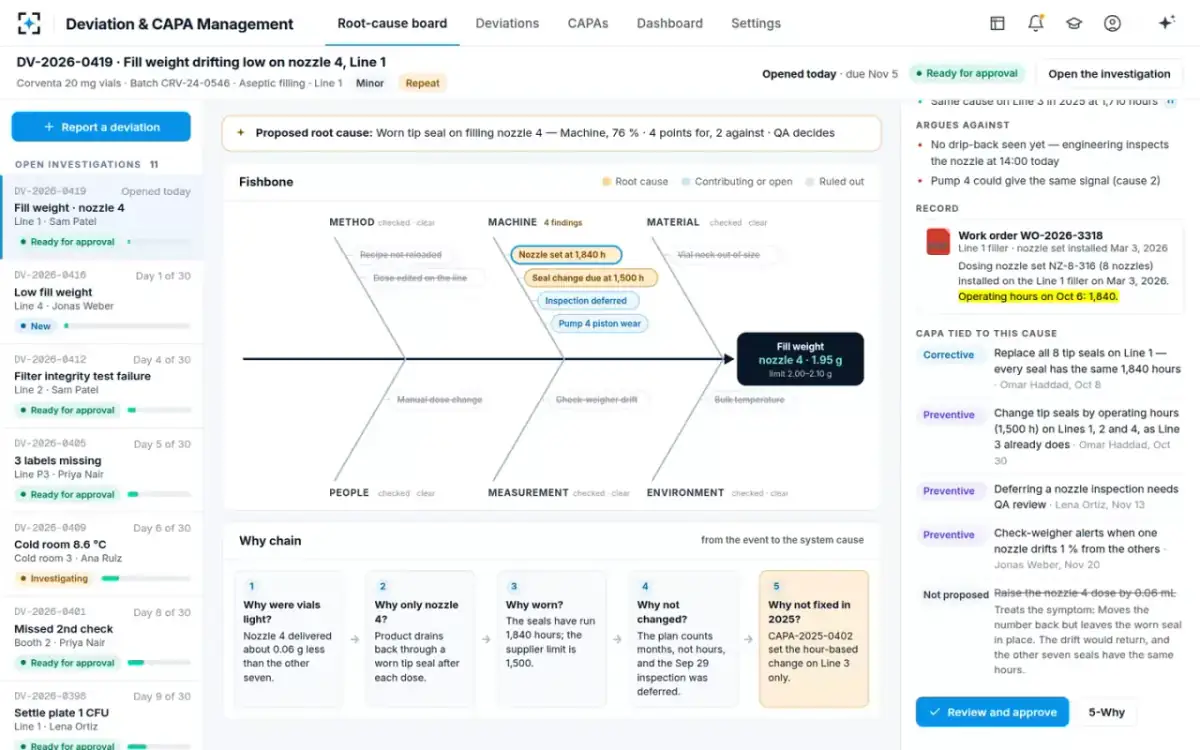
The hierarchy that ranks a fix, from elimination to a reminder
Using the hierarchy well means arguing about where an action sits, not just listing it. Three tests settle most disagreements. Does the action still work if nobody remembers it exists? Elimination and engineering controls pass; procedures and training do not. Does it change what is physically possible, or only what is expected? And would it have prevented this event, run forward from the day the condition started rather than from the day it was noticed?
The third test catches a common sleight of hand. An alert that fires when one nozzle drifts a per cent from the others would have caught the sample failure around 28 September, eight days before the in-process check did. A procedure asking operators to watch for drift would have caught it whenever somebody happened to look. The two actions read almost the same on a plan and are not remotely the same control.
The conditions that create the circumstances for human error
That phrase is the FDA's, and it is a better description of what an investigation should look for than root cause is. The conditions are mundane and familiar: information that has to be carried from one place to another by memory; a step that can be performed out of order without anything objecting; two similar items stored together; a reading that must be converted between units; a verification that happens hours later and by the same person; a schedule that can be deferred by one person's decision; and the plain one, a shift that has been short-staffed for a month.
None of those is a person being careless, and every one of them is a thing a plant can change. The sample case has one of its own, and it is the kind nobody files under human factors: a maintenance plan that counts calendar months while the supplier specifies operating hours. Nobody made an error. The system was built to ask the wrong question, and the person who deferred the September inspection was permitted to do it alone. The chain down to that answer is the same why chain as any other — it just has to be allowed to run past the operator.
What a human factors root cause analysis asks instead
It asks about the design of the work rather than the state of the worker, and it changes the first question from "who did it" to "what made that the natural thing to do". The practical difference shows up in what the investigator goes to look at: the screen the person was reading, the order the steps appear in on the form, the distance between the record and the equipment, what the system does when a value is out of range, and whether anything other than attention was standing between the act and the product.
It also asks the investigator to be suspicious of their own certainty. ICH Q9 warns that subjectivity enters a risk judgement through "differences in how risks are assessed and in how hazards, harms and risks are perceived by different stakeholders" (ICH Q9(R1) §5.3), and the human-error conclusion is where that bias is cheapest to indulge: it is quick, it is locally plausible, and nobody in the room is harmed by it except the person named. Showing the evidence against a conclusion is the cheapest discipline available, which is why the solution requires it on every candidate cause rather than only on this one.
Evidence against each candidate, shown beside the evidence for it
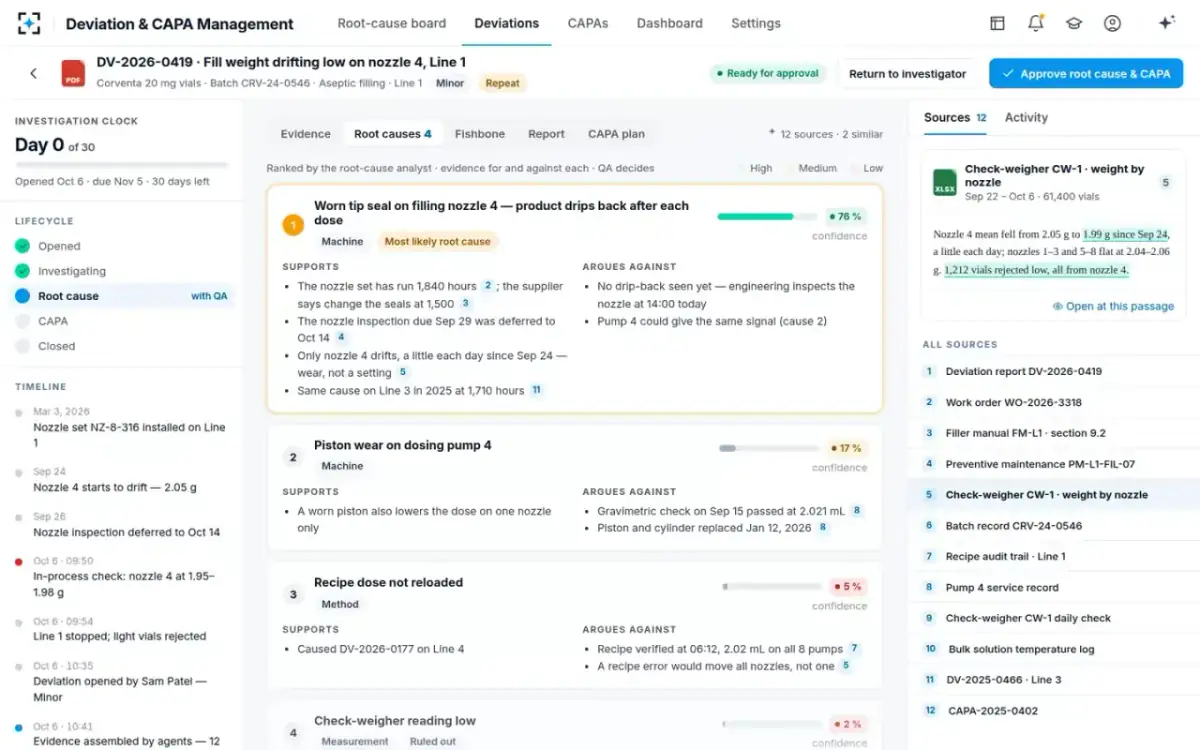
To see a cause chain that ends on a maintenance plan rather than on an operator, start from Deviation & CAPA Management, or read how to write a check that could have failed.
Questions people ask
What percentage of deviations are blamed on human error?
Regulators do not publish one. What inspectorates publish is the frequency of deficiencies by regulatory reference, not a breakdown of the causes plants wrote. The useful measure is your own: count the share of your closed investigations whose stated cause is a person and whose only action is training, and track whether those cases recur more often than the rest.
Can an investigation ever conclude with human error alone?
In principle, where the act is specific, the conditions have been examined, the system explanations have been refuted rather than skipped, and the file shows all three. In practice it is rare, because the question "what would have stopped this without depending on a person" usually has an answer, and once it does the answer belongs in the plan whether or not the person also made a mistake.
Is "failure to follow procedure" a root cause?
No, it is a restatement of the deviation. The investigative question is why the procedure was not followed: whether it was wrong, unworkable at the pace of the line, ambiguous at the step in question, superseded by a local practice everyone used, or simply not available where the work was done. Each of those is a different cause with a different remedy, and the phrase hides all of them.
Does naming a system cause mean nobody is accountable?
It separates two things that should be separate. An investigation's job is to find what to change so the failure cannot recur; performance management is a different process with different evidence and different rules. Mixing them damages both — investigations that can end a career produce accounts written for self-protection, which is the fastest way to lose the facts.
Does training ever belong in a CAPA?
Yes, as the companion to a change rather than as a substitute for one. If the action alters a procedure, an interval or a verification step, the people doing the work have to be told, and recording that is proper. The warning sign is a plan whose only item is training, or one where the training is listed as corrective and nothing is listed as preventive.
How do you measure whether a human-factors fix worked?
By counting the thing the fix was supposed to change, from data that already exists and is not produced by the people being assessed. In the sample case the criterion is that no single nozzle drifts more than one per cent on any of four lines over the next ninety days, read from the check-weigher data that found the original problem. A criterion of "no recurrence observed" measures how closely anyone was watching.