Under 21 CFR 211.22, a drug manufacturer's quality unit has the responsibility and authority to approve or reject materials and products, and "the authority to review production records to assure that no errors have occurred or, if errors have occurred, that they have been fully investigated". For a deviation that means the quality unit must review and approve the investigation, its conclusion and the corrective and preventive action. The investigating itself can sit with production, engineering or the laboratory, provided the roles are written down and kept apart. The hard part for a head of quality is not the rule but the staffing: investigations are usually run by people with other jobs, most of their time goes on pulling records, and the duty to check other batches and lines falls between the seats. Botminds' Deviation & CAPA Management gathers the evidence, proposes causes and actions, and keeps every approval, extension and effectiveness verdict with a named person.
The guide is for heads of quality, QA leads and site leadership who design the deviation procedure and answer for it at inspection. The rules are quoted from 21 CFR Parts 211 and 11 and EU GMP Chapter 1; the worked example is a fictional plant in Leiden from the solution's sample data.
What the regulation assigns, and what it leaves to the plant
211.22
gives the quality unit authority to assure errors have been fully investigated, and requires its responsibilities in writing
211.192
extends every investigation to other batches and other products that may share the failure
30days
a common plant target to close an investigation, set in the plant’s own procedure rather than in the regulation
What are the quality unit's responsibilities under 21 CFR 211.22?
Four duties, and the last is the one most often cited at inspection: to approve or reject components, containers, in-process materials, labelling and drug products; to review production records and assure errors have been fully investigated; to approve or reject procedures and specifications affecting identity, strength, quality and purity; and to have "the responsibilities and procedures applicable to the quality control unit" in writing, with those procedures followed (21 CFR 211.22).
The CGMP sections that shape a deviation procedure, and what each asks of the quality unit
| Section | What it says | What it means for a deviation |
|---|---|---|
| 211.100(b) | “Any deviation from the written procedures shall be recorded and justified.” | Every departure is recorded at the time, not reconstructed. |
| 211.192 | Unexplained discrepancies and failures “shall be thoroughly investigated, whether or not the batch has already been distributed”, with a written record including “the conclusions and followup”. | The investigation reaches other batches and products, and its follow-up is part of the record. |
| 211.22(a) | Authority to review production records to assure errors “have been fully investigated”. | The quality unit judges whether an investigation is complete, and can send it back. |
| 211.22(d) | Quality unit responsibilities and procedures “shall be in writing”. | Who investigates, approves, extends and rates effectiveness is written in the procedure. |
| 211.25(c) | “An adequate number of qualified personnel” to perform and supervise each operation. | Investigation capacity is a staffing obligation, not goodwill. |
| 11.50 | A signed electronic record shows the printed name, date and time, and the meaning of the signature. | Each approval states what the signer attests. |
Read together, the sections describe a quality unit that owns the standard and the verdict, not necessarily the labour. The unit's job is to assure; nothing in 211.22 requires its own staff to pull every run log. What the rule does require is that the unit can see what was done, judge whether it was enough, and refuse it if not. A unit that signs whatever arrives has given away the only authority the regulation gave it.
Who investigates, who approves: separating the roles in Deviation & CAPA Management
A sound procedure separates at least three roles: the investigator who gathers evidence and proposes a cause, the quality unit approver who accepts or rejects the cause and the CAPA plan, and a different person who later rates whether the CAPA worked. Plants add a fourth for Critical cases and extensions, usually the head of quality.
Five seats one deviation passes through on the sample plant, and what each keeps
Today
Runs two filling lines and owns most of their investigations on top, losing days pulling logs.
With agents
Reports in one sentence and spends the time on what only he knows: what happened on the floor.
Still theirs: The account of the event, and the investigation he leads.
Today
Learns about a fix on another line when his own breaks.
With agents
Gets actions scoped to every line with the same equipment, each with owner, date and check.
Still theirs: Whether the engineering fix is right, and when it can be done.
Today
Reviews six to ten investigations a week, most built from records pulled by hand.
With agents
Opens each cause with the records for and against it attached.
Still theirs: Approval of the root cause and CAPA plan, and the decision to send a file back.
Today
Runs effectiveness checks long after the detail has gone cold.
With agents
Rates each action from a list that shows its origin and when its check falls due.
Still theirs: The verdict on whether a CAPA held.
Today
Approves Critical cases and every extension, often on a request written the day before the clock runs out.
With agents
Receives extension requests drafted at day 25 with the reason, work left and a new date.
Still theirs: Critical classifications, extensions and the shape of the programme.
EU GMP states the organising principle in one line: a pharmaceutical quality system should ensure that "managerial responsibilities are clearly specified" (EU GMP Chapter 1, 1.4(v)). In US terms, 211.22(d) makes the same demand of the procedure. The test an inspector applies is simple: for any closed deviation, can the plant show who investigated, who approved, on what evidence, and who later confirmed the fix worked?
Can the same person investigate and approve a deviation?
Not in a well-written procedure. 211.22(a) gives the quality unit authority to review records "to assure" that errors have been fully investigated, which presupposes a reviewer who is not the author; an investigator who approves their own conclusion has reviewed nothing. Most plants also keep the effectiveness verdict away from both, because the person who designed a fix is the person least able to see that it did not hold.
Small sites find this hard, because the same few people do everything. The workable answer is to separate by case rather than by headcount: the supervisor who investigates a Line 2 event does not approve it, and the QA lead who approves it does not rate its CAPA. Where a site truly cannot separate roles, the procedure should say so and name the compensating control, such as review by another site's quality unit. The quality unit's independence from production is about decision rights, and a procedure that writes those rights down is what makes it visible.
The duty that falls between the seats: other batches, other lines
211.192 requires that an investigation "shall extend to other batches of the same drug product and other drug products that may have been associated with the specific failure or discrepancy" (21 CFR 211.192). It is the requirement most likely to be missed, because nobody's role is scoped to it: the investigator looks at one batch, the approver reviews one file, and the engineer owns one line.
The consequence shows up as repeat deviations. A worn seal fixed on Line 3 returns on Line 1 a quarter later because the CAPA was scoped to the line that failed rather than to every line with the same equipment. A head of quality should assign the extension explicitly (usually to the approver, the one seat that sees across files) and should give that seat a way to search closed deviations and CAPAs by failure mode and equipment class. Why the same failure returns elsewhere, and how to scope a CAPA so it does not, is set out in repeat deviations.
What the approver must refuse: human error without a process reason
The approver's most important power is the power to send an investigation back, and the clearest case for using it is a conclusion of human error. EU GMP is explicit: "Where human error is suspected or identified as the cause, this should be justified having taken care to ensure that process, procedural or system based errors or problems have not been overlooked, if present" (EU GMP Chapter 1, 1.4(xiv)).
“An appropriate level of root cause analysis should be applied during the investigation of deviations, suspected product defects and other problems. … In cases where the true root cause(s) of the issue cannot be determined, consideration should be given to identifying the most likely root cause(s) and to addressing those.”
EU GMP, Volume 4, Chapter 1, 1.4(xiv)
"Retraining" as the only CAPA is the usual symptom. It closes the file and changes nothing about the procedure, the equipment or the review step that let the error through. An approver who accepts it is approving a CAPA that cannot be shown effective, because there is nothing to measure. What GMP makes an investigator prove before human error can stand is the subject of is human error a root cause.
CAPA effectiveness: the third signature
The last role in the chain is the one most often merged with another. EU GMP requires that CAPAs "should be identified and taken in response to investigations" and that "the effectiveness of such actions should be monitored and assessed, in line with Quality Risk Management principles". Someone has to decide, at the end of a defined window, whether the action held, and that person should be neither the investigator nor the approver.
On the sample plant the effectiveness verdict belongs to the microbiology lead by setting, separate from the QA lead who approved the plan. The check is written when the CAPA is approved, as a measurable criterion over a defined window (for example, no single-nozzle drift above 1% on Lines 1 to 4 in the next 90 days), so the third signature attests a number rather than an impression. How to write those criteria is covered in CAPA effectiveness criteria.
Signatures that attest something: 21 CFR 11.50
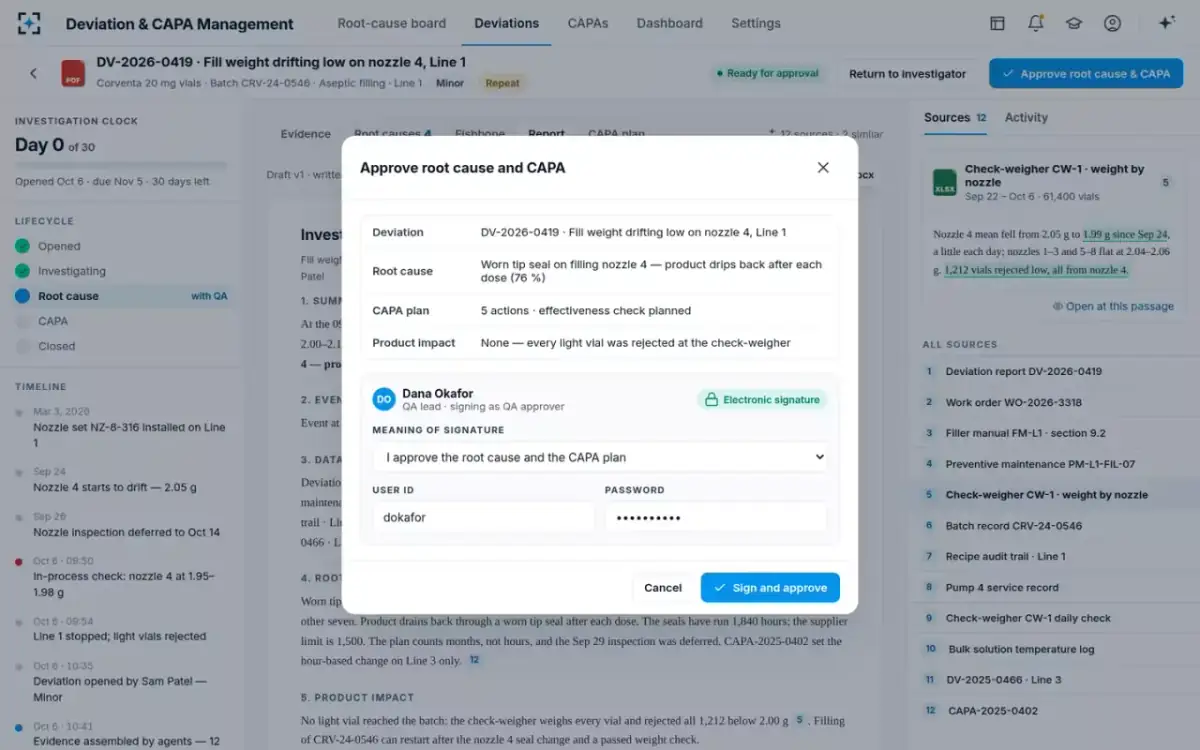
Three separate signatures (approval of cause and plan, confirmation of implementation, and the effectiveness verdict) each attest a different thing, and Part 11 specifies what an electronic signature must show for that to be clear.
What must sit beside each electronic signature on a deviation or CAPA
- The printed name of the signer.
Not an initial or a user ID alone; a reader years later must be able to name the person.
- The date and time the signature was executed.
The moment of signing, which shows whether approval came before or after the batch moved.
- The meaning of the signature.
Review, approval, responsibility or authorship are the rule’s own examples; one person may sign twice with two meanings.
Root cause, CAPA plan and product effect on one screen, signed with a stated meaning
Staffing the roles: where investigation time actually goes
211.25(c) requires "an adequate number of qualified personnel", and investigation capacity is where many plants fall short, not because investigators reason slowly but because most of an investigation's days go on retrieval. On the solution's estimate for a typical Minor or Major deviation at the sample plant, nearly a third of the elapsed time goes on pulling batch, equipment, maintenance and room records, and a tenth on searching for whether it has happened before.
One investigation's elapsed days, by kind of work
By hand, about 19 days (estimate)
- Report and classify · 5%
- Pull the records · 32%
- Search past cases · 10%
- Reason about cause · 26%
- Write it up · 16%
- Review and sign · 11%
With the solution, about 5 days (estimate)
- Report · 2%
- Records · 10%
- Past cases · 8%
- Reason about cause · 40%
- Write it up · 20%
- Review and sign · 20%
The staffing implication is that adding investigators to a retrieval problem buys less than removing the retrieval. The judgement bands (reasoning about cause, and review and sign) barely shrink, and should not. What a head of quality can change is how much of each investigator's month goes on finding documents rather than on the questions only a person close to the process can answer. Where the rest of the closure time goes, and what each day costs, is set out in deviation closure time.
What the head of quality reports to management review
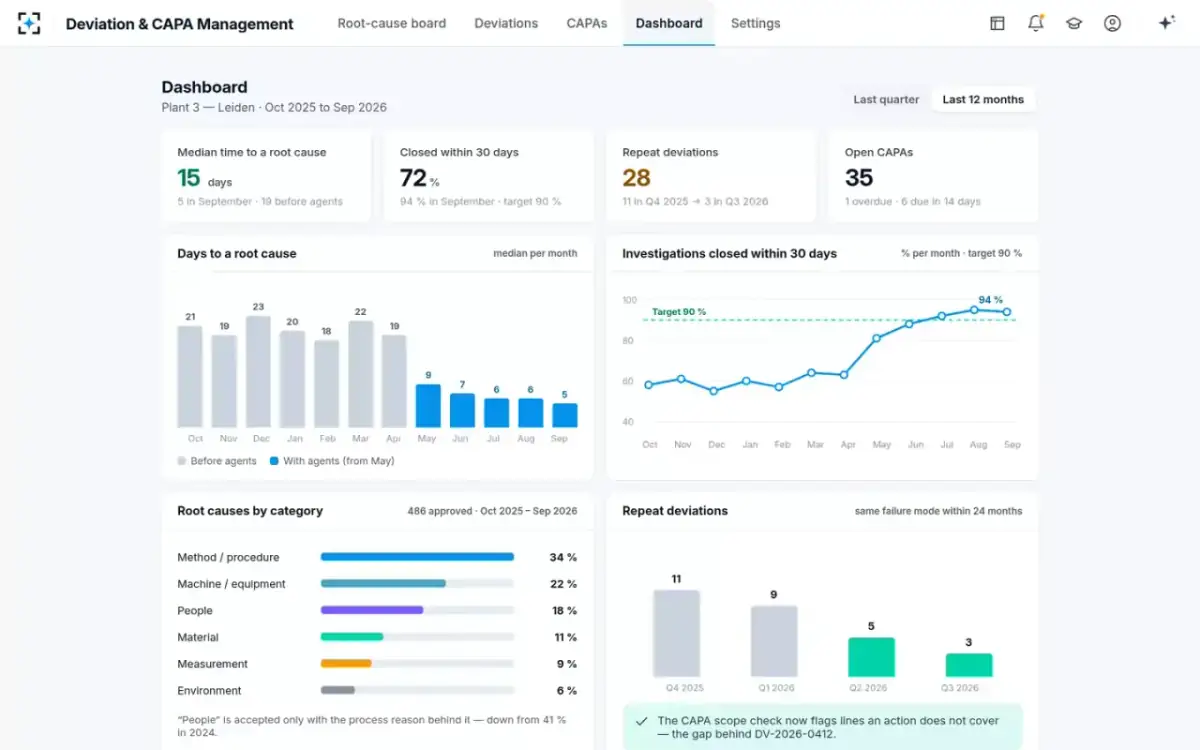
EU GMP calls for "periodic management review, with the involvement of senior management, of the operation of the Pharmaceutical Quality System" (Chapter 1, 1.6). For deviations and CAPAs, five numbers carry most of the signal: median days to an approved root cause, the share closed within the plant's target, extensions granted and why, repeat deviations by area and failure mode, and CAPA effectiveness at first check.
Each of those numbers maps to a role. Days to root cause measures the investigators and the evidence they work from; closure within target and extensions measure the approver and the head of quality; repeats measure whether the 211.192 extension is being done; effectiveness at first check measures whether approvers are accepting CAPAs that can work. A review that sees them by role can fix the right seat.
Root causes by category, closure within target and repeats by area
Where Deviation & CAPA Management fits in the quality unit's work
Deviation & CAPA Management takes the retrieval off the investigator. When a deviation is reported, its agents propose a class from the plant's own rules and start the clock, read the batch record, equipment, maintenance and environmental records for the event window, search 36 months of closed deviations and CAPAs for the same failure mode, fill the fishbone with evidence for and against each cause, check that every CAPA is scoped across all lines with the same equipment, and draft the report in the plant's template with every claim cited. Owners are warned at day 20, and an extension request is drafted at day 25.
It does not approve, extend or close anything. It never writes to a GMP record, never accepts human error without the process reason behind it, never confirms its own classification and never extends a clock. The approver, the head of quality and the effectiveness reviewer are named settings, and every signature carries its printed name, time and meaning. For the quality unit that means the authority 211.22 gives it is exercised on evidence it can audit in minutes rather than re-derive.
Questions people ask
What are the FDA quality unit responsibilities?
Under 21 CFR 211.22 the quality unit approves or rejects components, containers, in-process materials, labelling and drug products, approves or rejects procedures and specifications, and reviews production records to assure that errors have been fully investigated. Its responsibilities and procedures must be in writing and followed.
Does the quality unit have to perform every deviation investigation?
No. It must review and approve them, which is what 211.22(a) gives it authority to do, but the investigation can be conducted by production, engineering or the laboratory. What matters is that the roles are written into the procedure and that the quality unit can see the evidence and send the investigation back.
Who approves a CAPA in a GMP plant?
A named member of the quality unit, usually the QA lead, approves the root cause and CAPA plan; Critical cases and extensions often go to the head of quality. Action owners confirm implementation, and a different person rates effectiveness at the end of a defined check window, as EU GMP Chapter 1 expects effectiveness to be monitored and assessed.
Must a deviation investigation cover other batches?
Yes. 21 CFR 211.192 requires the investigation to extend to other batches of the same drug product and to other drug products that may have been associated with the failure or discrepancy, whether or not the batch was distributed. A written record must include the conclusions and follow-up.
What should a deviation SOP say about roles and responsibilities?
Who reports, who classifies, who investigates, who assesses product effect, who approves the root cause and CAPA plan, who may grant an extension, who rates effectiveness, and how the investigator and approver are kept separate. 211.22(d) requires the quality unit's responsibilities and procedures in writing, and EU GMP asks that managerial responsibilities be clearly specified.
How many deviations can one investigator handle?
There is no regulatory figure, and another plant's number describes that plant. Measure open files per investigator and hours per closed file by class. On the solution's estimate, about 40% of an investigation's elapsed days go on pulling records and searching past cases, so capacity depends heavily on how retrieval is done.