Deviation management software is the system a GMP plant uses to take an event from the moment it is reported to an approved root cause, a product impact decision and a CAPA plan with owners, due dates and effectiveness checks. Much of it is built around the same four capabilities — a form to report on, a workflow to route it, a clock to measure it, and an audit trail to prove nobody edited it quietly. Those four are necessary and none of them touches the part that actually takes the time, which is assembling and reading the records the investigation runs on. Botminds' Deviation & CAPA Management is built for that part: five specialist agents read the batch, equipment, maintenance and environmental records, search the plant's own closed cases by failure mode, and draft the report with a citation on every claim — while a named QA person decides and signs.
This guide is written for a selection, and it includes the places this solution does not reach. The screens and figures describing the sample plant are from a demonstration on sample data; the citation counts are ours, computed from FDA's own published spreadsheets.
Three numbers to hold in mind during a selection
164
FDA drug citations in FY2025 for failing to thoroughly review a discrepancy or failure — the single largest citation under the investigation clause
6
classes of record a deviation investigation actually runs on, usually in six different systems
0
CGMP sections that require a computerised system for any of this
What is deviation management software, and what it is not
It is a record system with a workflow on top. It holds the event, carries it through classification, investigation, approval and closure, keeps the dates, and keeps a trail of who did what. 21 CFR 211.100(b) is the regulation underneath it: production and process control procedures "shall be followed… and shall be documented at the time of performance. Any deviation from the written procedures shall be recorded and justified" (21 CFR 211.100). Recorded and justified is the whole job description, and software is one way of doing it.
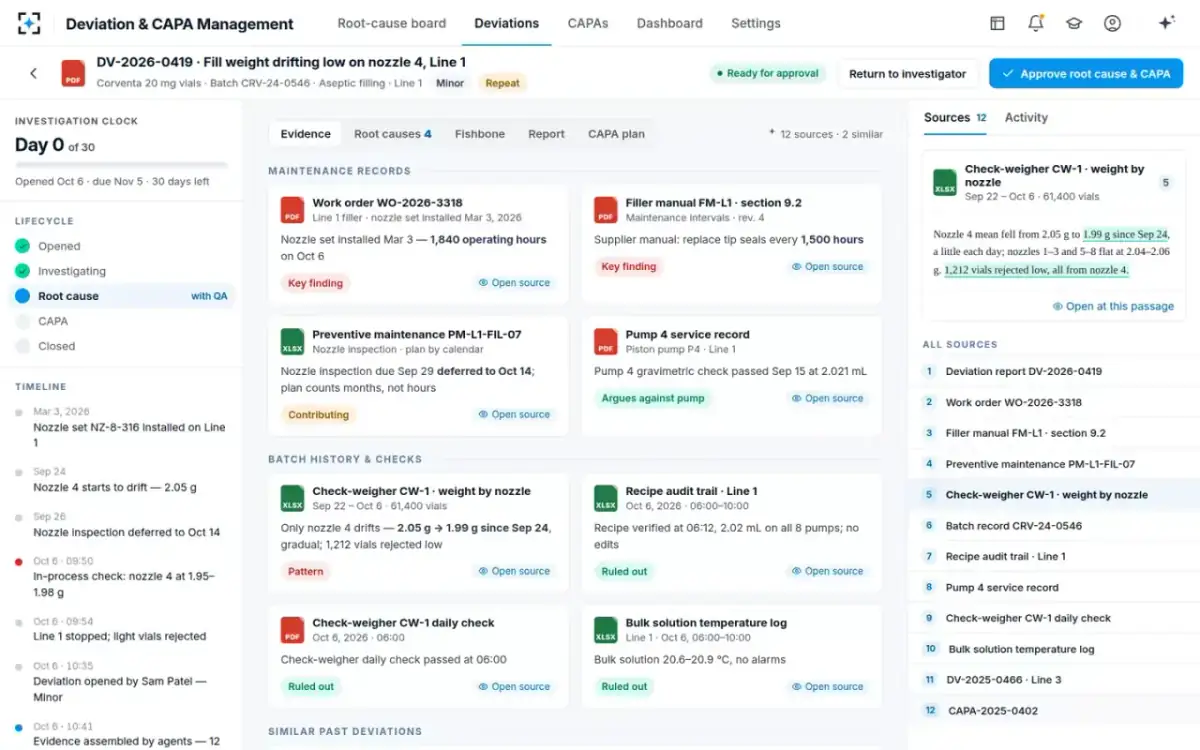
What it is not, in most implementations, is an investigation tool. The system knows the deviation number, the owner, the stage and the clock. It does not know that work order WO-2026-3318 says the nozzle set has run 1,840 operating hours, that the supplier's manual sets the interval at 1,500, or that a nozzle inspection was deferred in September. Those live in a maintenance system, a PDF on a shared drive and a preventive maintenance plan, and a person goes and gets them.
It is also not a quality management system, though it is often sold inside one. Document control, training records, change control, supplier management, complaints and audits are separate disciplines with their own regulations, and a plant usually has them before it has a deviation problem. Confusing the two makes selections go wrong in a particular way: the evaluation turns into a comparison of module lists, and nobody asks the only question that changes an investigator's week.
What should deviation management software do beyond routing a form?
It should read. Specifically, it should reach the records an investigation runs on, quote them at the level of the passage rather than the document, search the plant's own history by failure mode, test a proposed action's scope against the rest of the plant, and hold an effectiveness criterion that is a measurement rather than a date.
That list is not arbitrary. It is the set of things that fill the days an investigation actually spends, which is why a plant that buys a better form sees its closure time unchanged and concludes that software does not help. FDA's own inspection programme states the standard against which all of it is judged, and it is worth putting on a slide in any selection meeting:
Discrepancy and failure investigations: Documented; investigated in a timely manner using scientific evidence to identify the root cause; corrective actions and preventive actions (CAPAs) are included and effectiveness of the CAPAs is evaluated
FDA Compliance Program 7356.002, Drug Manufacturing Inspections, Part III — Quality System
Read that as a specification and check each clause against the product in front of you. Documented — every system does this. Timely — a clock measures it but does not produce it. Using scientific evidence to identify the root cause — this is the clause a routing tool cannot address, because evidence lives in other systems. Effectiveness of the CAPAs is evaluated — ask whether the product holds a measurable criterion with a window, or a due date and a tick box.
A routing tool and an investigation tool, clause by clause
A routing tool: What somebody typed into its own form, plus attachments.
An investigation tool: The batch, equipment, maintenance, utility and environmental records for the window around the event, in the systems they live in.
A routing tool: Status changes, comments and dates.
An investigation tool: A drafted investigation report in the plant’s template, marked a draft until a QA person signs it.
A routing tool: Attachment names.
An investigation tool: The passage behind each fact, opened in the record itself — twelve numbered sources on the sample case.
A routing tool: Text across past deviation titles and descriptions.
An investigation tool: Closed deviations and CAPAs by failure mode, equipment class and product, with a score and the reason for it.
A routing tool: Nothing. The scope is whatever the author typed.
An investigation tool: Every line sharing the equipment class that a proposed action does not cover, flagged before approval.
A routing tool: A due date and a reviewer.
An investigation tool: A criterion with a measure and a window — no single-nozzle drift above 1% on four lines for 90 days — and a named rater.
A routing tool: A complete file, on time, with a cause and an action.
An investigation tool: The same file, plus the evidence for and against each candidate cause and the scope decision written down.
What is the difference between a QMS and deviation management software?
A quality management system is the whole apparatus — documents, training, change control, suppliers, complaints, audits, deviations and CAPAs — and in ICH Q10's terms the CAPA system is one element within it, with the instruction that investigations follow a structured approach aimed at finding the root cause, with the effort commensurate with risk (ICH Q10 §3.2.2). Deviation management software is either one module of such a suite or a dedicated product that sits beside one.
The practical difference in a selection is which problem you are solving. If the plant has no system of record at all — deviations on paper, actions in a spreadsheet — the first purchase is a quality management system, and the module list matters. If the plant already has one and the complaint is that investigations are slow, shallow or repetitive, buying a second system of record solves nothing: the records are in the same six places they were before.
There is a third option that selections often miss, which is to leave the system of record where it is and add the reading. That is a narrower purchase, a smaller validation and a faster answer, and it is the honest place for a tool like this one. Ask any vendor whether their product can be the second thing rather than insisting on being the first.
The eight questions that separate a workflow from an investigation
Put these to every vendor, in writing, and keep the answers. Each has a right answer, and a wrong answer that is usually given in a particular form.
Eight questions, and the answer that should worry you
- Which of our record systems can it actually read, today, without an export?
The worrying answer is a list of connectors "available on the roadmap" or an offer to accept uploaded files. Ask which six systems, named, and who builds each connection.
- Does every fact it shows carry the passage it came from?
The worrying answer is a document name or a confidence score with no source. Ask to click through from a claim to the highlighted line in the record.
- Does it search our closed cases by failure mode, or by text?
The worrying answer is "full-text search across all deviations". Nobody writes the same title twice; a text search finds the cases you would have found anyway.
- Does it test a proposed action against every line with the same equipment?
The worrying answer is that scope is a free-text field. Ask what the system does when an action covers one of four identical lines.
- Does it hold an effectiveness criterion, or a date?
The worrying answer is a reminder on the due date. Ask to see a criterion with a measure, a threshold and a window, and who is named to rate it.
- Does it show evidence against a proposed cause as well as for it?
The worrying answer is a ranked list with no counter-evidence. An investigation that only argues one way is the one that produces human error as a cause.
- What can it do without a named person, and what can it never do?
The worrying answer is a vague assurance about oversight. Ask for the list of prohibitions, and check they are in the product rather than in the contract.
- What does it leave on the trail for each step, human and automated?
The worrying answer is that the audit trail covers "all changes". Ask what a reviewer of a two-year-old investigation can reconstruct from it.
One question deliberately not on that list is whether the product uses AI, because the answer carries almost no information. What matters is which outputs become decisions and who is named for each one; the draft European annex on AI under GMP is explicit that, during testing, models used in critical applications should capture the features that drove a classification, and that the model, the system and the process go under change control before deployment (draft EU GMP Annex 22 §8.1, §10.1, a consultation text not in force). What that draft permits and refuses is worth reading before any vendor meeting on the subject.
Can deviation management software find a root cause?
It can assemble the evidence, propose ranked candidates with what argues for and against each, and show the chain of reasoning. It cannot determine a root cause, and a product that claims to should be disqualified on that sentence alone, because the determination is a quality unit decision with product consequences attached to it.
The useful version is narrower and more valuable than the claim. In the sample investigation the evidence gatherer reads twelve sources for a single fill-weight deviation and cites each one: the work order with the operating hours, the supplier manual section with the replacement interval, the preventive maintenance plan showing the deferred inspection, the check-weigher data showing that only one nozzle of eight drifts, the recipe audit trail that rules out a recipe error, and the room temperature log that rules out the environment. The analyst then proposes a worn tip seal at 76% and lists what argues against it — no drip-back seen yet, and a pump that could give the same signal.
That is a case a QA lead can test in ten minutes rather than reconstruct in two days, and it is also the form that survives an inspection, because every statement in it has a record behind it. How the analysis itself is built, bone by bone is the subject of a separate guide.
Twelve sources for one deviation, each fact linked to its passage
Does deviation management software need validation?
Yes, if it holds or affects GMP records, and the requirement is older and plainer than any guidance on new technology. 21 CFR 11.10(a) requires systems to be validated for accuracy, reliability and consistent intended performance, and for the ability to detect invalid or altered records, and 11.10(e) requires secure, computer-generated, time-stamped audit trails in which a change to a record may never hide what was recorded before it (21 CFR 11.10).
Two practical consequences follow for a selection. The first is that validation effort is part of the price and belongs in the comparison: a system that reads from six other systems has more interfaces to qualify than one that holds a form, and a vendor who cannot describe what they supply towards qualification is adding months to your project without saying so. The second is that the validation question has an AI-specific layer if any model output is relied on — the intended use statement, the acceptance criteria measured against your own baseline, and the change control over the model as well as the system.
Ask for the supplier's own qualification documentation, the list of what they test and what you must, and what happens to your qualified state when they release. Ask it early; the answers can vary a great deal between vendors.
What the records have to reach before any of this works
The constraint on every product in this category is the same, and it is not in the product. An investigation runs on six classes of record, each in a different system, each with its own access rules and its own owner. What a tool can do is bounded entirely by which of those it can reach and at what granularity.
The six records a deviation investigation runs on, and what to ask about each
01
Deviation reports
What happened, where and when, and the immediate actions taken on the floor.
Can it read the free text, or only the structured fields somebody remembered to fill in?
02
Batch records
Electronic batch record steps and the in-process checks around the event window.
Can it reach a single step and quote it, or does it attach the whole 400-page batch record as a file?
03
Equipment and process data
Run logs, check-weigher and inspection data, recipe audit trails, calibration checks.
Can it read a time window across several instruments, or does an engineer export a spreadsheet by hand?
04
Maintenance
Work orders, preventive maintenance plans, supplier manuals.
This is where the cause usually is. Ask whether it reads the supplier manual as well as the work order.
05
Environmental and utility logs
Room, product and utility temperatures, pressures and alarms.
Can it say that nothing alarmed, and show the data behind the negative as well as the positive?
06
Past deviations and CAPAs
Closed investigations and their actions, searched by failure mode rather than by text.
Does it check whether an earlier action covered the line in front of you, or only that a similar case exists?
The honest implication is that this is the real work of an implementation, and the reason timelines slip. Connecting the maintenance system is often the hardest and the most valuable, because the machine bone of the fishbone is where the causes that produce repeats actually live. A plant that can connect only the deviation system and the batch record should say so and set its expectations accordingly, rather than buying a tool whose best capability it cannot feed.
How do you migrate open deviations to a new system?
Migrate three different things, with three different standards. The following is practical judgement from how these projects run rather than a regulatory requirement, and a plant's own validation lead should set the rules.
Open investigations are the hard case, because each one has a live clock, an owner, partially completed analysis and possibly a batch on hold. The safest approach is to let the open ones finish in the old system and start the new one with new events, accepting a few months of two systems. Where that is impossible, migrate the open items with their original open dates so no clock is reset by the move, and record the migration itself as a change under change control.
Closed cases are the valuable migration and the one easiest to skip. They are the search corpus: without them the new system cannot tell you that this failure has happened before, which is the capability you bought. They can be migrated with much less fidelity than an open case needs — the event, the failure mode, the equipment, the approved cause, the actions and the dates are usually enough to make a case findable. Open CAPAs come third and need full fidelity, because each has an owner, a due date and an effectiveness check that someone is accountable for.
Two things to decide before any of it starts: which system is the record of truth for a case that spans the move, and what the old system is kept readable on, and for how long. Both end up in a procedure, and both are easier to settle before the data moves than after.
What does deviation management software cost, and what to compare
There is no public price list for this category. What can be compared is the total shape of the spend, and four items can easily be larger than the licence.
A demonstration script to run on your own closed case
| Ask the vendor to | What a pass looks like |
|---|---|
| Take one deviation you closed last year, give them only the report as it was first written, and assemble the evidence | Facts from more than one system, each with the passage it came from, and an explicit statement of what it could not reach. |
| Propose candidate causes with confidence and counter-evidence | Your own conclusion appears among the candidates, and the tool names what argues against each — including against the one you chose. |
| Search your closed cases for anything similar | It finds the earlier case you know about, by failure mode rather than by wording, and says whether that case’s action covered this line. |
| Draft the investigation report in your template | Every claim carries a citation, the draft is marked as a draft, and the gaps are visible rather than filled with plausible prose. |
| Show what happens when the evidence is thin | It declines to name a most likely cause below the threshold you set, rather than producing one anyway. |
The four items to compare are the records to be connected (how many systems, who builds each connection, and what happens when one of them is upgraded); the validation and qualification effort, including what the supplier provides; the pilot itself — the closed cases you will need, and the time of the people who will read them; and the cost of the work the tool is meant to remove, which is the only number on the list that is already being spent. That last one is your own: investigator days per investigation, multiplied by investigations per year.
Where Deviation & CAPA Management fits, and where it does not
It fits where the records are the bottleneck: a plant with a quality management system it is not replacing, a thirty-day target it misses often enough to notice, investigations that settle on the first plausible cause, and failures that come back. It is designed to be the reading layer over the systems that already exist — the evidence gathering, the failure-mode search across closed cases, the cross-line scope check on a proposed action, and a report drafted with a citation on every claim. Its clock, approvers, look-back window, confidence threshold and scope check are settings a quality unit chooses and can show an inspector.
It does not fit as a replacement for a quality management system: document control, training, change control, supplier management and complaints are not in it. It does not decide anything — no agent approves a cause, closes an investigation or extends a clock. It is not validated for your plant, and qualification for your intended use is yours. It reads the records you can connect it to, and a plant that cannot reach its maintenance system will get a fraction of the value. And nothing in it carries any regulator's approval, here or anywhere else.
The clock, the approvers and the search window are settings, not behaviour
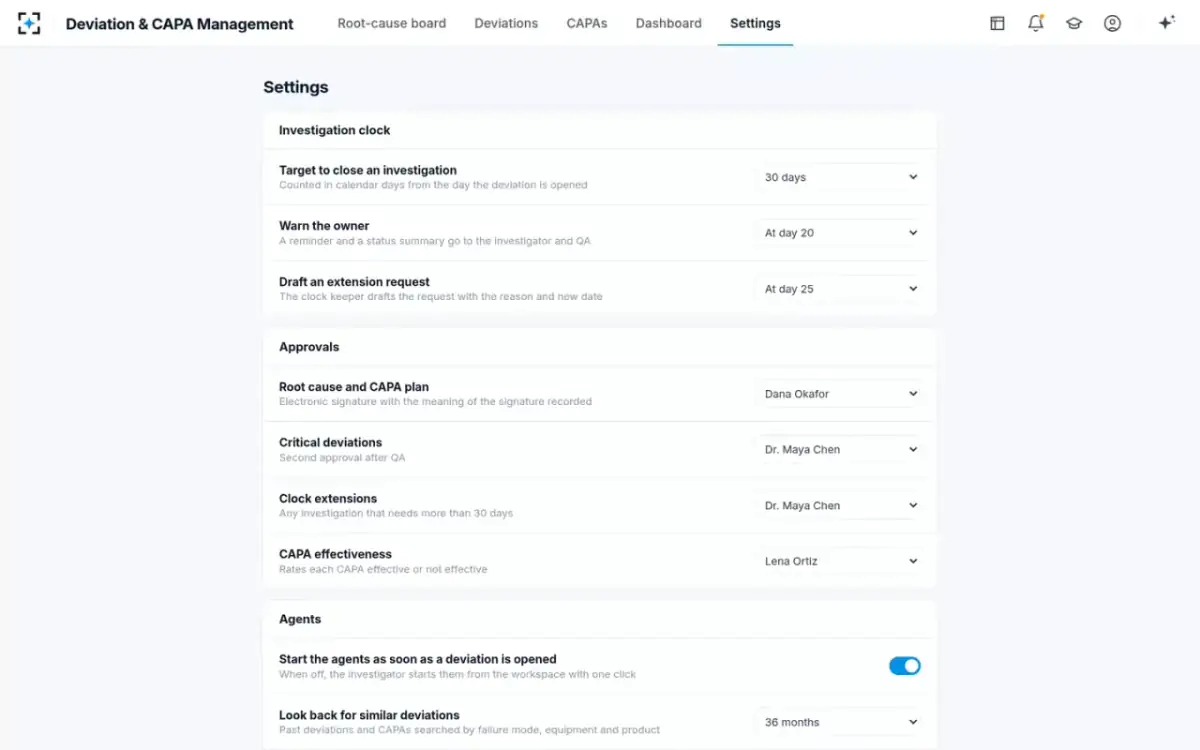
The test of any product in this category is not what it can show you on its own sample plant; it is what it can do with a case you already closed, where you know the answer. Run that test on five cases and the differences between systems stop being a matter of opinion. To see the evidence board, the scope check and the signature on real screens, start from Deviation & CAPA Management, or go on to how to run the replay as a six-week pilot.
Questions people ask
Is a validated spreadsheet enough for deviation management?
For a very small operation it can be, and nothing in CGMP requires a computerised system: Part 11 applies to records you have chosen to keep in electronic form. What a spreadsheet cannot give is the audit trail 21 CFR 11.10(e) describes — computer-generated, time-stamped, and incapable of obscuring what was recorded before — which is usually the reason a plant moves off it.
Should deviations and CAPAs live in the same system?
They should at least be linked, because the only way to answer whether an action worked is to trace it back to the event that caused it and forward to its effectiveness check. Separate systems make three things hard: seeing which open CAPAs belong to an overdue investigation, checking whether an earlier action covered this line, and reporting the repeat rate at all.
How long does it take to implement deviation management software?
The variable is not the software but the record connections and the validation, so the honest answer in a selection is to ask which systems will be connected, who builds each connection, and what the supplier provides towards qualification. A plant connecting two systems and a plant connecting six are running different projects, whatever the licence looks like.
Can one system cover deviations across several sites?
Usually yes, and the question to press is whether each site can keep its own rules — its closure target, its approvers, its classification rules and its search window — while the group can still see across them. Shared rules imposed on sites with different products and equipment are a common reason a multi-site rollout stalls.
What should I ask for in a demonstration?
Your own closed case, handed over as it was first reported, and the five tasks in the script above. A demonstration on the vendor's sample plant tells you the product works on data it was built around. A demonstration on one of your cases, where you already know the cause and whether the action held, tells you something you cannot learn any other way.
Does an audit trail satisfy the requirement for an investigation record?
No; they answer different questions. The audit trail shows who did what and when, and 21 CFR 11.10(e) requires it of an electronic system. The investigation record is what 21 CFR 211.192 asks for — a written record including the conclusions and followup — and a complete trail is no defence for a thin investigation — the largest FY2025 citation under 211.192 is for failing to review a discrepancy thoroughly, not for missing records.