The marginal cost of funds for deposits is the cost of the next dollar of funding: the rate a bank or credit union must pay to keep or raise one more dollar for a given term, or the rate on the cheapest other source of that dollar, such as an FHLB advance or a brokered certificate of the same term. A deposit exception should be priced against it, not against the board rate. The test is simple to state and easy to get wrong: an exception is worth approving when the expected cost of keeping the money at the exception rate, given the chance it stays, is below the cost of replacing it, or when the relationship that would leave with it is worth the difference. Botminds' Deposit Pricing prices every exception against same-term FHLB and brokered funding read that day and the ALM model's marginal cost, with the chance the money stays at each rate, so the approver sees the arithmetic before deciding.
The worked example uses sample data on a fictional institution, Norrell Federal Credit Union, a $6.8 billion credit union, on October 22, 2026: a $350,000 twelve-month certificate, a board rate of 4.15%, a member's ask of 4.60%, a counteroffer of 4.45%, and an ALM model marginal cost of 4.41% for twelve months. The expected-cost calculations are our arithmetic on those inputs.
Priced against a 4.41% marginal cost, the counteroffer costs $118 a year more than letting the money go
What is the marginal cost of funds for deposits?
The marginal cost of funds for deposits is the rate on the next dollar, not the average rate on all of them. A bank's average cost of deposits is interest expense divided by average deposits, a blend of noninterest-bearing checking, savings accounts priced years ago and certificates renewed last week. The marginal cost is what this week's dollar costs, and for a twelve-month certificate it is set by the twelve-month market: what the institution would pay the FHLB, the brokered market or its own depositors for twelve-month money today.
Which of those is the marginal source depends on whether the institution needs the money. Itzhak Ben-David, Ajay Palvia and Chester Spatt, using branch-level deposit rates, found little evidence that depositors discipline risky banks through rates and instead that "banks' loan growth has a causal effect on deposit rates", with branches' rates moving with loan growth in other states where the bank operates (NBER working paper 21526, 2015). A bank funding loan growth prices its deposits against what it would otherwise borrow. A bank with surplus liquidity prices them against what it earns on that surplus, which is lower. The same exception can be cheap at one institution and expensive at the other.
How do you calculate the cost of deposits, and why the average misleads
The cost of deposits is calculated as interest expense on deposits divided by average deposits over the period, and it answers a different question from the one an exception asks. The average is what the deposit base cost last quarter. An exception asks what one more year of one certificate will cost from today, against what the alternatives cost from today.
The two can diverge sharply. A credit union whose average cost of deposits is low because most balances sit in share drafts and old savings accounts can still face a twelve-month marginal cost near the twelve-month Treasury yield, because that is where the competing offers sit. Pricing an exception against the average makes every exception look expensive; pricing it against the board rate makes every one look like a giveaway. Pricing it against the marginal cost is the only comparison that tells the approver whether keeping the money is cheaper than replacing it.
Bank funding costs in 2025: deposits fell less than borrowing
2.26%
bank funding costs in 2025, down from 2.61% in 2024
−33bp
decline in the cost of deposits, most of the fall in funding costs
−64bp
decline in borrowing costs, as term debt and wholesale funding repriced
The FDIC's review of 2025 shows why the comparison has to be redone often. "Borrowing costs declined 64 basis points as costs for term debt and other wholesale funding declined," it reports, while the cost of deposits fell 33 basis points (FDIC, 2026 Risk Review). Community banks moved the same way on volume: "For community banks, wholesale funding declined slightly during the year, largely driven by reductions in FHLB advances and brokered deposits, suggesting an intentional move to reduce dependence on higher-cost or more volatile funding sources." An exception priced against last spring's FHLB curve was priced against a different market. How those moves show up in the margin is set out in net interest margin analysis by driver.
Funds transfer pricing for deposits, explained for a CD desk
Funds transfer pricing, or FTP, is how a bank charges each loan for the funding it uses and credits each deposit for the funding it provides, at a rate drawn from a curve of what money costs at each term. For a deposit desk it answers one question: what is this certificate's funding worth to the institution, so that paying more than that is a cost and paying less is a profit.
The federal banking agencies' interagency guidance on FTP, written for the largest institutions but clear enough for any, describes the most common method: "Matched-maturity marginal cost of funding is a commonly used methodology for non-trading exposures. Under this methodology, FTP costs and benefits are based on a firm's market cost of funds across the term structure (for example, wholesale long-term debt curve adjusted based on the composition of the firm's alternate sources of funding such as Federal Home Loan Bank advances and customer deposits)." It adds that the curve "should be derived from reliable and readily available data sources and be well understood by FTP users" (Interagency Guidance on Funds Transfer Pricing, March 2016, attached to SR 16-3).
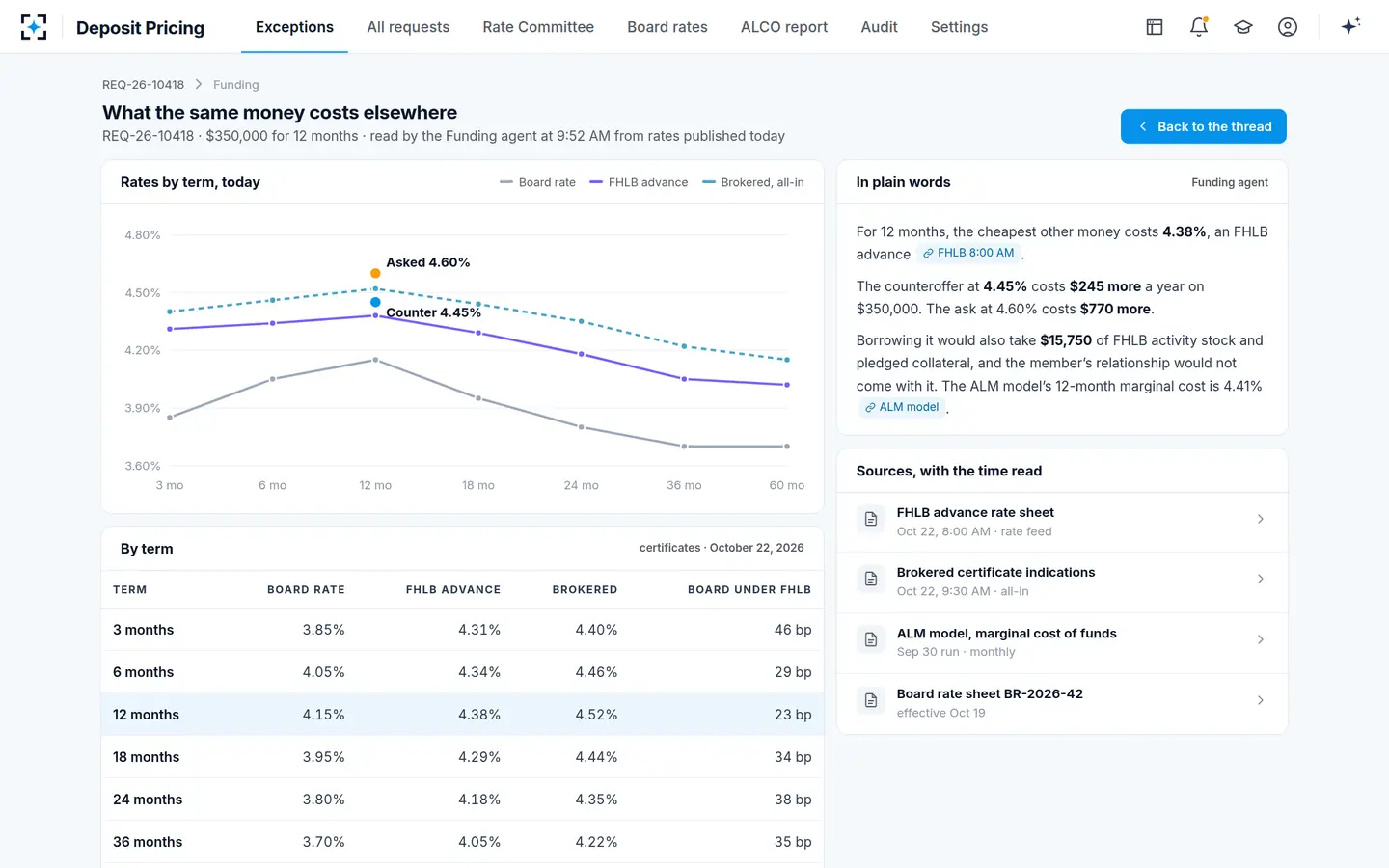
For a twelve-month certificate, matched maturity means the twelve-month point on that curve. The sample credit union's ALM model publishes it monthly; on the October 22 request it was 4.41%, from the September 30 run. The FHLB advance and brokered rates read that morning bracket it, at 4.38% and 4.52%. The point of FTP for an exception desk is that it replaces three numbers with one the whole institution agrees on, and that the number is credited to the branch that keeps the money as well as charged to it.
What the same money costs elsewhere: board, FHLB and brokered rates by term
How do you compare a CD rate to FHLB advances? Same term, same basis
Compare a CD rate to an FHLB advance at the same term and on the same basis: both as the cost of a dollar for a year, with interest timing and day count accounted for. A certificate's APY already states its annual yield under Truth in Savings, compounding included. An advance is quoted as a rate whose cost depends on the advance agreement: how days are counted and when interest is paid. Put the two side by side without converting and the comparison can change sign.
One quoted advance rate of 4.38%, three conventions, three costs for $100,000 for a year
| How the advance accrues and pays | Annual cost as a yield | Cost of $100,000 for a year | Against a 4.45% APY certificate |
|---|---|---|---|
| Simple interest on a 360-day year of 30-day months, paid at maturity | 4.38% | $4,380 | The certificate costs $70 more |
| Simple interest on actual days over 360, paid at maturity | 4.44% | $4,441 | The certificate costs $9 more |
| Actual days over 360, interest paid monthly and refinanced | 4.53% | $4,532 | The certificate costs $82 less |
Three more things belong in the comparison and are not in either rate. An FHLB advance must be secured: federal rules require each FHLBank to "make only fully secured advances to its members" (12 CFR 1266.2(c)), so borrowing encumbers collateral that would otherwise back contingent liquidity, a cost FHLB borrowing capacity measured in hours to cash examines. Borrowing also requires stock: each member must hold a minimum investment in the FHLBank's capital stock "as a condition to transacting business with the Bank or obtaining advances" (12 CFR 1277.22(a)); on the sample request the Funding agent shows $15,750 of activity stock. And researchers at the Federal Reserve Bank of New York note that "FHLB advances are a type of secured wholesale funding for which banks are typically required to pay a rate above the risk-free rate and thus above deposit rates" (Liberty Street Economics, April 2023), which is why a board rate that sits under the FHLB curve is normal, not a mistake.
Is it cheaper to keep a deposit or borrow from the FHLB?
Keeping a deposit is cheaper than borrowing when its rate, on the same basis, is below the advance's all-in cost, including the stock and collateral it ties up. At the board rate that is almost always true; that is why the board rate is set there. The exception question is narrower: is it cheaper to keep this deposit at the exception rate than to let it go and borrow, given that some of it would have stayed at the board rate anyway?
What approving the counteroffer instead of holding the board rate is worth, in four terms
Funding kept that would have left
(84% − 31%) × 4.41% × $350,000
The money the counteroffer keeps that the board rate would have lost, valued at the 4.41% it would cost to replace. +$8,181 a year.
The ALM model’s marginal cost
Rate paid on that kept money
(84% − 31%) × 4.45% × $350,000
The counteroffer rate on the same money. −$8,255 a year: slightly more than replacing it, because 4.45% is above 4.41%.
The approver’s rate
Extra paid to money that would have stayed
31% × (4.45% − 4.15%) × $350,000
The members who would have renewed at the board rate also get the higher rate. −$326 a year.
The retention estimate at the board rate
The relationship that leaves with the money
(84% − 31%) × annual value of the rest of it
Other deposits and loans that would follow the certificate out. Break-even: about $755 a year of value.
The approver’s judgment
On the sample request the first three terms sum to minus $400 a year. On rate alone, holding the board rate is cheaper than the counteroffer, because the counteroffer's 4.45% is a little above the 4.41% marginal cost and because 31% of the money would have stayed for less. The case for the counteroffer rests on the fourth term. The member has $1.2 million in deposits across six accounts and a $410,000 mortgage; the counteroffer pays for itself if the part of that relationship which would follow the certificate out is worth more than about $755 a year. That is a judgment, and it is why the approver, not the arithmetic, decides. It is also why the sample's rate committee member puts the rule as he does: never pay more for a deposit than the FHLB, unless the relationship earns it.
How much does a 15 bp exception cost a year?
A 15 basis point exception costs 0.15% of the balance a year: $150 on $100,000, $525 on $350,000, $1,500 on $1 million. That is the cost over the rate that would otherwise be paid if the money stayed. It is not the economic cost of the decision, which depends on what happens if the exception is refused.
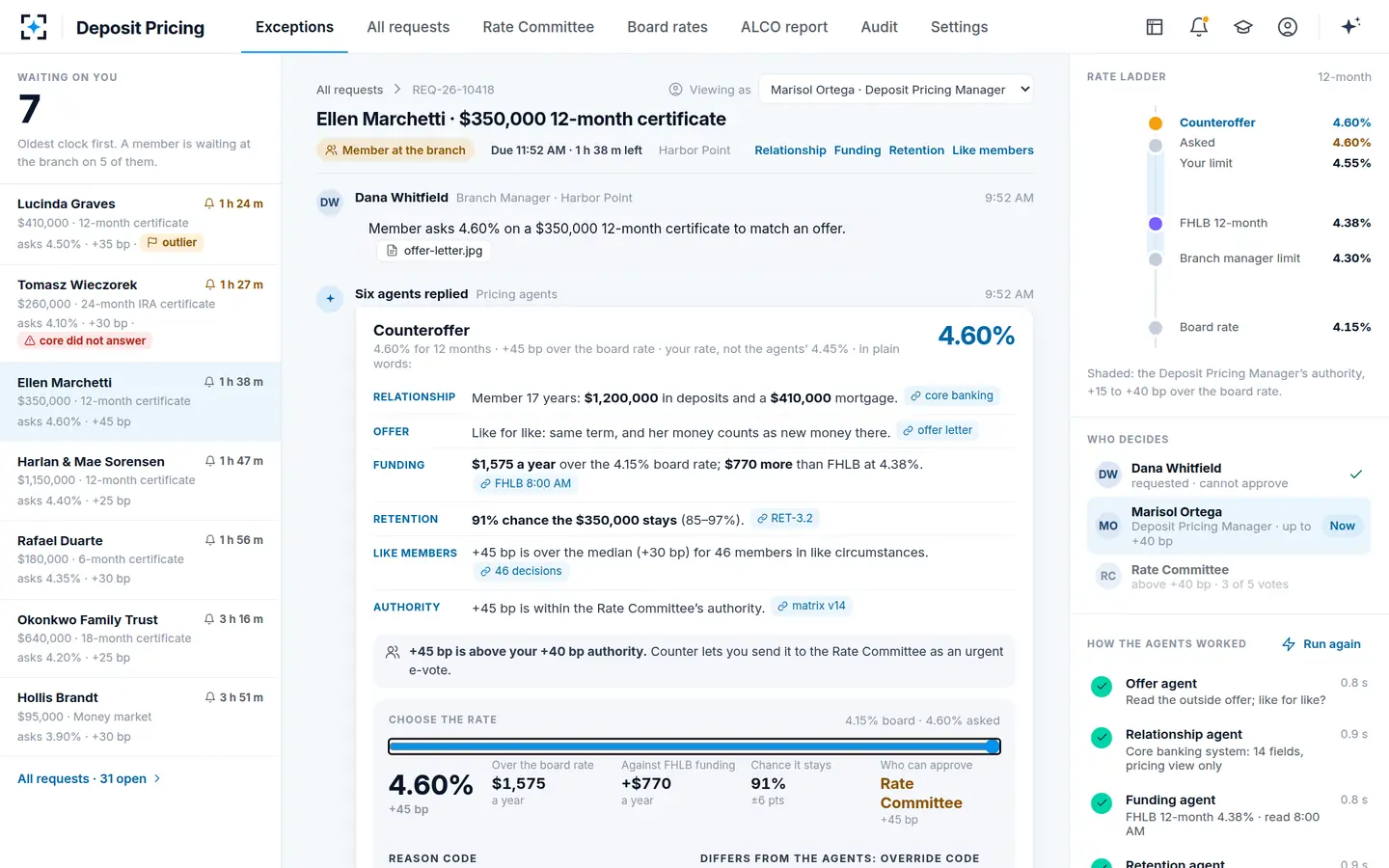
On the sample request the extra 15 basis points between the counteroffer and the ask would cost $525 a year and raise the chance the money stays from 84% to 91%. Priced against the 4.41% marginal cost, those 7 points cost about $47 a year more than replacing the same money would, and $441 of the $525 goes to money that would have stayed at 4.45% anyway. In expected terms, matching the ask costs about $488 a year more than the counteroffer. Small exceptions add up through volume, not size: in September the sample credit union's approved exceptions held $412.6 million at an average of 24 basis points over board rates, about $990,000 a year.
The rate dial: every figure recalculated at the full ask
The cost of deposits for banks in 2025 and what it means for exceptions
The cost of deposits for banks fell in 2025, by 33 basis points across the industry by the FDIC's measure, and the cost of borrowing fell further. For an exception desk that matters in two ways. A falling marginal cost lowers the price at which an exception stops paying for itself, so exceptions approved in 2024 terms are now often too generous. And a falling gap between deposits and wholesale funding makes the relationship term in the formula carry more of each decision.
The direction can reverse. The FDIC's own published rates for October 2026 show the twelve-month Treasury yield at 4.54%, up from 3.48% in January (FDIC national rates and rate caps sets out the table). When the marginal cost rises faster than the board rate, exceptions climb before anyone changes the rate sheet, because the board rate stops holding the money. That pattern belongs in front of the rate committee as a board-rate proposal; pricing the renewal first explains how.
From one exception to a month's cost for ALCO
A month of exceptions is priced the same way as one, summed: the extra rate over the board rate on the money that was approved, the funding kept against what would have been lost, and the cost of replacing what left anyway. The first part is a general ledger figure the institution already has. The second and third need the retention estimate and its back-test, because they depend on what would have happened without the exception.
The sample credit union's September report to ALCO puts the first part at about $990,000 a year over board rates against a forecast of $1.07 million, and reports that 87% of the money was still there after 30 days where the model expected 84%. That last line is an early check on the retention estimates the decisions relied on; the full test comes when each certificate's term has run. How that estimate should be built and back-tested is the subject of deposit attrition modeling. To see the funding comparison and the dial on your own rates, start from Deposit Pricing.
Questions people ask
What is the difference between cost of funds and marginal cost of funds?
Cost of funds is an average: total interest expense on deposits and borrowings divided by the average balance funded. The marginal cost of funds is the rate on the next dollar at a given term. The FDIC reports the average for the industry, 2.26% in 2025; a pricing decision needs the marginal figure for the term of the deposit being priced.
What is a deposit's all-in cost?
A deposit's all-in cost is its rate, stated as an annual yield, plus the costs of holding it that are not in the rate, such as servicing, less any value it brings, such as the rest of the relationship. For a comparison with an FHLB advance, the advance's all-in cost includes the stock it requires and the collateral it encumbers.
Should a credit union use the FHLB rate or the brokered rate as its marginal cost?
It should use the rate on the source it would actually use for that term, or a blended curve its ALM model maintains. On the sample request the FHLB twelve-month advance was 4.38%, brokered certificates 4.52% all-in, and the ALM model's twelve-month marginal cost 4.41%, between the two.
Does a lower marginal cost mean fewer exceptions should be approved?
It means each exception has a lower break-even rate. If the marginal cost falls below the exception rate, the exception only pays if the relationship is worth the difference, so either the relationship case must be stronger or the counteroffer lower. The board rate should be reviewed at the same time, because it sets how many requests arrive.
Is FTP required for community banks?
The 2016 interagency FTP guidance is addressed to institutions with $250 billion or more in assets. Community banks and credit unions are not required to run an FTP system, but the matched-maturity principle it describes is the right test for any exception: price the deposit against what the same term of funding costs today.