A rate match request is a branch's or contact center's request to the pricing desk to pay one depositor more than the board rate, usually on a maturing certificate of deposit, so that a better offer from another bank or credit union does not take the money. The answer itself takes minutes to work out. The request takes much longer because it passes through seven parties, the member, the branch, the pricing desk, the core banking system, a rate survey, the FHLB rate sheet and an approver, and most of the elapsed time is spent waiting for the next one to respond. Botminds' Deposit Pricing turns the request into a thread: agents gather the relationship, the offer, the cost of other funding and the chance the money stays in seconds, and a named approver who did not ask makes the decision while the member is still at the desk.
The example on this page is sample data on a fictional institution: Norrell Federal Credit Union, a $6.8 billion credit union with 38 branches, as it runs through the solution on Thursday, October 22, 2026. A member's $350,000 twelve-month certificate matures on the Saturday, and she has a written offer of 4.60% APY from an online bank.
One rate match request at the sample credit union, timed
23sec
from the branch manager’s one-line request to a cited counteroffer
29min
from the request to the approver’s decision, most of it in her queue
6min
from the decision to a signed disclosure and the rate booked in the core
2hours
the design target for answering a member at the branch, on a clock
What is a rate match request, and what does the branch send?
A rate match request is a pricing exception raised at the point of sale: the depositor names a competing rate, and the branch asks for permission to pay it or something close to it. The same thing is called a CD rate match, a CD rate exception or a pricing exception request, depending on the institution. What it is not is a change to the rate sheet. The board rate for each product is set by the rate committee, often weekly; an exception is a price for one depositor, one account and one term.
Banks and credit unions grant them because selective repricing is cheaper than repricing everyone. Researchers at the Federal Reserve Bank of New York, describing how banks held on to funding in the 2022 tightening, put it plainly: "To retain deposits, banks strategically raise rates on specific categories of deposits without re-pricing all deposits" (Liberty Street Economics, April 2023). A rate match is the narrowest form of that strategy. It is also the form most exposed to delay, because the person who wants the answer is sitting at a desk with a competing letter in her hand.
At the sample credit union the request is one sentence and an attachment. Dana Whitfield, the Harbor Point branch manager, writes "Member asks 4.60% on a $350,000 12-month certificate to match an offer" and attaches the offer letter. Everything else the pricing desk needs, it has to find.
Who waits on whom: six hand-offs around one pricing desk, drawn to the minutes each takes
Who approves a CD rate exception, and who waits on whom
A CD rate exception is approved by whoever the institution's pricing authority matrix names for that product, amount and spread, and never by the person who asked. In most matrices that means three tiers: the branch can grant a small premium itself, a deposit pricing or treasury manager can grant more, and anything beyond that goes to the rate committee or ALCO. The tiers are policy, not regulation; no federal rule sets them.
The sample credit union's matrix, version 14, lets a branch manager approve up to 15 basis points over the board rate on certificates up to $1 million, the Deposit Pricing Manager up to 40 basis points (25 over $1 million), and the rate committee anything above. Two rules apply to every row: the requester never approves, and an officer never approves an account in which they hold an interest. Dana asked for 45 basis points, so she cannot decide; Marisol Ortega, the Deposit Pricing Manager, can approve up to 40; the full ask needs the committee.
Four seats around one rate match request, and what each keeps
Today
Waits at the desk, or leaves with a promise of a call back and an offer that expires.
With agents
Waits while the branch manager sees the counteroffer arrive in the thread, within the visit on the sample request.
Still theirs: The decision to stay or go
Today
Phones and emails the pricing desk with the member in front of her; cannot say when an answer will come.
With agents
Writes one sentence and attaches the offer; sees the counteroffer, the approval, the disclosure and the booking in one thread.
Still theirs: The conversation with the member; never approves her own request
Today
Decides about 35 exceptions a day above branch authority, with the core, a rate survey and the FHLB sheet open side by side.
With agents
Opens a request already priced against funding, retention and like members; approves, counters or declines with a reason code.
Still theirs: The decision, up to +40 bp
Today
Hears about exceptions in a monthly count rebuilt from inboxes.
With agents
Votes on requests above authority within a clock, and on board-rate changes the exception pattern suggests.
Still theirs: Every decision above +40 bp
Why do rate match requests take so long? Six hand-offs, timed
Rate match requests take long because each step waits for the one before it, and most of the steps are lookups done by phone, email or a second screen. Nobody can price the request until someone has found the member's relationship; nobody can approve it until someone has found who may. The working time is short. The waiting between steps is what the member feels.
Botminds' estimate for the sample credit union splits a phone-and-email exception into six pieces. Reaching the pricing desk takes 20 minutes, because the desk is on another call. Looking up the member in the core banking system takes 10. Finding the latest rate survey and the morning's FHLB sheet takes 10, often in three windows and a spreadsheet. Checking the offer, and how members with the same ask were treated, takes 15. Finding who may approve and reaching them takes 20. Keying the override into the core and preparing the disclosure from a template takes 15.
Ninety working minutes become thirteen; the approval stays a person’s
- Reach the desk20
- Core lookup10
- Survey, FHLB10
- Offer, like members15
- Find the approver20
- Override, disclosure15
- Request1
- Core1
- Rates1
- Offer, like members3
- Approver4
- Booking, disclosure3
Two of the six are long for the same reason: they wait on a person who is doing something else. The first is the desk itself, which is also answering the last caller. The second is the approver, who may be in a meeting when the request needs someone above the desk's authority. The other four are lookups, and lookups are what software does well. That division is what the design follows: remove the lookups, put the request in front of the right approver at once, and leave the decision with that approver.
How long does a CD rate match approval take when the waits go?
When the lookups are done for the approver, a CD rate match approval takes as long as it takes a named person to read one screen and decide. No regulation sets the clock. The sample credit union sets two hours for a member at the branch and four for phone or chat, with a reminder when 60 minutes remain and an escalation to a backup approver and the VP Treasury & ALM at 30.
On the sample request the six agents replied 23 seconds after Dana wrote her sentence: the relationship (17 years, $1.2 million in deposits, a $410,000 mortgage), whether the offer was like for like, the cost against same-term FHLB and brokered funding, an 84% chance the $350,000 stays at a counteroffer of 4.45% against 91% at the full 4.60%, how 46 like requests were decided in 90 days, and who may approve. Marisol, with seven requests in her queue, opened it at 10:16 and approved 4.45% at 10:21.
The request as Marisol Ortega sees it: one sentence, six cited lines, who decides
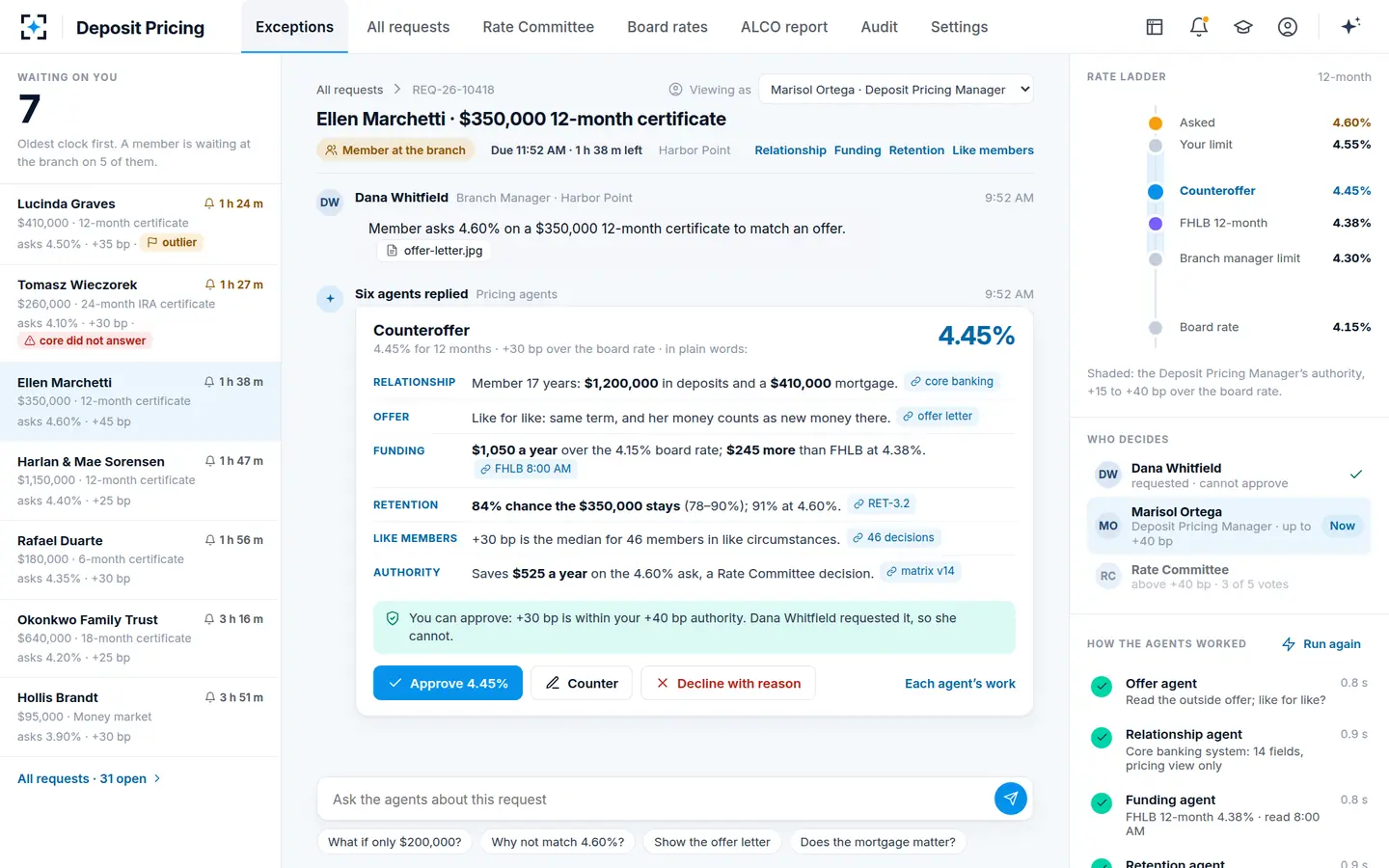
Twenty-nine minutes is not the best case; it is what a queue of seven looks like. The design aims to make the queue, not the lookups, the thing to manage: requests with a member at the branch go first, and a request that will miss its clock is escalated before it does. A desk that wants a faster answer adds approvers or widens branch authority. The sample credit union has a change of that kind pending, raising branch authority on three- and six-month certificates from 15 to 20 basis points, which the agents estimate would let the branch decide 41% of the 253 short-term requests a month that now reach the desk.
What information is needed for a rate match
A rate match needs the competing offer in writing, the terms of the deposit that would move, and enough of the relationship to price it, and nothing more. The offer is the part most often missing or misread. A screenshot of an annual percentage yield without its term, minimum or new-money condition is not an offer the desk can match, because it may not be one the member could actually get.
What the branch sends with a rate match request, and why each item matters
- The competing offer in writing
Letter, screenshot or rate sheet showing the APY, term, minimum deposit, whether it is for new money only, the early withdrawal penalty and when it expires. An offer that cannot be read is marked unverified, not matched.
- The deposit that would move
Which certificate or balance, its maturity date and current rate, and how much the member intends to move. At maturity the money can leave without a penalty; mid-term it cannot.
- The ask, stated as a rate
The rate requested and the spread over the board rate, so the request routes to the right approver without a phone call.
- Where the member is
At the branch, on the phone, or online. The clock depends on it.
- What the desk finds itself
Tenure, total deposits, loans and earlier exceptions from the core, read for pricing only. Tax ID, date of birth, credit score and income are not needed to price a deposit.
The maturity date matters more than it seems. Under Regulation DD a grace period is "a period following the maturity of an automatically renewing time account during which the consumer may withdraw funds without being assessed a penalty" (12 CFR 1030.2(m); credit unions follow the equivalent definition in Part 707). A member with a certificate maturing on Saturday and a ten-day grace period has a deadline about two weeks away, not today. The branch's deadline is shorter: the member is at the desk now, and a member sent home to wait for a call has time to sign the other offer.
What happens if the member leaves before approval?
If the member leaves before approval, the request turns into a call-back, and the institution loses the moment in which a counteroffer is easiest to accept. The money may still stay. But the member now has a decision to make at home with the other offer on the table, and the branch has a promise to keep with an answer it does not yet have.
The sample's retention estimates show what is at stake in that moment. At the 4.15% board rate the model gives the $350,000 a 31% chance of staying twelve months; at the 4.45% counteroffer, 84%. The difference is the value of answering at all, and it is far larger than the difference between the counteroffer and the ask, which the model puts at 7 points for an extra $525 a year. A desk that answers slowly is pricing many members at the board rate by default.
The opposite failure is also real. A branch that cannot get an answer is tempted to promise one: "we will match". A promise made at the desk and refused by the desk afterwards costs more goodwill than a counteroffer made on the spot. The clock is there to make the honest answer the fast one.
Who can approve above authority, and how fast a committee can vote
Above the pricing manager's authority, the rate committee approves, and the question is how a committee can decide inside a branch visit. The answer most institutions reach is an urgent electronic vote with its own clock, rather than waiting for the next meeting. The sample credit union gives the committee two hours on such an e-vote.
The rate dial is what makes that route rare rather than routine. Set to the member's full 4.60%, it shows $1,575 a year over the board rate, a 91% chance the money stays, and a committee decision; set to 4.45%, $1,050 a year, 84%, and the pricing manager's own authority. An approver who wants to go above the agents' counteroffer can counter at any rate in between, with a reason code and an override code, or send the full ask to the committee. What the approver cannot do is approve above authority, and what the agents cannot do is approve at all.
For the committee, the useful view is not one request but the pattern. If dozens of members a month bring the same online offer, exceptions are doing the work of a rate change. Pricing the renewal rather than the special sets out how that pattern turns into a board-rate proposal, and the marginal cost of funds for one CD exception shows how to put a price on each one.
How rate match decisions are documented in the thread
Rate match decisions are documented by the same thread that made them: the request, each agent's line with its source and the time it was read, the approver's reason code and note, the disclosure generated from the approved terms, and the core's booking under the approval number. Nobody rebuilds it afterwards from email.
Marisol approved with reason code PX-02, the code for a verified written offer matched within the like-circumstances range, and a note saying the counter sat at the like-circumstances median. The Truth in Savings disclosure was generated at 10:21 from those terms, delivered by Dana at 10:24 and e-signed by the member at 10:26; at 10:27 the core renewed the certificate at 4.45% under approval A-26-10418. The full anatomy of what each file should hold, and how long to keep it, is in what each pricing exception file must hold.
Approved, disclosed and booked: the rest of the request, in the same thread
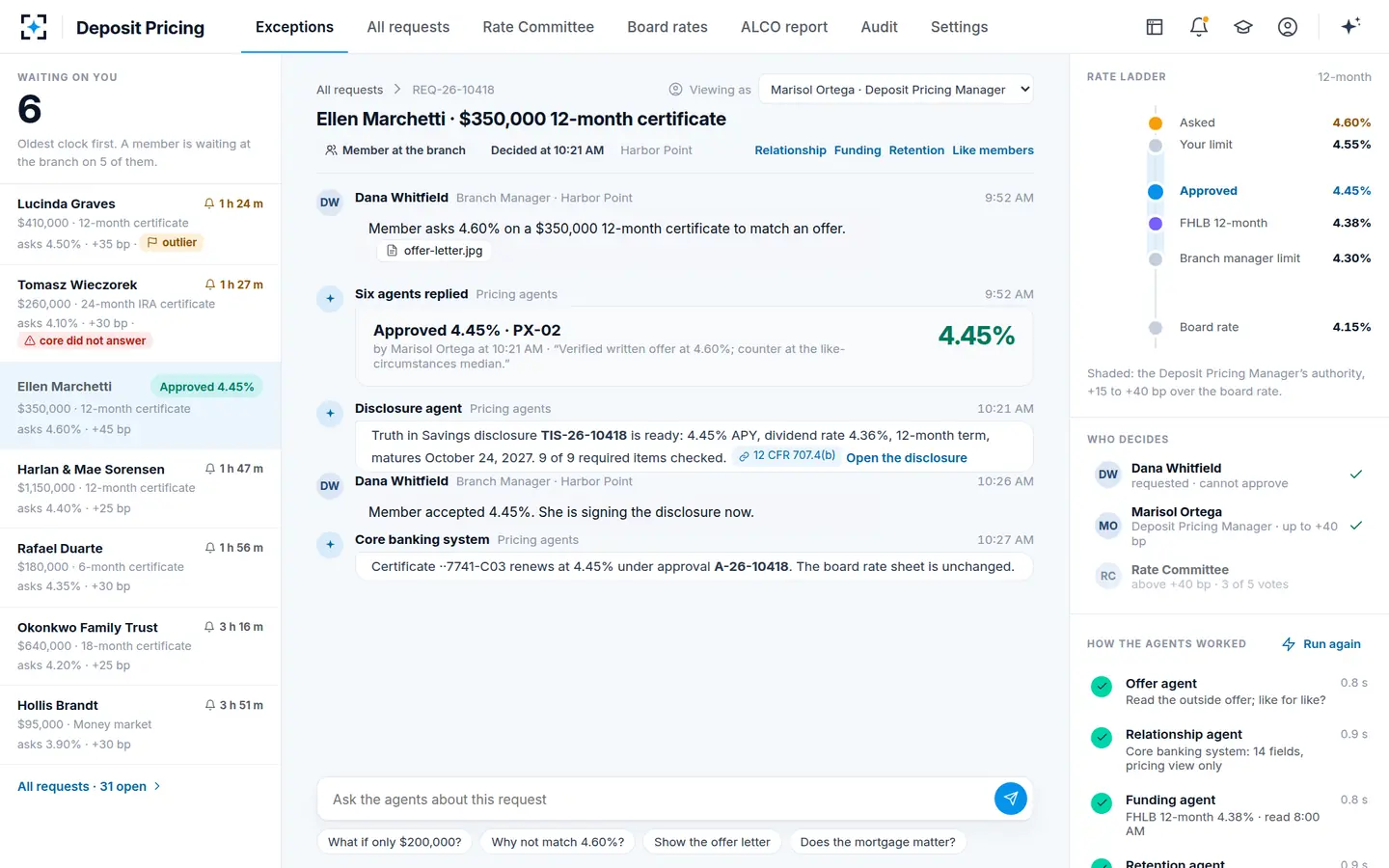
The thread also keeps what did not happen. The full ask, the committee route not taken, and the 91% retention figure at 4.60% stay on it, so a reviewer can see that the approver chose a lower price knowingly. To see a request run from the branch's sentence to the core booking, start from Deposit Pricing.
Questions people ask
Is a rate match the same as a rate exception?
A rate match is one kind of rate exception: the depositor brings a competing offer and asks the institution to meet it. Exceptions are also granted for relationship reasons with no competing offer at all. Both are prices above the board rate for one account, and both should go through the same authority matrix and leave the same evidence.
Do credit unions match CD rates?
Many do, through the same kind of authority matrix banks use, and the sample institution on this page is a credit union. The disclosure rules differ only in name: credit unions follow NCUA's Truth in Savings rule, 12 CFR Part 707, where banks follow Regulation DD, and a credit union's certificate is a share certificate paying dividends rather than interest.
Can a branch manager approve their own rate match request?
Not under a sound authority matrix, and not in the sample configuration, where the requester is excluded from approving every row. A branch manager may approve a request raised by a member of staff within branch authority, but a request the manager raised goes to someone else.
How fast should a rate match request be answered?
No rule sets a time. The practical limit is the length of the member's visit, which is why the sample credit union sets a two-hour target for a member at the branch and four hours for phone or chat, with escalation before the clock runs out. On the sample request the decision came 29 minutes after the ask.
Does matching one member's rate mean matching everyone's?
No, but the institution should be able to show that members in like circumstances were treated alike. The sample compares each request with like requests from the last 90 days on product, amount, term and offer, and flags an ask above the 90th percentile before anyone approves. Measuring exception pricing consistency sets out the method.