Exception pricing is a price agreed for one customer that differs from the institution's published rate, approved case by case by someone with the authority to do so. In deposits it means paying more than the board rate on one account, usually a certificate, because the depositor has a better offer or a relationship worth keeping. The practice is ordinary and useful. Its weakness is that it is decided by many people at many branches, and two members with the same balance, term and offer can receive different answers. Consistency is measurable: compare each decision with the decisions made on like requests, and look at where branches, approvers or channels part company. Botminds' Deposit Pricing puts that comparison in front of the approver before the decision rather than in an audit report after it.
Where this page uses the solution's own figures, they are sample data on a fictional institution, Norrell Federal Credit Union, a $6.8 billion credit union with 38 branches. The two branches in the first figure are illustrative and are not the sample.
Same asks, two answers: approved spread against asked spread at two branches
What is exception pricing on deposits? The meaning
In banking, exception pricing means approving a price outside the rate sheet for a single customer. On the loan side it is a rate or fee concession below the price the pricing engine produced; on the deposit side it is a rate above the board rate. The two share a name and an approval process, but they sit under different rules and carry different risks, which is why it helps to say which one is meant.
A deposit exception has three parts. There is the ask, stated as a spread over the board rate for one product and term. There is the decision, made by whoever the authority matrix names for that spread: approve, counter at a lower spread, or decline. And there is the reason, which is what lets anyone else judge the decision later. Exception pricing meaning, in practice, is the sum of those three, repeated thousands of times a year by different people.
The volume is what makes consistency a real question. At the sample credit union, September brought 2,812 exception requests: 1,884 were decided at the branch within branch authority, 802 by the Deposit Pricing Manager and 126 by the rate committee. Each tier applies the same policy through different hands.
Why two branches give two answers to the same ask
Two branches give two answers because each approver weighs the same request against a different picture: the rate survey they last saw, the FHLB sheet from whichever morning, their memory of what they approved last week, and their sense of what the member will do. None of those is wrong in itself. Together they produce a distribution like the one above, where one branch approves at the ask and the other counters ten basis points lower on the same requests.
Some of the difference can be justified. A verified written offer is worth more than a verbal one; a member whose certificate matures this week is at more risk than one whose matures next quarter; a relationship with a mortgage and direct deposit is not the same as a single certificate. A consistency measure has to hold those constant before it calls anything a disagreement. What is left after that is unexplained, and unexplained variation in price is what a pricing policy exists to remove.
The cost runs both ways. The branch that approves at the ask pays more than it needed to, member after member. The branch that counters low loses some members it could have kept. Neither shows up in the monthly count of exceptions, which treats both branches as having followed policy, because both stayed inside their authority.
What is a like-circumstances comparison?
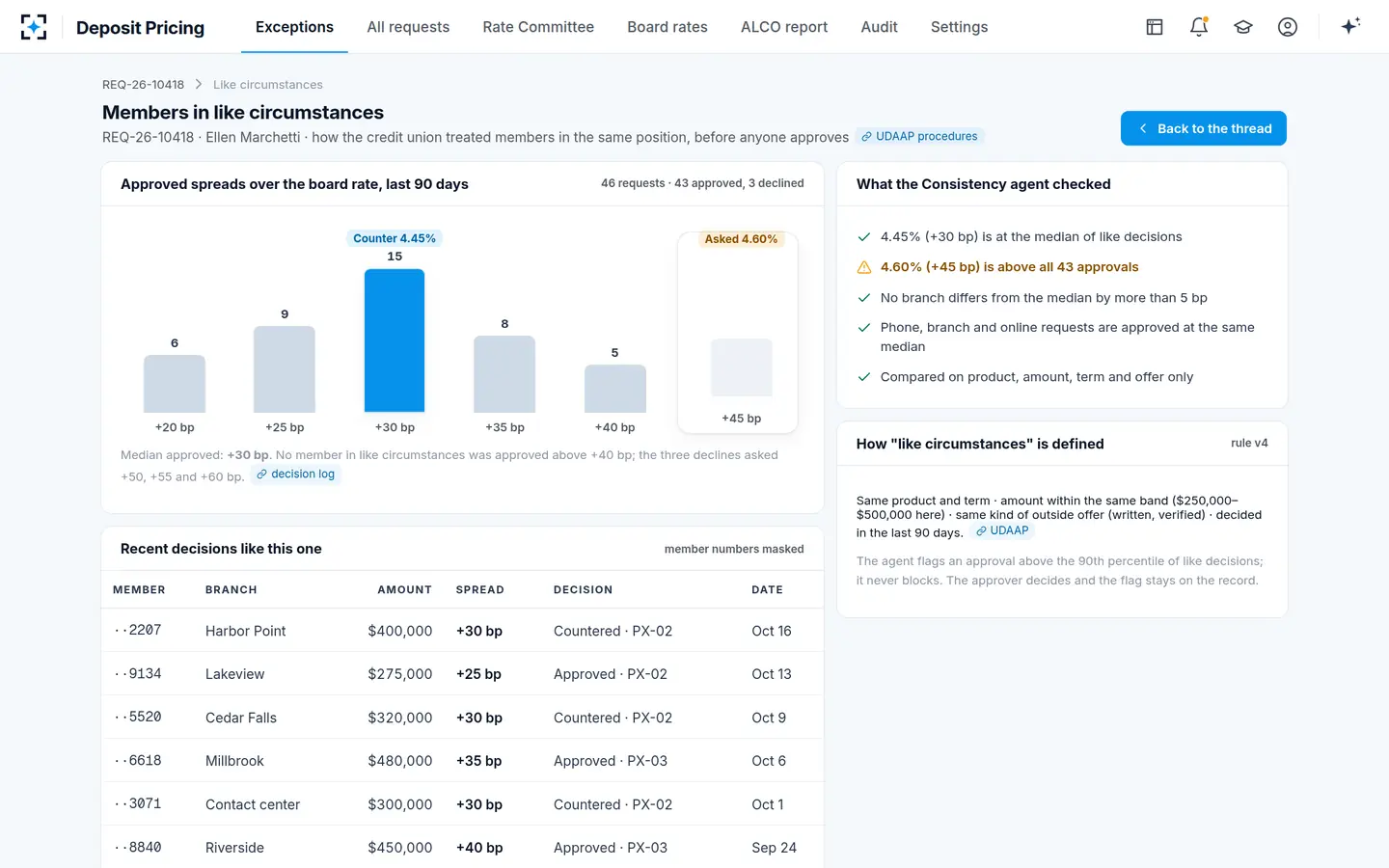
A like-circumstances comparison groups requests that a reasonable approver should price alike, and compares each decision with the others in its group. The group is defined by the few things the price should depend on and nothing else. In the sample configuration, version 4 of the rule, that is the same product and term, an amount within the same band ($250,000 to $500,000 on the sample request), the same kind of outside offer (written and verified), and a decision within the last 90 days.
What the definition leaves out matters as much as what it includes. Branch, channel and approver are deliberately not in it, because those are the dimensions along which consistency is tested; putting them in would compare each branch only with itself. Personal characteristics of the member are not in it either. The comparison is on product, amount, term and offer only, and that restriction is printed on the screen where it is used.
46 like requests in 90 days: where the 43 approvals landed, and the three declines
How do you measure pricing consistency on your own decision log?
Pricing consistency is measured by computing, for every like-circumstances group, the typical approved spread, and then asking how far each branch, approver and channel sits from it. The median is the right centre because exception spreads are lumpy and a few large approvals would drag a mean. The gap that matters is the gap after the like-circumstances grouping has done its work.
Five consistency measures, each computed on a bank's own decisions
| Measure | How it is computed | What to look for |
|---|---|---|
| Group median | Median approved spread over the board rate within each like-circumstances group | The reference price for that kind of request; it moves as the market moves |
| Branch gap | Median of each branch’s approvals minus the group median, weighted across groups | A branch persistently above or below by more than a few basis points |
| Approver gap | The same, by approver, at each tier of authority | One approver pricing differently from peers with the same authority |
| Channel gap | The same, by branch, phone and online requests | Members who walk in getting more than members who call |
| Outlier share | Share of approvals above the group’s 90th percentile | Rising share, or outliers clustered in one place |
The 90th-percentile flag is the per-request version of the outlier share. In the sample, the member's ask of 45 basis points sat above all 43 approvals, so the Consistency agent flagged it before anyone decided. The flag never blocks; the approver can still approve above it with a reason, and the flag stays with the decision. That design matters, because a consistency measure that blocks decisions becomes a second authority matrix nobody approved.
Members in like circumstances, shown to the approver before the decision
Reading a disagreement without calling it discrimination
A gap between branches is a finding about consistency, not a finding of discrimination, and an exception pricing review should not present it as one. The federal fair lending rules that govern pricing exceptions on loans are written for credit. Regulation B states that its purpose is "to promote the availability of credit to all creditworthy applicants without regard to race, color, religion, national origin, sex, marital status, or age", and defines credit as "the right granted by a creditor to an applicant to defer payment of a debt" (12 CFR 1002.1(b) and 1002.2(j)). A certificate of deposit is not credit.
That does not make deposit consistency optional. An institution's own policy promises like treatment, its members can compare notes, and a pattern that tracked a protected characteristic would raise questions under other law that compliance counsel, not a pricing model, should judge. It does mean the measure should be described for what it is: how far decisions on like requests diverge, and where. That is also why the comparison excludes personal characteristics and why the retention estimate does too.
Pricing exceptions on loans and on deposits: the same name, different rules
Loan pricing exceptions: Equal Credit Opportunity Act and Regulation B; the Fair Housing Act for housing-related credit
Deposit pricing exceptions: No federal rule names deposit exception pricing; the institution’s own pricing policy
Loan pricing exceptions: The loan’s terms under Truth in Lending
Deposit pricing exceptions: The account’s terms under Truth in Savings (Regulation DD, or Part 707 at credit unions)
Loan pricing exceptions: 25 months for consumer credit applications under Regulation B
Deposit pricing exceptions: Evidence of compliance for at least two years under Truth in Savings; the decision itself as policy requires
Loan pricing exceptions: A fair lending question, tested by examiners
Deposit pricing exceptions: A governance question: like requests, like answers, under the institution’s policy
On the loan side, the evidence an approver needs is different and so are the examiners' findings; who approves a mortgage pricing exception covers that ground.
How many pricing exceptions are normal?
There is no normal number of pricing exceptions: no regulator publishes a benchmark, and the count depends on how close the board rate sits to the market. What a supervisor does look at is how much of the deposit base was bought with above-market rates. The FDIC's examination manual tells examiners: "If an institution pays significantly above local or national rates to obtain or retain deposits, the institution's deposit base may be highly cost sensitive, and depositors may be more likely to move deposits if terms become more favorable elsewhere." It continues: "Examiners should also assess how much of the deposit base consists of rate specials and determine whether management measures and reports the level of such deposits" (FDIC RMS Manual, Section 6.1, Liquidity and Funds Management).
That gives three ratios worth tracking, rather than a count. Exceptions as a share of maturing certificates shows how often the board rate fails to hold the money; balances held at an exception rate as a share of time deposits shows how much of the funding is cost sensitive; and the average approved spread shows the price. In September the sample credit union approved 92.6% of 2,812 requests, and the approved exceptions held $412.6 million at an average of 24 basis points over board rates. A count that rises month after month for one product is a rate-sheet problem, not an exception problem; pricing the renewal first is about fixing it there.
What a deposit exception pricing policy should say
An exception pricing policy should say who may approve what, against what evidence, and how the institution will know whether it is being followed. Most policies cover the first; fewer cover the second and third, and those are the parts a consistency review tests.
Eight clauses for a deposit exception pricing policy
- Authority by product, amount and spread
Who may approve how far over the board rate, in a matrix the board or ALCO approves, with a maker and a checker for every change.
- Separation of request and approval
The requester never approves; an officer never approves an account in which they hold an interest.
- What evidence an ask needs
A competing offer in writing, read for rate, APY, term, minimum, new-money rule, penalty and expiry; unreadable offers are not matched.
- What the price is compared with
Same-term alternative funding and how like requests were decided, both shown before approval.
- The like-circumstances definition
Product, term, amount band, kind of offer and window, and nothing personal about the member.
- Reason codes
One required on every approval, counter and decline, and an override code when the decision differs from the recommendation.
- Consistency review
Who measures branch, approver and channel gaps, how often, and what gap triggers a review.
- Reporting
What goes to ALCO each month, and what the rate committee does with the pattern.
Who reviews exception pricing, and how often
Exception pricing is reviewed at three levels: the approver reviews each request, a second-line function such as compliance or treasury risk reviews the pattern, and internal audit tests whether the policy is followed. Each needs a different view of the same decisions. The approver needs the like-circumstances comparison on the request in front of them. The second line needs the gaps by branch, approver and channel each month. Internal audit needs to be able to pick any decision and see its evidence, which is the subject of what each pricing exception file must hold.
Frequency follows volume. At a few dozen exceptions a month, a quarterly review of the log is enough. At a few thousand, a monthly review is the minimum, and the comparison is only practical if it is computed as decisions are made rather than reconstructed afterwards from emails and core override reports.
How do you report exception pricing to ALCO?
Report exception pricing to ALCO as a funding cost and a funding risk, not as an operations count: how many requests, how many approved and at what average spread, what that costs a year over board rates, and how much of the money was still there afterwards against what was forecast. Add the consistency measures as one line, and the product where exceptions are doing the work of a rate change.
One page for ALCO: requests, spread, cost over board rates and money kept
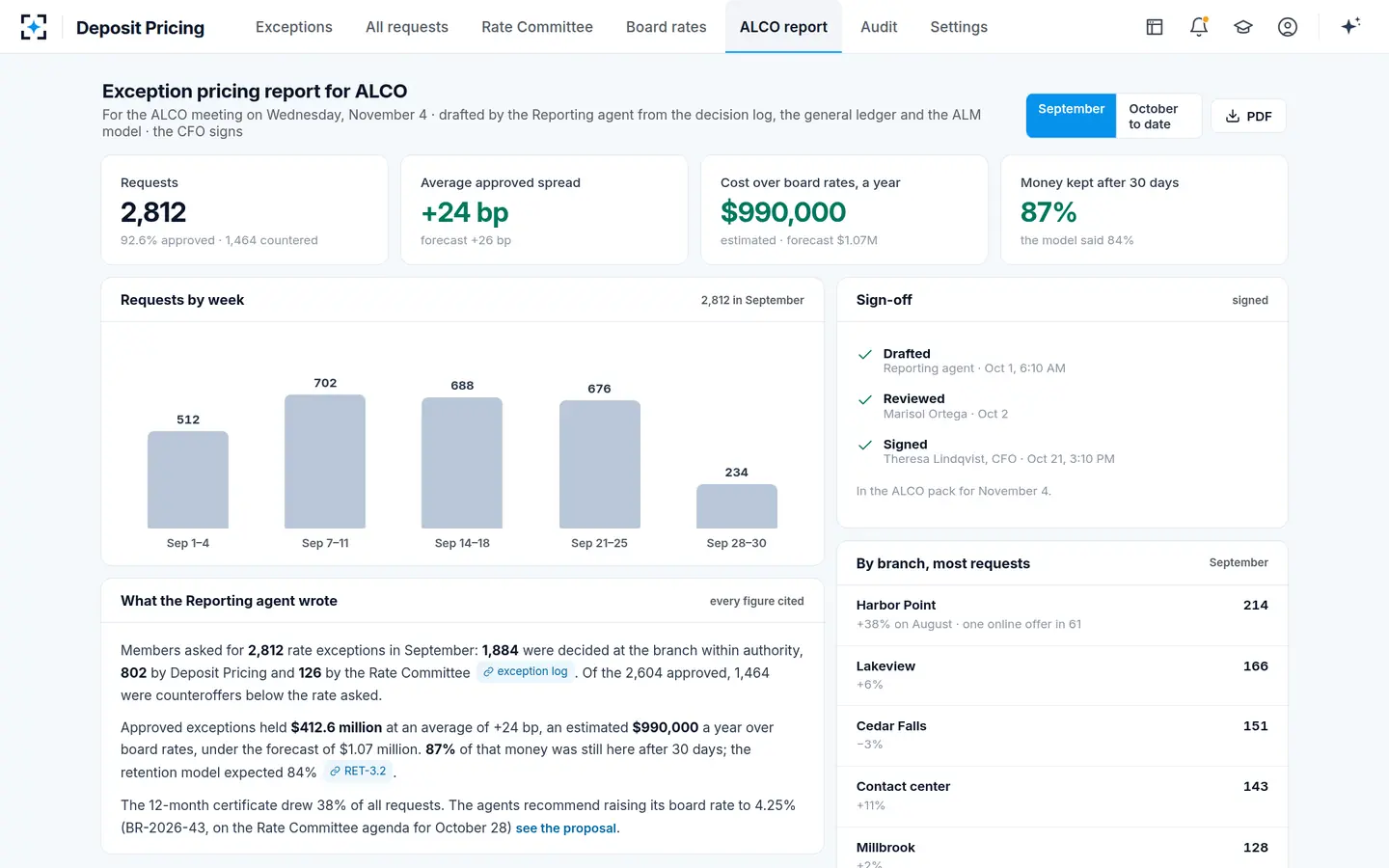
The branch list on that page is where consistency and pricing meet. Harbor Point's requests rose 38% on August, and 61 of its 214 cited the same online offer. That is not a branch behaving inconsistently; it is a market price the board rate no longer meets, visible first as exceptions at one branch. To see the comparison and the report on your own decisions, start from Deposit Pricing.
Questions people ask
What is the difference between exception pricing and relationship pricing?
Relationship pricing is a published rule that pays more to customers who hold more, such as a tier for members with direct deposit. Exception pricing is a one-off decision outside the published rates. A relationship can be a reason for an exception, but if the same relationship justifies an exception every time, it belongs in a published tier.
Is inconsistent deposit pricing illegal?
No federal rule names deposit exception pricing, and the Equal Credit Opportunity Act and Regulation B apply to credit, not deposits. Inconsistency is first a breach of the institution's own policy and a cost. Whether any pattern raises a question under other consumer protection law is a judgment for compliance counsel, not for a pricing model.
What is a pricing exception process?
It is the path a request takes: the ask with its evidence, routing to the approver the authority matrix names, a decision with a reason code, the disclosure generated from the approved terms, and the booking in the core. In the sample, that path runs in one thread and took 29 minutes from request to decision.
How large a branch gap should trigger a review?
The threshold is a policy choice. A gap of a few basis points within like-circumstances groups is within the noise of rates moving during a 90-day window; a gap that persists across several months, or concentrates in one approver, is worth a review. The sample institution watches for any branch more than 5 basis points from the median.
Should declines count in a consistency measure?
Yes. A branch that declines asks another branch would approve is inconsistent even if its approvals match the median. Count declines by ask size within each like-circumstances group alongside approvals; in the sample, the three declines asked +50, +55 and +60 basis points, all above every approval.