A mortgage pricing exception is usually approved by a pricing desk or secondary-marketing manager, sometimes a branch or production manager, under authority tiers the lender sets: a loan officer can discount a few basis points on their own, larger concessions go up a level, and the largest need the head of pricing. That approver rarely appears in a process map, yet examiners treat the seat as a control. The CFPB found lenders whose approvers worked with "no guidelines for the bases for approval or denial", and lenders whose officers could discount below a threshold with no approval and no record at all. Botminds' Fair Lending Exception Monitoring reads the reason behind every concession, fee waiver and override, compares each with similar loans, and shows the approver and the Fair Lending Officer what sits behind each yes.
This page is about that seat: what the approver decides, what the approver should be shown before deciding, and why the exceptions an approver never sees are often the ones an examiner finds.
Four seats around one rate concession
Today
Asks for a concession in the origination system, often with a one-word reason. Below a threshold, may grant it without asking anyone.
With agents
Gets a request for the reason and its evidence the day the concession is granted, and a reminder on day 2.
Still theirs: Talking to the borrower and choosing whether to ask for an exception.
Today
Approves requests above a threshold one at a time, with the rate sheet and the officer's word, and no view of how similar loans were priced.
With agents
Sees the reason classed against policy, the evidence on file and the peer median before approving.
Still theirs: The yes or no, and the amount.
Today
Learns about the quarter's exceptions from a report pulled after quarter end, then samples a few dozen files.
With agents
Starts from every exception already compared with its peers, with clusters flagged overnight.
Still theirs: Deciding what a gap means and what to remediate.
Today
Approves overrides of credit policy with compensating factors noted in the file, or not.
With agents
Sees each override with its compensating factors read the day it is granted.
Still theirs: Whether the compensating factors are enough.
What is a pricing exception in mortgage lending, and who can grant one?
A pricing exception is any price that departs from the lender's rate sheet or fee schedule for a reason not built into the sheet: a rate concession to match a competitor, a waived appraisal or origination fee, a lender credit without a matching rate increase. Rate sheets fix the price for credit score, loan-to-value, product and lock period, so an exception is by definition the part of price that a person chose.
That choice is what examiners scope first. The interagency procedures tell them to map "the extent to which discretion in pricing or setting credit terms and conditions is delegated to various levels of managers, employees or independent brokers or dealers", and they list as a risk factor "broad discretion in loan pricing ... even when institutions provide rate sheets and fees schedules, if loan officers or brokers are permitted to deviate from those rates and fees without clear and objective criteria" (FFIEC, 2009). The approval seat is the institution's answer to that risk factor. If it is empty, or if it approves without criteria, the risk factor is simply present.
The large pricing cases began there. In its 2011 settlement with Countrywide, the Justice Department described a practice that "allowed its loan officers and mortgage brokers to vary a loan's interest rate and other fees from the price it set based on the borrower's objective credit-related factors", and called it "subjective and unguided pricing discretion" (DOJ, December 2011). The settlement was $335 million.
Why do examiners care about pricing exceptions?
Because the incidence of pricing exceptions is where CFPB examiners have twice found discrimination since 2021. In the fall of 2021 they reported lenders that granted competitor-match exceptions unevenly to African American and female borrowers (Supervisory Highlights, Issue 25). In 2023 they reported more: "statistically significant disparities for the incidence of pricing exceptions at differential rates on a prohibited basis compared to similarly situated borrowers", across race, national origin, sex and age, and "examiners did not identify evidence of legitimate, non-discriminatory reasons that explained the disparities."
The 2023 findings also read like a list of ways an approval seat fails. Each one is a design choice a lender made, not a rogue loan officer.
"Other policies granted some loan officers pricing exception authority up to certain thresholds without the need for competitive offer documentation or management approval. As a result, the lenders did not flag those discretionary discounts as pricing exceptions and did not monitor them."
CFPB Supervisory Highlights, Issue 30 (2023)
The same report describes policies that "permitted mortgage loan officers to request a pricing exception by submitting a request into the loan origination system without requiring that the request be substantiated by documentation." Those requests were reviewed by managers, "there were no guidelines for the bases for approval or denial of the exception request or the amount of the exception." Elsewhere documentation rules were "limited ... and sometimes no documentation requirements for pricing exceptions below a certain threshold", so the lender "could not effectively monitor whether the pricing exception request was initiated by the consumer" (CFPB, 2023).
Three failures, then: an approver with no criteria, an approver with no evidence, and discounts that never reached an approver. The third is the hardest to see from inside, because a sub-threshold discount does not look like an exception in most systems. It is simply a lower price. Monitoring that starts from the approval log will miss it; monitoring that starts from the rate sheet of the lock day will not.
What the approver should see before saying yes
An approver can only apply criteria to what is in front of them. The Evolve consent order, the Justice Department's most detailed recent template for pricing controls, required "documentation of pricing exceptions, including loan officer and loan production office decision-making and managerial approval in a standardized manner" (consent order, ¶7). A standardized request answers the same questions every time.
An exception request that an approver can actually judge
| Field | What it holds | Why the approver needs it |
|---|---|---|
| Price against the sheet | The rate sheet in force on the lock day, the price it gives, and the requested concession in bps | Measures the exception from the sheet, so sub-threshold discounts are visible too |
| Reason category | Competitor match, relocation, relationship pricing, error correction, other | Ties the request to a clause of the pricing policy |
| Evidence | The competing Loan Estimate, employer letter, verified deposits | A reason the policy cannot verify is not a reason |
| Who initiated | Borrower request or officer offer, and how it was recorded | The CFPB faulted lenders that could not show the consumer asked |
| Similar loans | Median concession on loans of the same product, score band, LTV band, market and lock window | Shows whether this is ordinary or an outlier |
| Officer's pattern | This officer's exceptions this quarter and how many lack a reason | A routine request from an officer with many unexplained ones is not routine |
The last two rows are the ones approvers rarely have, and they change the decision. An approver who sees that similar loans that month received a median concession of 12 basis points will ask more questions about a request for 50. An approver who sees that the officer has nine exceptions with no reason this quarter will want the tenth to come with its evidence.
Who pays for a pricing concession, and why the approver must know
The lender pays, out of its margin, and never by quietly cutting the loan officer's pay. Regulation Z bars loan originator compensation based on a loan's terms, and its official commentary spells out the consequence for exceptions: "while the creditor may change credit terms or pricing to match a competitor, to avoid triggering high-cost mortgage provisions, or for other reasons, the loan originator's compensation on that transaction may not be changed for those reasons" (Regulation Z, comment 36(d)(1)-5). Nor may a lender set an officer's pay and then trim it case by case when a borrower negotiates; the commentary forbids exactly that.
There is one narrow opening. The officer's compensation may be reduced to defray "an unforeseen increase in an actual settlement cost over an estimated settlement cost", such as a rate-lock extension after an unexpected title delay or the cure of a tolerance violation (comment 36(d)(1)-7). For the approver, the rule cuts two ways. An exception request that proposes to come out of the officer's commission is a Regulation Z problem before it is a fair lending one. And because the lender bears every concession, the approval seat is where the business decides whether a price cut is worth it, which is exactly the judgement a written criterion is supposed to discipline.
Where the reasons stood at one sample bank at quarter end
Take Halden Ridge Bank, the fictional sample bank Fair Lending Exception Monitoring runs on: 3,186 mortgage loans closed in the third quarter of 2026 and 549 exceptions granted on them. When the agents read every reason against the evidence its policy requires, the picture was the one the CFPB described.
549 exceptions at a fictional bank, by the state of their reason
The 42 in the middle are the approver's problem. Each has a reason the officer typed, often "competitor match", and no competing offer in the file. An approver who accepted the word "competitor match" approved an exception the policy did not support. The guide to the evidence a competitor-match exception needs sets out what should have been asked for.
The approver's view the day an exception is granted
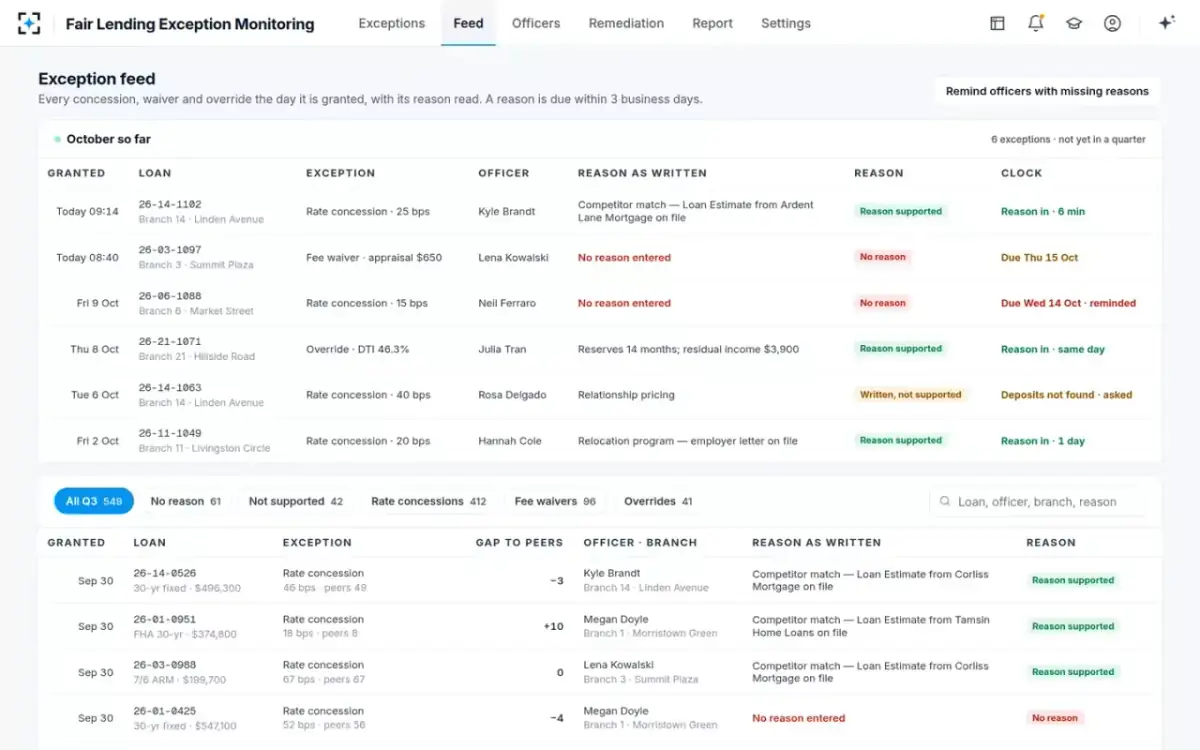
Look at the 40 bps relationship-pricing row: the reason is written, but the deposits it relies on were not found, so the request went back to the officer before anyone approved more.
What should a pricing exception policy include?
It should say who may grant what, for which reasons, on what evidence, and how every exception, approved or not, is captured and compared. The 2023 findings name each gap a policy can leave, and the Evolve consent order names what the Justice Department accepted as a fix: a policy "limiting Mortgage Division loan officers' and loan production offices' discretion in selecting interest rates, offering discounts, and charging fees", with documentation and "managerial approval in a standardized manner" (consent order, ¶7).
Seven clauses a pricing exception policy needs
- Authority tiers, including the bottom one
How many basis points each role may grant. A loan officer's own allowance is still an exception and is still captured; the CFPB faulted lenders that "did not flag those discretionary discounts as pricing exceptions."
- Permitted reasons, each with its evidence
Competitor match needs the competing offer; a relocation programme needs the employer letter; relationship pricing needs the deposits. A reason without its evidence is not accepted.
- Who initiated the request
A borrower request or an officer offer, captured at the time. Both CFPB reports faulted lenders that could not show the consumer asked.
- Criteria for the approver
What makes a request approvable and how large it may be. Managerial review with no stated basis for a yes or a no was a finding in its own right.
- Overrides kept apart
Underwriting overrides go to an underwriting manager under a compensating-factors policy, not to the pricing desk.
- Monitoring by prohibited basis
Incidence and amount of exceptions compared with similar loans, by branch and officer, often enough to act. Evolve's order required at least annual analysis of "concession incidence and value of concessions in basis points".
- Training and follow-through
The 2023 report found training that did not address fair lending risk in pricing exceptions, and policies that existed on paper while officers coached some borrowers and not others.
The clause most often missing is the first. A threshold below which no one approves is reasonable; a threshold below which nothing is recorded is the exact failure the CFPB described, because the discounts that never reach an approver are the ones no one compares.
Keeping the approver apart from the borrower's group
The approver should never know the borrower's race, ethnicity or sex, and the monitoring that watches the approver must. That separation is the point of the arrangement. Regulation B requires a home-purchase or refinance lender to ask for ethnicity, race and sex as "information for monitoring purposes", and the applicant is "asked but not required" to answer (12 CFR 1002.13); where it is missing, fair lending analysts estimate it. Both the reported and the estimated group belong with compliance. If they reach the pricing desk, the control becomes a risk.
In Fair Lending Exception Monitoring the borrower group estimator uses HMDA-reported data where the borrower gave it and an estimate from surname and census tract otherwise, keeps the probability, and is visible to the compliance role only. The peer matcher never uses it to choose comparison loans. The approver sees peers, reasons and evidence; the Fair Lending Officer sees the same exceptions with the groups applied.
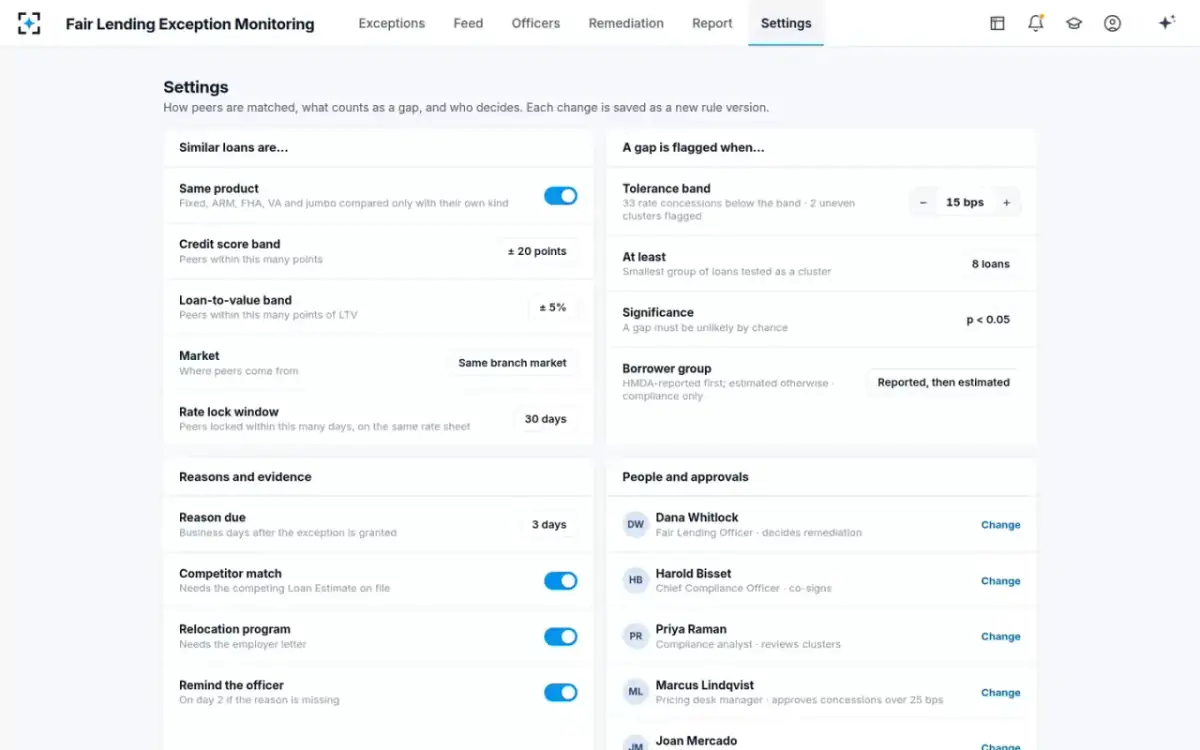
Who approves what, written down as settings
When the approver becomes part of the fix
When monitoring finds an uneven pattern, the approval seat is often where the correction lives. At the sample bank, the agents found that 11 rate concessions to Black borrowers (estimated) at one branch averaged 12 basis points against 50 for similar loans, with 9 of the 11 lacking any reason and 8 granted by one officer. The remediation the Fair Lending Officer signed had three parts. The borrowers were credited, the competitor-match policy was tightened, and for 90 days any concession by that officer above 10 basis points needed the pricing desk manager's approval before lock.
That third action is the approver seat used as a dial. It narrows one officer's discretion for a fixed period, to be reviewed on a set date, without changing the rate sheet for everyone else. The quarter that produced it is told in full in the quarterly review case study.
The broader lesson for anyone in this seat is simple. An approval is evidence only if it is recorded with what the approver saw. Approvals given on the officer's word leave the institution with a signature and no reason, which is the position the CFPB found lenders in twice. The Fair Lending Exception Monitoring page shows how the approver's view, the feed and the compliance review fit together.
Questions people ask
What is a pricing concession?
A concession is a reduction from the price the rate sheet gives for a loan: a lower rate, a lender credit or a fee waived. It is one kind of pricing exception. The Evolve complaint describes officers deciding "what 'concessions' or discounts from the loan price to offer borrowers, if any", with no reason required.
How much pricing discretion do loan officers have?
No federal rule sets a number; each lender sets its own tiers. What regulators have set is the condition: discretion without criteria, documentation and monitoring is a risk factor under the FFIEC procedures, and discounts below a threshold that were never flagged were a 2023 CFPB finding. In the sample settings, the pricing desk manager approves anything over 25 basis points. The findings did not ban discretion; they faulted discretion that left no trace.
Are pricing exceptions a risk even when the policy is good?
Yes. The 2023 report found lenders with "more robust documentation and approval requirements" that still did not monitor whether the policies were followed, or whether a loan officer was "coaching certain consumers and not others regarding the competitive match process." A policy is a control only once its use is measured.
Who should approve underwriting overrides?
An underwriting manager, not the pricing desk, under a written policy on compensating factors. The FFIEC procedures list "lack of clear loan file documentation regarding reasons for any exceptions to standard underwriting criteria" as a risk factor in its own right.
Can the approver also run the fair lending review?
It weakens both. The reviewer has to see borrower groups and the approver must not, and a reviewer judging their own approvals is no review. Most lenders put the review with a Fair Lending Officer in compliance.