In fair lending, disparate treatment means treating a borrower differently because of a prohibited basis such as race, sex or national origin; disparate impact means a neutral policy that falls harder on a protected group without enough business justification. Between April 2025 and July 2026 the federal banking agencies and the CFPB removed disparate impact from their exams and from Regulation B. Disparate treatment was not touched, and the main way examiners prove it, comparing similar borrowers who got different terms, is the work a lender's pricing exception review already does. Botminds' Fair Lending Exception Monitoring exists for that comparison: it reads the reason behind every rate concession, fee waiver and underwriting override and sets each one against loans that were alike on the factors that should drive price.
The short answer for a chief compliance officer, then: the disparate-impact half of a fair lending programme has shrunk at the federal level, while the half that looks for unexplained differences between like borrowers is where the 2025–26 guidance points every examiner. The rest of this page sets the two theories side by side, lists what each agency changed, and shows what a comparison has to contain to stand up now.
Two theories of discrimination, and where each stands in late 2026
Disparate treatment: Was this borrower treated less well than a similar borrower, on a prohibited basis?
Disparate impact (effects test): Does a neutral policy fall harder on a protected group, without enough business need?
Disparate treatment: Overt statements, or comparative evidence: like borrowers, different outcomes, no legitimate reason that explains it.
Disparate impact (effects test): Outcome statistics across a whole policy, then the lender's business justification and less discriminatory alternatives.
Disparate treatment: No. The FFIEC procedures say it does not require a showing of prejudice beyond the difference in treatment.
Disparate impact (effects test): No. That was its point, and the reason it was dropped.
Disparate treatment: Examined. OCC and FDIC say they look for evidence of disparate treatment.
Disparate impact (effects test): Not examined by the OCC (July 2025) or the FDIC (August 2025).
Disparate treatment: Unchanged.
Disparate impact (effects test): Effects test removed from §1002.6(a), effective 21 July 2026.
Disparate treatment: Unchanged.
Disparate impact (effects test): Recognised by the Supreme Court in 2015; HUD has only proposed removing its rule.
Disparate treatment: Matched pairs, comparative file review, regression with credit controls, the reason on file.
Disparate impact (effects test): Portfolio-wide outcome rates by group.
What is the difference between disparate impact and disparate treatment?
Disparate treatment is about how a person was treated; disparate impact is about what a neutral rule did to a group. Both are ways of proving a breach of the same two statutes. The Equal Credit Opportunity Act makes it unlawful for a creditor "to discriminate against any applicant, with respect to any aspect of a credit transaction" on a prohibited basis (15 U.S.C. 1691). The Fair Housing Act reaches the "terms or conditions" of residential real-estate lending (42 U.S.C. 3605). Pricing is a term, so a rate concession or a waived fee falls under both.
The interagency exam procedures name three methods of proof: "Overt evidence of disparate treatment", "Comparative evidence of disparate treatment" and "Evidence of disparate impact" (FFIEC, 2009). Comparative evidence is defined as "differences in treatment that are not fully explained by legitimate nondiscriminatory factors." Overt evidence, a policy or a remark that names a prohibited factor, is rare in a modern lender. Comparative evidence is how almost every pricing case is actually made, and it is the one a lender can measure for itself.
Disparate treatment "does not require any showing that the treatment was motivated by prejudice or a conscious intention to discriminate against a person beyond the difference in treatment itself."
FFIEC Interagency Fair Lending Examination Procedures
That sentence is the reason disparate treatment is not the "safe" theory some summaries of the 2025 changes make it sound. A loan officer who gives a larger concession to the customers who ask in a certain way, or who knows which customers to tell about a competitor-match policy, need not intend anything. If like borrowers end up with different prices on a prohibited basis and the file holds no reason that explains it, the comparison does the work.
What are examples of disparate treatment in lending?
An open rule that names a prohibited basis, a better price or approval for one group than for like borrowers, and unequal access to credit by neighbourhood. The interagency procedures give a textbook case of the first: a credit card with a limit of up to $750 for applicants aged 21 to 30 and $1,500 for applicants over 30, which "violated the ECOA's prohibition on discrimination based on age" (FFIEC, 2009).
Disparate treatment in lending, by the form it takes
| Form | What it looks like | How it is shown |
|---|---|---|
| Overt | A policy or statement that names a prohibited basis, such as the age-based card limits in the FFIEC example | The document or remark itself |
| Comparative, in pricing | A larger concession, waived fee or lender credit for one group than for like borrowers | Matched loans priced from the same sheet, and the reasons on file |
| Comparative, in underwriting | An override or exception approved for some applicants and denied to like applicants | Marginal approved and denied files side by side, with compensating factors |
| Steering | Like applicants guided to different products, such as a higher-priced loan | Product placement by group among applicants who qualified for the same products |
| Redlining | Unequal access to credit, or unequal terms, because of the make-up of an area | Lending by census tract against the market and peers |
Is disparate impact or disparate treatment more difficult to prove?
Disparate impact was always the longer road, and at the federal level it is now closed for ECOA. Under the procedures, a disparity from a neutral policy "is not alone proof of a violation": the agency then asks whether the policy is justified by "business necessity", a justification that "must be manifest and may not be hypothetical or speculative", and whether "an alternative policy or practice could serve the same purpose with less discriminatory effect" (FFIEC, 2009). Each step is contestable, and each needs portfolio data.
Comparative disparate treatment is shorter once the comparison exists. Like borrowers, different outcomes, and the burden moves to the lender to explain; an explanation that is not credible can end the inquiry. That is why the rollback changed less for pricing than the headlines suggested: the harder theory went, and the one that turns on a single file and its reason stayed.
Which agencies dropped disparate impact in 2025 and 2026, and how far each went
Five actions in fifteen months removed disparate impact from federal bank supervision and from Regulation B. None of them removed disparate treatment, and two of them said in terms that treatment would still be examined.
The federal disparate-impact rollback, action by action
| Date | Action | What it says | What it keeps |
|---|---|---|---|
| 23 Apr 2025 | Executive Order 14281 | "eliminate the use of disparate-impact liability in all contexts to the maximum degree possible" | Directs agencies; changes no statute |
| 14 Jul 2025 | OCC Bulletin 2025-16 | Examiners "will not request, review, or conclude on" disparate-impact risk | "analyzing Home Mortgage Disclosure Act data for possible evidence of disparate treatment" |
| 29 Aug 2025 | FDIC FIL-41-2025 | Exam manual updated | Evaluates discrimination "only through evidence of disparate treatment" |
| 14 Jan 2026 | HUD proposed rule | Would remove HUD's discriminatory-effects regulation | Proposal only; courts decide the FHA question |
| 22 Apr 2026 | CFPB Regulation B final rule | "The Act does not provide that the 'effects test' applies" | Effective 21 July 2026; treatment untouched |
Read the OCC bulletin closely and it describes a narrower exam, not a lighter one. The OCC said its supervisory processes "continue to include regularly conducting fair lending risk assessments, analyzing Home Mortgage Disclosure Act data for possible evidence of disparate treatment, conducting risk-based fair lending examinations, and taking appropriate action if evidence of disparate treatment is found" (OCC, July 2025). The FDIC's letter is shorter and says the same thing: it "will evaluate potential discrimination under the Equal Credit Opportunity Act and Fair Housing Act only through evidence of disparate treatment" (FDIC, August 2025).
Is disparate impact still enforced in fair lending?
Not by the federal banking agencies or, under ECOA, by the CFPB; it can still be raised under the Fair Housing Act, by private plaintiffs and by states. The statutes did not change, and neither did the people who can enforce them outside federal bank supervision. Private plaintiffs can still sue under ECOA and the Fair Housing Act. State attorneys general and state regulators enforce their own fair lending laws, and a state examiner reviewing a licensed mortgage lender is not bound by an OCC bulletin. Under the Fair Housing Act, disparate impact is a theory the Supreme Court has recognised, so an agency's choice not to examine for it leaves the courts' position where it was.
The practical point for a lender is about records, not theory. Every one of those parties proves its case from the same loan files and pricing data. A concession granted without a reason looks the same to an OCC examiner looking for treatment as it does to a plaintiff's expert or a state examiner. A programme that only tracked portfolio-wide outcome rates has lost much of its federal audience. A programme that can explain each discretionary price, loan by loan, serves every audience that is left.
Why pricing exceptions are disparate-treatment evidence, not an impact statistic
A pricing exception is a decision a person makes about one borrower, so a gap in exceptions is a gap in treatment. It is not a neutral rule with uneven effects. When the CFPB found competitor-match exceptions granted unevenly in 2021 and again in 2023, it described lenders "discriminating in the incidence of granting pricing exceptions" and found no "legitimate, non-discriminatory reasons that explained the disparities" (Supervisory Highlights, Issue 30). That is comparative evidence in its plainest form. In its 2023 fair lending report the CFPB named pricing exceptions as one of the two most frequent fair lending issues in its supervisory work (CFPB, July 2024).
Older cases point the same way, with one caution. The Justice Department's 2022 complaint against Evolve Bank & Trust alleged Black borrowers paid 13 to 19 basis points more in discretionary pricing and that the bank required no reason for concessions. It was pleaded as disparate impact (complaint, ¶¶ 24–31). The facts underneath it, discretion without a recorded reason and a gap between like borrowers, are the same facts an examiner would now test as treatment. The discussion of the evidence a competitor-match exception needs follows the 2021 and 2023 findings in detail.
One comparison, the way an examiner would read it
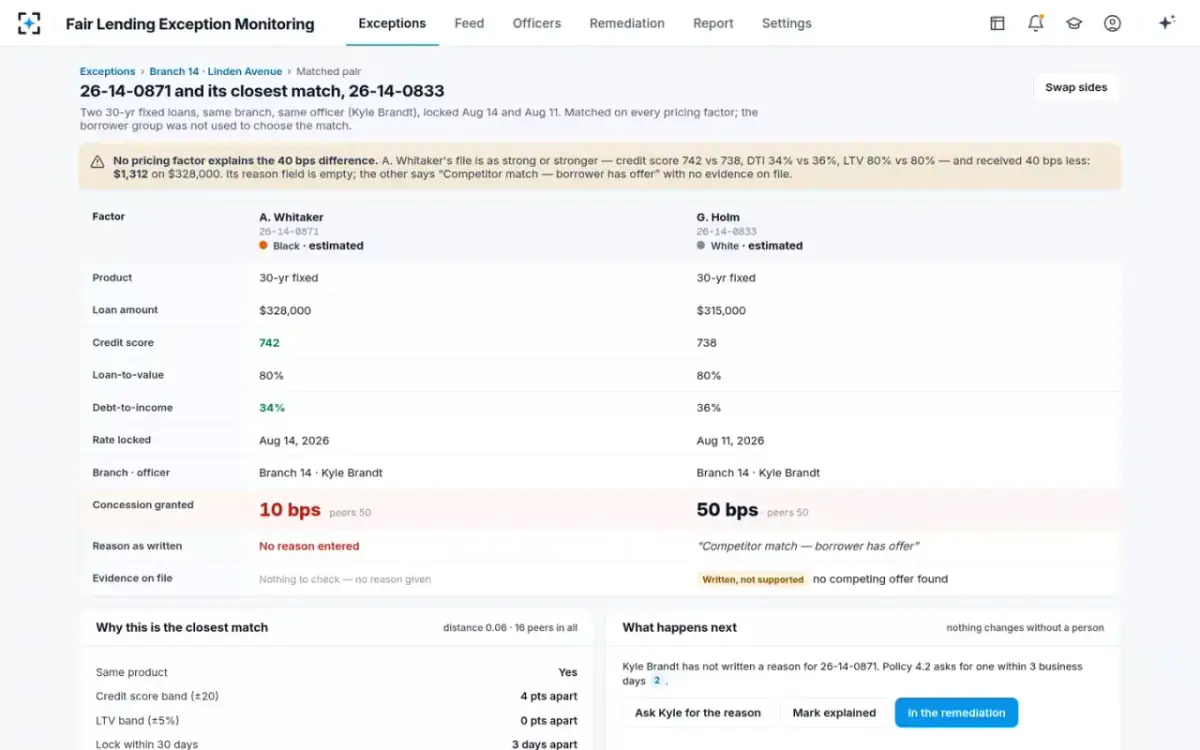
This is comparative evidence of disparate treatment as the FFIEC defines it: a difference in treatment not explained by a legitimate factor on file.
How examiners compare like borrowers, and what makes a comparison hold
Examiners select a prohibited-basis group and a control group, review every discretionary term, and look for control borrowers who were treated better than prohibited-basis borrowers with similar or weaker credentials. The procedures tell them to review "all loan terms and conditions (rates, points, fees, maturity variations, LTVs, collateral requirements, etc.) with special attention to those which are left, in whole or in part, to the discretion of loan officers or underwriters" (FFIEC). Where they find a difference, the lender must explain it: "If the lender's explanation is found to be not credible, the agency may find that the lender discriminated."
Three things decide whether a comparison holds. The peers have to be alike on the factors that legitimately drive price: product, credit score, loan-to-value, market and the rate sheet in force on the lock date. The borrower group must play no part in choosing the peers, or the comparison proves nothing. And the explanation has to be on file from the time of the decision, because an explanation produced during the exam is exactly what the procedures ask examiners to test for credibility. The page on reasons written at the time takes that last point further.
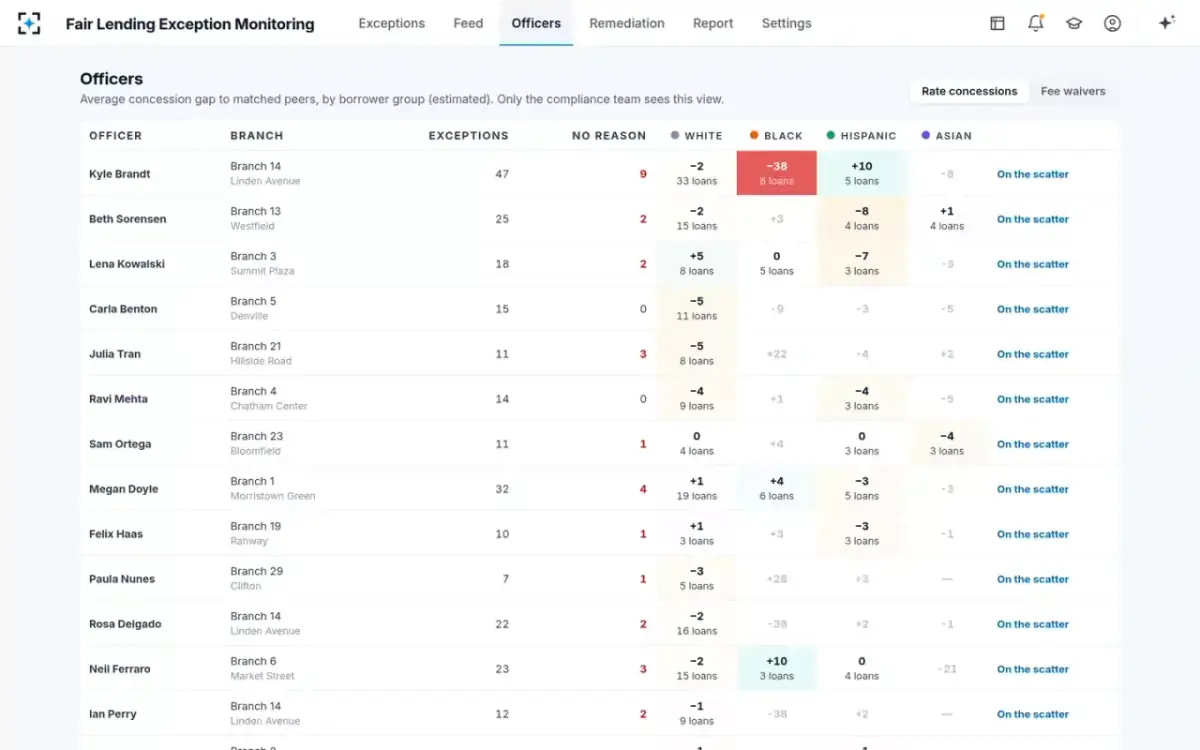
Small groups matter too. The procedures warn examiners not to ignore a pattern because it is small: "there is strong reason to examine a pattern in which almost all of 19 male borrowers received low rates but almost all of four female borrowers received high rates." A branch or a single officer is often where a pattern starts, long before it shows in bank-wide averages.
Where a treatment gap usually starts: one desk, not the whole bank
What a disparate-treatment monitoring programme needs in 2026
A programme built for the current exam answers one question for each discretionary price: was this borrower treated as similar borrowers were, and if not, what legitimate reason is on file? Portfolio statistics still help to find where to look, but the unit of proof is the exception and its comparison.
Six tests for a pricing review built around disparate treatment
- Every discretionary price is captured
Concessions, fee waivers, lender credits and overrides, including those below an approval threshold. The CFPB found lenders that did not flag sub-threshold discounts at all.
- Peers are chosen on pricing factors only
Product, score band, LTV band, market and lock date on the same rate sheet. The borrower group is used to read the result, never to pick the comparison.
- Each exception carries a reason from the day it was granted
With the evidence the policy requires, such as a competing Loan Estimate. A reason added months later is advocacy, not a record.
- Small groups are tested
Branch, officer and product, down to a handful of loans, because that is where examiners are told to look.
- Findings say "unexplained", not "discrimination"
The analysis reports a gap and its significance; a qualified person decides what it means.
- Corrections reach every affected borrower
Examiners check whether remediation covers all consumers harmed, not just the files in the sample.
Fair Lending Exception Monitoring is built on that list. Its agents collect each exception the day it is granted, read the reason against the evidence the pricing policy requires, match the loan to peers on product, score, LTV, market and lock window, and test branches, officers and products for gaps. The disparity finder reports a gap as "unexplained" and hands it to the Fair Lending Officer; it never labels anything discrimination. How that line between agents and people is drawn is the subject of agents compare, people conclude, and the Fair Lending Exception Monitoring page shows the whole quarter on sample data.
Questions people ask
Did the CFPB remove disparate impact from Regulation B?
Yes. Its April 2026 final rule revised 12 CFR 1002.6(a) to say "the Act does not provide that the 'effects test' applies for determining whether there is discrimination", effective 21 July 2026. Private plaintiffs and states are not bound by the CFPB's reading, and courts will decide how far the statute reaches.
What is overt evidence of discrimination in lending?
The interagency procedures say there is overt evidence "when a lender openly discriminates on a prohibited basis", in a written policy, a scorecard or a statement. It is rare in a modern lender, which is why most cases rest on comparative evidence.
Is redlining disparate treatment or disparate impact?
The interagency procedures treat it as disparate treatment: "a form of illegal disparate treatment in which a lender provides unequal access to credit, or unequal terms of credit," because of the make-up of an area. It survives the 2025–26 changes for that reason.
Do we still need statistical testing if disparate impact is gone?
Yes, for a different purpose. Statistics now serve to find where like borrowers were treated differently, so the controls for legitimate credit factors matter more than ever. A raw gap between groups is a pointer to files, not a finding.
Can a lender still be sued for disparate impact?
Under the Fair Housing Act, yes: the Supreme Court held in Inclusive Communities (2015) that disparate-impact claims are cognizable, and HUD has only proposed changing its own rule. Under ECOA, the CFPB's 2026 rule states its reading, which courts may or may not follow.