Racial disparities in mortgage lending show up in price as well as in denials, and they survive the credit controls lenders use. An FDIC study of 2020 HMDA data found Black borrowers paid about $1,583 more than white borrowers over the life of a conventional purchase loan, after credit score, LTV and income. In the Justice Department's 2022 case against Evolve Bank & Trust, Black borrowers paid 13 to 19 basis points more in discretionary pricing than white borrowers over six years. A basis point is one hundredth of one percent, so a pricing gap becomes dollars the moment it meets a loan amount. Botminds' Fair Lending Exception Monitoring measures each rate concession, fee waiver and override against similar loans in basis points, and when a gap is unexplained, drafts the credit to each borrower as the gap times that borrower's loan.
Extra discretionary pricing at one bank, 2014 to 2019, by borrower group
Do Black borrowers pay higher mortgage rates?
Yes, on the best government and academic evidence, and by more than the rate alone shows. Stephen Popick's FDIC study used the pricing fields added to HMDA in 2018 (interest rate, discount points, lender credits and total loan costs) together with credit score, LTV and income. On conventional purchase loans in 2020, Black borrowers paid 6.1 basis points more in interest rate than white borrowers after those controls, and Hispanic borrowers 6.4 more (FDIC CFR Working Paper 2022-05). Six basis points sounds trivial. Priced across all four components over a 30-year loan of $200,000, it is not.
The price gap over a loan's life, by loan type, 2020
The market-wide estimate most often quoted comes from Bartlett, Morse, Stanton and Wallace, who matched HMDA data to other loan data to control for credit: "lenders charge Latinx/African-American borrowers 7.9 and 3.6 basis points more for purchase and refinance mortgages respectively, costing them $765M in aggregate per year in extra interest" (NBER Working Paper 25943). The two studies use different data and methods and land in the same range: single-digit basis points of rate, hundreds to a couple of thousand dollars a loan.
Are racial disparities in mortgage pricing explained by credit?
Partly, and the part that remains is what fair lending law cares about. Without controls, Popick found conventional purchase rates 13.1 basis points higher for Black borrowers than for white borrowers; with credit score, LTV, income and lender controls, 6.1. More than half of the raw gap is explained by the factors a rate sheet prices. The rest is not, and the study found it "generally higher for borrowers in lower credit score ranges" in conventional purchase and refinance lending (FDIC CFR WP 2022-05).
The NBER authors found a second pattern that points at the mechanism: "FinTech algorithms also discriminate, but 40% less than face-to-face lenders." Where a person sets part of the price, more of the gap appears. Neither study proves that any one lender discriminated; a market average cannot. A lender answers that question with its own loans, its own rate sheets and the reasons its staff wrote down, which is where an examiner will look too.
The borrower's side, in four numbers
13.1 → 6.1bps
the conventional purchase rate gap for Black borrowers, before and after credit controls
FDIC CFR WP 2022-05
$765M
a year in extra interest paid by Latinx and African-American borrowers, market-wide
NBER w25943
40%
less discrimination by algorithmic lenders than face-to-face ones
NBER w25943
$1,312
the gap between two similar loans in a sample matched pair
Fictional sample data
What is discretionary pricing discrimination?
It is a difference in price that a person chose, off the rate sheet, which falls unevenly by race, ethnicity or sex and is not explained by a legitimate factor. The rate sheet prices risk: score, LTV, product, lock period. Discretion lives in what happens next. A loan officer grants a concession, waives a fee, adds a lender credit or holds the price where it is. The Justice Department's Countrywide settlement described "subjective and unguided pricing discretion" by loan officers and brokers (DOJ, 2011), and the phrase recurs in later cases.
The legal test does not need intent. The interagency examination procedures say disparate treatment "does not require any showing that the treatment was motivated by prejudice or a conscious intention to discriminate", and that when a lender "has apparently treated similar applicants differently on the basis of a prohibited factor, it must provide an explanation for the difference in treatment" (FFIEC Interagency Fair Lending Examination Procedures). The explanation has to be credible and on file. That is why the documented reason for each exception matters as much as its size; reasons written at the time covers what holds up.
How much does a basis point cost on a mortgage?
It depends on where the basis point sits. A basis point of up-front price, in fees, points or a concession off the rate sheet, is $30 on a $300,000 loan, paid once at closing. The Evolve complaint defines it that way: "A basis point is one hundredth of one percent of the total principal amount of the loan" (complaint, ¶31). A basis point of interest rate is paid on the balance every month the loan is held, so it costs far more over time than its up-front cousin.
A borrower's cost of an unexplained pricing gap
Up-front price gap
gap in bps ÷ 10,000 × loan amount
Paid once, through a smaller concession, a fee not waived or points not credited. A 40 bps gap on $328,000 is $1,312.
Measured against similar loans on the same rate sheet
Interest-rate gap
payment at the higher rate − payment at the lower rate, each month held
On $300,000 over 30 years, 6.60% instead of 6.50% adds about $19.77 a month: about $1,660 over seven years, about $7,118 if held to maturity.
Our arithmetic
Remedy returned
credit to principal, or refund
What the lender pays back once the gap is found and no legitimate reason explains it.
Decided and signed by people
For most retail lenders, the exception review measures the first kind. Rate sheets set the rate for credit score, LTV and lock period, and the discretion sits in concessions, waived fees and lender credits, which are fractions of the loan amount. That is why the Evolve complaint alleges gaps of 13 to 19 basis points in discretionary pricing and per-borrower figures in the hundreds of dollars, while research on rates quotes single-digit basis points that compound over years. The sample bank's matched pair, at 40 basis points, is one fictional pair, not a typical figure.
What did the Evolve Bank settlement find?
It found that unguided concessions, with no reason required, produced statistically significant price gaps by race, ethnicity and sex. According to the complaint, Evolve's pricing policy "allowed loan officers broad discretion to select inflated initial interest rates to present to borrowers and then to determine what 'concessions' or discounts from the loan price to offer borrowers, if any." Until at least July 2018 the bank "did not require its loan officers to have a reason or to provide any documentation or justification" for a concession (complaint, ¶¶ 18, 24). The disparities, the complaint says, "are not related to borrower credit characteristics."
The bank settled in 2022 with a $1.3 million fund for borrowers and a $50,000 penalty (DOJ). The consent order then set out what monitoring should look like: a pricing policy that "mandates documentation of pricing exceptions, including loan officer and loan production office decision-making and managerial approval in a standardized manner"; at least annual analysis of "concession incidence and value of concessions in basis points", using methods approved in advance; and prompt corrective action for any statistically significant disparity not explained by a legitimate business need (consent order, ¶¶ 7, 12–14). Read as a specification, it describes exception monitoring.
What the pricing cases cost borrowers, and what lenders paid back
The largest settlements were built on the same mechanism, discretion over part of the price, at very different scales. Dividing relief by the number of borrowers is only a rough guide, because relief also covers penalties and programmes, but it shows the order of magnitude per household.
Four pricing-discretion cases, from the borrower's side
| Case | Borrowers affected | Relief | Mechanism |
|---|---|---|---|
| Countrywide (DOJ, 2011) | More than 200,000 African-American and Hispanic borrowers | $335 million | "Subjective and unguided pricing discretion" by loan officers and brokers |
| Wells Fargo (DOJ, 2012) | Wholesale borrowers who paid higher rates and fees or were steered to subprime | More than $175 million in relief, in the Justice Department's words | The same discretion theory, in wholesale lending |
| Ally (CFPB and DOJ, 2013) | More than 235,000 minority auto borrowers | $80 million damages, plus an $18 million penalty | Dealer markup discretion "regardless of consumer creditworthiness" |
| Evolve Bank & Trust (DOJ, 2022) | Black, Hispanic and female mortgage borrowers among about 21,670 loans | $1.3 million fund, plus a $50,000 penalty | No reason required for concessions |
Two lessons sit in the table. Per-borrower harm is modest, a few hundred dollars to a little over a thousand, which is why it goes unnoticed by the borrower and unchallenged in the market. And the totals are large because discretion repeats: the same practice applied to thousands of loans over years. A monitor that finds a gap after one quarter rather than six years changes the second number, not the first.
Why the borrower's dollars are the measure of a lender's exposure
Because remediation is computed in them. When a lender finds that a violation more likely than not occurred, the corrective action Regulation B describes "may include both prospective and remedial relief", and remedial relief goes to each applicant "identified by the self-test as one whose rights were more likely than not violated" (12 CFR 1002.15). Examiners ask the same question from the other side: whether the institution "provides retrospective remediation to all consumers harmed by a particular violation" (CFPB compliance management review procedures). Both point to a number per borrower, summed.
That makes the exposure from a pricing gap easy to state and hard to bound without data. It is the gap times each affected loan, for every affected borrower, for every period the practice ran, before any penalty. A lender that knows its gaps by branch and officer each quarter can state that number; a lender that reads a small sample of files a quarter cannot. Time matters too: Regulation B requires a creditor to keep the information used in evaluating an application for 25 months (12 CFR 1002.12), so a gap found years late may have to be rebuilt from whatever files survive.
How are fair lending pricing disparities remediated?
By paying each affected borrower the unexplained part of their price and changing the practice that produced it. Fair Lending Exception Monitoring's fictional sample bank found one such gap in the third quarter of 2026. Eleven rate concessions to Black borrowers (estimated) at one branch averaged 12 basis points, against 50 for similar loans: a 38 basis point gap, significant at p = 0.002 after score, LTV, amount and product, with no documented reason on 9 of the 11. The agents drafted the credit as that gap applied to each loan amount, paid by principal reduction.
The remedy in dollars, borrower by borrower
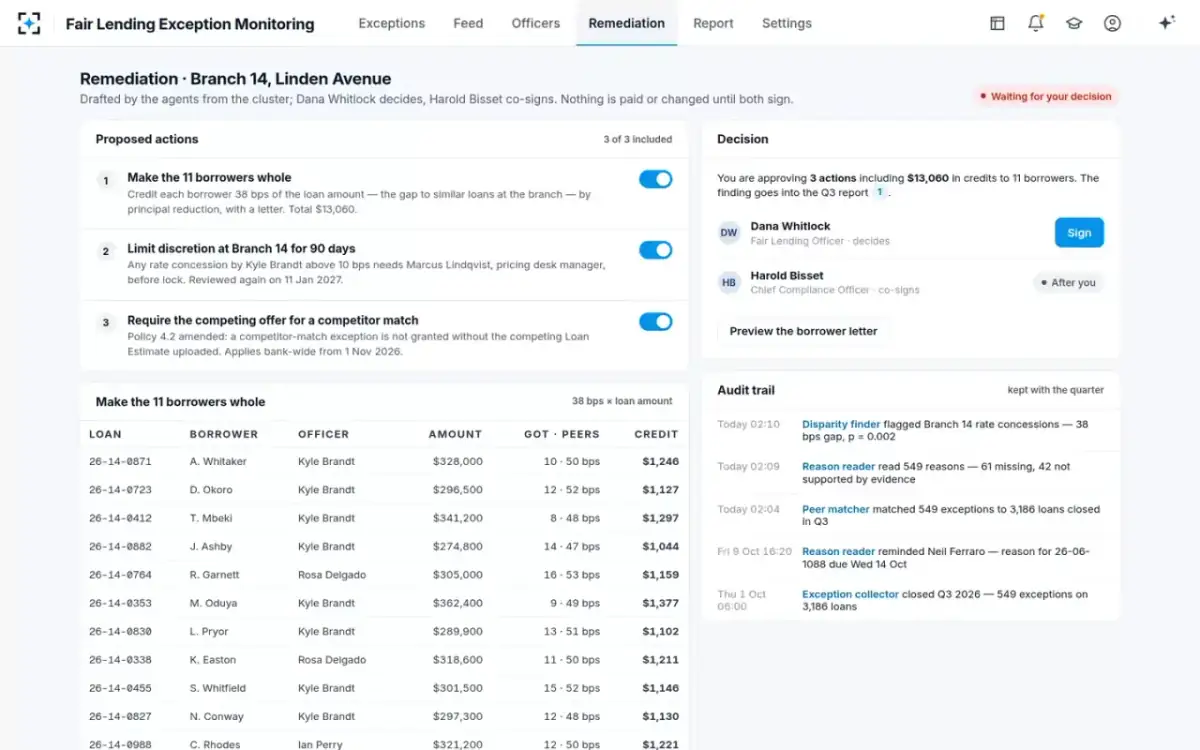
Two choices in that draft are worth noticing. The credit uses the cluster's average gap, 38 basis points, rather than each loan's own gap to its closest match, which ranged from 33 to 40; a bank could choose either, and the draft shows its working so the choice is visible. And it pays by principal reduction, which reaches the borrower without a cheque to cash. The forward-looking half came with it: for 90 days, that officer's concessions above 10 basis points need the pricing desk manager's approval before lock, and a competitor match now needs the competing Loan Estimate on file. These are decisions for people, which is why the agents draft and stop; agents compare, people conclude sets out that line.
What the borrower receives
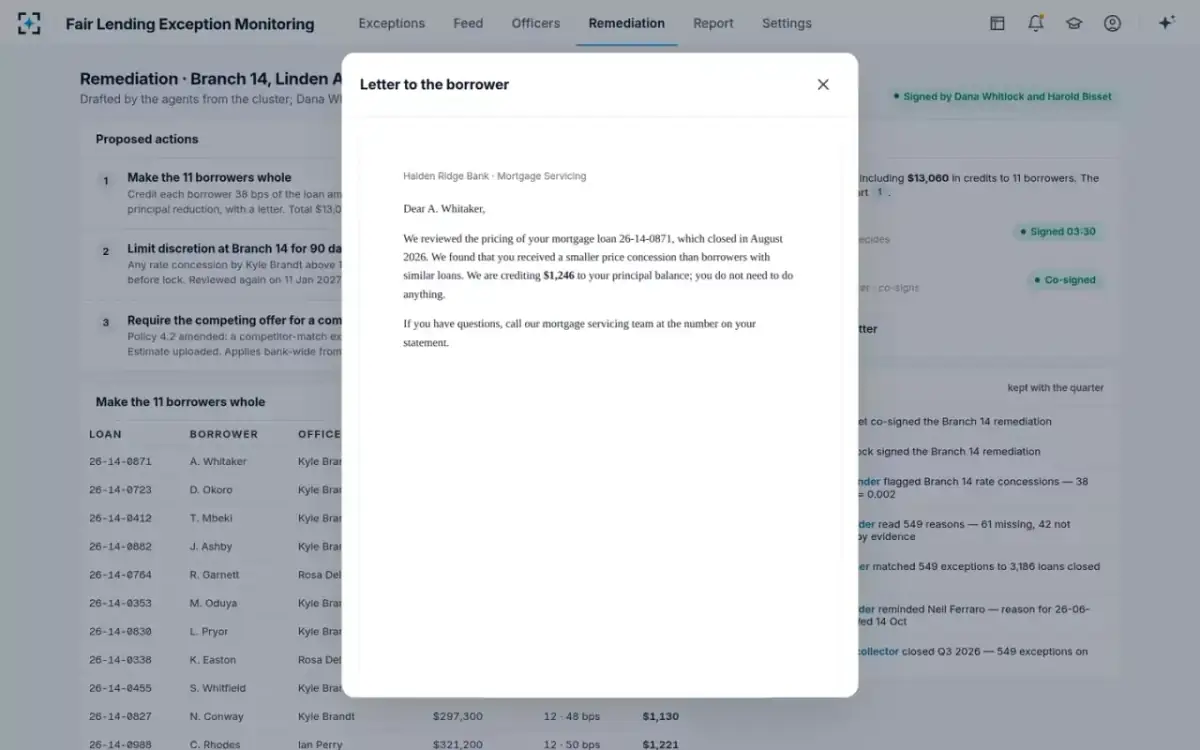
For the borrower in that letter, $1,246 is the difference between being priced like a similar neighbour and not. For the bank, it is a small sum found one quarter after the loans closed, rather than a six-year pattern found by someone else. The full quarter is told in the case study, and the public data that lets outsiders estimate gaps like these is covered in what HMDA pricing data shows an examiner. The Fair Lending Exception Monitoring page shows the remedy flow in full.
The same arithmetic on a fee waiver
Fee waivers are priced in the same unit and are easier to overlook, because a waived fee feels like a courtesy rather than a price. At the sample bank the second cluster found overnight was on fees: 14 waivers to Hispanic borrowers (estimated) at one branch were 6 basis points of loan amount on average, against 23 for similar loans, a 17 basis point gap, with 6 of the 14 lacking any reason and 10 of the 14 granted by one officer. That cluster was still in review by the bank's compliance analyst when the quarter's report was drafted, so no remedy had been decided.
The size of what is at stake is still easy to state. The 14 loans total $6,042,800, so a 17 basis point gap across them comes to about $10,270, or roughly $730 a borrower, by our arithmetic. Whether any of it is owed depends on what the review finds: a waiver programme the policy allowed for some loans and not others would explain part of it; an appraisal fee waived on request for some borrowers and not offered to others would not. The figure is the exposure, not the answer, and it is the number a Fair Lending Officer needs before deciding how deep the review should go.
Fees also reach borrowers differently from rate concessions. A borrower who paid a $650 appraisal fee that a neighbour had waived sees the difference on the Closing Disclosure, if they ever compare. A borrower whose concession was 40 basis points smaller sees only a final price. In neither case is the borrower in a position to know, which is why the measurement has to sit with the lender.
Questions people ask
How much more do minority borrowers pay for a mortgage?
Estimates vary with method and loan type. The FDIC study found about $1,583 more for Black borrowers and $1,725 for Hispanic borrowers over the life of a conventional purchase loan. The NBER study puts the market-wide total at about $765 million a year in extra interest.
Do women pay more for mortgages?
At one lender, the Justice Department alleged so. The Evolve complaint alleged that individual female borrowers paid 14 to 21 basis points more in discretionary pricing than individual male borrowers from 2014 to 2019, about $286 each in 2017. Sex is a prohibited basis under ECOA and the Fair Housing Act, so the same comparison applies.
Are FHA borrowers affected the same way?
Less, on the FDIC estimates. Over the life of an FHA purchase loan the gap was about $541 for Black borrowers and $26 for Hispanic borrowers, against $1,583 and $1,725 on conventional purchase loans. The study also found smaller interest-rate differences in FHA purchase lending.
Can a borrower tell whether they were overcharged?
Rarely. The public HMDA file shows each loan's rate and costs but, under the CFPB's 2019 disclosure policy, not the credit score or the loan officer (84 FR 649), so a borrower cannot build a true comparison. Only the lender holds the rate sheet, the score and the reason for each concession.
Is a 10 basis point gap worth remediating?
The size of the gap matters less than whether it is explained. A small unexplained gap that repeats across many loans and years is how the large settlements were built. A tolerance band that ignores small gaps should be set deliberately and approved in advance, as the Evolve order required for its methods.