A mortgage rate match, or competitor-match pricing exception, lowers a lender's price to meet another lender's offer, and it needs one piece of evidence above all: the competing offer itself, normally the other lender's Loan Estimate, in the file before the price changes. The CFPB found in 2021 and again in 2023 that mortgage lenders broke the Equal Credit Opportunity Act by granting these exceptions unevenly, often to borrowers with "no evidence of customer initiation" and with no documentation kept. Botminds' Fair Lending Exception Monitoring reads the reason behind every rate concession, fee waiver and override, and its reason reader will not class a competitor match as supported unless the competing offer is on file.
Matching a competitor is a legitimate business reason. A match nobody can verify is not a reason at all, and that gap is where the CFPB's findings sit. Here is the evidence a match needs, and why each piece is there.
What a competitor-match exception should carry before it is granted
- The competing offer itself
The other lender's Loan Estimate or written quote, with the borrower's name, the lender, the date, the product, the rate, points and lender credits. A note saying "has offer" proves nothing.
- Terms that are actually comparable
Same product and term, similar loan amount and lock period. A 15-year quote does not justify a concession on a 30-year loan.
- The borrower asked, and when
Who raised the competing offer, the borrower or the officer, recorded at the time. Both CFPB reports turned on whether the consumer initiated the request.
- A concession no larger than the match
The price difference to the competing offer, worked out, so the exception is sized to the reason rather than to the conversation.
- Approval at the right tier
Whoever approves sees the offer, not only the officer's summary of it.
- Kept with the loan file
Regulation B requires records used in evaluating an application to be kept for 25 months; an offer that lived in an email inbox is gone when the examiner asks.
Do lenders match mortgage rates?
Many do, as a pricing exception, and federal rules expect it. Regulation Z's commentary on loan officer pay says plainly that "the creditor may change credit terms or pricing to match a competitor", and then adds the condition that matters for who bears the cost: a lender and its officer "may not agree to set the loan originator's compensation at a certain level and then subsequently lower it in selective cases (such as where the consumer is able to obtain a lower rate from another creditor)" (Regulation Z, comment 36(d)(1)-5). The match comes out of the lender's margin, never out of the officer's commission.
Because the cost sits with the lender, the decision to match is a business decision, and a lender may decline. What it may not do is grant the match to some borrowers and not to like borrowers on a prohibited basis, or grant it on terms it cannot later explain. That is where every enforcement finding below sits: not in matching, but in matching without evidence and unevenly.
Why is a competitor match exception a fair lending risk?
Because the exception is discretionary, customer-driven and easy to grant, it reaches the borrowers who know to ask or whom an officer tells to ask. In the fall of 2021 the CFPB reported that "mortgage lenders violated ECOA and Regulation B by discriminating against African American and female borrowers in the granting of pricing exceptions based upon competitive offers from other institutions." Examiners found statistically significant disparities in how often the exceptions were granted, "did not identify evidence that explained the disparities", and found exceptions given to white and male borrowers "with no evidence of customer initiation" (Supervisory Highlights, Issue 25).
The lenders' own policies were part of the problem. They "relied on managers to promulgate a verbal policy that a consumer must initiate or request a competitor price match exception." Their own monitoring had already raised concerns: "lenders' fair lending monitoring reports and business line personnel raised fair lending concerns regarding the lack of documentation ... Despite such concerns, lenders did not improve the processes or document customer requests to match competitor pricing during the review period."
Competitor-match exceptions in the CFPB's own record
2reports
Supervisory Highlights findings on competitor-match exceptions, in 2021 and again in 2023
4bases
race, national origin, sex and age: the characteristics named in the 2023 finding
189
institutions cited by the agencies and the CFPB for ECOA or Regulation B violations in 2023
18
fair lending matters the CFPB referred to the Justice Department in 2023, including pricing-exception discrimination
What did the CFPB find about competitor match pricing exceptions in 2023?
It found the 2021 violation again, more widely, and traced it to policy design. The second report found the same violation "across a range of ECOA-protected characteristics, including race, national origin, sex, or age", and named the specific design flaws (Supervisory Highlights, Issue 30). Some policies let officers submit an exception request "without requiring that the request be substantiated by documentation." Some had "no documentation requirements for pricing exceptions below a certain threshold." Others gave some officers authority "up to certain thresholds without the need for competitive offer documentation or management approval", so those discounts were never flagged or monitored at all.
Those institutions "did not effectively monitor interactions between loan officers and consumers to ensure that the policies were followed and that the loan officer was not coaching certain consumers and not others regarding the competitive match process."
CFPB Supervisory Highlights, Issue 30 (2023)
Coaching is the hardest failure to control, and the evidence rule is the best defence a lender has against it. An officer can mention a competitor-match policy to one borrower and not another without leaving a trace. An officer cannot conjure a competing Loan Estimate for a borrower who never shopped. When every match needs the offer, the exception follows real shopping rather than the officer's sense of who might shop. The comparison also becomes testable: if borrowers in one group present competing offers as often as another but receive matches less often, that is a gap a review can find.
Lenders take one of two positions to close the coaching gap, and both work only with evidence. Some tell every applicant the match policy exists, in writing, so nobody depends on the officer to hear of it. Others leave the disclosure to the conversation but monitor the incidence of matches by group, by officer and by branch. Either way, a match without an offer defeats the control.
The same exception on the honour system and on evidence
Honour system: "Competitor match: borrower has offer."
Offer on file: The competing Loan Estimate, dated, with rate, points and credits.
Honour system: Unknown, or a verbal policy says the borrower must.
Offer on file: Recorded at the time: borrower presented the offer on a given date.
Honour system: Whatever was agreed in the conversation.
Offer on file: Worked out against the offer, no larger than needed to match.
Honour system: The officer's word.
Offer on file: The offer against the request.
Honour system: Cannot explain a gap; the CFPB found exactly this.
Offer on file: A legitimate, documented reason that can explain a difference between like borrowers.
Honour system: Invisible.
Offer on file: Limited to borrowers who really have an offer, and measurable.
Is a competing Loan Estimate required for a rate match?
No federal rule names the document, but the Loan Estimate is the one a lender can test, and a policy that requires it closes most of the gaps the CFPB found. Every lender must give one on the standard form within three business days of an application, so a borrower who has really shopped has one. And Regulation Z fixes what it shows, field by field, which makes two offers comparable without anyone's summary (12 CFR 1026.37).
Five fields on a competing Loan Estimate that decide a rate match
| Field on the form | What it shows | What the approver checks |
|---|---|---|
| Date Issued | The date the estimate was mailed or delivered | That the offer is current. Prices move daily; an old estimate is not today's competition. |
| Rate Lock | Whether the rate is locked and, if so, the date and time the lock ends | An unlocked quote "may change". A locked one shows a real commitment. |
| Loan Terms | Loan amount, interest rate, product and term | Same product, term and a similar amount. A 15-year quote does not support a 30-year concession. |
| Origination Charges | Points itemised as "% of Loan Amount (Points)", with lender fees | What the competitor's rate costs. A lower rate bought with points is not a lower price. |
| Comparisons: In 5 Years | Total principal, interest, mortgage insurance and loan costs over 60 months | One number for the whole offer, on the form's own instruction: "Use these measures to compare this loan with other loans". |
How recent must the offer be? Regulation Z does not say, so the lender's policy has to. A defensible rule ties it to the form: an offer whose rate is locked, or whose estimate was issued within a set number of days of the match, on the same product. Whatever the window, it is applied to every borrower the same way, because a window applied loosely is another kind of discretion.
How big should a rate-match concession be?
No larger than the price difference to the competing offer, worked out on the lender's own rate sheet. Matching the rate is not the same as matching the price, because the competitor's rate may be bought with points. An illustration on a $328,000 30-year fixed loan: the lender's sheet prices 6.500% at no points and 6.375% at 0.375 points. The borrower's competing Loan Estimate shows 6.375% with 0.25 points ($820). Matching on rate alone, at no points, gives away 37.5 basis points, $1,230. Matching the offer as it stands, 6.375% with 0.25 points, needs a concession of 12.5 basis points, $410.
The difference, $820 on a single loan, is the size of the discretion a policy leaves when it says "match" without saying "match what". Across a quarter it is also the difference that shows up as a gap between groups, if the generous version reaches some borrowers and the exact one reaches others. Writing the arithmetic into the exception request turns the size of the concession into something an approver can check and a reviewer can explain.
How to monitor rate matches for fair lending
Measure three rates by borrower group, branch and officer: how often borrowers present an offer, how often an offer is matched, and how large the match is against the offer. Each one answers a different failure. A gap in the first can point to coaching, the failure the 2023 report described. A gap in the second is uneven granting, the 2021 finding. A gap in the third is matches sized by conversation rather than by the offer.
None of the three can be measured without the offer on file, which is why the evidence rule comes first. With it, the monitor compares like with like: borrowers of similar score, LTV, product and lock date, priced from the same rate sheet, who showed the same kind of evidence. Without it, a review can only count the words "competitor match" in a free-text field.
What a sample bank's files showed when every match was checked
Take Halden Ridge Bank, the fictional sample bank that Fair Lending Exception Monitoring runs on, through its third quarter of 2026. Overnight after quarter end the agents read all 549 exceptions against their evidence. At one branch they found 11 rate concessions to Black borrowers (estimated) averaging 12 basis points, against 50 for similar loans, with 9 of the 11 carrying no reason at all. The comparison loans, the ones that got the larger concessions, told the other half of the story.
14 comparison loans at the fictional Branch 14: what their files held
One pair makes it concrete. Loan 26-14-0871, a $328,000 30-year fixed with a 742 credit score, 80% loan-to-value and 34% debt-to-income, received a 10 basis point concession and no reason. Its closest match at the same branch, same officer and same rate sheet, a $315,000 loan with a 738 score, 80% LTV and 36% DTI, received 50 basis points with the reason "Competitor match — borrower has offer". No competing offer was in the file. The stronger file got 40 basis points less, which is $1,312 on $328,000.
The match that could not be verified
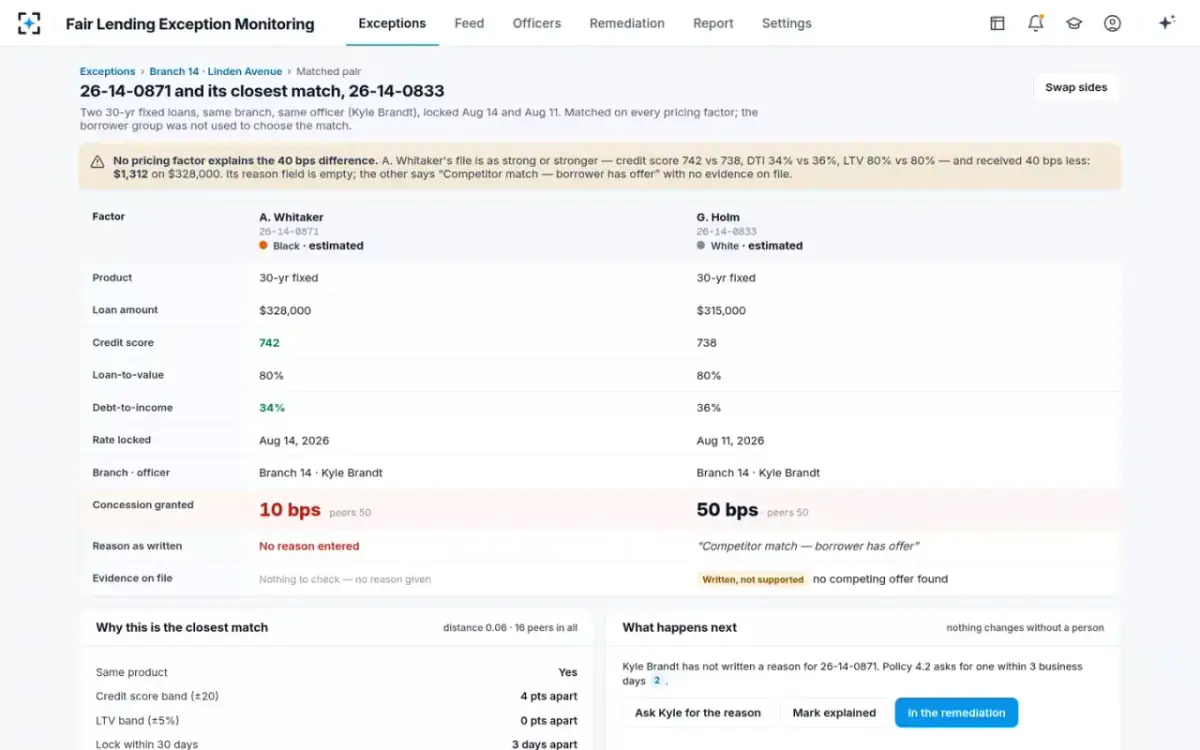
The borrower group is shown here to the compliance team only, and it was not used to choose the match.
From finding to policy: making the offer a condition of the match
The remediation the sample bank's Fair Lending Officer signed changed the policy rather than reminding officers of it. Its pricing policy was amended so that a competitor-match exception is not granted without the competing Loan Estimate uploaded, bank-wide, from 1 November 2026. The 11 borrowers were credited the 38 basis point gap, and one officer's larger concessions went to the pricing desk manager for 90 days. The consent order in the Justice Department's Evolve case pointed the same way: documented pricing exceptions, with "managerial approval in a standardized manner" (consent order, ¶7).
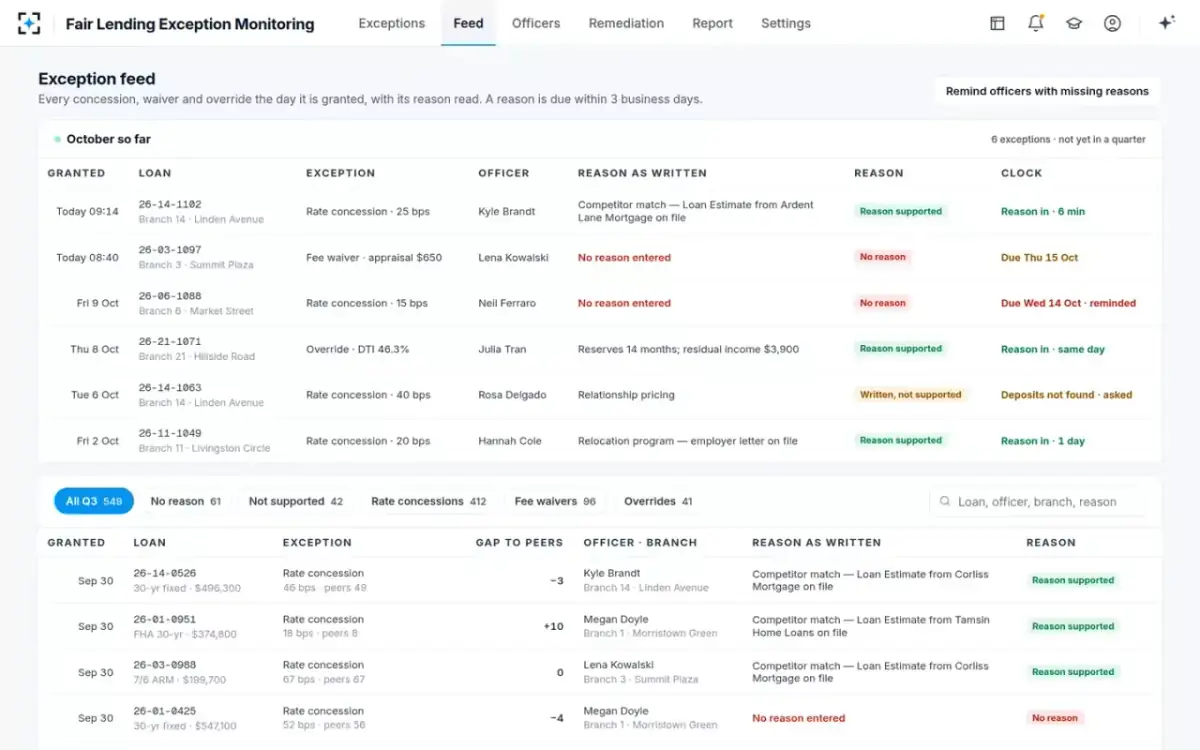
A rule like that only works if it is checked the day the exception is granted rather than at quarter end. In the solution's daily feed, a 25 basis point competitor match arrives with the competing lender's Loan Estimate attached and is classed supported within minutes. A match without one goes back to the officer with a request for the offer and a reminder on day 2. The page on reasons written at the time explains why that timing changes what the reason is worth.
A competitor match checked the morning it is granted
What the agents do not decide is as important. They do not judge whether a match was fair, whether the amount was right or whether a gap is discrimination. They make sure the evidence is there or flagged, and they put each exception next to similar loans so the people who do decide can see the pattern. That division of labour is set out in agents compare, people conclude. The Fair Lending Exception Monitoring page shows the rest of the sample quarter.
Questions people ask
Is it a fair lending violation to match a competitor's mortgage rate?
No. Matching a competitor is a legitimate business reason in itself. The CFPB's findings were about matches granted unevenly between like borrowers, without evidence that the borrower asked or had an offer, and without records that could explain the difference.
Does a verbal quote or a screenshot count as evidence?
A written offer that identifies the borrower, the lender, the date and the terms is what a reviewer can test. A verbal quote recorded only as the officer's note leaves the lender where the 2021 report found lenders: unable to show the consumer initiated the request.
Can a loan officer cut their commission to match a rate?
No. Under Regulation Z an individual loan originator's pay may not be lowered because the borrower got a lower rate elsewhere. The one exception is narrow: pay may be reduced to cover an unforeseen increase in a settlement cost, such as a rate-lock extension caused by an unexpected title delay (comment 36(d)(1)-7).
Does a mortgage rate match guarantee change the fair lending analysis?
It narrows it. A published guarantee states the terms to every borrower in the same words, which addresses the coaching risk. The lender still has to apply its conditions evenly and keep the competing offer, because examiners test who received matches, not what the advertisement promised.
Should we tell every applicant that we match competitors?
It narrows the coaching risk the 2023 report described, because nobody depends on an officer to learn of the policy. It does not replace the evidence rule or the monitoring; a match still needs the offer.