Yes, AI can monitor fair lending in pricing, if monitoring means finding and documenting: pulling every rate concession, fee waiver and underwriting override, reading each reason against the evidence the pricing policy requires, matching each loan to similar loans and testing branches and officers for gaps. It should not decide whether a gap is discrimination, what remediation is owed or whether a policy changes. Those are legal and institutional judgements with a named owner. Botminds' Fair Lending Exception Monitoring puts six specialist agents on the first kind of work and leaves the second to the Fair Lending Officer, with the Chief Compliance Officer co-signing anything that pays a borrower or changes a rule. Regulators draw the same line in their own use of AI, and it is the first thing to check in any AI fair lending tool.
Fair Lending Exception Monitoring, step by step: who does what, and what each agent may never do
Agent
Exception collectorPulls every concession, waiver and override the day it is granted, with the rate sheet of the lock day, the officer and the approver.
Never: Change a price or a loan.
Agent
Reason readerReads the officer's reason, looks for the evidence the policy requires, classes it supported, not supported or missing, and reminds on day 2.
Never: Write or suggest a reason, or accept a competitor match without the offer.
Agent
Peer matcherFinds loans with the same product, score within 20 points, LTV within 5, same market, lock within 30 days on the same sheet.
Never: Use the borrower group to choose peers.
Agent
Borrower group estimatorUses HMDA-reported race, ethnicity and sex where given; otherwise estimates from surname and census tract and keeps the probability.
Never: Show a group to a loan officer or the pricing desk, or feed a pricing decision.
Agent
Disparity finderTests branches, officers and products; where 8 or more loans differ beyond tolerance, tests significance with credit controls and looks for documented reasons.
Never: Call a gap discrimination. It says "unexplained" and shows its evidence.
A person decides
Fair Lending OfficerReviews the flagged cluster, the loans, reasons and peers; decides what the gap means and which actions to take; signs.
Agent
Report writerDrafts the remediation (credits and how each is computed, limits on discretion, policy changes) and the quarterly report.
Never: Send money or a letter. It drafts only.
A person decides
Chief Compliance OfficerCo-signs. Nothing is paid or changed until both have signed.
Where the line sits, and why it sits there
The line falls where the work stops being a comparison and becomes a conclusion about the law. Everything above it is checkable: whether a reason is on file, whether the evidence is attached, which loans are alike, how big a difference is and how likely it is to be chance. Everything below it involves weighing explanations, deciding what the institution believes happened and committing its money or its policy.
The rules themselves put those judgements on people. The interagency procedures say that where similar applicants were treated differently, the lender "must provide an explanation for the difference in treatment", and that the agency may find discrimination "if the lender's explanation is found to be not credible" (FFIEC, 2009). Credibility is weighed by people. The Evolve consent order required the bank, on finding a significant disparity, to "determine the reason(s)" and correct those "attributable to a policy or practice ... and not necessary to achieve one or more of its substantial, legitimate, nondiscriminatory business interests" (consent order, ¶14). Whether a business interest is substantial and legitimate is a judgement an institution has to own.
The decisions in a pricing review, and who owns each
| Decision | Who decides | What the agents prepare | Why it stays with a person |
|---|---|---|---|
| Is this exception's reason supported? | Agents class it; the officer can supply evidence | The reason, the policy clause, the evidence found or missing | It is a check against a written rule, so agents can do it; the officer still owns the reason |
| Which loans are alike? | Agents, on rules the bank sets | Peers on product, score, LTV, market, lock window | The peer definition is a policy setting, chosen and versioned by people |
| Is a gap worth a look? | Agents flag; the Fair Lending Officer triages | Gap, significance, cluster size, reasons | A flag is not a finding |
| What does the gap mean? | Fair Lending Officer | Every loan, reason and peer behind the flag, and how it was reached | Weighing explanations and credibility is a legal judgement |
| What is owed, and to whom? | Fair Lending Officer, co-signed by the CCO | Credits and how each is computed | It commits the bank's money and admits nothing by itself |
| Does policy or authority change? | Fair Lending Officer and CCO; pricing as the owner of the rate sheet | Drafted amendments and limits on discretion | It changes how the bank does business |
What do regulators say about AI in fair lending?
That existing law applies to it, people stay accountable, and the bank cannot hand its responsibility to a vendor. No regulator has published a rule on AI for fair lending monitoring. What exists says three consistent things: existing law applies, people stay accountable, and an institution cannot hand its responsibility to a vendor.
The NCUA, CFTC and Federal Reserve "use AI to help detect errors or outliers in data submitted by financial institutions." They said "they were not using AI to make decisions autonomously or relying on it as a sole source of input."
GAO-25-107197, Artificial Intelligence: Use and Oversight in Financial Services (May 2025)
That is the same split this page describes, applied by supervisors to their own work: AI finds outliers, people decide what they mean. The Treasury's 2024 report on AI in financial services notes that firms use AI for "risk management, regulatory compliance, customer service, and back-office operations", and says firms should review AI use cases "for compliance with existing laws and regulations before deployment" (Treasury, December 2024). On vendors, a Federal Reserve examiner put it plainly: "the institution remains responsible for ensuring that the output from vendor-provided systems and services meets regulatory requirements" (Consumer Compliance Outlook, 2019).
The revised interagency model risk guidance of April 2026 adds a gap rather than a rule. It says "Generative AI and agentic AI models are novel and rapidly evolving. As such, they are not within the scope of this guidance," and that a bank's own governance should decide the controls for anything it does not cover (revised guidance; SR 26-2). For an agent-based monitor, that leaves the bank to define the line itself, which is the argument for a line that is written down and enforced by design. What the second line should ask about the statistical part is set out in the model risk view.
Can AI decide whether a loan was discriminatory?
No, and a well-built monitor does not try: its agents write "unexplained", never "discrimination". "Unexplained" is what a comparison can establish, and "discrimination" is a legal conclusion about it. A gap of 38 basis points with a p-value of 0.002 and no documented reason is a strong reason to look. It is not yet a finding: the Fair Lending Officer may find a legitimate explanation the files did not record, such as a promotional program the policy permitted, or may conclude there is none.
The words also matter because of where the record goes. Regulation B privileges some self-tests, but not "loan and application files or other business records related to credit transactions, and information derived from such files and records, even if the information has been aggregated, summarized, or reorganized" (12 CFR 1002.15). A matched-pair review built from loan files should be written as if an examiner will read it, which means stating what the evidence shows and no more. Counsel should advise on privilege for any particular programme.
Preparing a finding and concluding one
What the agents prepare: "Concessions 38 bps smaller for one group, 9 of 11 without a documented reason. p = 0.002."
What people conclude: Whether that gap reflects treatment on a prohibited basis.
What the agents prepare: Every reason as written, the evidence found or missing, the closest matched pair.
What people conclude: Whether any explanation is legitimate and credible.
What the agents prepare: Who granted each exception and who approved it.
What people conclude: What, if anything, changes for that officer.
What the agents prepare: Credits drafted, with the arithmetic for each borrower; policy changes drafted.
What people conclude: Whether to pay, how much, and what to change.
What the agents prepare: Every step time-stamped, every number linked to its loans.
What people conclude: The signatures, and what is reported to the board.
Does AI fair lending monitoring need human review?
Yes, at every point where a flag becomes a conclusion. A flag earns a review, not a conclusion, and the review has a shape. The Fair Lending Officer opens the loans behind it and checks that the peers really are alike: same product and rate sheet, scores and loan-to-value close, locks in the same market week. She checks the borrower-group estimates that drive the split, since an estimate carries a probability rather than a fact. She looks for a legitimate explanation the files did not capture, such as a promotional programme that applied to some loans or a pricing correction made after an error. Where reasons are missing, she can ask the officers, knowing that an answer given now is weighed differently from one written at the time.
Closing a flag without action is a decision too, and it needs the same record. On the sample bank's quarter, one of the three overnight clusters (underwriting overrides above 45% debt-to-income, approved for 4 of 12 women against 7 of 11 men) was marked explained, with no action, because every denial had reserves and residual income on file. A second, a fee-waiver gap at another branch, went to the compliance analyst for review. Only the third went to remediation. Agents cannot make any of those three calls, and each is written to the audit trail with the name of the person who made it.
How is BISG used in fair lending analysis?
BISG, Bayesian Improved Surname Geocoding, estimates the probability that a borrower belongs to each race and ethnicity group from their surname and where they live, for loans where the borrower's own answer is missing. The CFPB uses it for non-mortgage products because ECOA and Regulation B "generally prohibit a creditor from inquiring" about race and similar characteristics, with exceptions that include HMDA-covered mortgage applications (CFPB, 2014). For mortgages, the borrower's HMDA answers come first; BISG fills the gaps where an applicant declined.
How the estimate is used matters as much as the estimate. The CFPB's research and enforcement staff "rely directly on the BISG probability" in their statistical work, rather than a threshold rule that assigns everyone above, say, 80% to a group with certainty. The report's example: two borrowers with 82% and 53% probabilities of being non-Hispanic Black become, under an 80% rule, one Black borrower and one non-Black borrower, which "removes the uncertainty about group membership at the cost of decreased statistical precision." A monitor should keep the probability, show which loans are estimated rather than reported, and keep both out of the pricing desk's view.
What should AI fair lending software do?
It should cover every exception, show its working down to the loan, and stop before any conclusion. A buyer evaluating AI fair lending software can test each point below on a quarter of its own loans; a tool that fails one of them moves work around rather than removing it.
Ten things to ask of AI fair lending software, before you buy
- Every exception, measured from the rate sheet
Not a sample, and not only the exceptions someone flagged. Sub-threshold discounts were a CFPB finding in 2023.
- Reasons read against the evidence
Supported, written but unsupported, or missing, with the document named. Never a reason written or suggested by the tool.
- A peer definition you set
Product, score and LTV bands, market and lock window as your settings, versioned, so an examiner can see which rule produced a result.
- Thresholds fixed before the run
Tolerance, minimum cluster size and significance level set in advance, as the Evolve consent order required for its methods.
- Borrower group handled with care
Reported first, estimated only where missing, probability kept, compliance-only access.
- Drill-through on every number
From a branch gap to the loans, the pairs and the reasons behind it. A score with no loans under it cannot be defended.
- Words that stop at the evidence
"Unexplained", with the evidence, not "discrimination".
- People sign every conclusion
Remediation, policy changes and closing a flag without action carry a named person's signature.
- A complete trail
Every request, reminder, run and decision time-stamped and kept with the quarter.
- A back-test on your own data
Run on a past period before you rely on it, with pass marks agreed in advance.
Where Botminds' solution fits, and where it does not: it is built for pricing exceptions and underwriting overrides on mortgage loans, the discretionary decisions a rate sheet does not make. It is not a test of a credit model for disparate impact, a redlining or market-coverage analysis, or a HMDA data validator. A lender whose main fair lending risk sits in those places needs those methods first. A lender whose risk sits in concessions, waivers and overrides is the case it was designed for, and the back-test page sets out how to prove that on your own exceptions.
What AI changes compared with a quarterly sample
Coverage, timing and the strength of the evidence an examiner sees. A quarterly review reads a sample of files weeks after quarter end; the agents compare every exception overnight, and from the day a policy goes live, ask for each reason while the borrower can still supply the document. Coverage matters to the exam itself: the interagency procedures let examiners lighten their own file testing where a lender's compliance programme and self-evaluation are strong (FFIEC, 2009), and a review that compared every exception is easier to show as strong than one that read forty files.
What AI does not change is accountability. A complete comparison makes the Fair Lending Officer's decision better informed and harder to avoid; it does not make it. The sample bank's estimated quarter shows the shift in effort: about 22 days of manual work on pulling data, chasing reasons, matched-pair sampling, branch testing and the report, against about 4.5 with the agents, an estimate rather than a measured result. The days that remain are the ones spent deciding.
How the line looks on one flagged cluster
On Fair Lending Exception Monitoring's fictional sample bank, the agents ran overnight after the third quarter of 2026 closed. By 02:10 they had collected 549 exceptions, read every reason, matched each loan to a median of 18 peers and found three clusters. One, at a branch on Linden Avenue, waited for the Fair Lending Officer's decision.
The agents' flag, waiting for a person
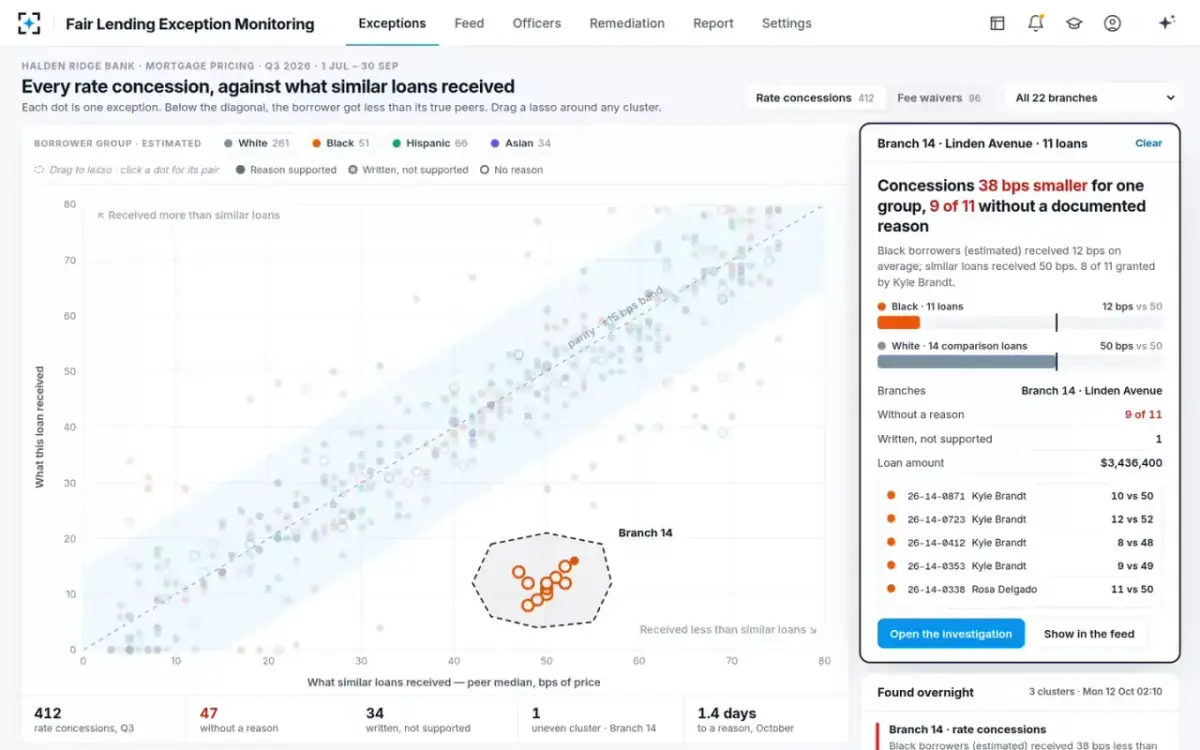
The Fair Lending Officer opened the investigation, read the 11 loans and the 14 comparison loans, and looked at how the agents had reached the flag. The test held after score, LTV, amount and product. Nine files had no reason, and of the comparison loans that got larger concessions, ten cited a competitor match and only four had the offer. She concluded that the gap had no legitimate explanation on file and chose a remediation from the draft: credits to the 11 borrowers, a 90-day limit on one officer's discretion and a change to the competitor-match policy.
The signature step states exactly what is being approved
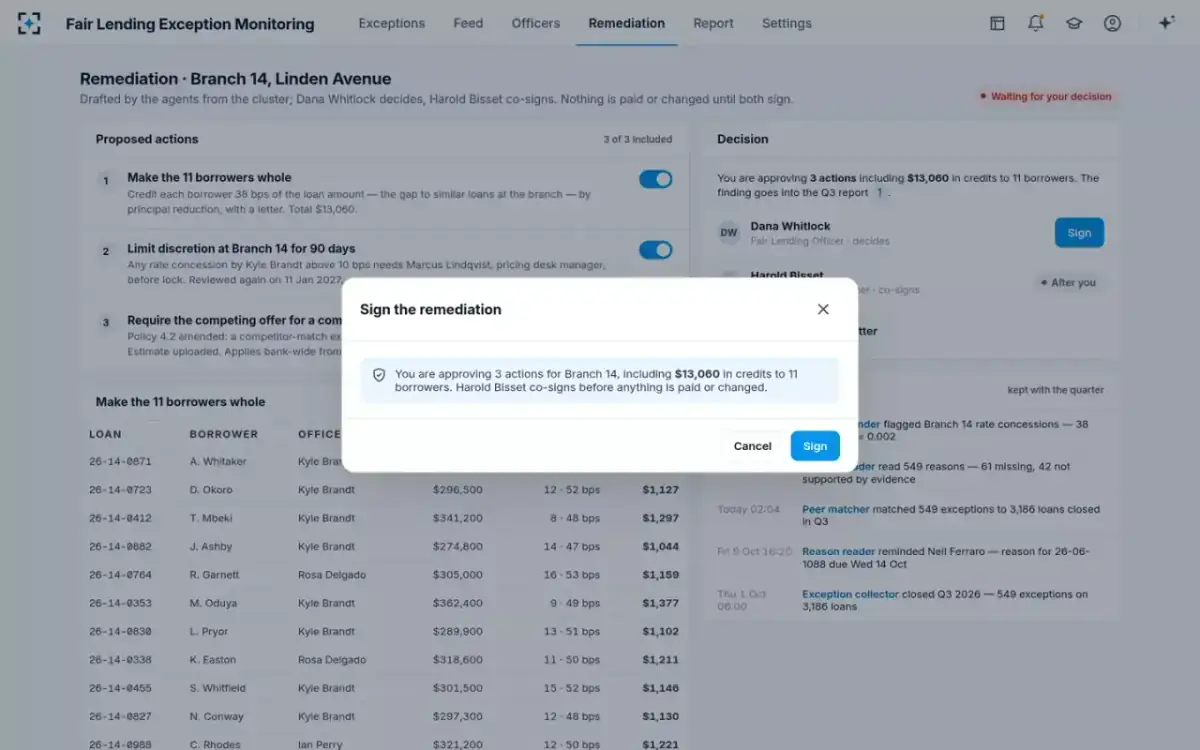
Nothing in that sequence asked an agent to decide. The agents made the decision possible on the morning after quarter end rather than weeks later, with every loan in view rather than a sample of forty. The full quarter is in the case study, and the reason the officer's own words carry so much weight is explained in reasons written at the time. The Fair Lending Exception Monitoring page shows the agents and their limits.
Questions people ask
Is an AI fair lending monitor a model under model risk guidance?
The statistical test inside it likely is, under the April 2026 definition of a model. The generative and agentic parts are outside that guidance's scope, so the bank's own governance must cover them. Either way the bank remains responsible for the output.
How do you explain an AI fair lending finding to an examiner?
By showing the loans, not the algorithm's opinion. Each flag carries the comparison loans, the peer rules and their version, the test and its result, and the reasons as written. An examiner can re-perform the comparison from the files rather than take the result on trust.
Can the bank change the thresholds?
Yes. In the sample settings the score band can be ±10, 20 or 30 points, the tolerance 5 to 40 basis points, the minimum cluster 5, 8 or 12 loans and the significance level 0.01 to 0.10. Each change is saved as a new rule version, so a later reviewer can see which rule produced which result.
Can the agents see borrower race?
One agent estimates borrower group where it was not reported, for the compliance team. The peer matcher never uses it, and it is never shown to loan officers or the pricing desk.
What if the agents miss an exception?
They work from the rate sheet of the lock day, so any price below it is captured whether or not it was flagged as an exception. A back-test on a past year is the way to check before relying on it, and the page on back-testing last year's exceptions sets one out.