For fair lending, a pricing exception's reason should be written when the exception is granted, by the person who granted it, with the evidence the pricing policy requires attached. A reason collected months later, when a quarterly fair lending review or an examiner asks, is reconstruction: the officer is remembering, or guessing, and the reviewer knows it. Most lenders still review rate concessions, fee waivers and underwriting overrides in a quarterly spreadsheet, so most reasons are chased long after closing. Botminds' Fair Lending Exception Monitoring moves the question to the day of the exception. It asks the officer for the reason, reads it against the evidence the policy names, and classes it supported, written but not supported, or missing.
The difference shows up at quarter end. At the solution's fictional sample bank, about one exception in nine had no reason at all when the quarter closed, and the shares were similar across every type of exception.
Where 549 exception reasons stood at quarter end, at a fictional bank
Rate concessions · 412
- Supported by evidence · 80%
- Unsupported or missing · 20%
Fee waivers · 96
- Supported by evidence · 82%
- Unsupported or missing · 18%
Underwriting overrides · 41
- Supported by evidence · 88%
- Unsupported or missing · 12%
Can an exception reason be documented after the fact?
It can, but it carries less weight, and examiners are told to test it. The burden falls on the lender to explain a difference, and an explanation is only as good as its credibility. The interagency procedures are direct: "If a lender has apparently treated similar applicants differently on the basis of a prohibited factor, it must provide an explanation for the difference in treatment. If the lender's explanation is found to be not credible, the agency may find that the lender discriminated" (FFIEC, 2009). Examiners are told to "obtain explanations from the appropriate loan officer or other employee for any differences that exist and reanalyze the sample."
An explanation written into the file the day the price was set meets that test on its face: nobody knew then which loans would be compared. An explanation given in the exam room, about a loan the officer priced eleven months earlier, has to be weighed against everything else the examiner sees. The same procedures list "lack of clear loan file documentation regarding reasons for any exceptions to standard underwriting criteria" as a risk factor in its own right.
"Contrary to the practice of many lenders in the industry, until at least July 2018, Evolve Bank did not require its loan officers to have a reason or to provide any documentation or justification for offering concessions or discounts to borrowers."
Complaint, United States v. Evolve Bank & Trust, ¶24 (2022)
That paragraph sat at the centre of a $1.3 million settlement fund and a $50,000 penalty. Its remedy put the reason back at the moment of decision: the consent order required "documentation of pricing exceptions, including loan officer and loan production office decision-making and managerial approval in a standardized manner" (consent order, ¶7). The CFPB's competitor-match findings say the same thing from the other side: lenders "failed to retain documentation to support pricing exceptions" (2021), and officers were "not properly documenting the initiation source of the concession request" (2023).
Two ways to have a reason on file
Rebuilt at review or exam: The officer, prompted by an analyst or examiner, about a loan priced months ago.
Written when granted: The officer who granted it, the same day or within the policy's window.
Rebuilt at review or exam: Memory, the customer's profile now, a guess at what the policy allowed.
Written when granted: The conversation that just happened and the document in hand.
Rebuilt at review or exam: Often gone: the competing offer was in an email, the deposits were never verified.
Written when granted: Attached or asked for while the borrower can still provide it.
Rebuilt at review or exam: An argument for a known outcome, after the comparison is known.
Written when granted: A record made before anyone knew which loans would be compared.
Rebuilt at review or exam: Weigh its credibility.
Written when granted: Check it against the evidence and the policy.
Rebuilt at review or exam: Discovered after the quarter, when the gap is already in the data.
Written when granted: Flagged on day 2 and chased while the loan is still in process.
How long a quarterly review lets a reason wait
Under a quarterly review, the reason for an exception granted early in the quarter is asked for three to four months after the price was set. The analyst pulls the exception report after quarter end, finds the blanks, and emails officers about loans they have closed and forgotten. Asked for at the time, the same reason takes days.
Days from an exception to its written reason
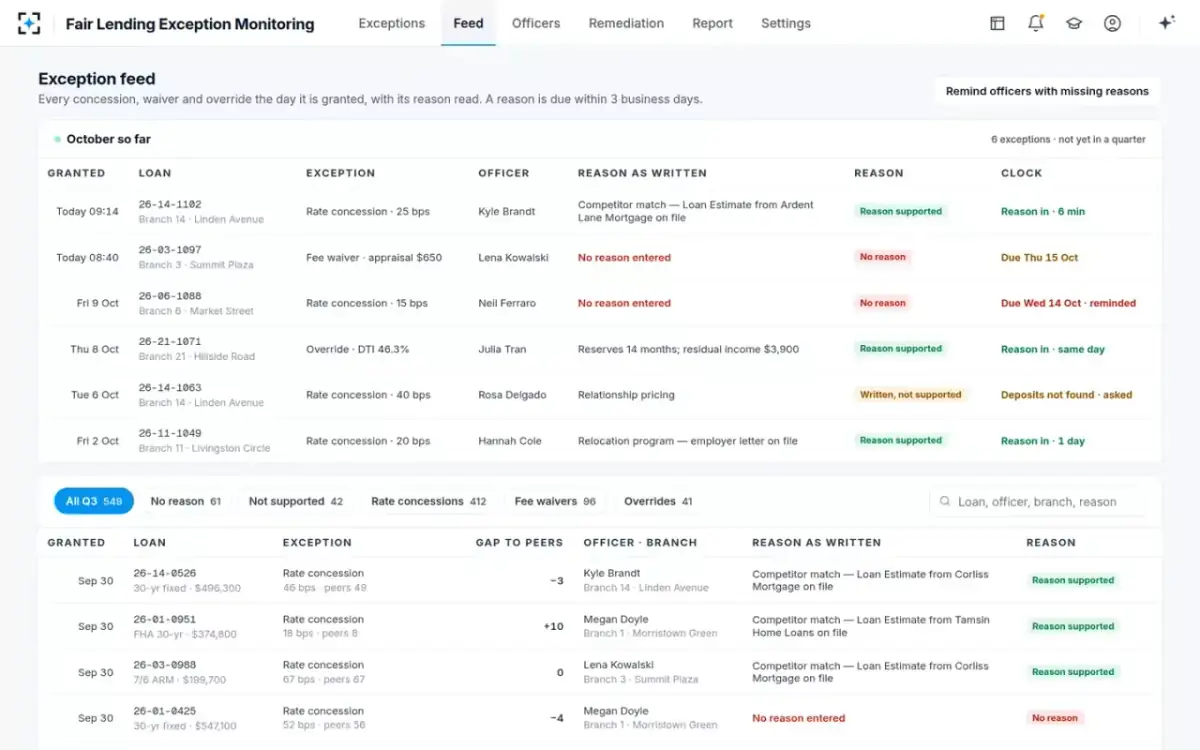
The October figure matters less for its speed than for what it changes. An officer asked for a reason within a day can still get the competing Loan Estimate from the borrower, still find the employer letter for a relocation discount, still check whether the deposits behind relationship pricing exist. Three months later, those documents are rarely retrievable and the officer's account cannot be checked.
What is a legitimate reason for a pricing exception?
A legitimate reason is a business ground the lender's own policy names in advance, applied to every borrower who meets it, with evidence that it applied to this loan. The interagency procedures frame the question as whether a difference is "fully explained by legitimate nondiscriminatory factors" (FFIEC, 2009). In practice, that means a short list of grounds, each with its document, and nothing that depends on an officer's impression of the borrower.
Common pricing exception reasons, and when each holds up
| Reason | Holds up when | Evidence on file | The weak version |
|---|---|---|---|
| Competitor match | The borrower presented a current offer on the same product | The competing Loan Estimate | "Borrower has offer", with nothing attached |
| Relocation or employer programme | A written programme exists and the borrower qualifies | The employer or programme letter | A discount for "a transferee" with no programme behind it |
| Relationship pricing | The published tiers apply to the borrower's verified balances | Statement or deposit verification | A "valued customer" concession with deposits never checked |
| Lender error | The lender caused a cost, such as a missed lock or a late disclosure | The error and its date | Any concession labelled "service recovery" with no error named |
| Management approval | Never on its own: it says who agreed, not why | The ground and evidence the approver relied on | "Manager approved" |
The last row is the one most often found in files and the least useful. It answers a governance question, who said yes, and leaves the fair lending question, why this borrower and not a similar one, exactly where it was.
How should pricing exceptions be documented?
With a reason category, its evidence, who asked and when, the size worked out, and the approver, all written at the time and kept with the loan. A reason that will hold up names the policy ground, carries the evidence for it, and records who asked and when. A single word in a free-text field does none of that. The best test is whether a reviewer who has never met the officer could check the reason without asking anyone.
Six parts of a pricing exception reason that a reviewer can check
- A reason category tied to a policy clause
Competitor match, relocation, relationship pricing, error correction. Each category names the evidence it needs.
- The evidence itself
The competing Loan Estimate, the employer letter, the deposit verification. Not a description of it.
- Who initiated and when
The borrower's request or the officer's offer, with the date. Both CFPB reports on competitor matches turned on this.
- The size, worked out
How the concession amount follows from the reason, such as the difference to the competing offer.
- The approver, if the tier requires one
Who approved it and what they saw.
- A time stamp that cannot be quietly changed
A late reason is still useful, but it should read as late. An edited reason should keep its history.
Overrides need their reasons at the time even more
An underwriting override is an exception to credit policy rather than to the rate sheet, and its reason is a set of compensating factors: reserves, residual income, a long employment history. The interagency procedures list both "lack of clear guidance on making exceptions to underwriting criteria, including credit scoring overrides" and "lack of clear loan file documentation regarding reasons for any exceptions" as risk factors, alongside "relatively high percentages" of overrides (FFIEC, 2009). An override decided on factors that were never written down can only be defended from memory.
Written at the time, the reasons can also close a question before it is asked. At the sample bank, an override granted on 8 October for a 46.3% debt-to-income ratio arrived the same day with its factors read: 14 months of reserves and $3,900 of residual income. At quarter end, the overnight run found that overrides above 45% debt-to-income had been approved for 4 of 12 women and 7 of 11 men, a difference that would need explaining. Every denial had reserves and residual income on file, so the cluster was marked explained, with no action, and went into the report that way.
How do you monitor pricing exceptions for fair lending?
Compare every exception with similar loans that did not get it, by borrower group, branch and officer, and read the reasons alongside the numbers. Three measures carry most of the weight: how often each group receives an exception (incidence, the measure in both CFPB reports), how large the exceptions are in basis points, and how many of them have a supported reason. A gap in either of the first two is a question; a gap with unsupported reasons behind it is a finding waiting to be made.
Two design choices decide whether the monitoring is credible. Similar loans have to be defined the way the rate sheet defines price: the same product, a close credit score and LTV, the same market and a lock date on the same sheet. And the thresholds for flagging a pattern have to be set before the run, not after. At the sample bank, a group needs at least 8 loans, a gap beyond a 15 basis point tolerance and p below 0.05 before the agents raise it; each exception was compared with a median of 18 similar loans. The second line's view of the matched-pair test covers how those choices are validated.
Cadence is the third choice, and it is where reasons and monitoring meet. A quarterly run finds gaps three months after they open; a daily feed with a reason clock finds the missing reasons while they can still be supplied, and leaves the quarterly run to judge patterns rather than chase paperwork.
The case for never letting software write the reason
A system that suggests a reason to an officer manufactures exactly the reconstruction this page warns against, only faster. If the suggested reason is "competitor match" and the officer clicks accept, the file now holds a reason nobody gave. Examiners asking where it came from would find a tool, not a decision.
Fair Lending Exception Monitoring draws the line in its design. Its reason reader reads what the officer wrote, looks for the evidence the policy requires, and classes the result. It reminds the officer on day 2 if the reason is missing. It never writes or suggests a reason, and it never accepts a competitor match without the offer. Each request, reminder and reply is time-stamped on the audit trail and kept with the quarter. The broader principle, that agents prepare and people decide, is the subject of agents compare, people conclude.
What missing reasons look like inside one flagged cluster
Missing reasons do not spread evenly; they collect where discretion is loosest. At the sample bank, the overnight run after quarter end found 11 rate concessions to Black borrowers (estimated) at one branch averaging 12 basis points, against 50 for similar loans. Nine of the eleven had no reason entered. One said "Manager approved", which is written but names no ground. One, a relocation discount with the employer letter on file, was supported.
A cluster where the reason column decides the case
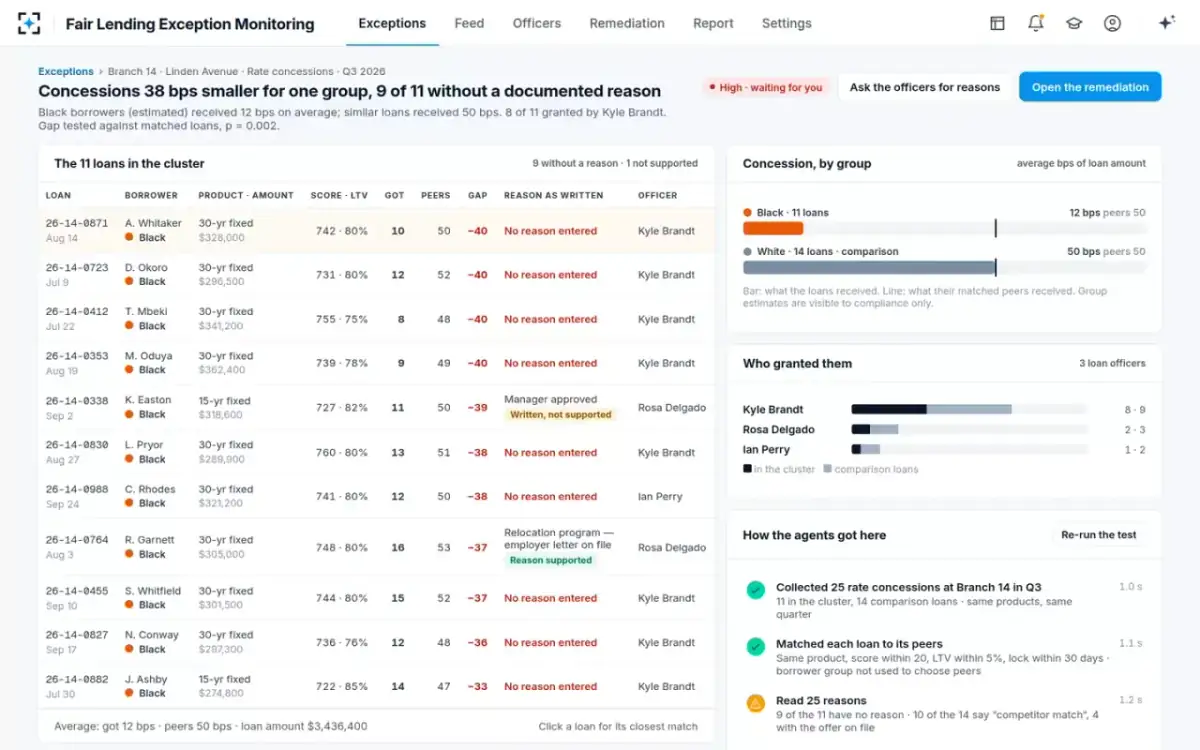
Of the 14 comparison loans that got larger concessions, 10 cite a competitor match and only 4 have the competing offer on file.
A quarterly review would have found the same nine blanks, then sent nine emails. The answers, three or four months after the price was set, would have been reasons rebuilt for a reviewer who already knew the comparison. From October, the sample bank asks at the time: the feed shows every exception the day it is granted, with a three-day clock, and the median reason arrived in 1.4 days. How the rest of that quarter ran is in the quarterly review case study, and the Fair Lending Exception Monitoring page shows the screens.
The reason clock, exception by exception
Questions people ask
How long must pricing exception records be kept?
Regulation B requires creditors to keep written or recorded information used in evaluating an application for 25 months after notifying the applicant of action taken. Many lenders keep pricing records longer to cover their own look-back periods and any HMDA-based review.
What did the CFPB find about pricing exceptions?
In 2021 and again in 2023, that mortgage lenders violated ECOA and Regulation B through statistically significant disparities in who received competitor-match pricing exceptions. Examiners found no legitimate reasons that explained the gaps, and lenders that had not kept the documents or recorded who started the request.
Who should write the reason, the officer or the approver?
The officer who granted or requested the exception, because only they know what happened with the borrower. The approver adds what they checked and why they agreed. A reason written by an analyst later is a summary, not a reason.
Is a reason added late worse than no reason?
Not if it is honest about its date. A late reason, time-stamped as late and backed by evidence, still helps. A late reason presented as if it were written at the time damages the credibility of every other reason in the file.
What if the officer's reason is "manager approved"?
That records who agreed, not why. It should be classed as written but not supported, and the approver asked for the ground and the evidence.