A certificate of deposit pricing strategy decides what a bank or credit union pays on certificates, for which terms, and when it changes those rates. The usual starting point is new money: what rate, or what special, will attract deposits this quarter. The better starting point is the renewal. Every certificate on the books comes back to the institution at maturity, and for an automatically renewing certificate of more than one month, Truth in Savings requires a notice of the renewal terms at least 30 days before maturity, or 20 days before the end of a grace period of five days or more. That notice window is when most certificate dollars are priced, whether anyone decides it or not. Botminds' Deposit Pricing helps the rate committee decide it: the month's rate exceptions, priced against same-term funding and the chance the money stays, become a proposal to move the renewal rate on the terms where the board rate no longer holds.
Sample figures on this page come from a fictional institution, Norrell Federal Credit Union, a $6.8 billion credit union with 38 branches, as it runs through the solution in October 2026.
One automatically renewing 12-month certificate: where the pricing decision really sits
- Price the maturing cohortDay −45 to −30
- Notice out; exceptions arrive30 days
- Grace period10 days
- Not yet thinking about it
- Reads the notice, may shop, may ask for a match30 days
- Can leave without a penalty10 days
What is a good CD pricing strategy? Start with the maturity calendar
A good CD pricing strategy prices the certificates the institution already has before it prices the ones it hopes to win, because that is where most of the money is. Each month a slice of the certificate book matures. Whatever rate it renews at becomes the cost of that slice for the next term, and most of it renews at whatever rate the institution set, because most depositors do not shop.
Research on account data shows how few do. Egan, Hortaçsu, Kaplan, Sunderam and Yao, using account openings and closures at more than 900 banks, find that "only 5–15% of depositors open new accounts per year. More closures are driven by moving or death than rate-shopping", and that "depositor sleepiness accounts for 57% of average deposit franchise value" (NBER working paper 34267, 2025). For a certificate book, that means the renewal rate on the maturity calendar sets the price of most certificate dollars, and a special for new money sets the price of a few.
Depositors rarely shop, which is why the renewal rate prices most of the book
5–15%
of depositors open new accounts in a year, across more than 900 banks
57%
of average deposit franchise value comes from depositor sleepiness, the same study estimates
74→79%
renewals kept at maturity, if the sample credit union raises its 12-month rate by 10 bp, by its own estimate
How do banks price CDs today?
Banks price CDs with a rate sheet set by a rate committee or ALCO, usually term by term, against some mix of market yields, wholesale funding costs and competitors' rates, and then adjust it with specials and exceptions. The rate sheet is the policy; the specials are campaigns; the exceptions are individual negotiations. Each layer prices a different group of depositors.
The difficulty is the one the OCC describes in its interest rate risk booklet: "The deposit pricing in such cases is a balancing act. If management lags rates by too much (in a rising rate environment), customers will withdraw funds. If management increases deposit rates too much, the bank could pay more than needed to retain the deposits" (OCC, Comptroller's Handbook, Interest Rate Risk, 2020). For certificates the balance is struck at each maturity, and it tilts faster than for other deposits. New York Fed researchers found that "Rates on time deposits are typically higher, but also rise more in response to a higher fed funds rate" (Liberty Street Economics, April 2023).
What notice is required before a CD renews?
Before an automatically renewing certificate with a term longer than one month matures, Truth in Savings requires the institution to send the depositor a notice at least 30 calendar days before maturity, or at least 20 calendar days before the end of the grace period if the grace period is at least five days (12 CFR 1030.5(b); credit unions follow the same timing in Part 707, explained in Truth in Savings Part 707 in plain words). What the notice contains depends on the term.
For terms longer than one year, the notice carries the full account disclosures for the new term and the date the existing certificate matures. For terms of one year or less but longer than one month, the institution may instead give the maturity dates, the new rate and APY if known, and any differences in terms. In both cases, if the new rate is not yet known, the notice must say when it will be determined and give a telephone number to call for it. A certificate longer than one year that does not renew automatically needs a shorter notice: the maturity date and whether interest is paid after it, at least 10 calendar days before maturity (12 CFR 1030.5(c)). The FDIC's examination procedures test exactly these timings and contents (FDIC Consumer Compliance Examination Manual, VI-3).
For a pricing strategy the consequence is practical. Either the renewal rate is set before the notice goes out, roughly 30 days ahead, or the notice says it will be set later. An institution that sets renewal rates for the coming month's maturities 45 days ahead has a calendar to price against; one that leaves them to the rate sheet in force on maturity day has made a pricing decision by default.
Should banks pay more on new money or renewals?
Banks should not pay more on new money than on renewals as a rule, because it pays strangers more than loyal depositors and teaches the loyal ones to ask. A new-money special can make sense for a specific funding need, but its cost is not the special rate on the new money alone. It is that rate plus every exception requested by existing depositors who see it, plus the renewal requests that cite it at their next maturity.
Promotions also need careful disclosure. A cash or gift incentive is a bonus under Truth in Savings: "a premium, gift, award, or other consideration worth more than $10 (whether in the form of cash, credit, merchandise, or any equivalent) given or offered to a consumer during a year in exchange for opening, maintaining, renewing, or increasing an account balance" (12 CFR 1030.2(f)), and the APY does not include it. A special built on a bonus therefore advertises one number and costs another, which makes its true cost harder to compare with a straightforward renewal rate.
Two certificate pricing strategies, compared on what each pays for
Special-led: A promotional rate for new money, changed by campaign.
Renewal-led: The renewal rate for each maturing cohort, set before its notices go out.
Special-led: Depositors new to the institution, and existing ones who notice and ask.
Renewal-led: Depositors whose certificates mature, at a rate the committee chose for them.
Special-led: Rise around each campaign as existing depositors ask for the special.
Renewal-led: Fall where the renewal rate is moved; concentrated where it is not.
Special-led: New balances raised.
Renewal-led: Balances kept at maturity against forecast, by term.
Special-led: A large cohort written at a high special rate, all maturing in one month.
Renewal-led: A renewal rate that lags the market, visible first as exceptions.
How do CD specials affect existing depositors?
CD specials affect existing depositors in two ways: some of them move into the special, and more of them ask for it at their next maturity, whether or not the special was meant for them. A special restricted to new money is the sharpest version. The depositor who has kept a certificate for years sees a better rate offered to strangers, and the request to match it lands at the branch, where the branch can grant only a small premium and the rest goes to the pricing desk.
Competitors' specials work the same way from outside. At the sample credit union, Harbor Point branch received 214 exception requests in September, up 38% on August, and 61 of them cited the same online offer. That is a market rate the board rate no longer meets, showing up first as exceptions at one branch. The agents' monthly signals are built to catch that pattern; what a rate match request costs in waiting shows what each of those 61 requests involves.
What is a CD maturity wall, and how to see it coming
A CD maturity wall is a month, or a run of months, in which an unusually large share of the certificate book matures at once, usually because a special or a rate spike drew a large cohort in a short period. A cohort written in one month comes due in one month, at the end of its term. If the renewal rate then is far from what the cohort was paid, the institution faces a choice across the whole cohort at once: reprice it down and risk the runoff, or hold the rate and pay for it.
Seeing it coming takes nothing more than the maturity schedule by month and term, read alongside where exceptions are concentrating. The exception count is the early signal, because it shows which terms' board rates are already failing to hold money before the wall arrives.
Where the board rate no longer holds: exceptions by certificate term
How do you price CD renewals, month by month
Price CD renewals one maturity cohort at a time, before each cohort's notices go out, against the same-term cost of other money and the chance the money stays at each rate. Then watch the exceptions the cohort produces, and back-test the retention estimate once the grace period ends.
A monthly renewal-pricing routine for a rate committee
- Day −60: list the cohort
Certificates maturing in the month after next, by term and balance band, with the rate each is paid now.
- Day −50: price it
For each term, the renewal rate against the same-term marginal cost of funds and the retention estimate at each candidate rate.
- Day −45: decide
The rate committee votes the renewal rates; a second person checks the change before it is published.
- Day −30: notices out
With the new rate and APY where known; otherwise the date it will be set and a number to call.
- Day −30 to +grace: answer exceptions
Requests from the cohort priced against the same inputs, inside an authority matrix, with like requests compared.
- After the grace period: measure
Balances kept against the forecast, by term; requests by term; the cost over the renewal rate.
- Feed it back
Terms where exceptions concentrate, or retention fell short, go to next month’s proposal.
The sample credit union's agents draft that proposal from the month's exceptions. For rate sheet BR-2026-43 they propose raising the twelve-month certificate from 4.15% to 4.25%, because 781 exceptions this month were for that term, the median approved spread was 30 basis points, the weekly rate survey's median is 4.30%, and the new rate would still sit 13 basis points under FHLB funding of the same term. Their estimate of the effect: about 300 fewer exception requests a month, about $640,000 a year more in dividend cost net of the exception spread no longer paid, and renewals kept at maturity rising from 74% to 79%. The Deposit Pricing Manager proposes it, the rate committee votes, 3 of 5, and the CFO checks.
A board-rate proposal drafted from the month's exceptions, with its estimated effect
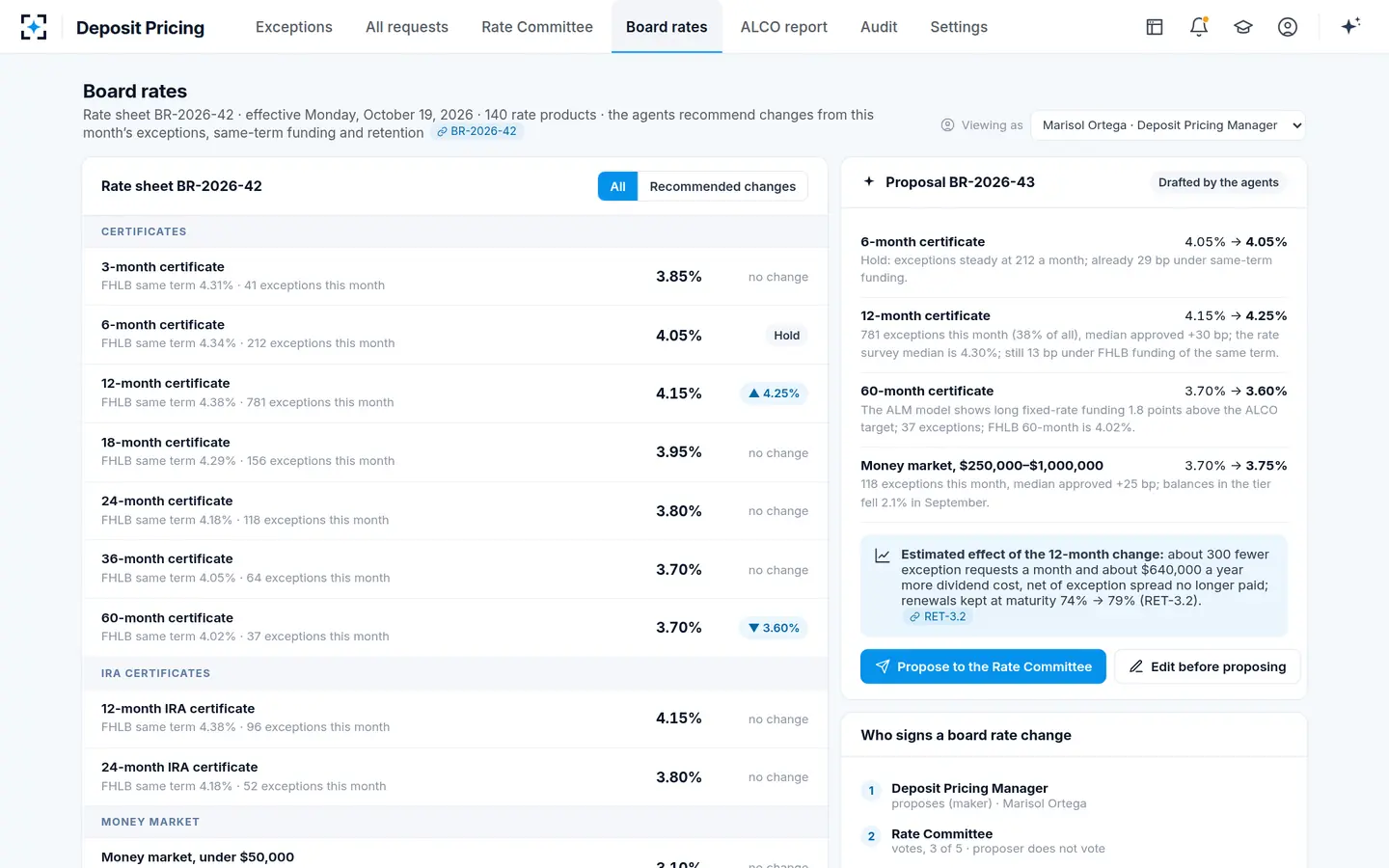
The proposal also moves a rate down. The sixty-month certificate would fall from 3.70% to 3.60%, because the ALM model shows long fixed-rate funding above the ALCO target. A renewal-led strategy is not a strategy of paying more; it is a strategy of deciding, term by term, before the notices go out. The member's view of the same moment is in can you negotiate CD rates with banks.
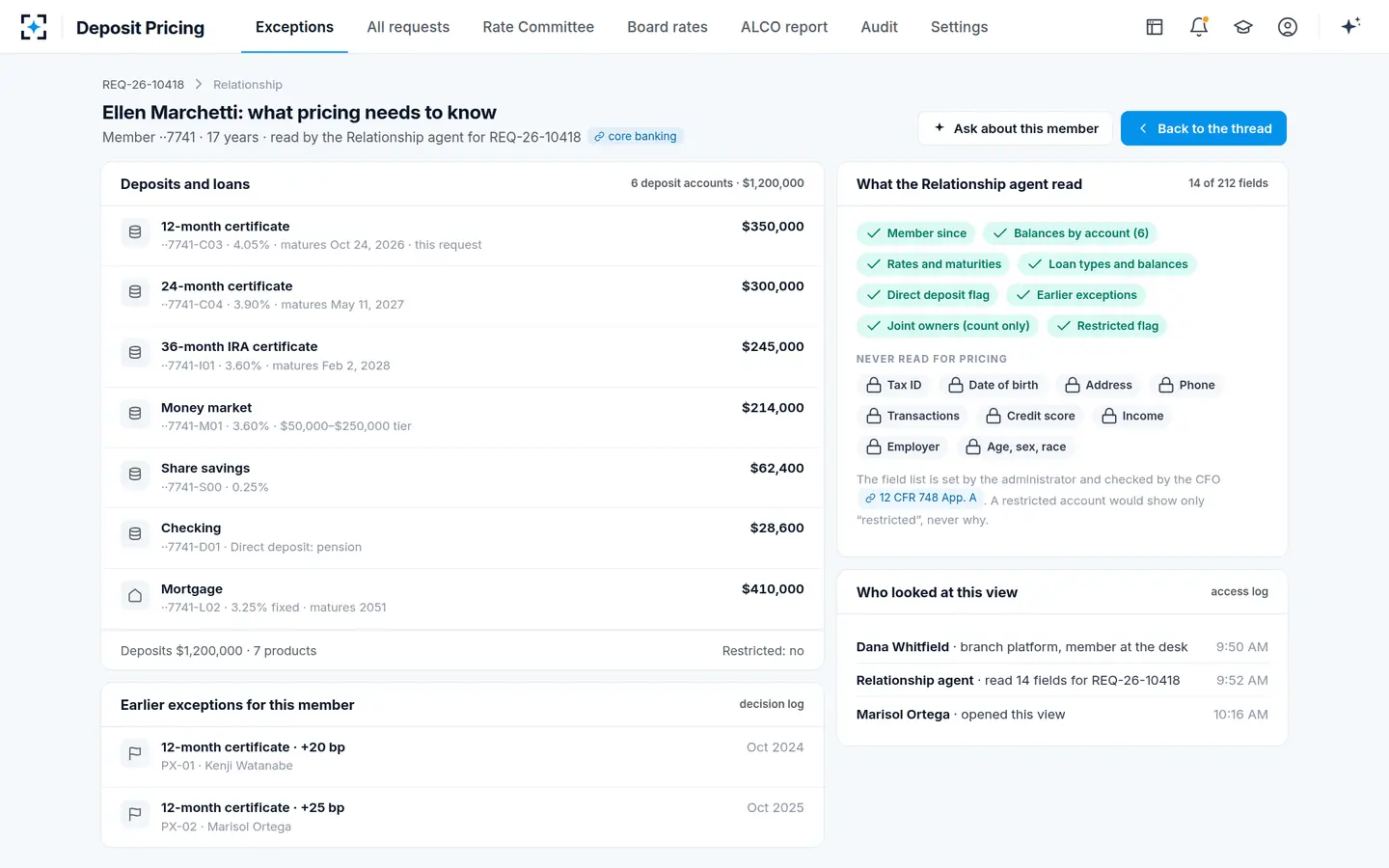
One member's maturity calendar, as the pricing view shows it
How do CD rates relate to Treasury yields?
CD rates follow Treasury yields of the same term loosely and with a lag, and usually below them. A certificate competes with a Treasury bill for a saver's money, and the institution's alternative funding, such as FHLB advances, is priced off the same curve, so both pull the certificate rate toward the Treasury yield. Inertia pulls it away: most depositors do not move, so the institution need not match the yield to keep most of the money.
The FDIC's monthly table shows how wide the gap can be. In October 2026 it listed the twelve-month Treasury yield at 4.54% and the deposit-weighted national rate for a twelve-month certificate at 1.76% (FDIC, National Rates and Rate Caps). The Treasury yield had risen from 3.48% in January; the national certificate rate had moved by a fraction of that. FDIC national rates and rate caps explains why the average sits so low, and the marginal cost of funds explains why the same-term funding curve, not the average, is what a renewal rate should be set against. To see the month's exceptions turned into a renewal-rate proposal, start from Deposit Pricing.
Questions people ask
Can a bank lower the rate on a CD at renewal?
Yes. A renewal starts a new term, and the renewal rate can be lower than the old one. For an automatically renewing certificate of more than one month, the depositor must receive the pre-maturity notice in time, and a grace period, where offered, lets the depositor withdraw after maturity without a penalty.
What is a CD grace period?
Truth in Savings defines it as a period after the maturity of an automatically renewing time account during which the depositor may withdraw without a penalty. Its length is the institution's choice and must be disclosed; the sample certificate's is 10 days. A grace period of at least five days lets the institution send the renewal notice 20 days before it ends instead of 30 days before maturity.
How often should a rate committee change CD rates?
No rule sets a frequency. The useful cadence is the maturity calendar: renewal rates for each month's cohort set before its notices go out, with the rate sheet reviewed whenever exceptions concentrate on a term. The sample credit union's rate committee works from a weekly rate sheet and votes on proposals drafted from the month's exceptions.
Is a CD special a bonus under Regulation DD?
A higher interest rate is not a bonus; it is reflected in the APY. A cash payment, gift or other consideration worth more than $10 in a year for opening, renewing or increasing a balance is a bonus, has its own disclosure and advertising rules, and is excluded from the APY.
What is a certificate of deposit pricing model?
It is the method an institution uses to set certificate rates: commonly a same-term reference rate such as the Treasury or FHLB curve, an adjustment for competition and funding need, and, in more developed versions, an estimate of how much money stays at each rate. That last part is a statistical model and should be back-tested, as deposit attrition modeling explains.