Yes, you can often negotiate CD rates with banks and credit unions. Many institutions allow staff to pay more than the posted rate on a certificate of deposit to keep or win a deposit, through what they call a rate match or a CD rate exception, approved by someone with the authority to do so. Nothing in federal law requires a bank to match a competing offer, and nothing forbids it. Whether you get a higher rate depends on three things: whether your competing offer is truly comparable, what your relationship with the institution looks like, and what the same money would cost the institution from other sources. Botminds' Deposit Pricing is a system banks and credit unions use to answer these requests, and this page uses it to show, from the institution's side, what is weighed when you ask. It is general information, not financial advice.
Where the page shows how a request is decided, the figures are sample data on a fictional institution, Norrell Federal Credit Union, which runs the solution on its own members' requests in October 2026.
What to bring when you ask for a CD rate match, and what the institution checks
- The competing offer in writing
A letter, a rate sheet or a screenshot that shows the APY, term, minimum deposit, whether it is for new money only, the early withdrawal penalty and when it expires. The institution checks it is like for like; an offer it cannot read is treated as unverified.
- The certificate you would move
Its maturity date and current rate. At maturity, and in any grace period after it, the money can move without a penalty; before then it usually cannot.
- The amount and the term you want
The institution prices the request against what money of that term costs it elsewhere, so a 12-month ask is priced against 12-month funding.
- Nothing personal beyond your account
Pricing a deposit needs your balances, products and how long you have banked there. In the sample design the pricing view reads 14 of 212 fields and never your credit score, income or date of birth.
- Time
A request that goes above the branch’s authority goes to a pricing manager or a committee. In the sample, the target answer time for a member at the branch is two hours.
Can you negotiate CD rates with banks? Often, within limits
You can negotiate CD rates with banks within limits the bank sets for itself. Every institution publishes a rate for each certificate term, set by a rate committee and approved under its pricing policy. Most also allow exceptions: a rate above the posted one for a single depositor, approved case by case. Those exceptions are what a negotiation produces.
The limits come from an authority matrix, a table that says who may approve how far above the posted rate. At the sample credit union a branch manager may approve up to 0.15 percentage points above the posted rate on certificates up to $1 million, the Deposit Pricing Manager up to 0.40, and anything more goes to the rate committee. Savings and checking accounts get no exceptions at all; the posted rate is final. Other institutions draw these lines differently, but the shape is common, and it explains why the person across the desk may need to ask someone else.
Two things are worth knowing before you ask. The person who raises your request cannot approve it in a well-run process, so a branch manager who says "let me check" is following policy, not stalling. And an institution that answers within your visit is not being casual: the sample's request below took 29 minutes from the branch's first message to the pricing manager's decision.
Do banks match other banks' CD rates?
Some banks match other banks' CD rates, as a policy or case by case, and many do not; there is no industry rule. Certificates are where banks compete hardest on rate, which is why they are also where matching happens. Researchers at the Federal Reserve Bank of New York, tracking offered rates through the 2022 rate rises, found:
Rates offered for twelve-month CDs have risen more than for money market deposit accounts—which are in turn more responsive than savings accounts, which themselves are more responsive than checking accounts.
Kang-Landsberg, Luck and Plosser, Federal Reserve Bank of New York, Liberty Street Economics, April 2023
How likely a match is depends partly on the institution. A study of the deposit business by d'Avernas, Eisfeldt, Huang, Stanton and Wallace finds that large banks offer lower deposit rates and that "customers of large banks also exhibit lower rate elasticities" (NBER working paper 31865): their depositors move less when rates change, so the bank has less reason to match. A smaller bank or credit union whose depositors shop around has more reason to keep them, and more often has a process for doing so.
What information should you bring to negotiate a CD rate?
Bring the competing offer in writing, with every term that affects what you would earn, and the details of the certificate you would move. The written offer matters most, because the institution's first question is whether the offer is real and comparable. An APY on a phone screen without its term, minimum or conditions is often not an offer you could actually get, and a pricing desk will not match it.
Bring the maturity date too. Under Regulation DD, a certificate that renews automatically may have a grace period after maturity during which you can withdraw without a penalty, and the institution must send you the renewal terms before maturity, or say when the new rate will be set (12 CFR 1030.5(b); credit unions follow the same rule in Part 707). That notice is your clock. Pricing the renewal first explains why it is also the institution's.
How to negotiate CD rates without comparing apples with oranges
To negotiate CD rates fairly, compare the two offers on the same terms: the annual percentage yield, not the interest rate; the same term; the same minimum; and the same conditions for who can get it. A pricing system checks those terms before anyone looks at the rate, and you can too.
Is the offer like for like? Seven terms to compare before asking for a match
Yield
What the offer should stateAPY, the yield over a year with compounding
What to checkAPY to APY; an interest rate without its APY is not comparable
Term
What the offer should state12 months
What to checkThe same term; a 13-month special is a different product
Minimum
What the offer should stateThe amount needed to earn that APY
What to checkYour balance meets it, at the tier quoted
Who can get it
What the offer should stateNew money only, or any deposit
What to checkWhether the offer is open to money already at that institution
Early withdrawal
What the offer should stateThe penalty, for example 180 days of interest
What to checkWhat leaving early would cost under each
Expiry
What the offer should stateThe date the offer ends
What to checkWhether it is still open when the money would move
Insurance
What the offer should stateFDIC or NCUA insured, and the institution’s name
What to checkHow much of the balance would be insured there
Two terms deserve a closer look. The early withdrawal penalty is part of the price: Regulation DD's definition of a time account assumes "an early withdrawal penalty of at least seven days' interest" on amounts withdrawn in the first six days (12 CFR 1030.2(u)), and a certificate's own penalty can be much larger: the sample's is 180 days of dividends. And insurance is part of the risk. FDIC insurance covers up to $250,000 for each depositor at each insured bank in each account ownership category, with deposits in the same category at the same bank added together (FDIC, Understanding Deposit Insurance), and NCUA's standard maximum share insurance amount for credit unions is also $250,000 (12 CFR 745.1(e)). A $350,000 deposit in a single ownership category at one institution is $100,000 over that limit, before counting anything else held there.
What the bank weighs that you cannot see
The bank weighs three things you cannot see from the desk: what the same money would cost it from other sources, how likely you are to stay at each rate, and how it has treated depositors in the same position. Each one can make the answer yes or no regardless of how good your offer is.
The first is funding. A bank can replace a departing deposit by borrowing, from a Federal Home Loan Bank or through brokered certificates, and it compares your ask with what that would cost for the same term. If twelve-month money is cheaper elsewhere than your ask, the bank is paying for the relationship, not the money. The marginal cost of funds for one CD exception works through that arithmetic.
The funding the institution compares your ask with, read the same morning
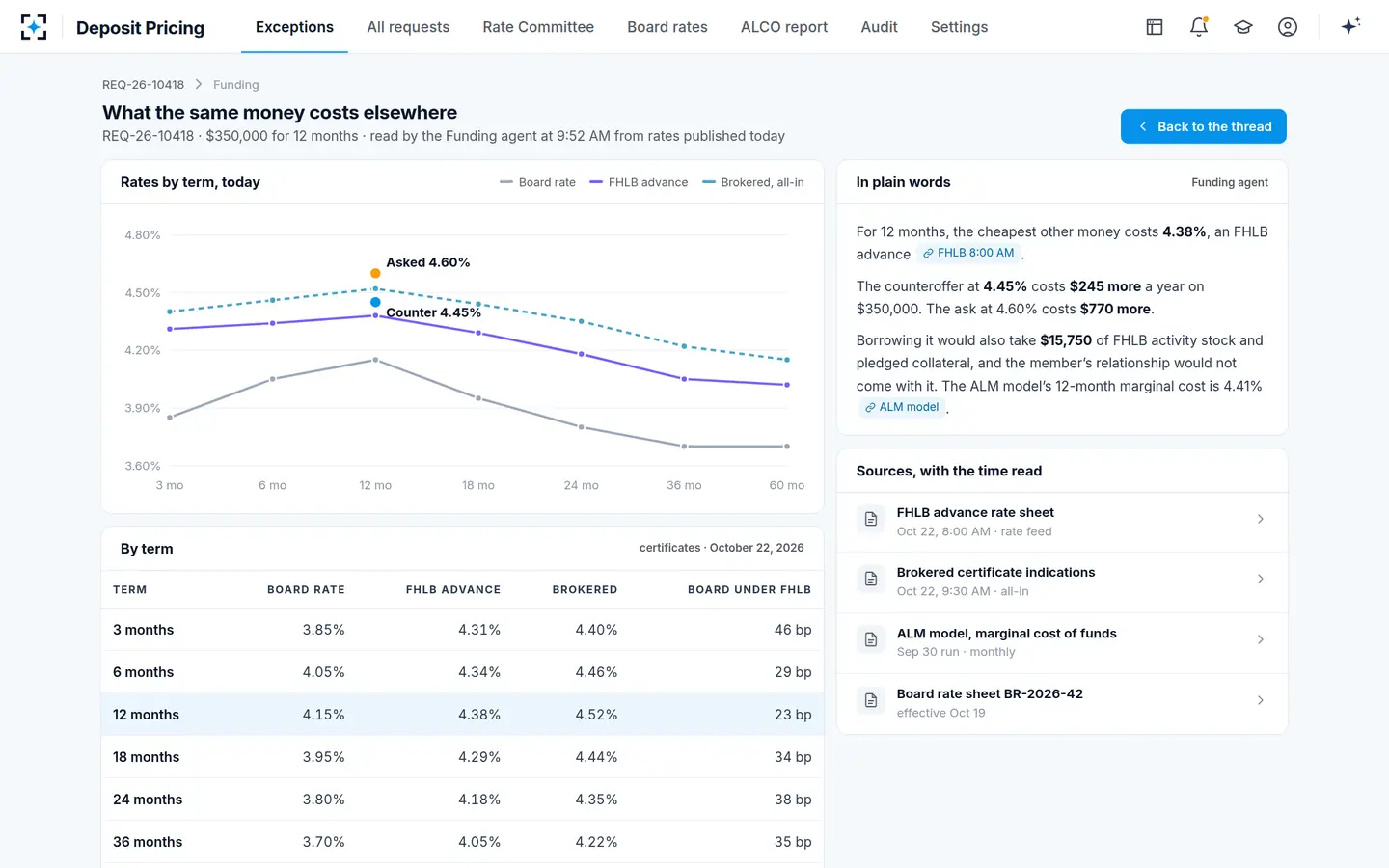
The second is the chance you stay. The sample's model estimated that a member's $350,000 had a 31% chance of staying twelve months at the posted rate, 84% at a counteroffer of 4.45% and 91% at her ask of 4.60%. The third is consistency: the sample compares each request with like requests from the last 90 days and shows the approver where the ask falls. In that example 43 of 46 like requests had been approved at 0.20 to 0.40 points above the posted rate, and her ask of 0.45 points was above all of them. She was offered 4.45%, the median, and accepted.
Why did my bank refuse to match a CD rate?
A bank usually refuses to match a CD rate for one of six reasons, and it should be able to tell you which. The offer was not comparable, for example a different term or a minimum you do not meet. It could not be verified. It was for new money only, which your existing deposit would not qualify for at the other institution either. The ask was higher than the bank has approved for anyone in the same position. It exceeded the authority of anyone available before you had to decide. Or the bank simply does not need the money at that price, because it has more funding than it can lend.
The last reason is the least visible and often the most important. Research on bank deposit rates finds that what a bank pays depends on its own need for funds, which the marginal cost page discusses. A refusal from a bank with surplus funding says little about your offer and a lot about its balance sheet that month. A counteroffer below your ask is also an answer: it is usually the most the approver could justify, and in the sample design it comes with a reason code that stays on file.
What is the national average CD rate, and why it is not your benchmark
The national average CD rate most often quoted is the FDIC's national rate, which for a twelve-month certificate was 1.76% in October 2026 (FDIC, National Rates and Rate Caps). It is an average weighted by each institution's share of domestic deposits, and it includes credit unions. Because each institution counts in proportion to its deposits, the institutions with the most deposits set the average, and research finds that large banks pay lower deposit rates. It can sit far below the offers a depositor shopping for a certificate sees: the sample member's online offer was 4.60% against a national rate of 1.76%.
The FDIC's national rates in October 2026: a deposit-weighted average, not a shopping rate
The national rate is useful for one thing a depositor might care about: it shows how far above the average a particular offer sits. It is the wrong benchmark for whether your bank should match a competitor, because the competitor's offer, not the average, is the price the bank is weighing. FDIC national rates and rate caps explains how the rate is built and why it is so low.
Is it worth negotiating a CD rate? The arithmetic
Whether it is worth negotiating a CD rate depends on the balance and the size of the gap, and the arithmetic is simple: the difference in APY times the balance gives the difference in a year's interest, before tax. Small balances rarely move much; large ones can.
What a higher rate is worth over twelve months, by balance
| Balance | +0.15 point | +0.30 point | +0.45 point |
|---|---|---|---|
| $10,000 | $15 | $30 | $45 |
| $50,000 | $75 | $150 | $225 |
| $100,000 | $150 | $300 | $450 |
| $350,000 | $525 | $1,050 | $1,575 |
The same table read from the other side explains the institution's answer. A 0.30-point exception on $350,000 costs the institution $1,050 a year, which it weighs against the cost of replacing the money and the value of the rest of the relationship. A 0.15-point request on $10,000 costs it $15, and is often within the branch's own authority. The disclosure you sign afterwards should show exactly the rate approved.
What the depositor signs: a disclosure generated from the approved terms
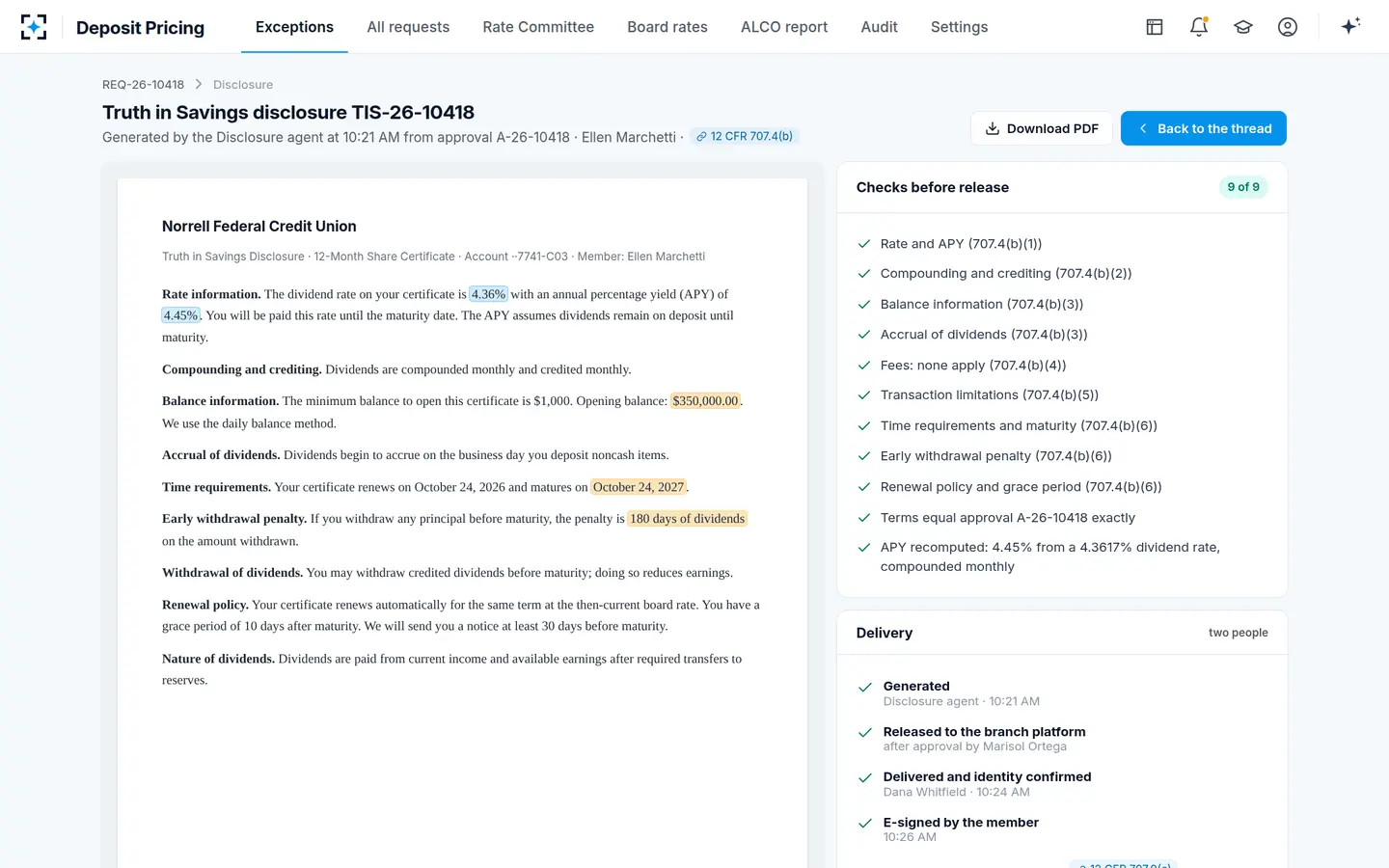
Read the renewal clause before signing. In the sample the certificate renews automatically for the same term "at the then-current board rate", so the negotiated rate lasts one term, and the next maturity is the next time to ask. To see the institution's side of a request in full, start from Deposit Pricing.
Questions people ask
Can you negotiate CD rates at a credit union?
Often, in the same way as at a bank: through an exception approved under the credit union's own authority limits. The certificate is called a share certificate and pays dividends, and its disclosures follow NCUA's Truth in Savings rule, Part 707, but the request and the decision work alike. The sample institution on this page is a credit union.
What is a CD rate exception?
A CD rate exception is a rate above the institution's posted rate, approved for one depositor and one certificate. It is how a rate match is granted. It does not change the posted rate for anyone else, and in a well-run process the person who asks for it on your behalf cannot approve it.
Do I have to decide before my CD renews?
Not necessarily. For a certificate that renews automatically, Truth in Savings requires the institution to send the renewal terms before maturity, and many certificates allow a grace period after maturity in which you can withdraw without a penalty. The sample certificate's grace period was 10 days.
Will my bank match an online bank's CD rate?
It may, if the offer is comparable and verifiable and within what its approvers can grant. Online offers are often for new money only, which an institution may treat differently; in the sample the online offer counted the member's money as new money there, and the credit union countered at 4.45% against an ask of 4.60%.
Does the competing CD need to be insured?
A pricing desk compares terms, not insurance, but you should check it yourself. FDIC and NCUA insurance each cover $250,000 per depositor, per institution, for each ownership category, so the same balance can be fully insured at one institution and partly uninsured at another where you already hold deposits.