Decedent account processing time is the number of days between a bank first learning that a customer has died and the last of that customer's accounts being paid out, retitled or closed. No federal rule sets it. Part of it is fixed by law, because some accounts must wait for a court or a state's small-estate waiting period; most of it, in a typical estate, is the bank's own work: proving the death, retrieving signature cards and beneficiary forms that may be decades old, deciding where each account goes, finding the federal benefits paid after the death and checking every payee. By Botminds' design estimate for a credit union handling 260 death notices a month, that work takes a median 34 days by hand. Deceased Account Processing puts six agents on the reading and retrieval, with a target of 11 days, while a specialist approves each estate's plan and an officer releases each payout.
The volumes and days on this page are the solution's design estimate and target for a fictional credit union, at 260 notices a month and about 3.4 accounts each, and its fictional sample estate; they are not measured results at any institution. The legal periods are real and linked.
The workload behind decedent account processing at one sample credit union
260
death notices a month in the design estimate
884
account decisions a month, at about 3.4 accounts per estate
34days
median from notice to settled estate by hand, our estimate
11days
the solution's design target for the same estate
How long should decedent account processing take?
As long as the slowest account's legal wait, and not much longer. A bank cannot pay a sole account to next of kin before the person with authority appears, and in Virginia a small-estate affidavit cannot be used until "at least 60 days have elapsed since the decedent's death" (Va. Code § 64.2-601). But a joint account with survivorship and a payable-on-death account wait on proof, not permission: Virginia lets a bank pay any party to a joint account "without regard to whether any other party is incapacitated or deceased" (Va. Code § 6.2-613).
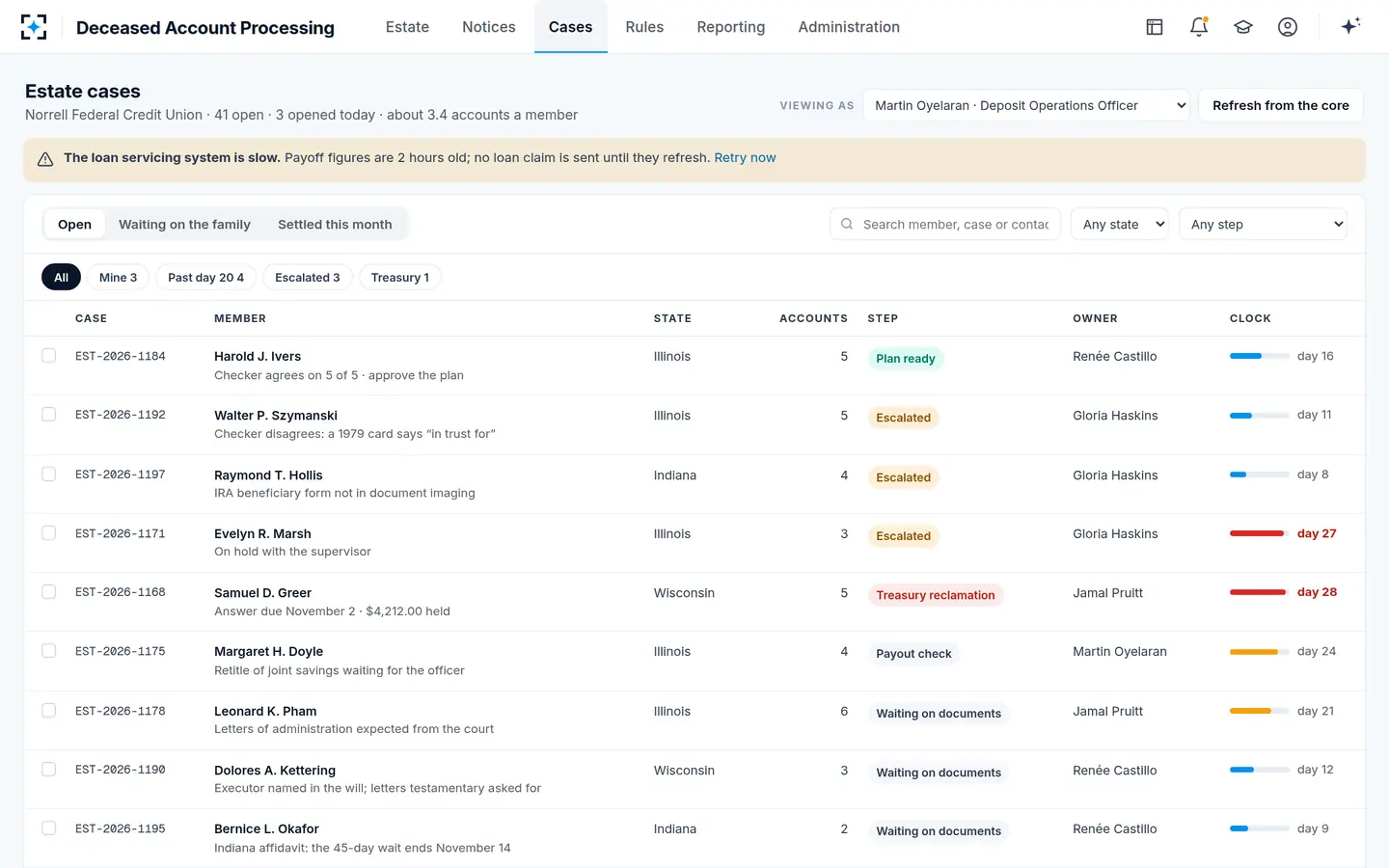
So the useful service standard is not one number per estate. It is a number per account type, measured from the day the bank has what the law requires for that account. The sample credit union sets an overall clock of 30 days from the notice, with a warning at day 20 and a supervisor at day 25, and holds estates that wait on a court or a statutory period in a separate lane so they do not hide the bank's own delays.
The floor the law sets under each account, before the bank's own work
| Account | What it legally waits for | Legal floor (example) |
|---|---|---|
| Joint with right of survivorship | Nothing for the survivor; retitling needs proof of death | None |
| Payable on death, in trust for | Proof of death and that each beneficiary survived the owner | Days |
| Sole, small estate | The state's affidavit and any waiting period | 60 days in Virginia |
| Sole, larger estate | Letters from the probate court | As long as the court takes |
| Federal benefit paid after death | Treasury's notice of reclamation | Held until the notice |
A bank whose median estate takes longer than its slowest common legal floor is holding money the law would let it release. Deceased account ownership and payout rules sets out where each account goes and on what proof.
Where an estate's 34 days go, by hand
Six steps make up the median estate in the design estimate, and only one of them is waiting on the family. The rest is the bank reading, deciding and checking, one account at a time, around other estates already in the queue.
Deceased Account Processing: a median estate's 34 days by hand, and the 11-day target
- Prove the death, freeze5 d
- Pull cards and forms6 d
- Decide each account5 d
- Find federal benefits4 d
- Check affidavit, letters, payees6 d
- Family, payouts, letters8 d
- Prove, pull, decide, find benefits3.5 d
- Check affidavit, letters, payees3 d
- Family, payouts, letters4.5 d
What the 34 days are made of
Median estate by hand (design estimate)
- Reading and retrieval · 29%
- Deciding and checking · 32%
- Proving the death · 15%
- Family, payouts, letters · 24%
The shares point to where improvement has to come from. Reading and retrieval, almost a third of the calendar, is pure queue: a specialist working through other estates' files before reaching this one. Deciding and checking is judgement and should stay with people, but it can start the day the documents are read rather than a week later. The family's share shrinks least, because it belongs to them.
Why retrieval is the slowest step in a deceased account
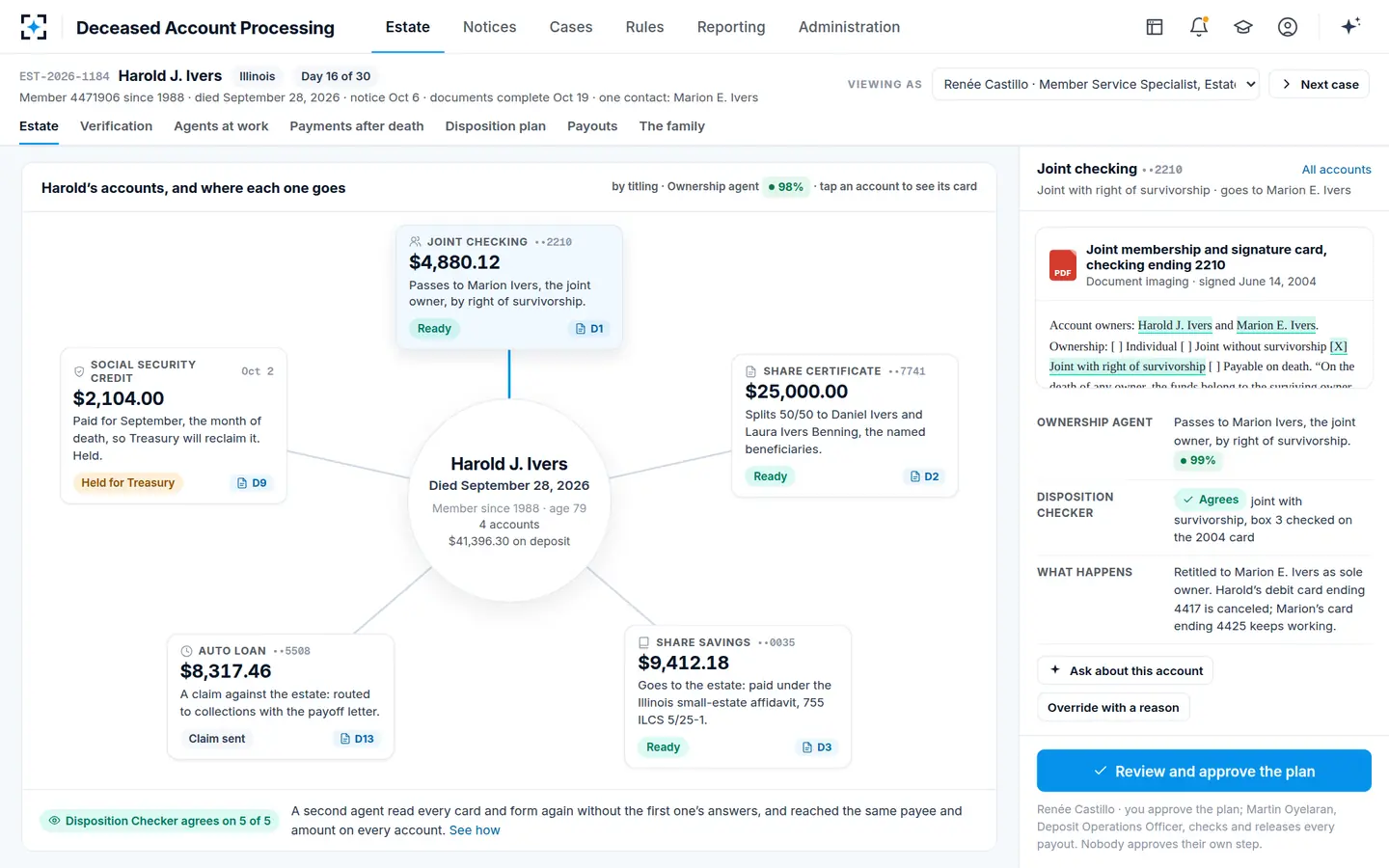
Because the documents that decide a deceased customer's accounts were signed when the accounts were opened, often decades earlier, and have lived through system conversions since. In the sample estate, the sole savings card was signed in 1988 and re-indexed in a 2011 conversion; the joint checking card dates from 2004; the share certificate's payable-on-death form is from 2025. A specialist has to find each one, confirm none was superseded, and read each before a single account can be decided.
The risk in that step is not only time. A replaced beneficiary form, or an old in-trust-for card read as sole ownership, pays the wrong person, and the bank pays twice. That is why the sample credit union's settings send every card from before 1990 to a person whatever the agent's confidence, and any card the agent reads below 90%.
The 2004 signature card beside the account it decides, with the agent's reading and an independent check
What should a bank measure in decedent account processing?
Measures that separate the bank's days from everyone else's. A single "days to settle" average blends estates waiting on a probate court with estates waiting on a specialist, and hides both. The checklist below is what a deposit operations leader can track each month.
Eight measures for a deceased account operation
- Notice to freeze
Business days from a verified notice to the deceased's card cancelled and sole access stopped. The sample setting is one business day.
- Wrong freezes
Living customers or surviving joint owners frozen by mistake, per hundred notices. The cost is a complaint, not a delay.
- Notice to first letter
Days until the family has one written list of what the bank needs, so certificates are not requested twice.
- Complete file to payout
Days from the bank having everything the law requires for an account to that account being paid. This is the bank's own number.
- Estates settled within the clock
Share settled within the bank's standard, excluding estates in a court or statutory lane.
- Escalations
Estates past the warning day and the supervisor day, by reason.
- Federal benefits held before the notice
Share of post-death federal credits held before Treasury asked, and reclamation notices answered in full within 60 days.
- Second payouts
Payouts reversed or repeated because an account was decided wrongly. The most expensive measure on the list.
The fourth measure deserves the most attention. "Complete file to payout" is the number the bank fully controls, and it is the one families notice: once they have brought everything, every further day is the bank's. A bank that tracks only the total will see it rise when probate courts slow down and conclude its own process got worse, or fall in a month of simple estates and conclude it got better.
Each open estate against its 30-day clock, with Treasury deadlines and state waiting periods
What does an open estate cost the bank?
Three things: exposure on federal benefits, calls from the family, and money moving that should not. None is a fee; each is risk or staff time.
The federal exposure is the sharpest. Once a bank knows of a death, it "shall return any benefit payments received after the RDFI becomes aware of the death … regardless of the manner in which the RDFI discovers such information" (31 CFR 210.10). To limit its liability for payments received before it knew, the bank must, among other conditions, respond to the notice of reclamation "within 60 calendar days from the date of the notice" (Treasury Green Book, chapter 5). An estate whose federal credits were released to the family before anyone checked them turns a reclamation the bank could answer from the account into one it pays from its own funds.
The insurance clock runs alongside. "The death of a deposit owner shall not affect the insurance coverage of the deposit for a period of six months following the owner's death unless the deposit account is restructured" (12 CFR 330.3(j)); the NCUA's rule for credit union members uses the same six months. An estate still open at month six raises a coverage question for large balances, as well as a service one.
The softer costs add up at volume. Every week open is another cycle of automatic debits on a sole account to sort out, and another call from a family member asking what is happening. At 260 notices a month, a week saved on the median estate is roughly 60 fewer open estates in the queue at any time, by simple arithmetic on the flow.
Faster everywhere except the federal benefit
Speed is the right goal for every account except one: a federal benefit credited after the death should be held, not released, until Treasury asks for it. The two goals apply to different money, so they do not conflict. Social Security pays a month in arrears and nothing for the month of death, so the credit that arrives early in the month after a death is usually reclaimable in full.
Every payment since the death on one timeline, with the benefit held before Treasury asks
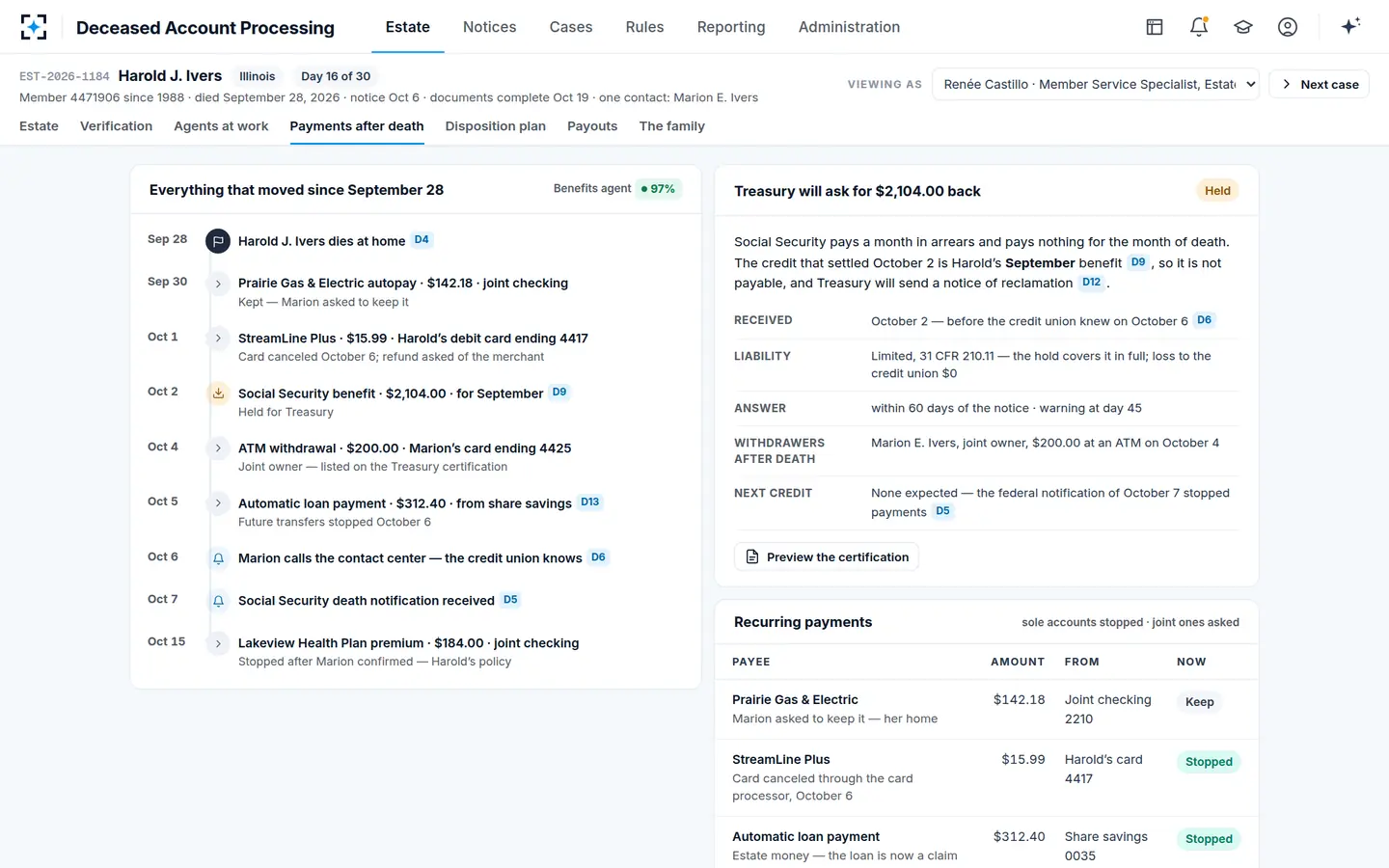
In the solution, the answer to the reclamation is drafted the day the hold is placed, with the date the credit union first knew and the people who withdrew funds already listed, so a notice can be answered the day it arrives. How banks learn of a death covers why that knowledge date matters so much.
Where the days went on one sample estate
On the fictional sample estate, the calendar ran like this. The member died on September 28. His widow called on October 6, and within seventeen minutes his card was cancelled and his sole savings frozen, with the joint checking left open for her. The Social Security credit of October 2 was held the next morning, when the federal death notification arrived. The family brought the certified certificate and an affidavit to a branch on October 19, the agents read everything that afternoon, the son was called back on October 21, and the plan was approved and four payouts released on October 22.
Two things in that calendar are worth copying whatever system a bank uses. The freezes were narrow and fast, so the survivor never lost access to her own account. And every wait after the first day had a named owner (the family, the son, Treasury), so the specialist could tell the family on the first call what would happen and roughly when. The bank bereavement process maps those dependencies seat by seat.
How Deceased Account Processing shortens the bank's share
The solution targets the bank's own days, not the law's. Six agents verify the death against the member file, the certificate and the federal notification; read every signature card and beneficiary form; propose where each account goes; list every payment since the death; check the affidavit or letters against the rule for the date of death; and draft one letter per person. The design target takes reading and retrieval from ten days to one; deciding and checking falls less, from eleven days to four, because those decisions stay with people.
The specialist approves the plan with a reason code, and the deposit operations officer releases each payout one signed entry at a time, with the supervisor also signing above $100,000. Every step is on an audit trail kept five years, with examiner and internal audit exports. To see the clocks with your own last quarter's estates, start from Deceased Account Processing.
Questions people ask
Is there a regulatory deadline for settling a deceased customer's accounts?
No federal rule sets one for the bank's handling. The deadlines that do exist are the state's waiting periods for small-estate payments, Treasury's 60 days to answer a notice of reclamation, and the six-month insurance grace period after an owner's death.
What is a reasonable service standard for deceased account processing?
One measured per account type, from the day the bank has what the law requires. Many operations set an overall clock (the sample credit union uses 30 days, with escalations at days 20 and 25) and run estates that wait on a court in a separate lane.
Why do banks freeze accounts when they learn of a death?
To stop the deceased's card and sole accounts being used, and to keep post-death federal benefits available for return. A freeze should be narrow: a surviving joint owner's access to a survivorship account should continue.
How many staff does a deceased account team need?
It depends on notices per month, accounts per estate and how much of the work is reading old documents. In the design estimate, 260 notices a month means about 884 account decisions, and the retrieval share of the work is the part that shrinks most with automation.
Should federal benefits be released with the rest of the estate?
No. A federal benefit credited after the death should be held until Treasury's notice of reclamation, because once the bank knows of the death it must return such payments however it learned. Holding the credit keeps the return in the account rather than out of the bank's own funds.