Deceased account procedures at a bank or credit union rest on one rule: each account goes where its titling sends it, not where the will does. A joint account with right of survivorship belongs to the surviving owner; a payable-on-death or in-trust-for account to the named beneficiaries who outlived every owner; a sole account with no beneficiary to the estate, through letters from a probate court or a state's small-estate affidavit. The procedure's job is to read each account's signature card and beneficiary form, apply the state's multiple-party account statute, and pay only on the proof that answer requires. The hard part is that the deciding document is often a box ticked decades ago, re-indexed through system conversions since. Botminds' Deceased Account Processing has an agent read every card and form and a second agent check the result independently, while a specialist approves the estate's plan and an officer releases each payout.
Statutes quoted here come from Virginia and Florida as examples; every state has its own multiple-party account law and small-estate rules, and the procedure should apply the one in force on the date of death. The worked estate is a fictional sample estate at a fictional credit union.
What decides who a deceased customer's deposit is paid to?
The account contract and the state statute behind it, in that order. Virginia's multiple-party account law says survivorship rights and payable-on-death designations "cannot be changed by will" (Va. Code § 6.2-608(E)), and transfers by survivorship or designation take effect by the account contract, not by probate. Only what is left after survivorship and designations is the estate's, and only the estate's share is governed by the will or, without one, by intestacy law.
For the bank that means the will is rarely the first document to read. A family that arrives with a will leaving "everything to my daughter" while the savings account names a son as payable-on-death beneficiary will be told the son is paid, and the procedure has to say so in writing with the designation that decides it. Getting the order wrong is how a bank pays the wrong person and then pays again.
The order a deceased account procedure should ask its questions
Six questions, asked of each account in turn, place almost every account. The order matters: loans and federal benefits come out first because they are not the family's money to divide, and survivorship and designations come before the estate because they take an account out of it altogether.
The titling tree a deceased account procedure applies to each account
- Is it a loan, line of credit or card balance?
If yes, it is a claim against the estate, sent to the personal representative or small-estate successor. Relatives who did not sign owe nothing.
- Is it a federal benefit credited after the death?
If yes, it goes back to the paying agency: held when the bank learns of the death and returned on the notice of reclamation under 31 CFR 210.
- Is there a surviving co-owner, with survivorship stated or presumed?
If yes, it belongs to the surviving owner. No payout and no freeze for the survivor; retitle on proof of death.
- Is a payable-on-death or in-trust-for beneficiary named who outlived every owner?
If yes, pay the surviving beneficiaries in the shares the designation sets, on proof of death and identity.
- Is the estate within the state's small-estate limit, and has any waiting period passed?
If yes, pay the successor the affidavit names, without probate, checked against the limit in force on the date of death.
- Has a court appointed a personal representative?
If yes, pay into the estate's account on letters testamentary or of administration. If no answer yet, the account stays frozen until someone with authority appears.
Joint accounts: survivorship, stated or presumed
A joint account with survivorship belongs to the surviving owner, who can go on using it. Virginia's statute says sums on deposit at a party's death "belong to the surviving party as against the estate of the decedent unless there is clear and convincing evidence of a different intention at the time the account is created" (Va. Code § 6.2-608(A)). Virginia also lets the bank pay any party "without regard to whether any other party is incapacitated or deceased" (Va. Code § 6.2-613), which is why the survivor's access should never stop.
Where the card is silent, many states presume survivorship. Florida presumes that, unless "a contract, agreement, or signature card" says otherwise, a deposit account in two or more names vests at a death in the surviving person or persons, "less all proper setoffs and charges in favor of the institution," and the presumption "may be overcome only by proof of fraud or undue influence or clear and convincing proof of a contrary intent" (Fla. Stat. § 655.79). A joint account held as tenants in common, by contrast, sends the deceased owner's share to the estate.
The 2004 signature card opened beside the estate, with the survivorship box highlighted
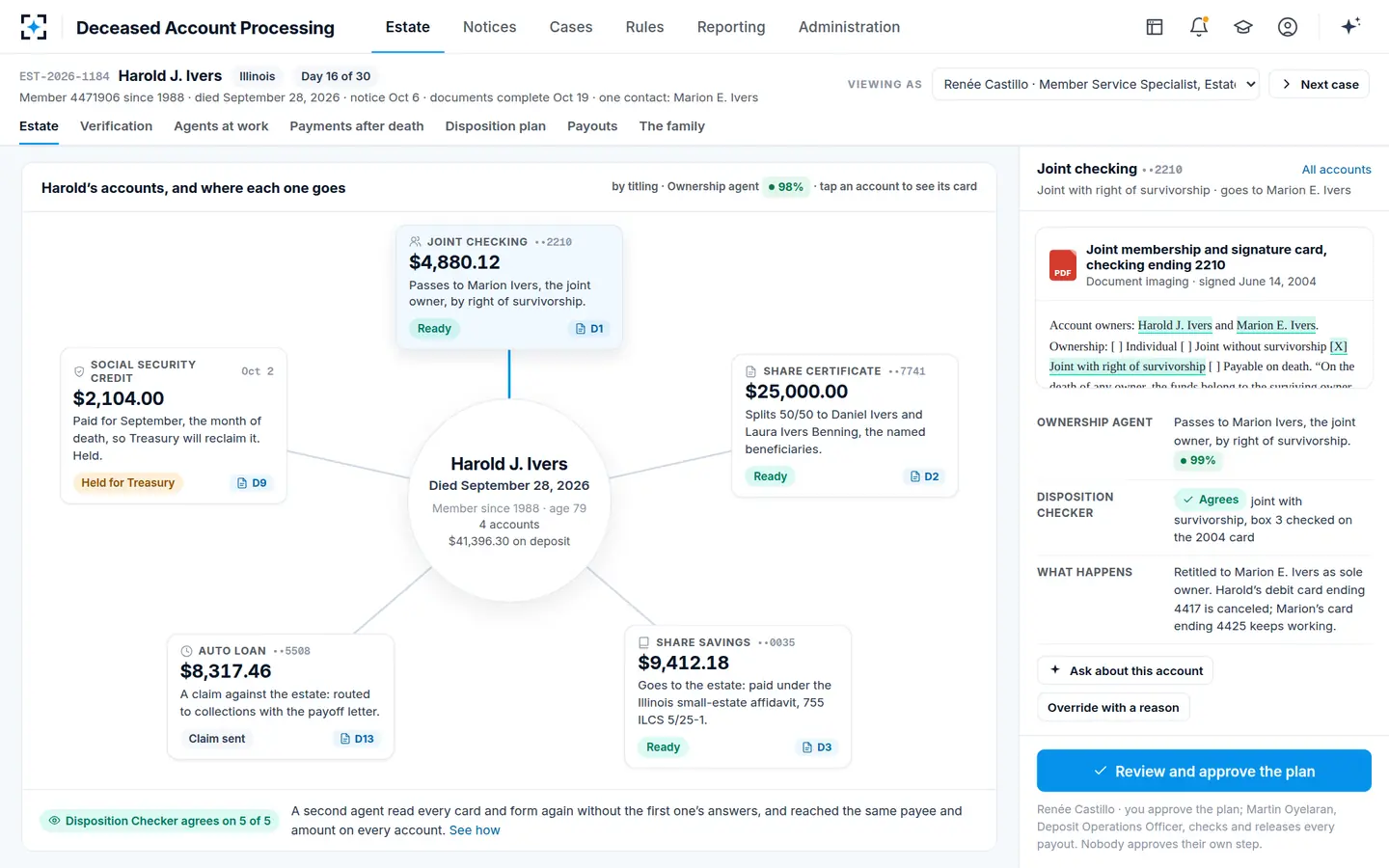
What should a bank do when the signature card is silent or unclear?
Apply the state's presumption, record that it did, and send the card to a person. A card that is silent on survivorship, a card replaced in a conversion with no image of the original, or a joint account opened with one owner's signature only are the cases where the statute's presumption decides, and where a family member may later argue a contrary intent. The procedure should name who reads such cards and what evidence is kept.
Age is a useful trigger. The sample credit union sends every card signed before 1990 to a person whatever the agent's confidence, and any card the agent reads below 90%. The second reader is not a formality: an old in-trust-for card read as sole ownership sends a beneficiary's money to the estate, and the bank cannot recover it from an estate already distributed.
Two ways a joint account goes wrong at a death
Read as sole when it is joint: The survivor is frozen out of her own money and the balance waits for the estate.
Read as joint when it is not: A co-signer added for convenience keeps money the owner meant for the estate.
Read as sole when it is joint: The survivor, the same week, with a complaint.
Read as joint when it is not: The other heirs, months later, often with a lawyer.
Read as sole when it is joint: Reading the card before freezing anything but the deceased's card.
Read as joint when it is not: The statute's presumption, applied and recorded, and the card kept.
Payable-on-death and in-trust-for accounts: the designation beats the will
A payable-on-death account goes to the beneficiaries named on it who survive every owner. Virginia lets the bank pay a P.O.D. payee "upon presentation to the financial institution of proof of death showing that the P.O.D. payee survived all persons named as original payees" (Va. Code § 6.2-614). If two or more payees survive, each takes a share and there is no survivorship between them, so a later death among the payees sends that payee's share to their own estate.
Three cases cause most errors. A beneficiary who died before the owner takes nothing, and the procedure must say whether the share goes to the other beneficiaries or to the estate under the statute. A later form may have replaced an earlier one, so the procedure must find every designation, not the first one indexed. And state rules can void a designation outright: in Florida, "a pay-on-death designation in a multiple-party account without right of survivorship is ineffective" (Fla. Stat. § 655.82(4)).
The rest is identity. A beneficiary who is not a customer has to be identified and screened before payment, and the sample credit union's procedure calls back on the phone number from the beneficiary form, not a number the caller gives, before any payout to a non-member. That one control stops the most common impersonation of a beneficiary.
Sole accounts: letters from a court, or a small-estate affidavit
An account in the deceased's name alone with no beneficiary is the estate's, paid through one of two doors. Letters testamentary or of administration appoint a personal representative, who opens an estate account. Small estates can skip probate through a sworn affidavit where the state allows it: Virginia's works only where the personal probate estate "does not exceed $75,000" and "at least 60 days have elapsed since the decedent's death" (Va. Code § 64.2-601).
Each ownership type, who is paid, and the proof the procedure requires
| Titling on the card or form | Goes to | Decided by | The bank pays on |
|---|---|---|---|
| Joint with right of survivorship | The surviving owner or owners | The account terms; presumed in many states | Proof of death; then retitle |
| Joint as tenants in common | The deceased's share to the estate | The account terms | Proof of death plus letters or affidavit for the share |
| Payable on death, in trust for | Named beneficiaries who outlived every owner | The designation; a will cannot change it | Proof of death and each beneficiary's identity |
| Sole, no beneficiary, small estate | The estate, through the affidavit's successor | The will, or intestacy law | A valid affidavit after any waiting period |
| Sole, no beneficiary, larger estate | The estate | The will, or intestacy law | Letters testamentary or of administration |
| Loan or line of credit | A claim against the estate | The note | Nothing from the family |
| Federal benefit after the death | The paying agency | 31 CFR 210 | The notice of reclamation |
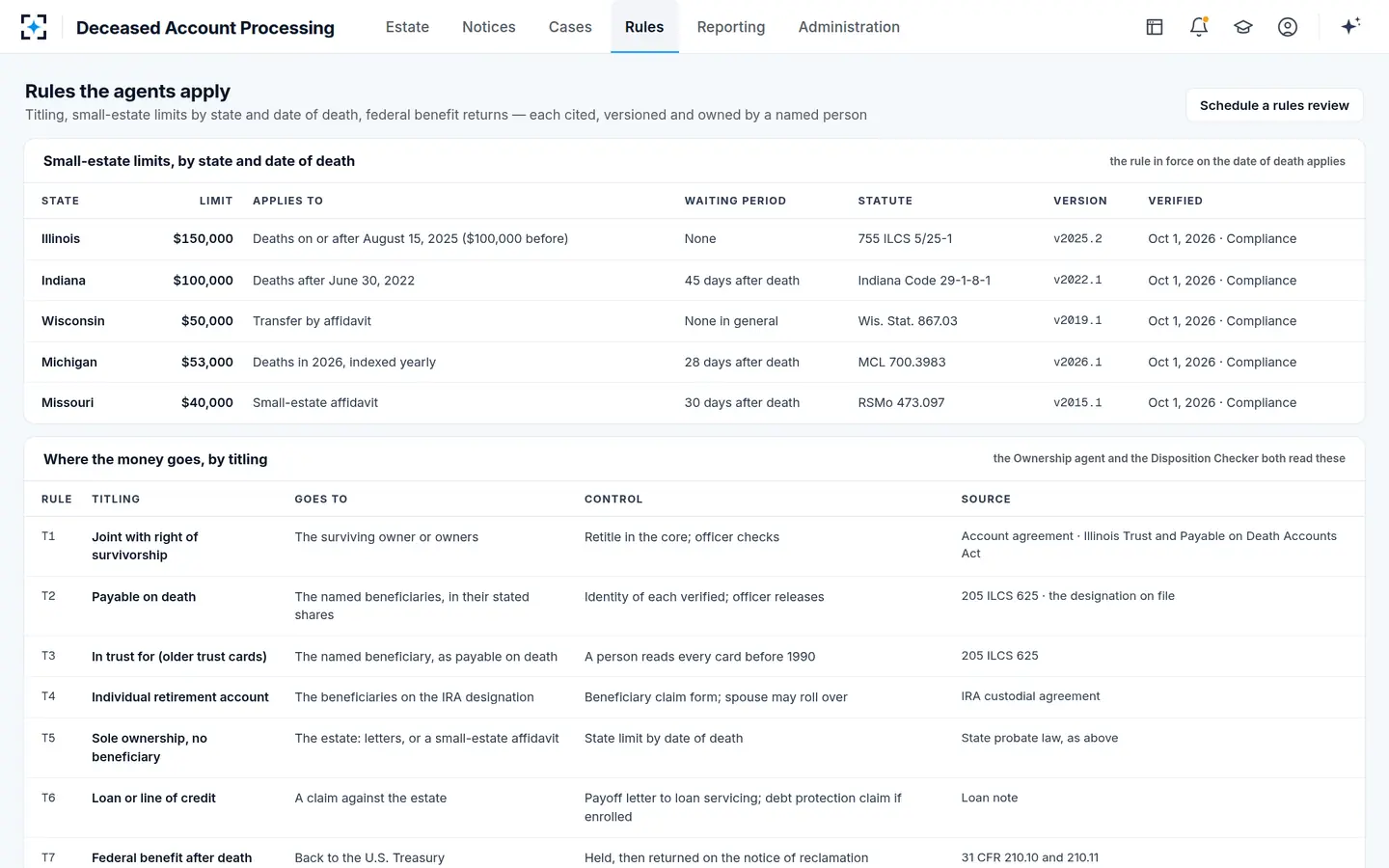
Small-estate limits and waiting periods change, and the right one is the one in force on the date of death, not the date the affidavit arrives. A procedure that keeps a single current limit per state will pay some estates under a limit that did not apply to them. The sample credit union keeps each state's limit by date of death with its statute and the date someone last checked it.
Small-estate limits by state and date of death, each with its statute
Loans, federal benefits and the bank's own claims
A loan does not pass to the family; it becomes a debt of the estate, and the bank files its payoff with the personal representative or the affiant like any other creditor. Where state law allows setoff, as Florida's survivorship statute does with "proper setoffs and charges in favor of the institution," the procedure should say when the bank uses it and who approves, because a setoff against a survivor's account is the decision most likely to be challenged.
Federal benefits cut across every titling. A benefit credited after the death goes back under 31 CFR 210 whichever account it landed in, and when the bank certifies the return it must list "all person(s) who withdrew funds from the recipient's account after the death" (31 CFR 210.11), surviving joint owners included. That is why the procedure holds the benefit on the day the bank knows, even in a survivorship account the survivor is otherwise free to use.
Disputes, competing claims and accounts no one claims
When claimants disagree, the statute lets the bank stand still. In Virginia, if any party or a personal representative "notifies the financial institution in writing not to permit withdrawals by any party, the financial institution may refuse, without liability, to allow any withdrawal pending the determination of the rights of the parties" (Va. Code § 6.2-616(D)). The procedure should say who receives such a notice, how fast the hold goes on, and that the hold covers only the disputed account.
An account no one claims stays frozen and in time leaves the bank as unclaimed property under state law. The years in between are not idle: returned mail or a relative's note in a dormant file can be the bank's first notice of the death, and from that date any federal benefit still arriving must be returned.
One sample estate through the procedure
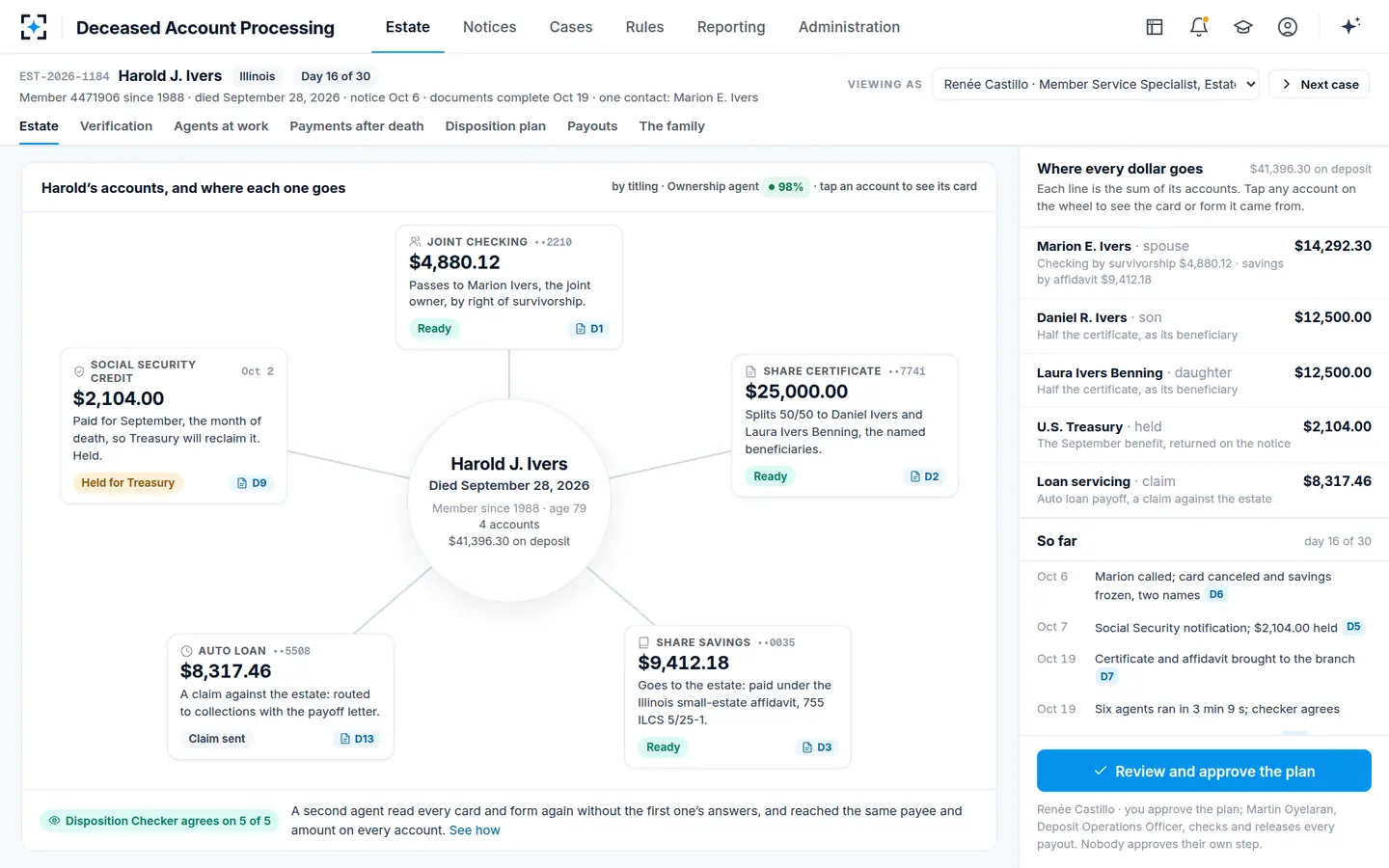
Take a fictional sample estate at the fictional credit union. The member died on September 28 with $41,396.30 on deposit in four places and an $8,317.46 auto loan. Run through the tree, each account lands somewhere different, and each needs different proof.
Deceased Account Processing: where one sample estate's $41,396.30 goes, by ownership type
The joint checking was retitled to the widow on proof of death, and her card never stopped. The certificate was paid to the two beneficiaries after each was identified and called back. The sole savings, signed on a 1988 card and re-indexed in a 2011 conversion, went to the estate under the small-estate affidavit, checked against the limit for the date of death. The Social Security credit was held the morning the federal death notification arrived and returned on the notice of reclamation. Decedent account processing time puts days on each of those branches.
How Deceased Account Processing applies the procedure
The solution reads each card and form so the specialist starts from a proposed answer with its evidence. The Ownership agent reads the titling from the signature card or beneficiary form and cites the box or clause; a Disposition Checker reaches its own answer independently; where they disagree, or confidence is below the threshold, a person reads the card. Each account appears as one spoke on a relationship wheel, with where its money goes in one plain sentence.
Every account as a spoke, with where its money goes and the document that decides it
People keep every decision that moves money. The specialist approves the estate's plan with a reason code and signature; the deposit operations officer releases each payout one signed entry at a time, with a supervisor also signing above $100,000; and every step is on an audit trail kept five years. The deceased account checklist lists what the finished file must prove, and the whole solution is on the Deceased Account Processing page.
Questions people ask
What is a multiple-party account?
A deposit account with more than one party: a joint account, a payable-on-death account or a trust account. State multiple-party account statutes, such as Virginia's in title 6.2, chapter 6, decide who owns the balance during life and at a death, and protect the bank that pays according to them.
Can a will override a payable-on-death beneficiary?
No. In Virginia a payable-on-death designation, a trust-account beneficiary and a survivorship right "cannot be changed by will." The beneficiaries who outlived every owner are paid on proof of death and identity.
What if a payable-on-death beneficiary died before the account owner?
That beneficiary takes nothing. Under Virginia's statute the sums belong to the surviving payees; if none survive, the account falls to the estate. The procedure should require proof that each payee outlived every owner.
Can a surviving joint owner keep using the account after a death?
Yes, where the account has survivorship, stated or presumed. Only the deceased owner's card and access should stop; a federal benefit credited after the death should still be held for return.
What should a bank do if two family members dispute an account?
Hold the disputed account on a written notice and wait for agreement or a court order. Virginia lets a bank refuse withdrawals without liability pending the determination of the parties' rights.
Which small-estate limit applies to a deceased customer's account?
The one in force in the governing state on the date of death. Limits and waiting periods change, so a procedure that keeps only the current figure can pay an estate under the wrong rule.